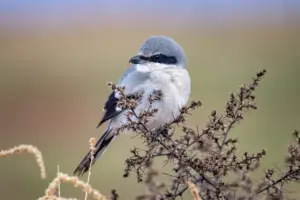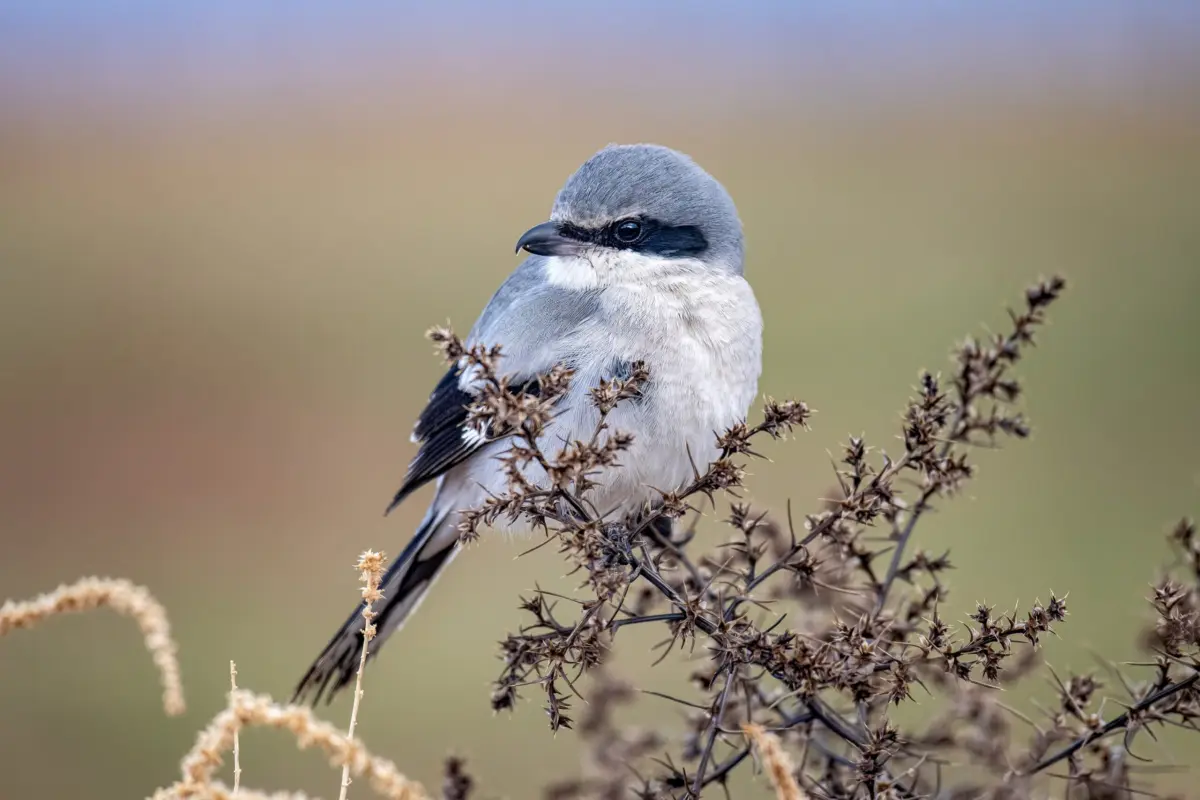

At first glance, the Northern Shrike (Lanius excubitor) appears entirely unassuming. Dressed impeccably in a dapper palette of slate gray, stark white, and jet black, with a slender frame and a classic perching silhouette, it could easily be mistaken for any number of common backyard songbirds. Yet, beneath this innocent facade beats the heart of a merciless apex predator. Often dubbed the "butcher bird," the Northern Shrike occupies a startling ecological niche: it is a songbird equipped with the predatory instincts, anatomical weaponry, and tactical brilliance of a raptor.
Spanning the rugged expanse of northern Canada and Alaska’s boreal forests during the breeding season, and migrating southward into the northern United States and southern Canada for the winter, this robin-sized carnivore defies conventional ornithological classifications. While the vast majority of passerines subsist on a diet of seeds, nectar, and soft-bodied insects, the Northern Shrike hungers for a carnivorous menu. It is famous for a collection of macabre survival strategies—ranging from precision spinal-severing bites and roller-coaster-level head shakes to the gruesome, iconic habit of impaling its catches on thorns and barbed wire.
This comprehensive report examines the biology, evolutionary adaptations, and behavioral complexities of the Northern Shrike. By exploring its brutal hunting mechanisms, physiological oddities, and surprisingly complex social dynamics, we uncover how a songbird evolved into one of nature’s most efficient and fascinating micro-assassins.
Detailed Chronology: The Lifecycle and Seasonal Adaptations of the Butcher Bird
The existence of the Northern Shrike is defined by stark seasonal shifts, harsh environments, and a relentless drive to hunt, survive, and reproduce. Understanding this species requires tracing its movements and behavioral evolution through the calendar year.
Summer: The Boreal Breeding Grounds
When spring arrives in the sprawling boreal forests of Alaska and northern Canada, Northern Shrikes abandon their southern wintering grounds to claim expansive, solitary territories. Unlike gregarious songbirds that flock together during nesting season, shrikes are aggressively territorial. They establish high-vantage perches from which males advertise their domains through a complex, mimicry-rich song.
Nesting pairs form through courtship rituals centered around provisioning: the male wins over the female by presenting her with freshly hunted prey—often skewered on a nearby branch. Once eggs are laid and hatched, the nestlings emerge into a world of endless summer daylight and abundant insect life. Boreal summers offer a feast of grasshoppers, beetles, and bumblebees, which form the dietary staples for growing chicks.
Long before they can fly, young shrike nestlings begin their education in violence. Through relentless play, they launch mock attacks on inanimate objects like feathers and leaves, chase one another with piercing cries, and direct fierce, outsized scolds at passing mammals.
Autumn: The Division of Broods and Migration
As the summer wanes, the juvenile shrikes reach independence. In a strategic parenting move common among certain passerines, the adult pair divides the fledgling brood, each parent taking charge of a subset of the young. This split minimizes the risk of a single predator wiping out an entire generation and ensures that every juvenile receives adequate hunting instruction.
By late autumn, these family units dissolve completely. As sub-zero temperatures sweep across the northern latitudes, the insect populations vanish, forcing the Northern Shrike to alter its dietary strategy entirely. Driven by necessity, the species migrates southward into the northern Lower 48 states and southern Canada, seeking semi-open landscapes, agricultural fields, and shrublands where small mammals and over-wintering birds remain active.
Winter: The Grim Reality of the Cold Months
Winter is a crucible for the Northern Shrike. In environments where food is scarce and temperatures plummet, the butcher bird relies heavily on its cognitive map of cached food—its gruesome larders of impaled carcasses. Operating as a solitary hunter, the shrike spends countless hours scanning open fields from exposed posts, waiting for a vole, mouse, or unsuspecting songbird to break cover. It is during these harsh months that human birders are most likely to catch a prized glimpse of the species, perched statue-like against a snowy backdrop, radiating an aura of cold, calculating efficiency.
Supporting Context & Metrics: Anatomy, Adaptations, and Behavioral Metrics
To truly comprehend how a songbird survives as a vertebrate carnivore, one must examine the specific physiological and morphological adaptations that make the Northern Shrike a masterclass in evolutionary engineering.
The Lethal Arsenal: The "Tomial Tooth"
Raptors like hawks and falcons rely on massive, muscular feet armed with crushing talons to subdue mammalian and avian prey. Shrikes, however, possess delicate, fragile passerine feet that are entirely unsuited for gripping or crushing struggling prey. To compensate for this physical limitation, shrikes have evolved a specialized facial weapon: the tomial tooth.
This anatomical adaptation consists of a distinct, sharp spike on the upper mandible that mates precisely with a matching notch on the lower bill. Functioning like a pair of surgical shears, the tomial tooth allows the shrike to bypass the need for heavy talons. With a single, lightning-fast strike to the neck of its victim, the shrike severs the spinal cord, instantly paralyzing the prey. To ensure the kill, the bird then shakes its head violently, generating up to six g-forces of acceleration—the equivalent of an intense roller-coaster ride—snapping the prey’s neck cleanly.
The Impaling Imperative
Perhaps the most infamous trait of the Northern Shrike is its habit of impaling carcasses on sharp natural or artificial objects, such as hawthorn spikes, jagged branches, and barbed-wire fences. This behavior is driven primarily by anatomical necessity. Because a shrike cannot hold a heavy carcass with its feet while tearing flesh, the larder spike acts as a makeshift third hand, holding the meal steady for consumption.
Beyond immediate feeding logistics, these macabre larders serve several vital functions:
- Food Storage: Excess prey is stored frozen or wedged tightly for times when hunting yields zero results.
- Brood Provisioning: Cached items provide critical nutrition for fast-growing nestlings.
- Territorial Advertising: A well-stocked larder acts as a visual status symbol for males, signaling to potential mates and rival shrikes that the territory owner is a capable and prolific hunter.
Digestive Engineering: The Pellet Production
Lacking a crop—the muscular pouch in the esophagus where many birds temporarily store food—and possessing a relatively small gizzard, shrikes digest their meals through a specialized internal sorting system. Because they frequently swallow the heads, bones, fur, feathers, and insect exoskeletons of their prey whole, their digestive tract compresses these indigestible materials into dense nuggets called pellets. A few times a day, the shrike coughs these pellets up, mirroring the biological processes of owls and herons.
Solar Defense and the Masked Visage
The distinct black mask stretching across the Northern Shrike’s eyes is not merely an aesthetic flourish; it is a tactical military-grade adaptation. When hunting from exposed perches during high-glare daylight hours, shrikes deliberately orient themselves facing into the sun. This positioning prevents them from casting a revealing shadow toward their intended target.
Furthermore, the dark pigmentation of the facial feathers functions identically to the greasepaint worn by professional baseball players: it absorbs stray sunlight, dramatically reducing blinding glare and allowing the predator to maintain razor-sharp visual focus on dynamic, moving targets.
Official Statements & Scientific Perspectives
Ornithologists, evolutionary biologists, and wildlife behaviorists have long studied the paradox of the "passerine raptor." Historical texts and modern field studies alike point to the unique psychological and ecological footprint of the shrike family.
Centuries ago, naturalists were already baffled and captivated by the predatory prowess of these birds. In the 1486 Book of Saint Albans, a medieval commentator famously marveled at how smaller songbirds foolishly flocked to the call of a Great Grey Shrike (a close European relative of the Northern Shrike), only to be devoured for their naivety:
"The credulous sellie birds do flocke together at her call. If any happen to approach neare her, she out of hand ceazeth on them, and devoureth them (ungrateful subtill fowle) in requital for their simplicity."
Modern ornithological research expands upon this historical observation, particularly regarding vocal mimicry. Both male and female Northern Shrikes possess complex, rich repertoires that swing effortlessly between sweet whistles, warbles, screeches, and harsh buzzes. During the spring mating season, they frequently mimic the alarm or contact calls of local songbird species. While this vocal versatility serves territory defense and courtship, behavioral biologists note that it also acts as a sophisticated acoustic lure, drawing curious or alarmed songbirds directly into striking range.
Furthermore, field researchers emphasize the sheer audacity of the Northern Shrike’s territorial aggression. Dr. Emily Vance, an avian ecologist specializing in boreal predator-prey dynamics, notes the species’ fearless demeanor:
"It is a psychological marvel. A bird weighing barely over two ounces will routinely dive-bomb, harass, and physically strike apex raptors and mammals—including Rough-legged Hawks, Golden Eagles, Great Gray Owls, and even wolves and bears. They acknowledge no size hierarchy within their chosen domain."
Conservation biologists tracking the closely related Loggerhead Shrike point out that these behavioral traits highlight an evolutionary lineage that refused to conform to standard ecological boxes. The preservation of shrike habitats requires protecting complex, semi-open shrublands and agricultural edges where these intricate hunting behaviors can be successfully executed year-round.
Future Outlook: Conservation Challenges and Ecological Importance
As global ecosystems face unprecedented pressures from agricultural intensification, climate change, and habitat fragmentation, the future of the Northern Shrike—and its southern counterpart, the Loggerhead Shrike—remains a subject of intense monitoring by conservation organizations such as the National Audubon Society.
Habitat Loss and Agricultural Shifts
While the Northern Shrike currently maintains stable breeding populations across the vast, undisturbed expanses of the northern boreal forest, its wintering grounds in southern Canada and the northern United States face ongoing threats. The removal of hedgerows, the clearing of semi-open pastures for intensive development, and the widespread use of pesticides drastically reduce the abundance of small mammals and large insects upon which the shrike depends.
Without an adequate supply of grassy hunting perches, barbed-wire fences, and thorny shrubs for impaling prey, local shrike populations struggle to maintain territories or successfully cache food through harsh winters.
Climate Disruptions in the Boreal Zone
Climate change poses an indirect but severe threat to the Northern Shrike’s summer breeding grounds. Rapid warming in Alaska and northern Canada disrupts the synchronized emergence of insect populations and the breeding cycles of small mammals. If prey availability peaks before or after shrike nestlings hatch, reproductive success drops significantly.
The Ecological Value of an Apex Micro-Predator
Despite their grim habits, shrikes play a vital ecological role. As high-level invertebrate and vertebrate predators, they help regulate populations of small rodents and insects, preventing localized overpopulation and culling weak or diseased prey from the environment. Their abandoned impaling larders and discarded pellets even provide secondary micro-habitats and resources for scavengers and insects.
Ensuring the long-term survival of the Northern Shrike requires a paradigm shift in how we view ecosystem management. Protecting wild lands is not merely about preserving gentle, seed-eating songbirds or majestic eagles; it requires safeguarding the fierce, complex, and uncompromising niches occupied by nature’s most eccentric killers. By maintaining diverse, semi-open habitats and preserving the structural complexity of rural landscapes, conservationists can ensure that the "butcher bird" continues to patrol the winter fields—a relentless reminder of evolution’s astonishing ingenuity.