
Executive Overview
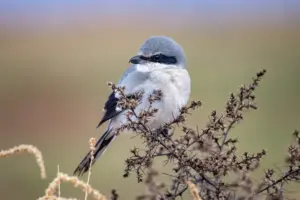
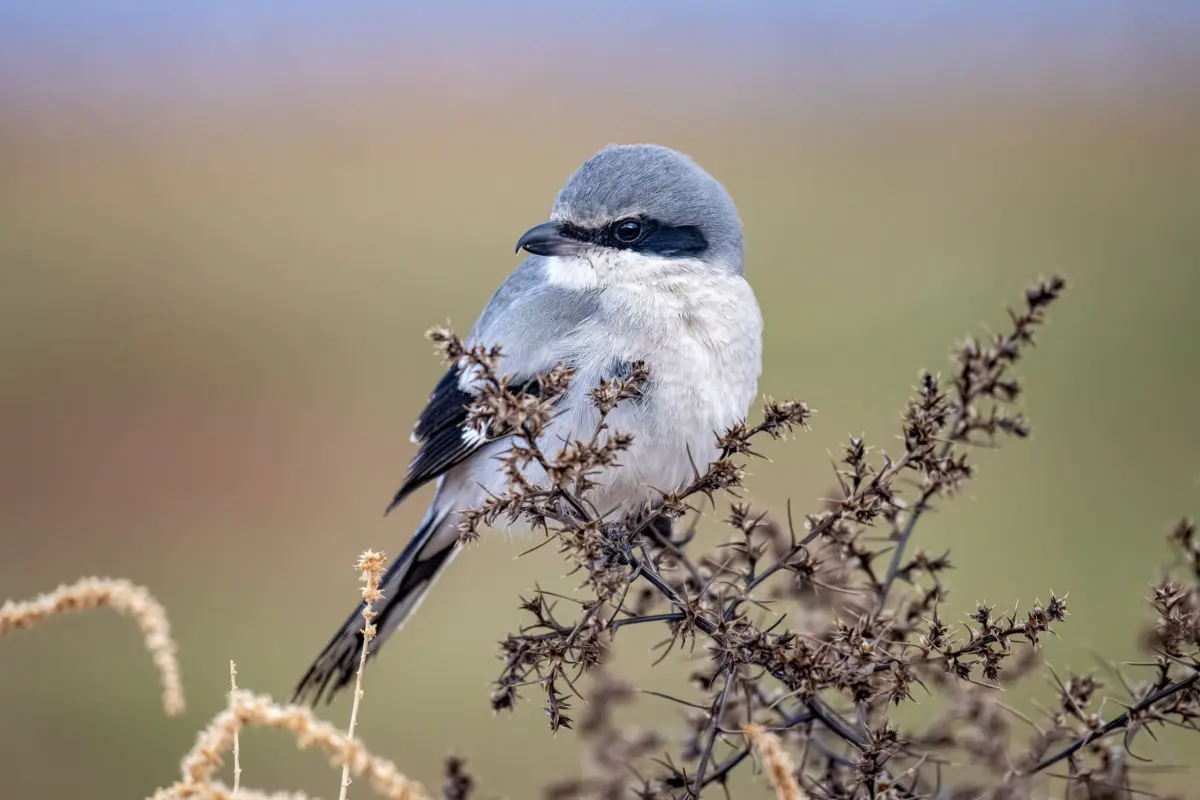
At first glance, the Northern Shrike (Lanius excubitor) appears entirely unassuming. Dapperly dressed in a crisp palette of black, white, and glacial gray, this robin-sized creature bears all the visual hallmarks of a standard North American songbird. Yet, appearances are profoundly deceiving. Beneath its delicate, melodic exterior lies one of nature’s most ruthless micro-predators. Equipped with a predatory hooked bill, a masked visage reminiscent of a highwayman, and a penchant for impaling its victims on thorns and barbed wire, the Northern Shrike has rightfully earned a chilling moniker: the "butcher bird."
While the vast majority of passerines—the vast order of perching birds—subsist on a diet of seeds, fruit, and modest insects, the Northern Shrike operates with the predatory ambitions of a raptor. It hunts vertebrates, executes high-impact aerial ambushes, and manages its larder through medieval means. Spanning the boreal forests of Canada and Alaska during the breeding season before migrating into the northern United States for the winter, this solitary carnivore challenges our very definitions of avian classification.
This deep-dive investigation examines the anatomical adaptations, evolutionary anomalies, psychological behavioral traits, and ecological significance of a songbird that refuses to sing by nature’s conventional rules.
Detailed Chronology & Seasonal Life Cycle
The life of a Northern Shrike is governed by harsh geographical extremes, shifting dramatically from the sun-drenched expanses of the northern taiga to the windswept, semi-open agricultural fields of its winter range. Understanding this avian predator requires tracing its annual cycle from its remote breeding grounds to its solitary winter territories.
Spring: Courtship, Territory, and the "Rodent on a Stick"
As winter breaks, Northern Shrikes transition from solitary hunters to partnered pairs. Mating rituals in the spring are characterized by fierce territorial establishment and unique courtship displays. Unlike many songbirds where courtship relies solely on vocalizations or plumage displays, the male shrike seals the deal through culinary provisions.
To prove his fitness and territory quality, a male shrike will present a prospective mate with fresh kills—often small mammals or birds impaled on makeshift skewers. Once a bond is forged, the pair establishes a rigid breeding territory, defending it vigorously against intruders of all species.
Summer: Boreal Nesting and Playful Predators
During the brief, insect-rich Arctic and sub-Arctic summer, Northern Shrikes occupy the dense, remote stretches of Canada and Alaska’s boreal forests. Here, protein sources explode in the form of grasshoppers, beetles, and bumblebees, which form the primary dietary staple for rearing nestlings.
As the chicks mature from hatchlings to nestlings, their development mirrors that of apex mammalian predators. Young shrikes engage in elaborate play-hunting behaviors:
- Mock Attacks: Nestlings launch aggressive strikes at inanimate objects, including flower petals, blowing leaves, and discarded feathers.
- Vocal Aggression: Young birds chase one another through the branches, issuing harsh scoldings.
- Early Impaling Practice: Observed in closely related loggerhead shrikes, juveniles instinctively practice the art of taxidermy, picking up leaves and twigs and attempting to wedge them onto sharp branches.
Interestingly, once the fledging period arrives, the adult pair splits the brood. Each parent assumes responsibility for a subset of the young. This evolutionary strategy minimizes the risk of a single avian or mammalian predator wiping out an entire lineage, while ensuring that the high-caloric demands of the growing chicks are adequately met.
Autumn and Winter: The Migration South
As temperatures plunge and the boreal insect populations vanish, Northern Shrikes migrate southward into the northern Lower 48 states and southern Canada. For winter birders, spotting a Northern Shrike perched high on a utility wire, bare tree branch, or fence post is a celebrated event.
During these lean months, the shrike shifts its biological strategy. Insects are replaced entirely by small mammals, lizards, and other birds. It is in these frost-bitten landscapes that the shrike’s chilling habit of caching surplus food—impaled on thorns or barbed wire—becomes vital for survival, acting as an avian refrigerator during deep freezes.
Supporting Context & Anatomy of a Killer
To appreciate how a bird weighing a mere 60 to 80 grams can successfully hunt prey nearly its own size, one must examine the specialized evolutionary machinery packed into its small frame.
The Tomial Tooth and Kinetic Strike
Lacking the massive, crushing talons of a hawk or the muscular bulk of an owl, the Northern Shrike must execute a kill with surgical speed and precision. Nature engineered this solution via the "tomial tooth"—a specialized spike on the upper beak that locks directly into a matching groove on the lower mandible.
This anatomical adaptation functions as a biological pair of shears. With a single, calculated strike to the neck of its prey, the shrike severs the spinal cord, inducing immediate paralysis. To finish the job, the bird shakes its head with an intensity reaching up to six g-forces—the equivalent of an extreme roller coaster ride—instantly snapping the victim’s neck.
The Impaling Imperative
Perhaps the most infamous trait of the shrike is its compulsion to impale carcasses. This behavior is not born out of sadism, but out of physical necessity.
- Passerine Foot Limitations: Shrikes possess delicate, slender perching feet (typical of songbirds) rather than the heavy, gripping talons of raptors. They cannot hold a heavy carcass with their feet while tearing flesh. A thorn, barbed wire fence, or sharp twig serves as an external vice grip, holding the prey steady.
- The Avian Larder: Impaling acts as a long-term storage system. Excess food is preserved for harsh weather, fed to nestlings, or displayed within a male’s territory to signal high hunting prowess to potential mates.
Pellets and Digestion
Like owls, hawks, and herons, Northern Shrikes regularly cough up dense pellets composed of indigestible materials: shattered bones, dense fur, feathers, and hard insect exoskeletons. Because shrikes lack a crop (the throat pouch used by many birds to temporarily store food) and possess a relatively small, muscular gizzard, their digestive tracts compact what cannot be broken down. Given that shrikes frequently swallow the heads of smaller prey whole, these daily egestions are a biological necessity.
Hydration Without Water
In a remarkable display of metabolic efficiency, wild Northern Shrikes virtually never drink standing water. Much like apex raptors, their bodies derive all necessary hydration directly from the moisture-rich, fresh blood and tissues of their prey. While captive individuals have been observed drinking, wild shrikes approach water sources almost exclusively for bathing purposes.
The Masked Hunter: Optics and Strategy
The striking black feathers stretching across the shrike’s eyes are more than just a stylish aesthetic; they are tactical camouflage.
- Glare Reduction: Much like baseball players who paint black grease beneath their eyes to absorb stadium glare, the shrike’s facial mask cuts down harsh sunlight reflecting off snow or open fields, keeping the focus sharp on distant movement.
- Solar Positioning: When hunting from exposed winter perches, shrikes systematically face directly into the sun. This positioning prevents their bodies from casting a long shadow forward, ensuring their approach remains entirely invisible to prey below.
Official Perspectives and Scientific Observations
Ornithologists, wildlife behaviorists, and historical chroniclers have long been fascinated by the dichotomy of a songbird possessing the hunting instincts of a falcon.
Dr. Robert Yosef, a leading authority on shrike behavior, notes that the species represents one of the most successful examples of convergent evolution in the avian world. "They bypassed millions of years of raptor lineage development by outfitting a standard songbird chassis with high-end predatory hardware," notes field notes from behavioral tracking studies.
Historical documentation stretches back centuries. In the 1486 Book of Saint Albans, a medieval English writer chronicled the fatal attraction other birds held toward the Great Grey Shrike (a close Old World relative of the Northern Shrike), observing how smaller species foolishly flocked to the predator’s calls only to be ruthlessly ambushed:
"The credulous sellie birds do flocke together at her call. If any happen to approach neare her, she out of hand ceazeth on them, and devoureth them (ungrateful subtill fowle) in requital for their simplicity."
Modern acoustic research has confirmed this historical observation. Both male and female Northern Shrikes are exceptional vocal mimics. During spring territories, they weave complex, eclectic songs combining sweet warbles, whistles, screeches, and buzzes. While part of territorial defense, scientists believe this mimicry acts as an acoustic lure, drawing curious songbirds directly into striking range.
Furthermore, shrikes display an astonishing lack of intimidation regarding animal size. Field biologists frequently document territorial Northern Shrikes aggressively dive-bombing and harassing raptors many times their mass, including Rough-legged Hawks, Golden Eagles, and Great Gray Owls. When mammalian intruders—including wolves, bears, and human researchers—venture too close to active nests, shrikes display zero hesitation in launching high-speed aerial strikes directly at the intruder’s head.
Future Outlook & Conservation Status
Despite their fierce disposition and adaptable hunting strategies, Northern Shrike populations face growing ecological pressures across their breeding and wintering grounds.
Habitat Fragmentation and Climate Change
Because Northern Shrikes rely heavily on semi-open habitats, agricultural lands, and contiguous boreal forests, they are acutely sensitive to large-scale landscape alterations.
- Boreal Alterations: Climate change is rapidly transforming the structure of the North American boreal forest, altering insect emergence timelines and shifting prey distribution.
- Loss of Scrubland: In their wintering ranges across southern Canada and the northern United States, the conversion of overgrown pastures, hedgerows, and scrublands into intensive, monoculture agriculture or urban developments deprives the shrikes of vital hunting perches and impaling sites.
Comparative Vulnerability: The Loggerhead Shrike
While the Northern Shrike maintains stable populations in its remote northern strongholds, its southern counterpart—the Loggerhead Shrike—has suffered catastrophic population declines across North America over the past half-century. Pesticide accumulation, loss of open pastoral land, and vehicle collisions along rural roads have placed the Loggerhead on numerous endangered and species-of-concern registries. Conservationists view the robust health of the Northern Shrike as a critical benchmark, providing comparative data on how shrike species respond to broader environmental shifts.
Ongoing Research Initiatives
Ornithological organizations, including the National Audubon Society and various university research groups, continue to deploy advanced telemetry tracking, acoustic monitoring, and nest-box programs to map winter movement corridors. Understanding the precise winter territory requirements of the Northern Shrike will allow conservationists to advocate for the preservation of hedgerows, wild field edges, and unmanaged rural lands.
Ultimately, the Northern Shrike stands as a vital reminder of nature’s complexity. It shatters the human tendency to neatly categorize animals into harmless songbirds and fearsome beasts of prey. In the chilling gaze of the butcher bird, we witness the raw, unfiltered brilliance of evolutionary adaptation—proving that true survival mastery often wears an unexpected mask.