
Executive Overview
Sometimes, the most profound paradigm shifts in industry are born out of cataclysmic failure. For Barrett Ersek, that turning point arrived in 2009 in the form of towering, uncontrollable flames that consumed his entire Pennsylvania lawn care warehouse, reducing a high-flying commercial fertilizer inventory to ash and twisted steel.
At the time, Ersek was running a traditional turf management operation. The sudden loss of his chemical inventory left him at a financial and operational crossroads. Compounding this crisis was an escalating regulatory and environmental crusade across Pennsylvania and the broader Mid-Atlantic region to drastically curb the volume of excess nitrogen and synthetic runoff bleeding into fragile local waterways.
Faced with an empty warehouse and mounting industry pressure, Ersek began searching for an alternative path forward. His exploration led him to the concept of “compost tea”—a liquid bio-stimulant created by steeping mature compost in water to extract and multiply a dense ecosystem of beneficial nutrients and microscopic organisms. With little left to lose, Ersek gambled on the concoction.
That desperate pivot evolved into Holganix, a pioneering agricultural technology company that has transformed from a regional lawn care experiment into a national powerhouse. Today, Holganix stands as a fixture on the Inc. 5000 list of America’s fastest-growing private companies. Its biological solutions have attracted elite backing, including agricultural philanthropist Howard Buffett—who now chairs the company’s advisory board—and Virgin Group founder Richard Branson, who famously dubbed the company’s flagship Bio 800 product "Mother Nature in a bottle."
As Holganix expands its footprint across the North American agricultural sector—deepening its engagement with regenerative farming, environmental credit markets, and proprietary data intelligence—Chief Strategy Officer Tim Weaver sat down to discuss the company’s evolution, its scientific philosophy, and its roadmap for the future.
Detailed Chronology: The Evolution of Holganix
The 2009 Catalyst and the Birth of Bio-Stimulants
To understand the trajectory of Holganix, one must look back at the state of commercial agriculture and turf management in the late 2000s. The industry was deeply reliant on synthetic nitrogen, phosphorus, and broad-spectrum chemical inputs. While these products produced immediate, visually appealing results, they systematically degraded the living biome of the soil over time, stripping away natural organic matter and locking farmers into an expensive, ever-escalating cycle of chemical dependency.
When Ersek’s Pennsylvania warehouse burned down, it severed that cycle by force. Seeking a viable substitute for synthetic fertilizers, Ersek began experimenting with compost extraction techniques. He quickly realized that the liquid byproduct was not merely an alternative fertilizer; it was a complex delivery mechanism for living biology.
By refining the steeping process to preserve active microbes, bacteria, nematodes, and fungi, Ersek formulated a stable, scalable liquid probiotic. This early iteration was initially deployed on Pennsylvania lawns, where it outperformed expectations by building deep root systems and reducing chemical watering and fertilization needs by up to 75%.
Scaling into Big Agriculture
Buoyed by early successes in the turf and ornamental markets, the leadership team recognized a much larger, more urgent application for their biological technology: industrial row-crop agriculture.
Traditional farming practices had pushed American soils to the brink. Decades of deep tillage, heavy chemical applications, and monoculture cropping had depleted native soil microbiomes. Holganix pivoted its business model to target large-scale agricultural producers, positioning its flagship product, Bio 800, as a direct remedy for soil exhaustion.
As the company scaled, it attracted venture capital, private equity, and high-profile strategic investors. Howard Buffett’s involvement signaled a major validation from the philanthropic and agricultural conservation community, while Richard Branson’s endorsement thrust the brand onto the global stage.
Today, Holganix operates on a multi-tiered platform model encompassing biological inputs, environmental asset verification, and big-data analytics.
Supporting Context & Metrics: "Penicillin for Soil"
To grasp the mechanics of Holganix’s flagship offering, Chief Strategy Officer Tim Weaver offers a striking medical analogy.
"Holganix is a soil health platform," Weaver explains. "We’re on a mission to help growers, to help climate, to help food and water security, and most of it lands in three buckets. The first is Bio 800, which is a liquid biological probiotic for soil that brings life back to the soil. It’s penicillin for soil."
The Mechanics of Regenerative Acceleration
In recent years, regenerative agriculture has emerged as the industry standard for sustainable farming. Practices such as no-till farming, cover cropping, and reduced nitrogen application are widely championed for their ability to sequester carbon and restore degraded land. However, these practices come with a significant operational bottleneck: time.
While cover crops and reduced tillage create the conditions for soil life to return, natural microbial recovery can take years. For a commercial farmer operating on tight profit margins, waiting half a decade for soil biology to rebound represents a severe financial risk.
According to Weaver, Bio 800 acts as an operational shortcut:
"Regenerative practices like cover crops and reduced tillage are great, but they don’t necessarily bring that microbial life back to the soil instantly. Over time, they allow that life to recover, but Bio 800 is a hack where you can bring life there instantly. Then those practices help grow it and nurture it. That first big wave of life has this catalytic effect that starts that virtuous cycle. It’s regen accelerated."
The Longevity of the Soil Flywheel
A common question facing biological soil amendments is whether they represent a permanent recurring cost for the grower, or if the soil eventually becomes self-sustaining.
Weaver notes that while the ultimate goal of regenerative agriculture is a self-sustaining ecosystem, the realities of modern farming mean biological inputs will likely remain a valuable tool.
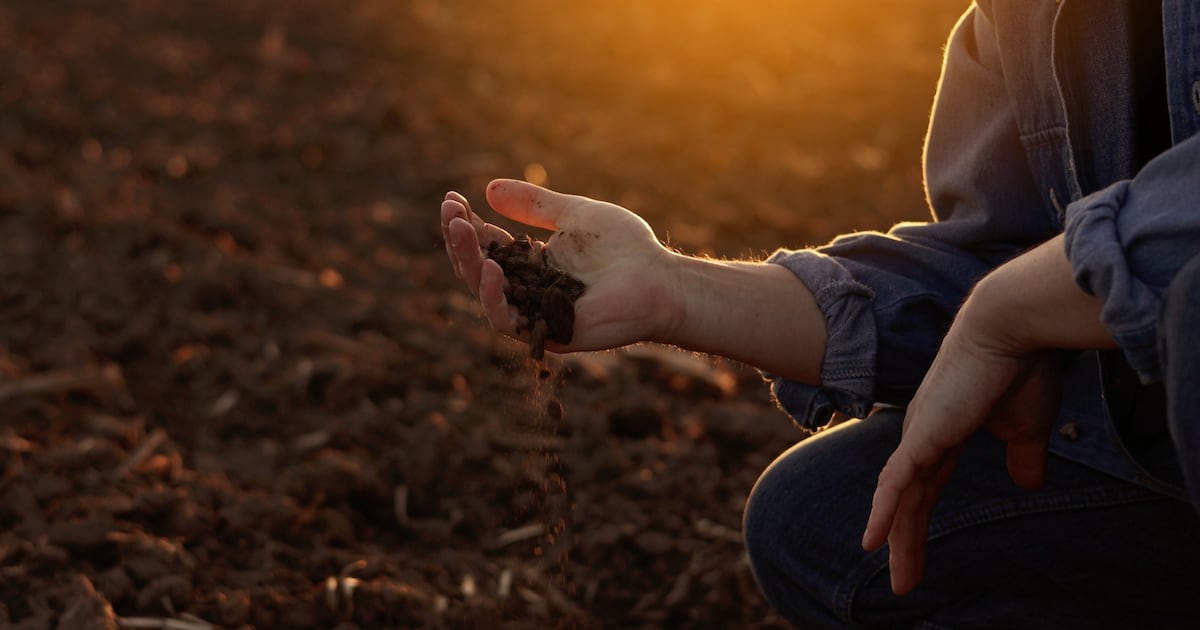
"We have growers in the US in their eighth year of using Bio 800 and they’re seeing their organic matter grow and grow and grow," Weaver says. "If somewhere in this journey that flywheel is flowing on its own and they don’t need Bio 800, that would be amazing for us. But there are always challenges to soil health: extreme weather, extreme water issues, and farming does have an impact on soil every season, so we’re pretty confident there will always be a use for Holganix."
Official Statements: De-Risking the Regenerative Transition
Transitioning a commercial farm from conventional chemical-heavy practices to regenerative agriculture is fraught with economic peril. Farmers are inherently risk-averse—and for good reason. Their livelihood depends on seasonal yields, and deviating from proven, traditional methods can result in catastrophic crop failure or financial ruin.
The Role of Corporate Environmental Markets
To ease this transition, Holganix has integrated environmental assets—such as carbon and water insets and offsets—into its platform architecture. Corporate buyers seeking to meet net-zero emissions targets are increasingly willing to pay farmers for verified environmental improvements.
"To go to something like no-till, cover crops or reduced nitrogen is a meaningful risk for growers because the inertia of farming is to continue to do all those things and get the results that are expected," Weaver explains.
"Where the support from corporates really helps is by bringing in an additional income stream to mitigate some of that risk. That allows them to make that jump and is an incredible catalyst for getting them to look beyond that risk. Then, once they’re on the other side of it, they stick around."
A Transition Company or a Permanent Fixture?
When asked whether Holganix views itself as a traditional commercial enterprise or a transitional, mission-driven entity akin to a charity putting itself out of business, Weaver adopts a philosophical view rooted in long-term impact.
"We do feel like we’ve been gifted this penicillin for soil and it is our mission to get it on at least 2 billion acres globally," Weaver states. "If our role is to reintroduce soil health, to reintroduce life to the soil, and if that’s all we do, we’ll have had a very good run. We’ll smile as we sit back on our rocking chairs."
Turning Soil into Data: The Horizons Platform
Beyond its biological inputs, Holganix has carved out a unique position in the ag-tech space through its proprietary data intelligence platform, Horizons.
In an era where precision agriculture is dominated by satellite imaging, drone data, and yield monitors, Holganix takes a decidedly subterranean approach.
Unmatched Physical Soil Intelligence
While many tech platforms rely on remote sensing, Horizons is built on physical, empirical soil sampling executed at an industrial scale.
"The thing I am most proud of with Horizons is the gross tonnage of soil that is collected," Weaver emphasizes. "What we’re able to generate in terms of intelligence from the soil is unmatched, and it is a lot of work. It is a lot of work at scale to get right, and we have a lot of field crews and a lot of laboratory time that goes into it, but the results that our growers and those corporate partners have pulled out of it have been invaluable."
Operating across row-crop acreage spanning from the East Coast to the West Coast of the United States, as well as select regions in Canada, Holganix has shouldered the financial and logistical burden of comprehensive soil testing.
While financing such a labor-intensive operation carried significant corporate risk, Weaver asserts that the investment has paid massive dividends.
"What we’ve learned in the last 15 years is that when you’ve got so much evidence of the product working and its efficacy, it makes it much easier to make investments in that whole platform. No one’s done soil testing this way. No one’s made this kind of investment in data."
Future Outlook: Horizons and Global Expansion
As Holganix looks toward the horizon, its strategic roadmap centers on geographic expansion, disciplined resource allocation, and advanced data utilization.
Measured International Growth
Expanding biological agricultural products across international borders is notoriously difficult due to varying regulatory frameworks, local soil compositions, and import restrictions on biological entities. When asked about expanding beyond North America, Weaver strikes a note of deliberate caution.
"We have to be thoughtful about the go-to-market and make sure that everything is balanced," he notes. "The investment of bandwidth is equally as important, and we have to be thoughtful about how and where we grow."
The Next Frontier: Crop Quality
Looking inward at its existing markets, Holganix is pivoting its data capabilities toward a new frontier: nutritional density.
"What’s next for Holganix? Continued growth in the US and continuing to explore new markets," Weaver concludes. "Using the data is maybe the biggest new horizon as we’re starting to understand crop quality as well as we understand quantity."
From a devastating warehouse fire in 2009 to a multi-million-acre soil health platform backed by environmental titans, Holganix has proven that the path to agricultural innovation often lies beneath our feet. By marrying the microscopic power of Bio 800 with rigorous data analytics and corporate environmental markets, the company is not just healing degraded dirt—it is quietly rewriting the future of global food security.