
Executive Overview
Deep within the hyper-arid coastal desert of Peru, roughly 190 miles north of the bustling capital of Lima, archaeologists have unearthed a transformative window into the ancient world. At the sprawling administrative and funerary complex of Castillo de Huarmey, researchers have recovered the first definitive physical evidence of Peruvian hairless dogs dating back more than 1,200 years. Long predating the rise of the iconic Inca Empire, these ancient canines lived, died, and were buried alongside—or sometimes discarded away from—the humans of the Wari civilization.
The discoveries, detailed in a landmark study published in the Journal of Anthropological Archaeology, include naturally mummified remains, rare skeletal anomalies, and chemical clues detailing the diets and life histories of these distinct animals. Featuring smooth, hairless skin, slender bodies, and pointed ears, the Peruvian hairless dog—recognized today by the American Kennel Club as the Peruvian Inca Orchid and celebrated as an official element of Peru’s national cultural heritage—has long been immortalized in Andean pre-Columbian pottery. However, direct physical and biological confirmation of the breed within an intact pre-Inca archaeological horizon has remained elusive until now.
Led by Weronika Tomczyk, a research associate at Dartmouth College’s Department of Anthropology and a postdoctoral fellow in its Ecology, Evolution, Environment and Society Program, an international team of researchers utilized advanced zooarchaeological techniques and isotopic analysis to decode the lives of these ancient canines. Their findings reveal a complex, multifaceted relationship between humans and animals. Far from fitting a single utilitarian or domestic mold, the lives of these dogs reflect the nuanced, sometimes contradictory attitudes of ancient societies—where a cherished companion for one segment of a community could simultaneously be treated as a pest or outsider by their neighbors.
The research not only establishes the deep antiquity of the hairless breed in South America but also sheds light on social stratification, organized breeding practices, and the daily rituals of the Wari Empire, which dominated the Andean coast and highlands from approximately 600 to 1050 CE.
Detailed Chronology
The discovery of the hairless dog remains at Castillo de Huarmey is the culmination of years of meticulous excavation, emergency salvage, and high-tech laboratory analysis. To understand the significance of these findings, researchers have had to piece together a complex chronology defined by imperial rise, natural disaster, looting, and modern scientific inquiry.
The Wari Empire and Castillo de Huarmey (600–1050 CE)
Occupying a sprawling 110-acre expanse, Castillo de Huarmey served as a vital regional administrative, ritual, and burial center for the Wari Empire. Flourishing centuries before the Inca established their dominion over the Andes, the Wari constructed sophisticated administrative networks, monumental architecture, and elaborate burial complexes.
The site has consistently yielded groundbreaking archaeological discoveries that redefine our understanding of pre-Columbian Andean governance and social structure. In 2012, archaeologists made international headlines when they uncovered the first fully undisturbed elite Wari tomb at the site. This chamber contained the lavishly adorned remains of 58 high-status women, six human sacrificial victims, and approximately 1,300 precious artifacts fashioned from gold, silver, bronze, wood, and textiles. A decade later, in 2022, excavations revealed additional elite burials belonging to master craftspeople, accompanied by specialized metalworking tools.
Natural Disasters and Archaeological Complications
The preservation of Castillo de Huarmey is largely a blessing of geography. Situated in one of the driest coastal deserts on Earth, the extreme aridity prevents the rapid degradation of organic materials, allowing hair, bones, textiles, leather, pigments, and unbaked clay to survive across the millennia.
However, the site’s stratigraphic integrity has faced severe disruptions. In 1970, a massive, high-magnitude earthquake struck Peru, causing structural collapses across sections of Castillo de Huarmey. This seismic event exposed underground burial chambers, inadvertently drawing the attention of looters who subsequently plundered and disturbed large portions of the upper archaeological strata.
Fortunately, deeper stratigraphical layers remained sealed and untouched, preserving their pristine Wari-era contexts. Most of the animal remains, including the newly analyzed dog bones, were recovered from upper layers where mixed contexts required sophisticated dating and analytical techniques to untangle from modern contamination or post-depositional disturbance.
Excavations and the Breakthrough Discovery (2010–2025)
Between 2010 and extensive fieldwork running through 2025, archaeologists uncovered numerous animal remains, predominantly South American camelids—such as domesticated llamas and alpacas—which were frequently deployed as ritual offerings or discarded as domestic waste. Amid these faunal remains, researchers recovered hundreds of dog bone specimens.
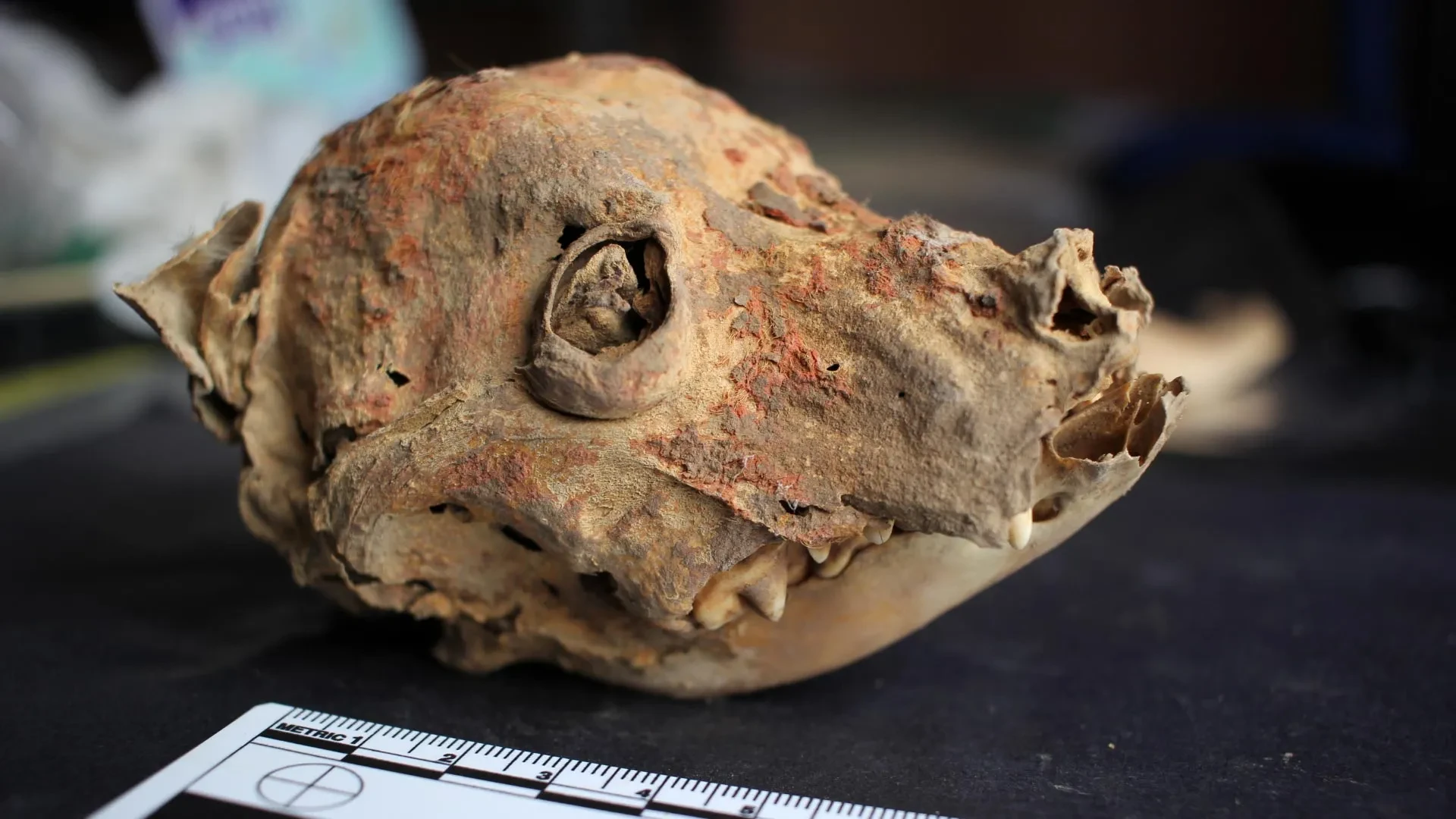
Among the most compelling finds were three distinct sets of canine remains recovered from the northern section of the main ceremonial area:
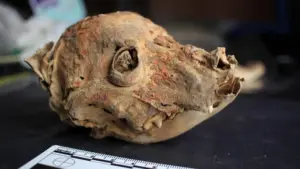
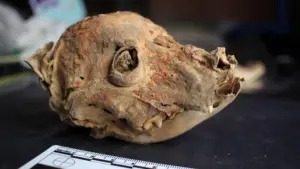
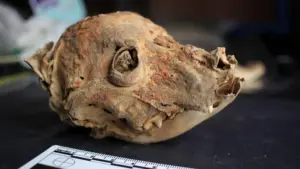
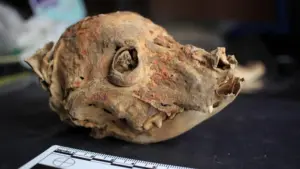
- A naturally mummified skull, complete with preserved hairless skin and attached ears, heavily adorned with cinnabar—a toxic, bright red mercury sulfide pigment widely utilized in ancient Peruvian funerary rituals.
- A second, larger dog skull, found alongside associated skeletal elements.
- A nearly complete, naturally mummified male dog skeleton, discovered in a shallow pit and missing only the lower portions of its front limbs.
Initially, researchers harbored natural skepticism regarding the age of the mummified male dog. Given its remarkable state of preservation—retaining soft tissue and skin—some team members suspected it might be a relatively recent introduction, potentially dating back to the era of mid-20th-century looting.
However, detailed anatomical examination by Weronika Tomczyk shattered those assumptions. Not only was the animal unequivocally hairless, but it—alongside the other two specimens—exhibited a very specific dental anomaly: the complete absence of their first premolars.
Radiocarbon Confirmation
To definitively settle the chronology, the research team subjected the complete mummified male dog to radiocarbon dating. The results confirmed that the animal was at least 1,200 years old, placing its life squarely within the Wari occupation period. This specimen now stands as the oldest radiocarbon-dated dog specimen recovered from Castillo de Huarmey, providing an invaluable temporal anchor for future excavations at the complex.
Supporting Context & Metrics
The depth of the study goes far beyond visual identification, utilizing rigorous quantitative metrics, osteological analysis, and advanced chemistry to reconstruct the lives of these ancient canines.
Osteological and Dental Indicators
The breakthrough identification of the dogs as Peruvian hairless specimens hinged on a well-documented genetic link. In modern veterinary science and canine genetics, the autosomal dominant gene responsible for hairlessness in dogs is pleiotropic, meaning it simultaneously controls other physical traits—most notably, oligodontia (congenital absence of teeth), particularly affecting the first premolars and last molars.
When Tomczyk observed that several of the dog skeletons from Castillo de Huarmey featured unerupted, congenitally missing teeth rather than teeth lost to trauma, disease, or old age, the biological puzzle fell into place. This dental signature provided incontrovertible physical evidence that the Wari were breeding or maintaining specialized hairless dogs more than a millennium ago.
Quantitative Breakdown of the Faunal Assemblage
- Total Dog Specimens: 341 individual bone specimens recovered during excavations.
- Minimum Number of Individuals (MNI): At least 19 distinct individual dogs accounted for in the assemblage, alongside complete mummified specimens.
- Age Distribution: While the majority of recovered dogs were adults at the time of death, the assemblage included very young puppies, pointing toward varied life trajectories and mortality profiles.
- Geographic Provenance: Castillo de Huarmey is located approximately 190 miles (300 kilometers) north of Lima, spanning 110 acres of strategic desert terrain.
- Temporal Span: The Wari occupation of the site ranges from 600 to 1050 CE, placing these dogs roughly 400 years prior to the rise of the Inca Empire (circa 1438 CE).
Isotopic Analysis: Reconstructing Ancient Diets
To understand how these animals lived and what they consumed, the research team employed zooarchaeological analysis alongside stable isotope geochemistry. By measuring isotopes of carbon, nitrogen, oxygen, and strontium preserved in the collagen of bones and tooth enamel, scientists can reconstruct an animal’s geographic origins, mobility, and trophic level (diet).
- Carbon and Nitrogen Isotopes: Revealed that the majority of the dogs consumed diets heavily reliant on maize (corn), the staple agricultural product of the pre-Hispanic Andes. Their carbon signatures closely mirrored those of the human population at Castillo de Huarmey, indicating that the dogs were eating either human leftovers, agricultural crop waste, or deliberate rations prepared by their owners.
- Life-Stage Dietary Shifts: Isotopic sampling of tooth enamel—which forms rapidly during puppyhood—compared against bone collagen—which turns over slowly, reflecting the final year of life—exposed a fascinating trend among the hairless dogs. As puppies, their dietary isotope signatures closely mirrored those of human children, suggesting they may have been fed specialized diets or table scraps directly from human households. As they matured into adulthood, their diets diversified.
- Strontium Isotopes: Measured to track local geology and environmental uptake, helping researchers determine whether the dogs were born locally at Castillo de Huarmey or imported from the Andean highlands or other regions under Wari imperial control.
Official Statements
The emotional and social dimensions of archaeology are frequently difficult to parse through inanimate artifacts alone. However, the integration of biological data with cultural context has allowed the research team to offer profound insights into the human-animal bond in pre-Columbian Peru.
Reflecting on the psychological and social implications of the findings, lead author Weronika Tomczyk emphasized the duality of human-animal relationships across time:
"Our findings indicate that humans and dogs coexisted at this Wari site, but reconstructing their bond is challenging, as past emotions are difficult to capture through archaeological methods," noted Tomczyk, a research associate in Dartmouth’s Department of Anthropology and a postdoctoral fellow in its Ecology, Evolution, Environment and Society Program.
"The goal of our study was to not only present data on Castillo de Huarmey’s dog burials, but also emphasize that people in the past had often contradictory relationships with the animals, just as they do today: a pet for one group of people could at the same time be considered a pest by their closest neighbors."
Elaborating on the crucial genetic link that unlocked the dogs’ identity, Tomczyk explained:
"What I noticed is that some of the dog skeletons were missing teeth, and not that they lost them during their lifespan; some teeth, especially first premolars and sometimes last molars, had just never erupted. And then I found in the literature that the same gene which is responsible for hairlessness in dogs is responsible for a reduced number of teeth, indicating that these were Peruvian hairless dogs."
Addressing the dietary revelations provided by isotopic testing, Tomczyk noted the implications for ancient husbandry:
"We do not know if the dogs were intentionally fed maize or if perhaps, they were just eating leftovers or trash. Yet, the distinct dietary patterns of hairless puppies provide insights into what may have been organized breeding."
Summarizing the social standing of the hairless canines compared to other fauna recovered from the desert site, Tomczyk concluded:
"While we will never know if any of the three dogs were pets or how people treated them, it is evident they received different treatment than other dogs."
The collaborative international research team behind the study includes co-authors Miłosz Giersz, Wiesław Więckowski, and Roberto Pimentel Nita of the University of Warsaw, alongside Claire Ebert of the University of Pittsburgh. Their joint effort underscores the interdisciplinary nature of modern archaeology, blending osteology, genetics, geochemistry, and rigorous field stratigraphy.
Future Outlook
The identification of 1,200-year-old Peruvian hairless dogs at Castillo de Huarmey opens up compelling new avenues for research in Andean archaeology and paleogenomics. While these findings firmly establish the deep historical roots of the breed prior to the Inca Empire, they also raise pressing questions that future excavations and scientific analyses aim to answer.
Expanding Ancient DNA (aDNA) Research
Future studies will likely focus on extracting ancient DNA (aDNA) from the mummified hairless dog remains and bone specimens. While morphological and dental traits strongly indicate that these animals belong to the Peruvian hairless lineage, genetic sequencing could confirm the precise mutations responsible for their hairlessness and trace the population genetics of pre-Columbian dogs across different ecological zones of the Andes. Comparing Wari-era dog genomes with those of modern Peruvian Inca Orchids will reveal how isolation, breeding selection, and European contact influenced the lineage over the past millennium.
Unraveling Ritual vs. Domestic Contexts
The varied burial contexts of the dogs at Castillo de Huarmey—ranging from a puppy interred alongside an elite craftsperson known as the "Master Basketmaker," to an adult dog buried within the site’s palace, to a puppy accompanying a sacrificial tomb guardian—demonstrate that these animals occupied multiple social niches. Future research will analyze the spatial distribution of animal bones across elite residential zones versus commoner domestic sectors to map out whether hairless dogs were status symbols restricted to the Wari elite or if they were integrated into broader segments of society.
Broader Implications for Wari Imperial Ecology
As archaeologists continue to process thousands of faunal specimens from Castillo de Huarmey and other Wari sites, the integration of stable isotope analysis will become increasingly vital. By scaling up isotopic testing across a broader baseline of camelids, canines, and humans, researchers hope to map the flow of provisioning networks, agricultural production, and tribute economies that sustained the Wari Empire at the height of its imperial reach.
Ultimately, the ghostly mummies and weathered bones resting beneath the Peruvian desert sand remind us that humanity’s relationship with dogs is ancient, deeply emotional, and endlessly complex. More than a millennium ago, beneath the burning sun of the Andean coast, hairless dogs walked side-by-side with the architects of one of South America’s most sophisticated early empires—leaving behind a legacy written in bone, tooth, and DNA that modern science is only just beginning to read.