
Executive Overview
The intersection of human displacement and animal abandonment remains a silent crisis across urban and suburban neighborhoods alike. When family units fracture through divorce, relocation, or financial distress, household pets are too frequently left in the precarious position of navigating a world for which they were never domesticated.
This is the narrative of Theodore, a resilient feline whose life was upended when his original owners separated, leaving him behind to fend for himself. For three harrowing days, Theodore endured the elements, starvation, and the terrifying unknown until a digital whisper through a workplace messaging app bridged the gap between abandonment and salvation.
Rescued by a compassionate woman named Marissa, Theodore’s journey transformed from a story of neglect into an inspiring testament to the healing power of human-animal bonds. Beneath his unique physical traits—including distinctively folded ears and scars that hint at a turbulent past—lies a cat whose capacity for affection is boundless.
However, Theodore’s rescue was only the first chapter. A comprehensive veterinary evaluation revealed complex medical challenges, including a diagnosis of Feline Immunodeficiency Virus (FIV), chronic ear issues stemming from historical mite damage, and feline asthma.
Despite these hurdles, Theodore and Marissa have forged an unbreakable partnership. This in-depth report explores the chronology of Theodore’s rescue, the medical realities of caring for a special-needs cat, the unique behavioral nuances of FIV-positive felines, and the broader societal implications of pet abandonment during domestic transitions.
Detailed Chronology: From Abandonment to Sanctuary
The Three Days of Isolation
The catalyst for Theodore’s ordeal began when his former household dissolved. In the wake of a divorce, domestic priorities shifted, and the cat who had once known the security of an indoor life was turned out onto the streets—or left behind in an empty residence—with no familiar territory, no designated caregiver, and no reliable food source.
For seventy-two hours, Theodore was forced to survive on his own instincts. Domesticated cats possess neither the predatory survival skills of feral populations nor the immunity to urban hazards such as vehicular traffic, hostile wildlife, and extreme weather. During these three days, Theodore suffered not only physically from hunger and exposure, but psychologically from the profound confusion inherent to sudden abandonment.
The Digital Lifeline
The turning point in Theodore’s life arrived via modern workplace connectivity. A digital message circulated within a professional group chat—a modern-day bulletin board that frequently serves as an informal rescue network. Marissa, a dedicated animal advocate and observant colleague, intercepted the notification regarding an abandoned cat in urgent need of intervention.
Recognizing the gravity of the situation, Marissa wasted no time. She mobilized immediately, traveling to the location where Theodore had been left isolated. Upon arrival, she encountered a cat who, despite his ordeal, exhibited no feral hostility. Instead, Theodore immediately sought human contact, leaning into Marissa’s hands as if recognizing that his long nightmare had finally ended.
The Transition to Home
Securing Theodore was merely the preliminary step; integrating him into a stable domestic environment required patience and careful observation. From the moment he crossed the threshold of Marissa’s home, Theodore demonstrated an extraordinary eagerness to bond.
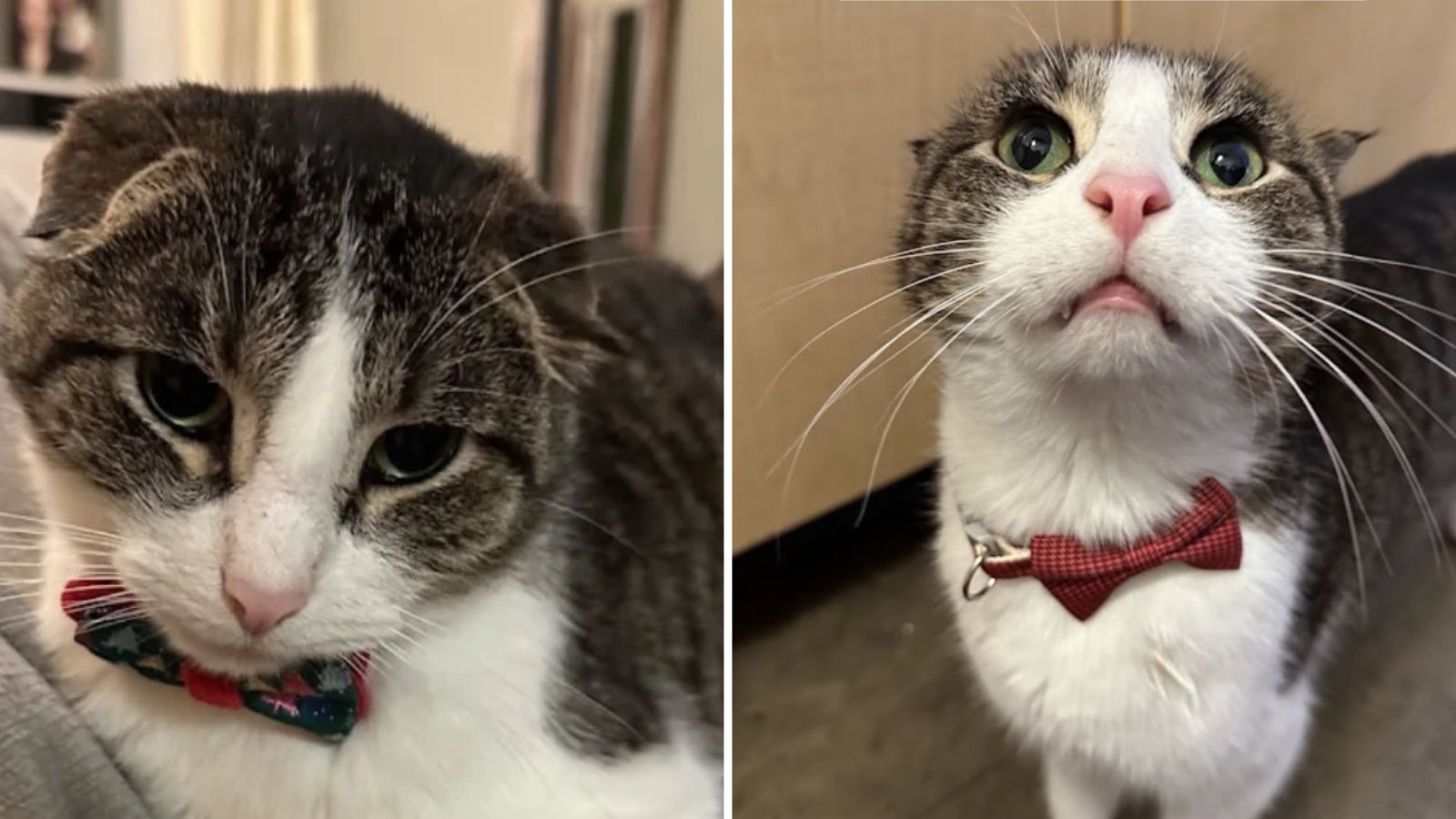
Where trauma often manifests as aggression, hiding, or defensive posturing in displaced animals, Theodore offered gentleness. He sought proximity, shadowing Marissa from room to room, choosing to curl up beside her rather than retreating to dark corners. This rapid behavioral adjustment highlighted a profound resilience and an innate desire for companionship that had been suppressed, but not extinguished, during his three days of solitary terror.
Supporting Context & Metrics: Decoding Theodore’s Unique Presentation
Once Theodore was settled into his new home, Marissa prioritized a thorough veterinary assessment to establish a baseline for his health and address any lingering impacts of his abandonment. This medical evaluation uncovered several critical factors that define Theodore’s daily care regimen.
Unraveling the Mystery of the Folded Ears
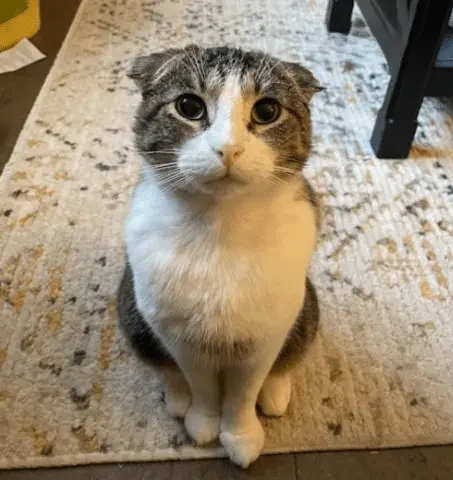
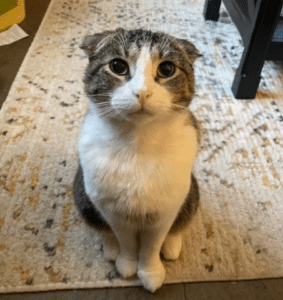
One of Theodore’s most striking physical features is his distinctively folded ears, a trait that frequently leads casual observers to mistake him for a Scottish Fold breed. However, a closer veterinary inspection revealed a more complex and sobering etiology.
Theodore bears a visible scar near his face, and veterinary diagnostics pointed toward historical complications involving Demodex mites—a type of microscopic parasite that can cause severe localized dermatitis, mange, and tissue inflammation. Marissa and her veterinarian deduced that the chronic inflammation, tissue damage, and cartilage breakdown caused by untreated mite infestations likely altered the structural integrity of Theodore’s ear pinnae, resulting in their permanent fold.
Despite this anatomical anomaly, Theodore’s auditory function remains intact. He hears normally, though his ears require ongoing pharmaceutical management to control underlying inflammation and prevent secondary infections. This daily maintenance is a small price to pay for a cat who is otherwise vibrant and responsive.
Navigating Feline Immunodeficiency Virus (FIV)
The most significant finding during Theodore’s initial veterinary workup was a positive diagnosis for Feline Immunodeficiency Virus (FIV). Commonly misunderstood, FIV is a slow-acting lentivirus that affects the feline immune system, roughly analogous to HIV in humans (though it is species-specific and cannot be transmitted to humans or other non-feline species).
- Transmission Dynamics: FIV is most commonly transmitted through deep bite wounds sustained during aggressive territorial fights—a reality that aligns with the facial scar Theodore carries from his time outdoors. Casual contact, sharing water bowls, grooming, and sneezing do not typically spread the virus.
- Prognosis and Quality of Life: Modern veterinary medicine recognizes that FIV-positive cats can live long, comfortable, and asymptomatic lives, provided they are kept indoors, fed a high-quality diet, and provided with prompt medical care at the first sign of illness.
- Immune Considerations: Because the virus compromises immune function, Theodore requires proactive health monitoring. Minor infections, dental issues, or upper respiratory ailments demand immediate veterinary intervention before they can escalate into systemic problems.
Managing Feline Asthma
Adding to his complex medical profile, Theodore also suffers from feline asthma. This chronic inflammatory condition affects the lower airways, leading to occasional respiratory distress, coughing, or wheezing if triggered by environmental allergens such as dust, smoke, or pollen.
Managing Theodore’s asthma requires careful environmental controls—minimizing airborne irritants in the home—alongside targeted veterinary treatments to keep his airways clear. Despite juggling FIV, chronic ear care, and asthma, Marissa notes that Theodore remains remarkably energetic and emotionally steady, proving that a complex medical chart does not preclude a joyful life.
Official Perspectives: The Human-Animal Bond and Divorce-Related Surrenders
The circumstances surrounding Theodore’s abandonment highlight a broader, often overlooked issue within animal welfare: the vulnerability of pets during major domestic life changes, particularly divorce.
Animal Welfare Implications of Domestic Disruptions
According to animal behaviorists and shelter directors, domestic upheavals represent one of the leading catalysts for pet relinquishment and, tragically, abandonment. When marriages dissolve, financial constraints, housing transitions, and emotional turmoil can cloud human decision-making. Pets, legally categorized as property in many jurisdictions, frequently become casualties of these logistical conflicts.
Animal welfare organizations consistently advocate for structured surrender protocols—such as utilizing local shelters, breed-specific rescues, or foster networks—rather than turning animals out to fend for themselves. Theodore’s case underscores the catastrophic risks pets face when informal, reckless abandonment replaces responsible rehoming strategies.
The Transformative Power of Rescue
Veterinary behavioral experts frequently emphasize the restorative power of a secure environment on traumatized animals. The profound shift observed in Theodore—from a frightened, isolated survivor to a devoted, communicative companion—illustrates the concept of animal resilience.
Marissa’s perspective reflects a growing movement among pet owners who embrace special-needs animals. Rather than viewing diagnoses like FIV or chronic asthma as burdens, dedicated rescuers view them as commitments to provide a higher standard of preventative care. The reciprocal nature of this relationship is profound: while Marissa saved Theodore from physical peril, Theodore provides deep emotional anchoring in return.
Future Outlook: A Lifetime of Partnership and Advocacy
As Theodore settles into his permanent home, his daily life is characterized by routine, safety, and mutual affection. The dynamic between him and Marissa serves as a masterclass in attunement and empathy.
Daily Routines and Emotional Resonance
Theodore’s behavior reveals a cat deeply attuned to his human’s emotional state. While he enjoys independent relaxation—such as choosing a sunlit vantage point on the bed while Marissa folds laundry on the floor—he remains keenly aware of his surroundings.
Marissa notes a particularly poignant behavioral trait: during moments of personal distress or sadness, when she is crying, Theodore consistently approaches her, pressing his body gently against her face and offering a silent, grounding presence. This intuitive responsiveness transcends standard pet companionship, operating on a level of deep emotional reciprocity.
Raising Awareness for Special-Needs Felines
Looking forward, Theodore’s story offers valuable educational outreach for the wider pet-owning community. By sharing the realities of caring for an FIV-positive cat with folded ears and asthma, Marissa helps dismantle the stigma surrounding special-needs animals.
Too often, cats with FIV or chronic medical conditions languish in shelters or face premature euthanasia due to public misconceptions about disease management and lifespan. Theodore stands as living proof that with attentive veterinary care, environmental enrichment, and unconditional love, special-needs felines can thrive.
Conclusion
Theodore’s journey from a forgotten victim of domestic upheaval to a cherished best friend is a triumph of compassion over negligence. Through the digital reach of a workplace message, a life was redirected from isolation to sanctuary.
While his medical chart requires vigilance—encompassing FIV management, asthma protocols, and ear care—these responsibilities are eclipsed by the profound joy he brings into Marissa’s daily existence. Theodore no longer faces the uncertainty of the streets; instead, he rests securely in the knowledge that he is protected, valued, and deeply loved.