
Executive Overview
The pristine, isolated expanse of Antarctica—long considered a final sanctuary shielded from many of the devastating pathogens plaguing the rest of the planet—has officially fallen victim to the global highly pathogenic avian influenza (HPAI) crisis. During the austral summers of 2023 and 2024, more than 50 skuas perished across the frozen continent, marking the first scientifically confirmed wildlife mass mortality event driven by the H5N1 virus in the region.
This grim milestone is the primary finding of a landmark study spearheaded by researchers from Erasmus MC in the Netherlands and the University of California, Davis (UC Davis). Published in the journal Scientific Reports, the study provides undeniable diagnostic proof that H5N1 is actively killing native Antarctic wildlife, transitioning the region from a state of anxious anticipation to active ecological crisis.
Skuas—large, formidable seabirds closely related to gulls—are apex scavengers and predators of the polar world. Their ecological role in cleaning up carcasses has inadvertently turned them into vectors and primary victims of a disease that attacks the central nervous system with horrifying speed. As H5N1 continues its relentless global march—having originated in commercial poultry farms nearly three decades ago—its entrenchment in the Antarctic ecosystem presents a profound threat to biodiversity. Already burdened by the compounding pressures of climate change, commercial overfishing, and expanding tourism, the fragile Antarctic food web now faces an unprecedented microbial adversary. Scientists are issuing urgent calls for heightened surveillance, warning that without immediate and coordinated international action, the silent spread of H5N1 could devastate populations of polar wildlife before humanity even realizes the extent of the damage.
Detailed Chronology: Tracking the Virus to the Ice Edge
The Early Warnings of 2024
The alarm bells began ringing in earnest during the first few months of 2024. In January and February, field researchers and conservationists detected isolated cases of H5N1 in a kelp gull and two skuas found dead in the Antarctic sector. However, detection alone does not equal attribution. While the presence of the genetic material of the virus was confirmed, scientists lacked the definitive post-mortem pathology required to prove that H5N1 was the primary mechanism of mortality rather than an incidental finding in an already weakened animal.
That crucial evidentiary gap was bridged by an international research expedition mounted in March 2024. Capitalizing on the immediate aftermath of the skua and penguin breeding season, a team of disease ecologists, wildlife veterinarians, and polar researchers journeyed to the end of the Earth. Their mission was clear: systematically investigate mortality events across 10 strategic sites spanning the South Shetland Islands, the northern Weddell Sea, and the rugged terrain of the Antarctic Peninsula.
The March 2024 Expedition
Operating in harsh polar conditions, the expedition team meticulously combed beaches, nesting colonies, and rocky outcrops. Whenever they encountered sick, dying, or recently deceased wildlife, they executed rigorous protocols. This included collecting comprehensive tissue and environmental samples, securing swabs, and performing detailed necropsies to ascertain the exact cause of death.
The scope of their investigation was broad, encompassing multiple iconic polar species including gentoo penguins (Pygoscelis papua), Adélie penguins (Pygoscelis adeliae), and Antarctic fur seals (Arctocephalus gazella). To the initial relief of the researchers, H5N1 was not identified as the cause of death in these specific pinniped and penguin populations during this phase of the study.
However, that relief was short-lived. "As the expedition progressed, it became obvious quickly that skuas were a major victim," noted Dr. Ralph Vanstreels, a wildlife veterinarian with the UC Davis One Health Institute.
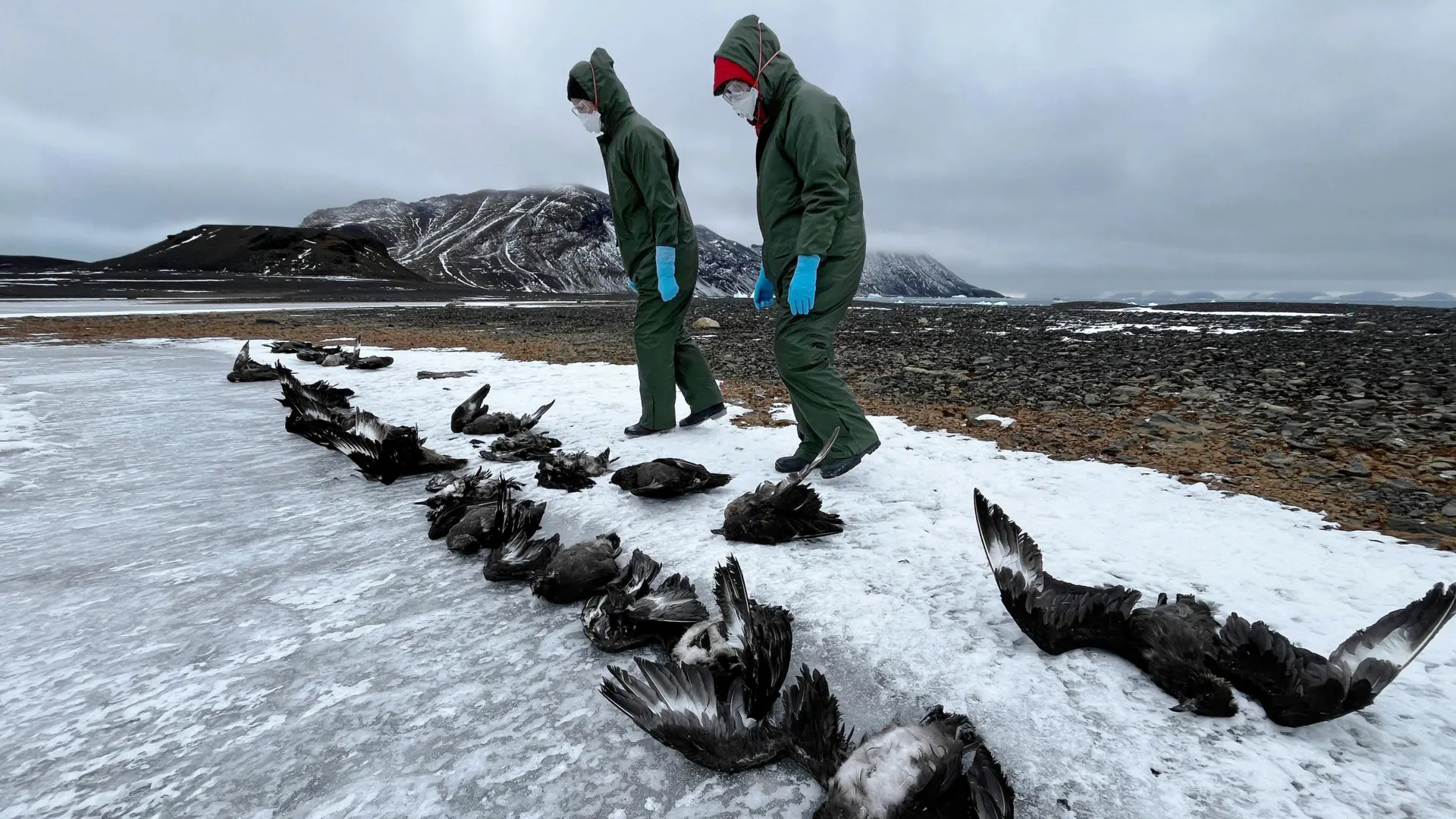
The virus was definitively diagnosed in skuas across three distinct geographic locations: Hope Bay, Devil Island, and Beak Island. Among these, Beak Island emerged as the epicenter of a severe mass mortality event involving south polar skuas (Catharacta maccormicki).
Pathology on the Ice
At Beak Island, the physical reality of the outbreak confronted the researchers with devastating clarity. Matteo Iervolino, a Ph.D. candidate at Erasmus MC in Rotterdam and the study’s first author, recalled the grim scene: "We diagnosed high pathogenicity avian influenza as the cause of death for nearly all of the dead skuas we found at Beak Island. There, I could really see with my eyes the impact this virus can have on these populations."
The pathology of H5N1 in these birds is profoundly cruel. The virus has a distinct neurotropic tropism, meaning it attacks the central nervous system and brain tissue. The clinical manifestations observed by researchers read like a neurological nightmare:
- Severe Postural Abnormalities: Infected birds frequently displayed twisted necks (torticollis) and abnormal, rigid body stretching.
- Locomotor Disruption: Skuas lost the ability to navigate normally, walking or swimming in tight, compulsive circles.
- Catastrophic Flight Failure: Deprived of spatial awareness and motor control, afflicted birds were observed crashing violently into physical objects or plummeting mid-air from the sky.
This localized die-off of more than 50 skuas across the 2023–2024 summers is not viewed by scientists as an isolated incident, but rather the opening salvo of an ecological catastrophe taking root in the southern polar regions.
Supporting Context & Metrics: A Global Pathogen’s Journey
The Origins of a Pandemic Strain
To understand the gravity of H5N1’s arrival in Antarctica, one must trace its evolutionary and geographical trajectory over the last three decades. The lineage can be directly tracked back to 1996, when a virulent strain of H5N1 avian influenza was first isolated on a domestic goose farm in Guangdong Province, Southeast China.
For years, the virus circulated largely unchecked within intensive poultry production systems across Asia. Weak biosecurity, high stocking densities, and unregulated trade provided an ideal incubator for viral mutation and amplification. Eventually, the virus broke containment, spilling over from captive flocks into migratory wild bird populations.
From that pivotal junction, the epidemiological map of the world was redrawn. Wild birds acted as intercontinental couriers, carrying the pathogen across Europe, the Middle East, and Africa. By the late 2010s and early 2020s, the virus had crossed the Atlantic, sweeping through North American ecosystems before tearing down the length of South America. By the dawn of 2024, it had successfully breached the formidable natural barrier of the Drake Passage to establish a foothold in Antarctica.
A Multitude of Victims Worldwide
The Antarctic skua die-off is merely the latest chapter in a staggering global toll. The scale of the H5N1 panzootic is historically unprecedented:
- Poultry Industry Losses: More than 400 million domestic birds have either died from the infection or been culled globally to prevent further transmission.
- Mammalian Spillover: While historically classified strictly as an avian pathogen, the modern H5N1 lineage has demonstrated a terrifying capacity to cross the species barrier into mammals. It has been documented in dairy cattle, farmed mink, red foxes, black bears, sea otters, skunks, and marine mammals.
- Marine Megafauna Devastation: Prior to hitting Antarctic birds, the exact same genotype caused catastrophic mortality events among elephant seals and sea lions along the coasts of Argentina, Chile, and Peru, wiping out tens of thousands of marine mammals.
- Human Health Impacts: While human infections remain relatively rare—largely restricted to individuals with intense, direct occupational exposure to infected animals—the case fatality rate is alarmingly high. Of the roughly 1,000 documented human cases globally, approximately 50% have resulted in death.
Official Statements and Expert Perspectives
The publication of the Erasmus MC and UC Davis study has drawn sharp commentary from the international scientific community, underscoring both the urgency of the moment and the regulatory failures that permitted the crisis to reach this stage.
Dr. Ralph Vanstreels emphasized the vital legal and scientific distinction between detecting antibodies or viral fragments versus proving actual mortality: "We knew there were animals with the infection, but this is the first study to show they died of the viral infection. It’s an important distinction in the early days of an outbreak." Vanstreels further characterized the on-the-ground reality as a profound "crisis in animal suffering," noting that anthropogenic activities catalyzed the emergence of the virus and that human intervention remains the only tool capable of mitigating its downstream impacts.
Perhaps the most blistering critique came from corresponding senior author Thijs Kuiken, a professor at Erasmus MC, who placed direct responsibility on historical regulatory negligence within the agricultural sector:
"We let the virus slip out through our fingers when it first emerged in the poultry industry. Once it got into wild bird populations, we lost the ability to control this virus. Now it’s established in wild bird populations in all the continental regions of the world except Oceania."
Kuiken’s assessment serves as a stark warning to policymakers: mitigation is no longer about eradication; it is entirely about containment, monitoring, and protecting remaining vulnerable ecosystems from total collapse.
Future Outlook: The Urgent Need for Antarctic Surveillance
Compounding Stressors on Polar Ecosystems
The introduction of H5N1 into Antarctica does not occur in a vacuum. The region’s wildlife is already straining under a cumulative suite of anthropogenic and environmental pressures. Climate change is rapidly altering ice shelves, modifying marine food webs, and warming polar waters. Concurrently, Antarctic ecosystems are grappling with:
- Expanding Tourism: Record numbers of cruise ships and land-based visitors bring human traffic closer to sensitive breeding colonies, increasing the theoretical risk of anthropomorphic pathogen transfer or disturbance.
- Invasive Species: Non-native flora and fauna hitchhiking on gear and vessels continue to alter local habitats.
- Commercial Overfishing: Industrial extraction of krill—the foundational keystone species of the Southern Ocean—depletes the primary food source for penguins, seals, and seabirds, leaving them nutritionally compromised and physiologically more susceptible to disease.
- Marine Pollution and Plastics: Microplastics and chemical contaminants accumulate in polar food chains, further eroding immune system resilience.
The Blind Spots of Science
Compounding the threat of H5N1 is a critical data gap regarding population baselines. Astoundingly, the last comprehensive census of Antarctic skuas was conducted in the 1980s, at which time researchers estimated a population of roughly 800 breeding pairs.
In the absence of contemporary demographic data, calculating the exact ecological significance of losing 50 or more breeding adults is exceptionally difficult. A loss of this magnitude could represent a minor statistical fluctuation or a catastrophic localized collapse for populations already hovering near historical lows.
"Everything points toward this virus spreading further," Professor Kuiken warned bluntly. "If nobody is watching, we won’t know what is happening."
The Road Ahead
Addressing this crisis demands a paradigm shift in polar conservation. Researchers are calling for immediate, sustained funding for continuous wildlife health surveillance across the Antarctic Peninsula and sub-Antarctic islands. This requires collaborative frameworks involving international research stations, tour operators, and environmental management bodies.
The expedition itself—the HPAI Australis Expedition—stands as a model for proactive polar research, funded jointly through the International Association of Antarctica Tour Operators (IAATO) and Ocean Expeditions, with additional scientific support from the European Union, the Spanish Consejo Superior de Investigaciones Científicas (CSIC), and PTI Global Health.
However, sporadic expeditions are no substitute for permanent, continent-wide pathogen monitoring networks. As H5N1 knocks persistently at the gates of the world’s most remote ecosystems, humanity’s obligation is clear: to watch, to measure, and to act before the silence of the ice becomes permanent.