
EXECUTIVE OVERVIEW
In the world of commercial pet food safety, consumer trust relies heavily on the assumption that federal oversight guarantees basic product transparency. When a pet suddenly falls ill, pet owners and veterinary professionals turn to product packaging for critical identifiers—specifically, lot codes and expiration dates—to report potential contamination to federal authorities or verify whether a product is subject to an active recall.
However, an alarming regulatory blind spot has come to light: neither the U.S. Food and Drug Administration (FDA) nor the Association of American Feed Control Officials (AAFCO) legally mandates the inclusion of lot numbers or "Best by" dates on pet food labels.
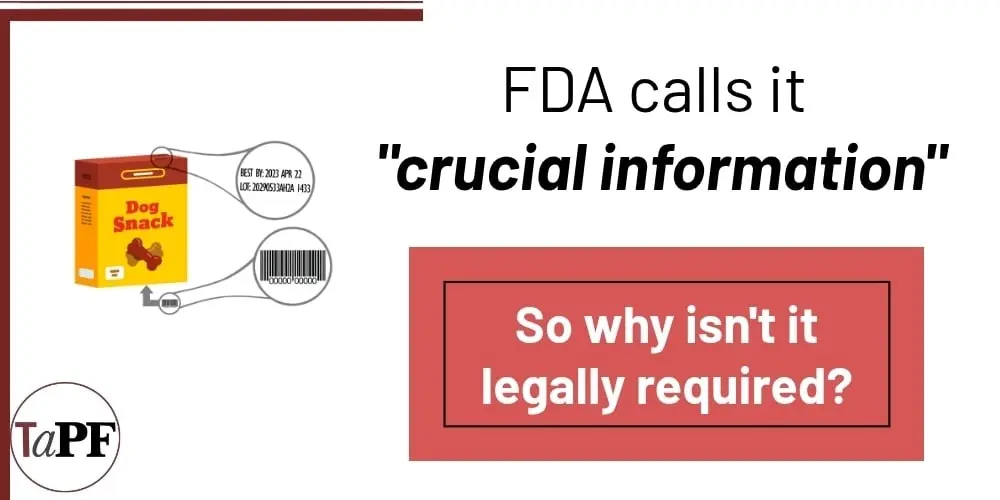
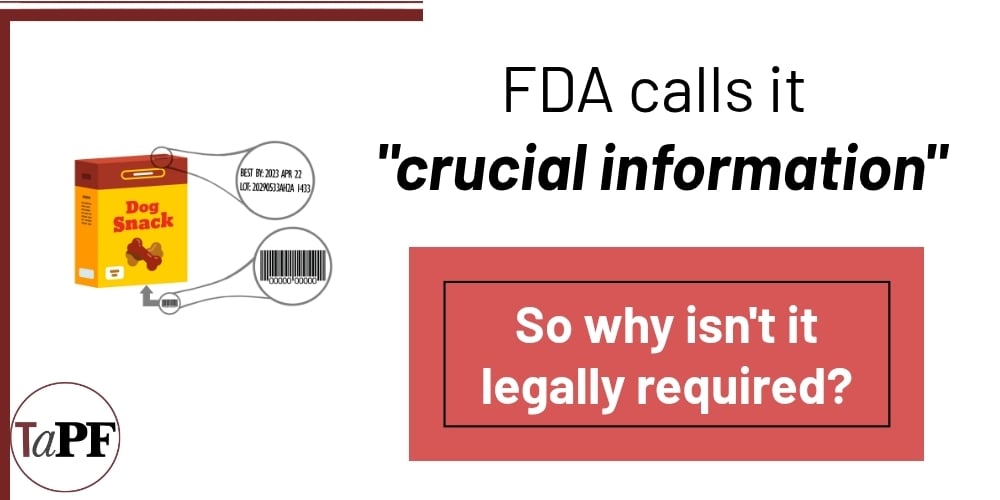
While the FDA publicly emphasizes that lot numbers are a "crucial piece of information" for tracking unsafe inventory, preventing widespread illness, and executing targeted product recalls, the agency does not legally enforce their placement on consumer-facing packaging. Simultaneously, "Best by" dates—which dictate product quality and nutritional integrity—are left entirely to the voluntary discretion of manufacturers, with no federal requirement for scientific verification of nutrient stability over time.
This systemic policy disconnect exposes pets to unaccountable quality variations and leaves consumers stranded during critical adverse event investigations. As advocacy groups prepare formal petitions demanding comprehensive legislative reform, industry stakeholders and pet parents face an urgent challenge: navigating a marketplace where basic product traceability remains largely voluntary.
DETAILED CHRONOLOGY: FROM A VETERINARY INQUIRY TO A REGULATORY REVELATION
The Initial Catalyst: A Clinical Dilemma
The investigation into this regulatory vulnerability began with a query from a practicing veterinarian to pet food consumer advocate Susan Thixton, founder of TruthaboutPetFood.com and the Association for Truth in Pet Food.
A veterinary client brought in a companion animal suffering from acute, unexplained gastrointestinal distress. Suspecting a foodborne illness linked to a recently opened bag of commercial pet food, the veterinarian assisted the owner in submitting an adverse event report to the FDA’s Center for Veterinary Medicine (CVM).
When the veterinarian examined the packaging to record the product’s tracking details, she discovered that the bag contained no lot number, batch code, or "Best by" date anywhere on its surface. Assuming this omission was a clear violation of federal labeling standards, the veterinarian sought advice on how to report the non-compliant packaging alongside the medical incident.
+-----------------------------------------------------------------------------------+
|                            THE REPORTING BREAKDOWN                                |
+-----------------------------------------------------------------------------------+
|  [ Pet Falls Ill ] ---> [ Vet Suspects Contamination ] ---> [ Examines Package ]  |
|                                                                     |             |
|                                                                     v             |
|  [ Investigation Stalled ] <--- [ No Federal Mandate ] <--- [ Missing Lot Code ]  |
+-----------------------------------------------------------------------------------+
The Regulatory Audit: Uncovering the Loophole
Initial assumptions within the veterinary and consumer advocacy communities leaned toward the belief that basic batch identification was a statutory requirement. However, a systematic audit of federal regulations and state feed control standards revealed a starkly different reality:
-
The FDA Consumer Advisory Gap: The FDA maintains public-facing educational resources, including an article titled "Save Your Pet Food Lot Number!" In this publication, the agency explicitly states:
"The lot number is a crucial piece of information when you’re trying to identify if a product has been recalled or if you’re reporting a potential product problem to FDA or the company. The lot number helps identify a specific batch of pet food or treats… so problems can be quickly addressed."
-
The Legal Disconnect: Despite publicly acknowledging the vital role of these identifiers, an exhaustive review of the Code of Federal Regulations (CFR Title 21) and the AAFCO Official Publication confirmed that no statute requires pet food companies to print this data on retail packaging.
-
Arbitrary Quality Metrics: Further investigation into the FDA’s guidance regarding "Best by," "Use By," or "Sell By" dates revealed that federal regulators view these markings purely as manufacturer-determined quality indicators. The agency’s official documentation notes:
"Each of these dates, determined by the company, indicates when a product’s quality starts to decrease… Some pet food companies may use these dates, in conjunction with lot numbers, to help identify product batches."
Crucially, federal law contains no requirement that these dates be derived from empirical shelf-life testing, nutrient retention assays, or scientific stability studies. A manufacturer can legally print an arbitrary date without providing underlying data to support product safety or nutritional adequacy up to that point.
SUPPORTING CONTEXT & INDUSTRY METRICS: THE MECHANICS OF TRACEABILITY AND DEGRADATION
To fully comprehend the risks associated with this regulatory gap, it is necessary to examine the operational mechanics of commercial pet food manufacturing, internal supply-chain tracking requirements, and the biochemical degradation of pet food over time.
Internal Traceability vs. Consumer Visibility
A distinct paradox exists between industrial B2B (business-to-business) supply-chain traceability laws and consumer-facing transparency.

Under the Food Safety Modernization Act (FSMA), commercial pet food facilities are required to maintain strict internal record-keeping systems. Manufacturers must be able to trace incoming raw ingredients back to their suppliers and track outgoing distribution networks for every production lot.
+-----------------------------------------------------------------------------------+
|                         TRACEABILITY PARADOX UNDER FSMA                           |
+-----------------------------------------------------------------------------------+
| STAGE 1: INGREDIENT SOURCING                                                      |
| Mandatory supplier logs, internal batch tracking, and facility record-keeping.   |
| STATUS: Legally Mandated (Internal FDA Access Only)                               |
+-----------------------------------------------------------------------------------+
| STAGE 2: RETAIL PACKAGING                                                         |
| Printing lot numbers and expiration dates on bags/cans for consumer visibility.   |
| STATUS: Voluntary (No Federal Mandate)                                            |
+-----------------------------------------------------------------------------------+
While these internal metrics exist to satisfy FDA auditors during an active outbreak investigation, the absence of mandatory on-package labeling creates a fatal breakdown at the point of consumer interaction:
- Obstructed Adverse Event Reporting: When a pet owner files a report via the FDA Safety Reporting Portal, the absence of a lot number prevents federal investigators from linking individual illness cases to specific manufacturing runs, production plants, or raw material shipments.
- Ineffective Consumer Recalls: In the event of a voluntary or mandated recall, consumers cannot verify whether the product in their pantry matches the affected batch, leading either to the unnecessary disposal of safe food or, more dangerously, the continued feeding of contaminated food.
The Biochemical Reality of Food Degradation
The lack of scientific standards for "Best by" dates poses significant nutritional risks. Dry kibble and canned pet foods undergo complex chemical changes over time, particularly regarding fat stability and micronutrient preservation.
+-----------------------------------------------------------------------------------+
|                        PET FOOD DEGRADATION PATHWAYS                              |
+-----------------------------------------------------------------------------------+
| Lipid Oxidation        --> Essential fatty acids break down, producing toxic      |
|                            peroxides and volatile aldehydes (rancidity).          |
+-----------------------------------------------------------------------------------+
| Vitamin Breakdown      --> Heat-sensitive vitamins (e.g., Thiamine/B1, Vitamin E)  |
|                            degrade, risking clinical nutrient deficiencies.        |
+-----------------------------------------------------------------------------------+
| Protein Denaturation   --> Bioavailability of essential amino acids declines      |
|                            over extended storage periods.                         |
+-----------------------------------------------------------------------------------+
Without mandated stability testing, a "Best by" date printed on a pet food label may reflect commercial marketing goals rather than verifiable nutritional preservation. If fats turn rancid or essential vitamins degrade below the minimum profiles guaranteed on the label, pets may suffer from chronic health issues, including hepatic stress, systemic inflammation, or severe dietary deficiencies.
OFFICIAL STATEMENTS & REGULATORY DISCONNECTS
The gap between regulatory messaging and regulatory enforcement highlights a profound structural flaw in current oversight frameworks.
The FDA’s Position: Vital Context Without Enforcement
The FDA’s Center for Veterinary Medicine routinely publishes educational content advising pet owners to preserve product packaging. The agency stresses that lot numbers allow manufacturers to pull targeted batches from market channels without disrupting uncompromised inventory.
However, when questioned on the legal enforcement of these codes, the regulatory reality emerges: the FDA does not mandate on-package lot numbers for animal feed or pet food.
The agency relies on corporate self-interest, operating under the assumption that companies will voluntarily print lot numbers to protect themselves from broad, sweeping recalls that could ruin an entire product line. While large multinational brands typically include coded matrix stamps on their packaging, smaller manufacturers, private-label brands, or re-packagers may omit them to reduce operational costs or bypass specialized printing equipment.

AAFCO’s Model Regulations: A Missing Standard
The Association of American Feed Control Officials (AAFCO)—the advisory body responsible for establishing model feed laws adopted by state regulators—similarly lacks a mandate for consumer-facing batch codes and scientifically validated expiration dates.
+-----------------------------------------------------------------------------------+
|                        REGULATORY GAP COMPARISON MATRIX                           |
+-----------------------------------------------------------------------------------+
| LABEL REQUIREMENT       | FDA MANDATE (PET FOOD) | AAFCO MODEL REGULATIONS       |
+-------------------------+------------------------+--------------------------------+
| Brand & Product Name    | Mandatory              | Mandatory                      |
| Net Quantity Statement  | Mandatory              | Mandatory                      |
| Guaranteed Analysis     | Mandatory              | Mandatory                      |
| Ingredient Statement    | Mandatory              | Mandatory                      |
| Nutritional Adequacy    | Mandatory              | Mandatory                      |
| Lot Code / Batch ID     | VOLUNTARY              | VOLUNTARY                      |
| Expiration / Best By    | VOLUNTARY              | VOLUNTARY                      |
+-----------------------------------------------------------------------------------+
Because AAFCO’s Model Pet Food Regulations serve as the baseline for state-level feed legislation, the omission of lot number requirements at the AAFCO level ensures that state departments of agriculture also lack the legal authority to cite companies for omitting this critical safety data.
FUTURE OUTLOOK & STRATEGIC RECOMMENDATIONS
The discovery of these regulatory omissions has mobilized consumer advocacy organizations, pet owners, and veterinary professionals to press for systemic legislative changes.
Immediate Legislative Petitions
The Association for Truth in Pet Food has announced plans to submit formal regulatory petitions to both the FDA and AAFCO. These petitions will seek to transform voluntary guidelines into enforceable standards by requesting:
- Mandatory On-Package Lot Identifiers: Requiring clear, legible, and permanent lot number printing on all primary and secondary pet food packaging sold in the United States.
- Scientifically Validated Expiration Dating: Mandating that any "Best by," "Use By," or expiration date included on pet food packaging be supported by standardized accelerated degradation testing, lipid oxidation testing, and vitamin stability verification under real-world storage conditions.
- Standardized Formatting: Establishing clear rules for code legibility, preventing high-speed ink-jet codes from being printed over dark backgrounds, folded seams, or areas prone to smudging during distribution.
+-----------------------------------------------------------------------------------+
|                        PROPOSED LEGISLATIVE REFORMS                               |
+-----------------------------------------------------------------------------------+
|  1. MANDATORY LOT CODES     --> Clear, indelible printing on all primary packaging|
|  2. SCIENTIFIC "BEST BY"    --> Required laboratory stability data for shelf-life |
|  3. LEGIBILITY STANDARDS    --> Standardized placement away from dark seams/folds |
+-----------------------------------------------------------------------------------+
Actionable Guidance for Pet Owners and Veterinarians
Until legislative reforms take effect, consumers and veterinary professionals must adopt proactive protocols to protect companion animals:
- Inspect Packaging Before Purchase: Prioritize purchasing pet foods that clearly display legible lot numbers and "Best by" dates. Avoid products that omit this information.
- Document Package Identifiers Immediately: Upon opening a new container of pet food or treats, take a clear photo of the entire package, including the ingredient panel, guaranteed analysis, and any stamped coding.
- Store Food in Original Packaging: Avoid pouring kibble directly into plastic storage bins without keeping the original bag. The original bag contains protective barrier properties and preserves essential tracking data needed during a safety emergency.
- Direct Inquiries to Manufacturers: If a product lacks tracking data, contact the manufacturer directly to ask why lot numbers are omitted and request the specific laboratory methodology used to establish the product’s "Best by" date.
- Report Omissions to Regulators: When reporting suspected pet food-related illnesses to state feed officials or the FDA CVM, explicitly note the absence of lot numbers or expiration dates as an operational barrier to consumer safety.
Industry Implications
As public scrutiny over pet food safety intensifies, manufacturers that proactively adopt full label transparency will hold a distinct competitive advantage. Establishing verifiable supply-chain visibility not only builds consumer trust but also protects public health, ensuring that when safety crises arise, swift and accurate intervention remains within reach.