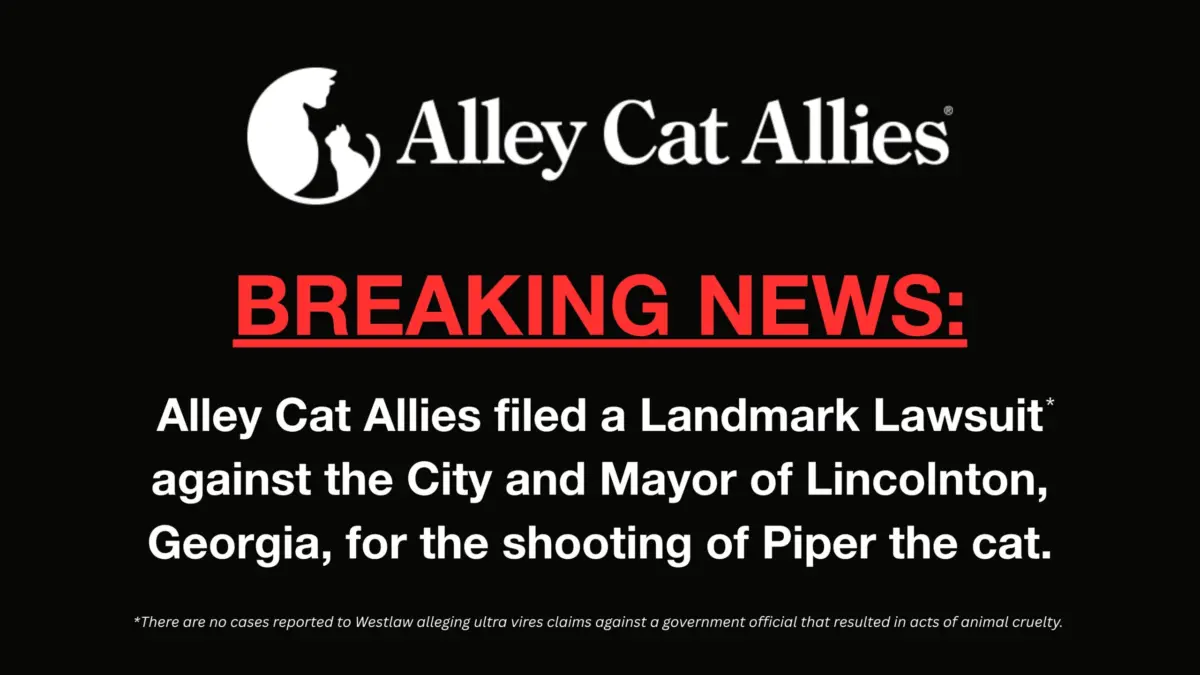

LINCOLNTON, GEORGIA — In what legal experts are calling a historic first-of-its-kind legal challenge, the global animal protection organization Alley Cat Allies has filed a landmark civil lawsuit against the City of Lincolnton, Georgia, and Mayor Mike McCombs. The litigation targets the unlawful abuse of municipal authority, which allegedly enabled a private citizen—specifically the mayor’s wife, Lizzy Long—to use a shotgun to shoot and kill a domestic cat named Piper on private property.
Legal databases and reported case histories indicate that this complaint is the first of its kind filed against a government official for exceeding their legal authority in a manner that directly results in acts of animal cruelty. The filing attempts to establish accountability at the highest levels of local government, asserting that public office does not grant immunity or the power to deputize private individuals to carry out lethal acts against domestic animals.
Executive Overview
The controversy centers on a deeply disturbing sequence of events captured on municipal police body camera footage in the spring of 2026. According to the lawsuit, Mayor Mike McCombs systematically attempted to co-opt local law enforcement to eliminate a cat belonging to local resident Tommy Lee. When police officers repeatedly refused to execute what they recognized as unlawful and high-liability directives, the mayor allegedly bypassed municipal protocols entirely. He brought his wife to the scene, armed with a shotgun, and permitted her to execute the cat on private property.
Despite initial police intervention that resulted in an arrest warrant for Lizzy Long on animal cruelty charges, the legal accountability evaporated almost as quickly as it appeared; the warrant was recalled on the very same day it was issued. With local criminal justice pathways seemingly stalled, Alley Cat Allies stepped into the legal arena.
The organization’s complaint challenges what lawyers term an ultra vires act—an action taken without legal authority or outside the scope of municipal powers. By filing this lawsuit, Alley Cat Allies aims to pierce the veil of local political immunity, secure justice for Piper, and set a definitive legal precedent ensuring that public officials, along with their friends and family members, remain strictly subject to the rule of law.
Detailed Chronology of Events: From Police Pressure to Fatal Execution
To understand the gravity of the lawsuit filed by Alley Cat Allies, one must examine the timeline of events leading up to the shooting of Piper in April 2026. The incident was not a spontaneous outburst, but rather a calculated escalation by an elected official leveraging his administrative power.
The Breakdown of Law Enforcement Resistance
In April 2026, Mayor McCombs reportedly approached Lincolnton Police Officer Jason Shelton with a direct command: go to the property of Tommy Lee, the owner of a cat named Piper, and kill the animal using the officer’s department-issued firearm.
Officer Shelton recognized the blatant illegality and ethical breach of the order. He lawfully refused. Undeterred, Mayor McCombs escalated his demands. He instructed Officer Shelton to take his service weapon, go to Lee’s home, and hand the gun to the cat owner so that Lee could shoot his own pet. Officer Shelton refused a second time, explicitly citing the "incredible liability" the city would face if a municipal police officer handed a loaded firearm to a civilian to execute a domestic animal on private property.
The Mayor Takes Matters into His Own Hands
Frustrated by the police officer’s adherence to professional standards and legal boundaries, Mayor McCombs bypassed the police department’s chain of command entirely. He ordered Officer Shelton to report to Tommy Lee’s property regardless, setting the stage for a confrontation.
When Officer Shelton arrived at the scene, Mayor McCombs arrived shortly thereafter accompanied by Lizzy Long, who was carrying a shotgun. Newly released police body camera footage documents the chilling ease with which the mayor orchestrated the execution. On the recording, Mayor McCombs can be heard directing the parties, stating plainly: "Lizzy’s right there. She can shoot it."
The Execution of Piper
Long approached the property where Piper was cowering behind a garage. With neither the mayor, the police officer, nor the cat’s owner intervening to stop her, Long raised the shotgun and fired.
The body camera footage reveals a harrowing scene: the gunshot failed to kill Piper instantaneously. Instead, the cat suffered in extreme distress, screaming and rolling across the ground in severe agony before finally succumbing to its wounds.
Compounding the horror, audio captured on the body camera suggests that Piper’s death was not an isolated incident. When discussing the request to shoot the cat, Long remarked, "Well, they all… I’ve done this. They’ve called me all the time," indicating a disturbing pattern of vigilante animal execution sanctioned by informal municipal custom.
Supporting Context, Metrics, and Legal Significance
The lawsuit filed by Alley Cat Allies on October 29, 2026, breaks new ground in American jurisprudence concerning municipal liability and animal protection.
What is an Ultra Vires Claim?
The core legal theory of the complaint centers on the doctrine of ultra vires—Latin for "beyond powers." An ultra vires act occurs when a government body or official takes a step that exceeds the authority granted to them by law or constitution.
According to legal research of Westlaw and reported state cases, there are zero recorded precedents alleging ultra vires claims specifically against a government official whose unauthorized delegation of power resulted in acts of animal cruelty. Alley Cat Allies’ complaint explicitly seeks "to prevent the continued ultra vires exercise, authorization, and/or delegation of governmental animal control authority to private individuals who are not legally authorized under Georgia law to exercise such authority."
The Regulatory Vacuum and Broken Accountability
In the wake of Piper’s death, community outrage prompted immediate advocacy. Alley Cat Allies launched a robust public campaign demanding the arrest and prosecution of Lizzy Long for animal cruelty, alongside calls for the immediate removal of Mayor Mike McCombs from office. A Department of Agriculture criminal investigator officially identified the slain cat as Piper.
Yet, despite clear video evidence and an initial arrest warrant, the system stalled. The arrest warrant for Long was recalled on the same day it was issued. To date, neither Long nor Mayor McCombs has faced criminal prosecution. Furthermore, the City of Lincolnton has failed to implement internal disciplinary measures, issue public reprimands, or establish policies to prevent similar abuses from occurring in the future.
Official Statements and Advocacy Perspectives
The refusal of local authorities to pursue justice has galvanized animal welfare advocates nationwide. The leadership of Alley Cat Allies has made it clear that they view this case as a litmus test for the accountability of public servants.
"Mayor McCombs and the City of Lincolnton must answer for the heinous act of cruelty to Piper and their abuse of authority in this case," stated Coryn Julien, program communications officer at Alley Cat Allies. "Alley Cat Allies will not stop until Piper receives justice and anyone who commits cruel, unlawful acts against animals faces consequences that reflect the severity of their crimes. Public officials and their friends and family are not above the law."
Julien’s sentiments reflect the broader mission of Alley Cat Allies, an organization founded in 1990 that has spent decades fighting to transform communities into safe environments for all cats and kittens. With a network of over 1.8 million supporters globally, the organization utilizes education, litigation, and policy activism to ensure that nonlethal, humane, and evidence-based approaches govern interactions with animals.
Future Outlook and Broader Implications
As this landmark lawsuit moves through the legal system, its ramifications extend far beyond the borders of Lincolnton, Georgia.
- Setting a Legal Precedent: If the courts validate the ultra vires claims brought by Alley Cat Allies, it will create a powerful legal weapon for animal advocates across the United States. It will establish that elected officials cannot use informal influence to bypass state animal cruelty laws or deputize private citizens to perform extrajudicial killings of pets.
- Municipal Reform: The lawsuit forces the City of Lincolnton to defend its governance in an open court, shining a harsh light on internal administrative practices. It serves as an urgent warning to local governments everywhere regarding the severe legal liabilities of unchecked mayoral overreach.
- Community Healing and Vigilance: For the residents of Lincolnton, the case exposes deep fractures in local governance. The continued advocacy of organizations like Alley Cat Allies ensures that Piper’s memory remains a catalyst for systemic transparency and animal rights protection.
Alley Cat Allies has made the full legal complaint and the raw police body camera footage publicly accessible, inviting citizens, legal scholars, and journalists to review the evidence firsthand. As the legal battle unfolds, the organization remains steadfast in its core belief: that every cat deserves to live out its life fully, and that no individual—regardless of their political title or marital status—operates above the law.