
Executive Overview
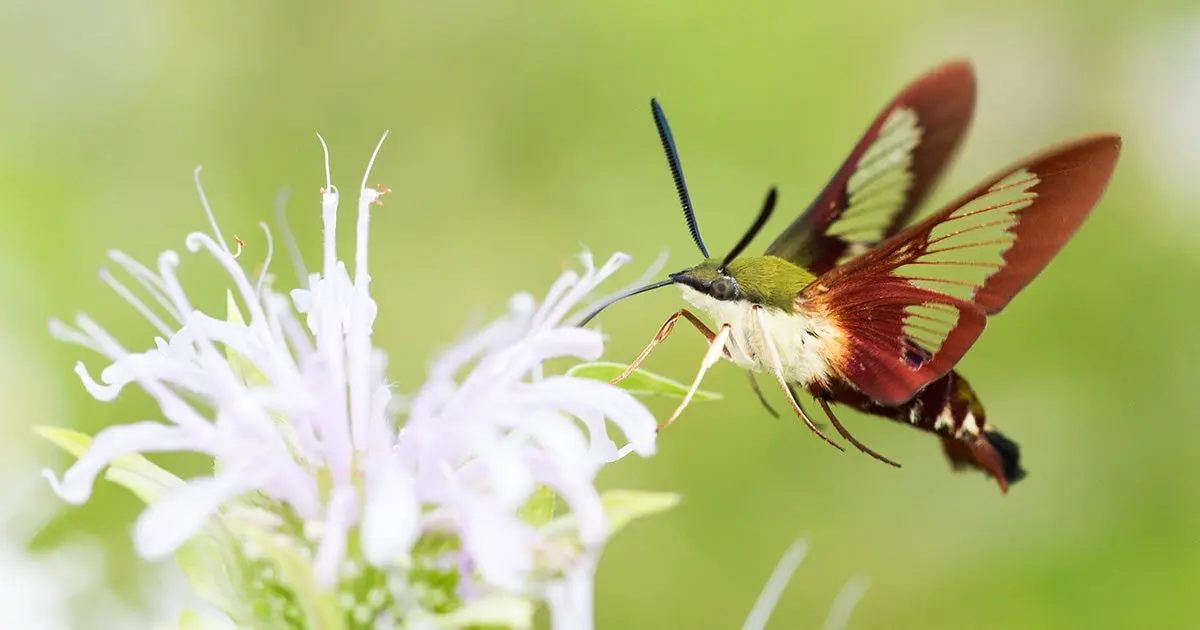
For centuries, casual observers and seasoned naturalists alike have experienced moments of breathless hesitation in gardens across North America: a sudden flash of iridescent red and green, a whir of wings defying optical tracking, and a long, slender proboscis uncoiling to sip nectar from a trumpet-shaped bloom. The immediate assumption is almost always avian—a hummingbird darting from flower to flower with dizzying agility. Yet, upon closer inspection, the creature reveals feathery antennae, scaled bodies, and a set of entirely transparent wings.
This is not a bird, but a moth—specifically, a member of the hawkmoth family (Sphingidae), commonly known as the hummingbird moth.
While the superficial resemblance between hummingbirds and hummingbird moths is striking, the scientific reality of their relationship is a masterclass in evolutionary biology. Diverging more than half a billion years ago from a common, wormlike marine ancestor, these two distinct lineages share no recent evolutionary kinship. Instead, their uncanny convergence is one of nature’s most compelling demonstrations of convergent evolution. Driven by the demands of a high-energy, nectar-feeding ecological niche, both insects and birds independently arrived at remarkably similar physiological and aerodynamic solutions.
Beyond serving as a delightful garden curiosity, the hummingbird moth occupies a vital role in terrestrial ecosystems as an elite pollinator. Capable of reaching deep into tubular flowers that are inaccessible to other insects, these moths help sustain complex botanical networks across North America. However, like many pollinators, they face mounting threats from habitat fragmentation, pesticide use, and climate disruption. This article explores the biological architecture, evolutionary mechanics, and ecological significance of the hummingbird moth, offering a comprehensive look at one of the natural world’s most successful aerodynamic mimics.
Detailed Chronology: Unraveling the Mystery of the Hawkmoth
To understand how a moth came to mirror a bird so precisely, it is necessary to trace both the historical fascination with these creatures and the deep evolutionary timeline that shaped them.
The Deep Evolutionary Split (>500 Million Years Ago)
Long before feathers graced the earth or scales coated the bodies of early insects, the last common ancestor of birds and lepidopterans (butterflies and moths) crawled through ancient seas. This organism was a simple, bilateral, wormlike marine creature. Approximately 500 million years ago, a profound evolutionary divergence occurred, splitting the lineage that would eventually produce vertebrates (including aves, or birds) from the lineage producing protostomes and ecdysozoans (including arthropods and insects).
For hundreds of millions of years, these two branches evolved along entirely separate tracks. Birds developed endothermy, hollow bones, and feathers, while insects perfected an exoskeleton, tracheal breathing systems, and complex metamorphosis. Yet, when angiosperms (flowering plants) burst onto the evolutionary scene during the Cretaceous period, they created a lucrative, untapped ecological niche: high-energy nectar locked deep within floral tubes.
The Rise of the Sphingidae Family
Within the insect order Lepidoptera, the family Sphingidae emerged as heavyweight contenders for this floral bounty. Comprising approximately 1,400 species worldwide—with 115 species residing in North America—hawkmoths earned their moniker due to two distinct behavioral traits. As adults, their powerful, steady, and rapid flight patterns evoke the soaring majesty of hawks. As larvae (caterpillars), many species exhibit a dramatic defense mechanism when threatened: they rear up the front portions of their bodies, resting on their prolegs, in a posture strikingly reminiscent of the Egyptian Sphinx.
While most hawkmoths are nocturnal or crepuscular (active at dusk and dawn), a small, specialized minority broke evolutionary convention to forage under the blazing summer sun. These daylight-active species are the true hummingbird moths. In North America, this group prominently features the four "clearwing" species:
- The Hummingbird Clearwing (Hemaris diffinis): The most widespread and commonly observed clearwing in eastern and central North America.
- The Snowberry Clearwing (Hemaris thysbe): Recognized by its olive-green and burgundy markings, spanning across the continent.
- The Slender Clearwing (Hemaris gracilis): A more localized species preferring pine barrens and acidic soils.
- The Rocky Mountain Clearwing (Hemaris thetis): An inhabitant of the intermountain west whose distinct yellow-and-black coloration often leads to it being mistaken for a bumblebee.
Supporting Context & Metrics: Anatomy, Aerodynamics, and Convergent Evolution
The resemblance between hummingbirds and hummingbird moths is not merely a trick of the human eye; it is rooted in deep physiological convergence.
Aerodynamic Parallels
To achieve hovering flight—a metabolically expensive and mechanically demanding feat—both hummingbirds and hummingbird moths must beat their wings at astonishing speeds.
- Wingbeat Frequency: Hummingbird moths oscillate their wings at rates up to 70 times per second. Certain hummingbird species operate at approximately 80 wingbeats per second.
- Flight Mechanics: Both animals generate lift on both the forward and backward strokes by sweeping their wings in a rapid, continuous figure-eight pattern. This grants them the rare ability among flying animals to fly backward, hover motionless in mid-air, and dart forward with instantaneous acceleration.
- Metabolic Demands: Sustaining this high-frequency flight style requires an enormous caloric intake. Both organisms possess exceptionally high metabolic rates, relying entirely on a constant supply of concentrated sugar-rich nectar.
Mouthparts and Foraging Adaptations
The anatomical adaptations for nectar extraction are equally striking:
- Hummingbirds: Possess elongated beaks housing long, grooved, and extendable tongues that wrap around the inside of their skulls when retracted.
- Hummingbird Moths: Possess a proboscis—a strawlike mouthpart—that can be up to twice the length of their entire body. When not feeding, this proboscis remains tightly coiled beneath the insect’s chin like a watch spring.
Perhaps the most famous extreme adaptation within this family is Darwin’s hawkmoth (Xanthopan praedicta) of Madagascar. Predicted by Charles Darwin and Alfred Russel Wallace before it was ever officially discovered, this moth features a staggering 12-inch (30-centimeter) proboscis. It is uniquely evolved to pollinate the comet orchid (Angraecum sesquipedale), whose nectar is stored at the very base of a foot-long floral spur. Entomologists often describe this feeding mechanism as akin to trying to hit the opening of a soda can with a two-meter straw held in your mouth.
| Metric / Trait | Ruby-Throated Hummingbird (Archilochus colubris) | Hummingbird Clearwing Moth (Hemaris diffinis) |
|---|---|---|
| Taxonomic Class | Aves (Bird) | Insecta (Insect) |
| Wingspan | 3.0 to 4.3 inches | 1.5 to 2.2 inches |
| Wingbeat Speed | ~50 to 80 beats per second | Up to 70 beats per second |
| Feeding Apparatus | Long bill with extendable tongue | Coiled proboscis (2x body length) |
| Primary Foraging Time | Daylight hours | Daylight hours (Diurnal) |
| Overwintering State | Migration to Central/South America | Pupation in leaf litter / soil |
Official Statements and Expert Insights
To understand the deeper evolutionary mechanics driving this phenomenon, researchers look to the principles of evolutionary biology and ecology.
Dr. Akito Kawahara, a leading entomologist and Director of the McGuire Center for Lepidoptera and Biodiversity at the Florida Museum of Natural History, emphasizes that the similarities between hummingbirds and hawkmoths represent a classic textbook example of convergent evolution.
"In convergent evolution, species independently evolve similar traits to suit the same ecological niche," Dr. Kawahara explains. "In this case, that niche is drinking nectar while hovering. We see this principle across the animal kingdom—from the streamlined body shapes of sharks and dolphins to the opposable thumbs of primates and chameleons."
Unlike cases of defensive mimicry—where a palatable species evolves to resemble a toxic one to deceive predators (such as the cinereous mourner chick mimicking a venomous caterpillar)—the relationship between hummingbirds and hummingbird moths is driven entirely by operational efficiency and predator avoidance.
"If you land on a plant, you’re prone to predation," notes Kawahara. "If there’s an ambushing spider or lizard waiting on the flower, a stationary insect will be eaten. By hovering, you can avoid ground-dwelling predators and move much more quickly, systematically, and efficiently from flower to flower."
Furthermore, entomologists stress that society’s general aversion to insects—often termed "entomophobia" or insect bias—prevents many people from appreciating the critical ecological services provided by moths.
"There is still tremendous negativity towards insects," Kawahara observes. "But it doesn’t have to be that way. To more deeply appreciate bugs, consider bugwatching. In hummingbird moths, people often find their ‘spark insect’—an entry point into a vast, hidden world of ecological wonder."
Future Outlook: Conservation Challenges and How to Help
Despite their widespread distribution across North America—ranging from the boreal forests of Alaska to the sun-drenched gardens of Florida—hummingbird moths face growing environmental pressures. Habitat destruction, intensive agricultural development, and the widespread application of systemic insecticides and pesticides have significantly reduced populations of native pollinators.
The Overwintering Vulnerability
A major threat to hummingbird moths occurs during their vulnerable life stages outside of the active summer feeding window. Unlike migratory birds that fly thousands of miles south, North American clearwing moths typically overwinter as pupae. They spin loose cocoons nestled directly within leaf litter, duff, and loose soil, frequently positioned beneath host plants such as wild cherry, viburnum, and plum.
Standard suburban landscaping practices—such as aggressive autumn lawn cleanup, the complete removal of fallen leaves, and chemical lawn treatments—inadvertently destroy entire generations of developing hawkmoths before they can emerge in the spring.
Actionable Conservation Strategies
Gardeners, conservationists, and homeowners can take direct, measurable steps to support hummingbird moths and bolster local biodiversity:
- Plant Native Nectar Sources: Replace invasive ornamental flora with native, tubular, nectar-rich plants. Preferred species include bee balm (Monarda), purple coneflower, verbena, salvia, honeysuckle, garden phlox, and butterfly bush (Buddleja).
- Practice "Lazy" Fall Yard Care: Leave fallen leaves undisturbed in garden beds and beneath trees through the autumn and winter months. This preserves critical overwintering habitat not only for hawkmoth pupae but also for beneficial ground beetles, native bees, and overwintering songbirds.
- Eliminate Chemical Pesticides: Minimize or entirely eliminate the use of broad-spectrum insecticides, neonicotinoids, and chemical weed killers, which accumulate in floral nectar and devastate non-target insect populations.
- Embrace Bugwatching: Cultivate public interest in invertebrate ecology by observing insects with the same enthusiasm traditionally reserved for birdwatching.
By understanding the remarkable evolutionary journey of the hummingbird moth—a creature that mirrors a bird through pure biological convergence—we can better appreciate the intricate, interconnected webs of life operating in our own backyards. Protecting these aerial acrobats ensures that summer gardens will continue to hum with life for generations to come.