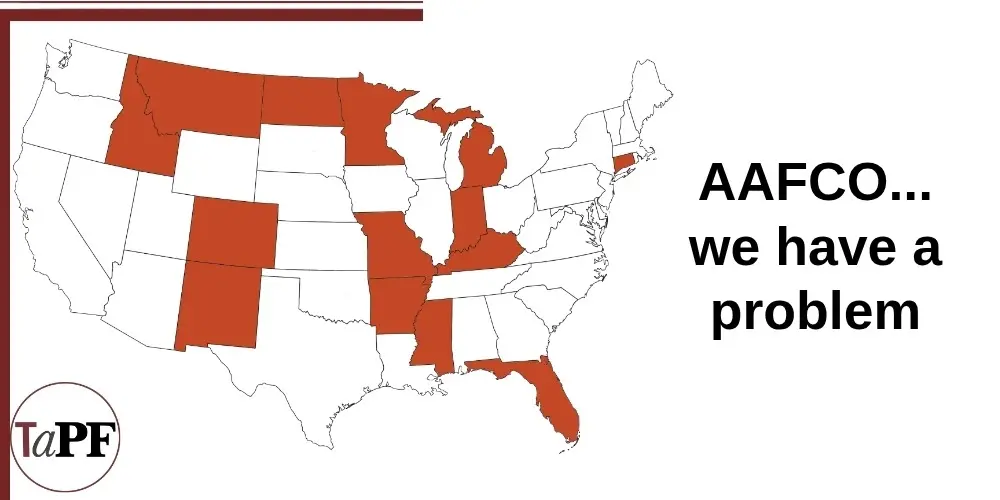
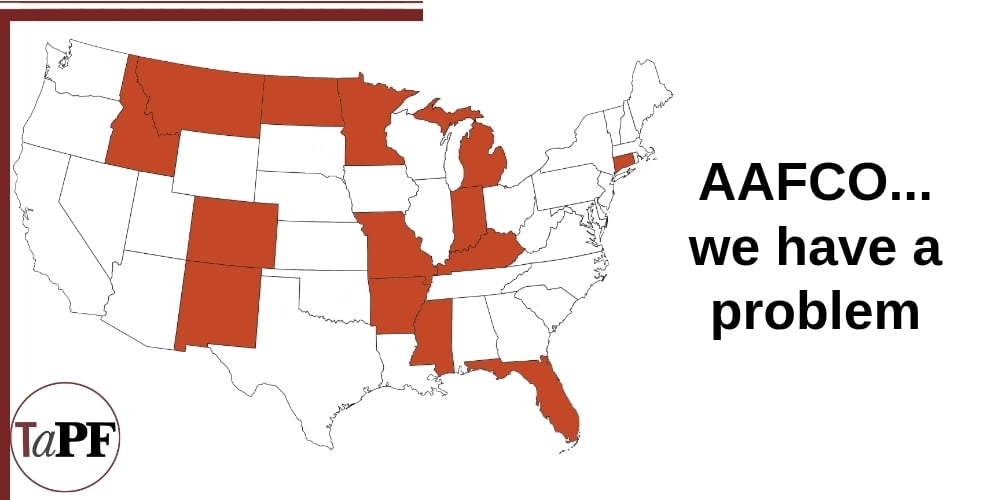
A critical legal vulnerability has emerged across the United States pet food regulatory framework, exposing a major conflict between state statutes and national ingredient definitions. An investigation into feed enforcement laws reveals that fourteen U.S. states maintain explicit statutory prohibitions against the use of non-slaughtered, diseased, or decomposed animal tissues in commercial feed—prohibitions that directly contradict the ingredient definitions established by the Association of American Feed Control Officials (AAFCO).
Because state laws legally supersede administrative guidelines and organizational standards, a judicial challenge in any of these fourteen jurisdictions could render standard AAFCO animal protein definitions legally invalid. Such a outcome would leave widely used ingredients—including poultry by-product meal, meat meal, and animal digest—without legal standing in those states. Consequently, pet food manufacturers could face immediate bans on selling products containing these ingredients across significant portions of the country, triggering a regulatory and economic crisis for the pet food industry.
The fourteen states caught in this legal friction are Arkansas, Colorado, Connecticut, Florida, Idaho, Indiana, Kentucky, Michigan, Minnesota, Mississippi, Missouri, Montana, New Mexico, and North Dakota.
+-----------------------------------------------------------------------------------+
|                        REGULATORY CONFLICT FLOWCHART                             |
+-----------------------------------------------------------------------------------+
|  STATE STATUTES                                    AAFCO INGREDIENT DEFINITIONS   |
|  (e.g., Missouri Sec. 266.180)                     (Model Regulations)            |
|  - Mandatory slaughtered source                     - Lacks explicit slaughter rule |
|  - Strictly forbids diseased/dead tissue            - Permits FDA "enforcement      |
|  - Declares non-slaughtered material                 discretion" exceptions         |
|    "adulterated feed"                              - Allows "suitable for use"    |
+-----------------------------------------------------------------------------------+
                                          |
                                          v
+-----------------------------------------------------------------------------------+
|                             JUDICIAL DISCREPANCY                                  |
|  State Administrative Acts (e.g., MO Sec. 536.014) declare agency regulations     |
|  invalid if they conflict with overarching state statutes.                        |
+-----------------------------------------------------------------------------------+
                                          |
                                          v
+-----------------------------------------------------------------------------------+
|                                POTENTIAL FALLOUT                                  |
|  AAFCO definitions ruled void --> Ingredients lack legal definitions -->          |
|  Commercial feed containing rendered animal by-products banned in up to 14 states |
+-----------------------------------------------------------------------------------+
Detailed Chronology
The Evolution of the Regulatory Gap
For decades, the regulation of pet food in the United States has relied on a complex co-regulatory system. The U.S. Food and Drug Administration (FDA) oversees federal safety standards under the Federal Food, Drug, and Cosmetic Act (FD&C Act), while individual states enforce commercial feed laws within their borders. To ensure consistency across state lines, regulatory agencies rely on AAFCO—a private, non-profit voluntary membership association—to define official feed ingredients and draft model codes.
However, state legislatures have concurrently enacted statutory protections governing commercial feed. Designed to protect agriculture and consumer health, these state-level legislative acts establish strict definitions for feed "adulteration."
The Regulatory Oversight
Over several decades, as AAFCO committees drafted and revised ingredient definitions for rendered animal products, a structural omission took hold. While state statutes explicitly required commercial animal feeds to be derived from humanely slaughtered livestock free of disease and decomposition, AAFCO definitions adopted broader, conditional language.
Despite state agricultural officials actively participating in AAFCO voting procedures, serving on ingredient committees, and holding leadership roles within the organization, state laws were never harmonized with AAFCO’s model definitions. As a result, state regulators routinely voted to adopt and maintain administrative definitions that violated the statutory laws of their own home states.
Formal Advocacy Intervention
The legal gap was formally brought to light by pet food consumer advocate Susan Thixton, founder of TruthaboutPetFood.com and the Association for Truth in Pet Food. Following a legislative analysis of state feed codes, Thixton submitted a formal administrative notice to AAFCO leadership, calling for immediate corrective action to realign ingredient definitions with state statutes before judicial challenges or commercial disruptions occur.
Supporting Context & Metrics
Key Conflict Areas: Missouri Statute Analysis
To understand the legal conflict, consider the statutory structure of Missouri, which mirrors the legal frameworks of the thirteen other affected states.
Under Missouri Revised Statutes Section 266.180 (Adulterated feed, what constitutes):
"A commercial feed shall be deemed to be adulterated: (1) If it is, in whole or in part, the product of a diseased animal or of an animal which dies other than by slaughter which is unsafe within the meaning of section 402(a)(5) of the Federal Food, Drug, and Cosmetic Act…"
Furthermore, the statute clarifies that feed is adulterated:
"If it consists in whole or in part of any filthy, putrid, or decomposed substance, or if it is otherwise unfit for feed."
In contrast, standard AAFCO definitions for animal-derived ingredients do not require the raw material to originate exclusively from slaughtered animals, nor do they explicitly exclude diseased or decomposed tissues within the body of the definition.
Ingredient Name
AAFCO Definition Standard
State Statutory Mandate (14 States)
Core Conflict Area
Poultry By-Product Meal
Lacks mandatory slaughter requirement; relies on general "suitable for use" framing.
Must originate strictly from slaughtered, non-diseased poultry.
Permits potential inclusion of non-slaughtered or dead-on-arrival (DOA) birds.
Poultry By-Products
Does not restrict raw material to non-decomposed, disease-free origin within definition text.
Forbids filthy, putrid, decomposed, or diseased tissue.
Leaves entry open for compromised tissue unless explicitly blocked.
Meat Meal
Omits explicit requirement for slaughter source in primary standard text.
Requires tissue exclusively from slaughtered mammals.
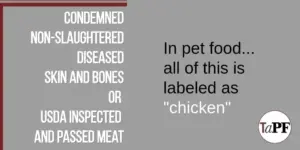
Allows inclusion of 4-D livestock (Dead, Dying, Diseased, Disabled).
Meat & Bone Meal
Uses generic "suitable for use in animal food" conditional phrasing.
Declares any non-slaughtered mammalian tissue adulterated feed.
Relying on FDA enforcement discretion conflicts with state law prohibitions.
Animal By-Product Meal
Fails to mandate disease-free, slaughter-only sourcing.
Strictly prohibits product from animals dying other than by slaughter.
Permits non-slaughtered animal tissues into commercial supply.
Animal Digest
Lacks explicit exclusion of putrid or decomposed raw materials.
Deems feed composed of decomposed or filthy substance adulterated.
Material undergoing chemical breakdown can bypass origin cleanliness standards.
The Administrative Invalidity Clause
The structural problem for the pet food industry lies in state administrative law. When an administrative agency adopts an AAFCO definition that fails to match state statutory standards, the definition becomes legally void.
For example, Missouri Revised Statutes Section 536.014 (Rules invalid, when) explicitly establishes:
"No department, agency, commission or board rule shall be valid in the event that: … (2) The rule is in conflict with state law."
Because AAFCO definitions do not possess standalone legislative power and rely on adoption by state agencies, any definition that permits what state law forbids is invalid. If tested in court, judges in these fourteen states would be bound to invalidate the underlying ingredient definitions.
       STATUTORY COLLISION: AAFCO vs. STATE LAW

  [ State Statutes: 14 States ]            [ AAFCO Ingredient Rules ]
  +--------------------------+            +--------------------------+
  | Mandates Slaughtered     |            | Omits Explicit Slaughter |
  | Animals Only             |            | Mandates                 |
  +--------------------------+            +--------------------------+
                                                      /
                                                     /
                 v                                   v
  +------------------------------------------------------------------+
  |              CONFLICT: Violates State Feed Laws                  |
  +------------------------------------------------------------------+
                                   |
                                   v
  +------------------------------------------------------------------+
  | JUDICIAL OUTCOME: Administrative Rule Declared Void              |
  | CONSEQUENCE: Ingredients Become Legally Undefined & Prohibited   |
  +------------------------------------------------------------------+
The Regulatory Discretion Loophole
AAFCO’s animal product definitions frequently include a qualifying sentence: "It shall be suitable for use in animal food."
Under AAFCO’s glossary, "suitable for use in animal food" is defined as conforming to the Federal Food, Drug, and Cosmetic Act "unless otherwise expressly permitted by the appropriate state or federal agency."
This phrasing relies on FDA "enforcement discretion"—policy guidance documents (such as CPG Sec. 675.400) that allow regulatory agencies to look the other way when rendered ingredients contain tissues from animals that died other than by slaughter.
However, while federal policy offers informal leeway, state statutes do not. A state agency cannot use informal enforcement discretion to override an explicit legislative statute banning adulterated feed. As a result, the regulatory loophole that permits 4-D animals in pet food under federal policy remains illegal under the legislative statutes of these 14 states.
Official Statements
In a formal petition submitted to AAFCO leadership, consumer advocate Susan Thixton detailed the legal contradictions and outlined the systemic liability faced by both state regulators and commercial manufacturers.
Excerpts from the Formal Advocacy Submission to AAFCO:
"Fourteen US states (Arkansas, Colorado, Connecticut, Florida, Idaho, Indiana, Kentucky, Michigan, Minnesota, Mississippi, Missouri, Montana, New Mexico, and North Dakota) have state laws that conflict with AAFCO ingredient definitions commonly used in pet food."
Addressing the core omission regarding animal origin, the petition stated:
"The AAFCO definitions of the following ingredients do not hold the requirement to be sourced from a slaughtered animal, directly in conflict with Missouri state law: Poultry by-product meal, Poultry by-products, Meat meal, Meat and bone meal, Animal by-product meal, Animal Digest. Without the requirement in the AAFCO definition to be sourced from slaughtered animals (as Missouri law requires), ingredient manufacturers are free to source non-slaughtered dead animals in their ingredients."
The filing further challenged the legal validity of agency reliance on regulatory discretion:
"All AAFCO Animal Product definitions commonly used in pet food include the sentence ‘It shall be suitable for use in animal food.’ Suitable for use in animal food is defined as (in part) ‘conforms to the Federal Food, Drug and Cosmetic Act unless otherwise expressly permitted by the appropriate state or federal agency.’ Which means that diseased animals—directly in conflict with Missouri state law—could be ‘permitted’ to be included in Animal Product ingredients."
Highlighting the structural legal vulnerability under State Administrative Procedure Acts, the notice warned:
"If challenged, a Missouri court could easily rule that many AAFCO ingredient definitions are ‘in conflict with state law’ and would be ruled as invalid. All 14 states have similar laws. If challenged in any of the 14 states, courts would more than likely rule many AAFCO ingredient definitions conflict with state law and would invalidate the definitions."
Critiquing the historic lack of regulatory oversight within AAFCO committees, the statement noted:
"It is concerning that many individuals from these 14 states voted to approve these ingredient definitions, participated on the Pet Food and Ingredient Definitions committees and even held high positions within AAFCO knowing their state laws conflicted with the AAFCO definitions—yet no one ever spoke up."
In closing, the advocacy group demanded immediate structural reform:
"We are asking AAFCO to immediately address this issue, before a serious problem for pet food consumers and industry occurs. AAFCO’s Animal Product ingredient definitions SHOULD be aligned with state laws. At the very least, the Animal Product ingredient definitions for the states Arkansas, Colorado, Connecticut, Florida, Idaho, Indiana, Kentucky, Michigan, Minnesota, Mississippi, Missouri, Montana, New Mexico, and North Dakota must be revised to fully align with state laws; include the requirements to be sourced from a slaughtered animal, a disease-free animal, and free from filth and decomposition."
Future Outlook
Legal Exposures and Market Disruption
The structural conflict between state legislation and AAFCO definitions presents significant liability for the pet food industry. If a public interest group, consumer class-action lawsuit, or agricultural stakeholder challenges these ingredient definitions in court, state judges will be required to apply statutory law over administrative regulations.
If a court strikes down AAFCO’s rendered animal product definitions in any of these 14 states, the affected ingredients would instantly lose their legal classification. Without an official, legally sound definition, state Departments of Agriculture would have no statutory authority to register commercial feed products containing those items. Manufacturers would be faced with three options:
Reformulate products across all national supply networks to eliminate rendered by-product meals.
Restrict Distribution, withdrawing brands containing these ingredients from market channels across the 14 affected states.
Source Exclusively Slaughtered Material, auditing supply chains to guarantee that all animal proteins derive strictly from humanely slaughtered, non-diseased livestock.
Systemic Reform Requirements
To resolve this regulatory exposure, AAFCO and state regulators must execute systemic reforms.
Definition Amendments: The AAFCO Ingredient Definitions Committee must amend all animal product standards to explicitly require that raw materials originate strictly from slaughtered animals, remain free from decomposition, and contain no diseased tissues.
Removal of Discretion Phrases: The conditional phrase "unless otherwise expressly permitted by the appropriate state or federal agency" must be removed from animal protein standards to close regulatory loopholes that violate state laws.
Harmonization Across Jurisdictions: State feed control officials in all 14 jurisdictions must review their administrative regulations to ensure their state’s adoption of model feed rules complies with local legislative acts.
Until these adjustments are made, commercial pet food distribution across a significant portion of the United States rests on a fragile administrative framework—one that remains vulnerable to immediate legal challenge.