
BOONE, Iowa — The age-old, labor-intensive practice of hay and forage baling has officially entered the 21st century. Agricultural machinery giant John Deere has announced the commercial rollout of its cutting-edge hands-free baling technology, a sophisticated integration of precision agriculture systems designed to drastically simplify operations, reduce operator fatigue, and drive bottom-line savings for farmers worldwide.
By harmonizing autonomous tractor guidance with advanced baler automation, the company is bridging the gap between traditional fieldwork and high-tech digital farming. As modern agricultural operations face mounting economic pressures, tighter profit margins, and a persistent shortage of skilled farm labor, innovations like hands-free baling are transforming how producers approach everyday field tasks.
Executive Overview: A Paradigm Shift in Forage Harvesting
For generations, baling hay has demanded relentless attention from operators. Precision steering, managing ground speed, monitoring bale chamber density, and executing precise headland turns require constant cognitive and physical exertion. A single misstep can result in uneven windrows, poorly formed bales, wasted crop material, and unnecessary fuel consumption.
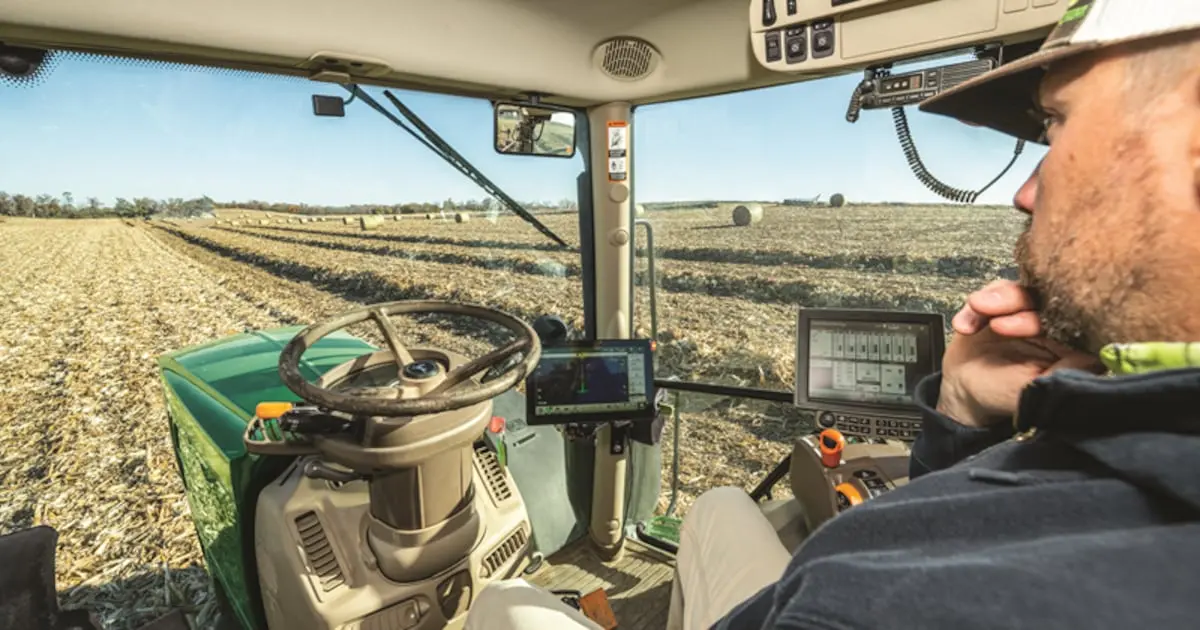
John Deere’s new hands-free baling capability fundamentally alters this dynamic. Engineered for compatibility with John Deere 1 Series round balers paired with precision-enabled 6R, 7R, and even high-horsepower 8R tractors, the technology automates the entire harvesting cycle. The tractor takes over steering, speed control, windrow tracking, and weave management, allowing the operator to transition from an active driver to a high-level system supervisor.
Field testing and company data reveal impressive efficiency gains. Operations utilizing the hands-free suite have documented an 8.4% improvement in overall productivity—measured in bales per hour—and a 4.4% boost in fuel efficiency, quantified in tons per gallon. Furthermore, routine operator interventions, such as manual steering inputs and console management, are slashed by up to 76%.
As the agricultural sector prepares to showcase its latest innovations at the upcoming 2026 Farm Progress Show in Boone, Iowa, John Deere’s hands-free baling solution stands out as a defining milestone in the ongoing evolution of automated crop management.
Detailed Mechanics: How John Deere’s Automation Suite Works
The magic behind hands-free baling is not a standalone feature, but rather the seamless convergence of several established and newly refined John Deere technology stacks. To achieve true autonomy in the hayfield, the system relies on a tightly integrated ecosystem of hardware and software working in real time.
1. AutoTrac Guidance and Turn Automation
At the foundation of the technology is John Deere’s industry-standard AutoTrac guidance system, paired with AutoTrac Turn Automation. Once a field is mapped, the tractor autonomously follows established windrows with centimeter-level precision. When reaching the end of a row, AutoTrac Turn Automation takes over the steering wheel, executing repeatable, highly efficient headland turns without requiring operator input. Notably, the system can even leverage pre-existing guidance lines generated during previous crop passes—such as those created during the prior corn or wheat harvest seasons—streamlining setup times significantly.
2. Integrated Gate, Speed, and Weave Automation
While guidance keeps the tractor on path, baler automation manages the physical mechanics of crop intake and packaging. Gate automation manages the ejection cycle, while speed and weave automation dynamically adjust the tractor’s forward velocity and path across the windrow. By actively weaving the tractor back and forth over the swath, the system ensures that crop material is distributed evenly across the full width of the pickup. This uniform distribution is the secret to building consistently shaped, tightly packed bales every single time.
3. Data Visibility and Documentation via Operations Center
Every bale produced under the hands-free regime is logged digitally. Through the John Deere Operations Center, farm managers gain instant data visibility and documentation. Moisture levels, weight estimates, bale counts, and spatial yield maps are transmitted seamlessly to the cloud. This provides agronomists and farm owners with a comprehensive digital footprint of their forage operations, facilitating better inventory management, tracking field performance over time, and supporting traceability for livestock feed quality.
Supporting Context & Metrics: Quantifying the Return on Investment
In modern agriculture, technology must justify its cost through measurable efficiency gains. John Deere’s rigorous field trials of the hands-free baling system have yielded concrete performance metrics that speak directly to a farm’s profitability and long-term sustainability.
Productivity and Density Gains
The reported 8.4% increase in bales per hour is not merely a product of driving faster; rather, it is driven by superior bale density consistency.
"The bales per hour part of it is largely due to density. So, you’re using this automation and doing it consistently every time," explained Kaylene Ballesteros, who oversees the go-to-market strategy for hay and forage at John Deere, in an interview with AgNavigator.
When an experienced operator is fatigued at the end of a long 14-hour harvest day, bale density can fluctuate. In contrast, automated weave and pressure control ensure that every bale achieves optimal compaction. Tighter, more uniform bales mean fewer total units are required to harvest the same tonnage of hay.
Fuel Efficiency and Labor Relief
Fewer total trips across the field, combined with optimized engine-load management through automated speed control, yield the documented 4.4% improvement in fuel efficiency. Over the course of a massive forage harvest, small percentage gains in diesel conservation compound into substantial financial savings.
Equally compelling is the human element: the reduction of operator input by up to 76%. Farming operations are increasingly strained by labor shortages, often forcing producers to rely on seasonal, novice, or less-skilled operators during peak harvest windows.
"If you have somebody in the seat that maybe isn’t as skilled, a more novice operator, the fact that they have a consistent bale every time means that they’re packing a tighter bale in one bale," Ballesteros noted. "So, you ultimately have less bales, which means you are being more productive from a fuel efficiency standpoint."
Official Insights: Perspectives from Industry Leadership
The introduction of hands-free baling arrives at a pivotal moment for agricultural equipment manufacturers. Precision agriculture is shifting from a luxury add-on to a core requirement for commercial farm viability.
Industry analysts point out that reducing screen time and physical steering demands fundamentally changes the operator experience. Instead of white-knuckling a steering wheel and constantly adjusting tractor throttles while monitoring a baler monitor, the operator’s role shifts to supervision and strategic oversight.
"That either means you’re able to take a breath and think about something else, or whether that’s what you’re doing later tonight, or you’re able to think about other things on your operation that need to be done," Ballesteros said, emphasizing the psychological and operational benefits of reduced cognitive load. "And so, being able to have that strong reduction in screen time essentially is really valuable too. It’s just a different way to experience that return on investment."
This sentiment aligns closely with John Deere’s broader corporate trajectory. The launch of hands-free baling follows closely on the heels of the company’s fiscal third-quarter 2026 financial results, which highlighted robust adoption rates for digital farming technologies even as traditional large-ag equipment sales experienced cyclical market normalization. Deere’s ongoing refinements to its pioneering See & Spray technology and advanced planter suites underscore a company-wide commitment to autonomous crop production systems.
Future Outlook: The Road Ahead for Autonomous Forage Harvesting
As agriculture looks toward the horizon, the boundaries between row-crop automation and forage harvesting continue to blur. Historically, advanced autonomy—such as fully autonomous tillage and planting—has focused heavily on large-scale grain production. Bringing sophisticated automation down to the forage and hay sector signals a democratization of precision ag tools for livestock producers, dairy operations, and commercial hay growers.
The debut of the model year 2027 equipment lineup—featuring hands-free baling capabilities—will be a centerpiece of John Deere’s exhibition at the upcoming 2026 Farm Progress Show, taking place September 1–3 in Boone, Iowa. Thousands of growers, dealers, and agricultural tech enthusiasts are expected to examine the machinery firsthand, test the software interfaces, and evaluate how the technology can integrate into their existing equipment fleets.
Looking further ahead, industry experts anticipate that hands-free baling is merely a stepping stone toward even greater levels of farm autonomy. As sensor resolution improves, artificial intelligence models become more adept at processing edge-case scenarios, and rural connectivity expands via satellite and 5G networks, the vision of a completely unattended tractor pulling a baler through a rolling pasture moves closer to reality.
For today’s farmers, however, the immediate promise is compelling enough: reduced fatigue, lower fuel consumption, consistent crop quality, and the ability to reclaim peace of mind during the most grueling weeks of the harvest season.