
Executive Overview
Deep within the hyper-arid coastal desert of northern Peru, a team of international archaeologists has unearthed a remarkable biological and cultural treasure: physical evidence of Peruvian hairless dogs dating back more than 1,200 years. Long predating the rise of the expansive Inca Empire, these ancient canines walked the dusty administrative avenues of Castillo de Huarmey, a sprawling 110-acre complex once governed by the influential Wari Empire.
The breakthrough discovery, recently detailed in the Journal of Anthropological Archaeology, rests upon an unusual alliance of zooarchaeological detective work and genetic science. By analyzing naturally mummified remains, distinctive skeletal anomalies, and chemical isotopes preserved in ancient teeth and bone, researchers have opened a window into the nuanced, sometimes contradictory relationships that ancient Andean societies maintained with their animals.
Far from being treated as a monolithic category of beast, these hairless canines occupied a complex social landscape. Some were interred with high-status individuals—such as an elite craftsperson and a sacrificed tomb guardian—while others were discovered among discarded debris. Furthermore, chemical analyses indicate that these dogs shared dietary habits with humans, consuming diets rich in maize, with young puppies receiving care that hints at early, organized breeding practices. This comprehensive investigation underscores how human-animal relationships over a millennium ago mirror the multifaceted, affectionate, yet utilitarian dynamics observed in modern households today.
Detailed Chronology & Archaeological Excavations
The journey to uncovering these ancient canines spans decades of meticulous excavation, shifting political landscapes, and moments of accidental exposure followed by methodical scientific salvage.
The Setting: Castillo de Huarmey
Situated approximately 190 miles north of Lima, Castillo de Huarmey served as a vital administrative, religious, and burial center for the Wari Empire between 600 and 1050 CE. This timeline places the site roughly four centuries before the Inca Empire consolidated its power across the Andean region. Because the complex is located in one of the driest stretches of Peru’s Pacific coast, its extreme aridity has acted as a natural preservation chamber. Fragile organic materials that normally vanish in archaeological contexts—including human hair, textiles, animal skin, leather, pigments, and decorated ceramics—have endured the centuries remarkably well.
A History of Monumental Discoveries
Castillo de Huarmey has long been recognized as a site of profound historical importance, though its secrets have been hard-won:
- The 1970 Earthquake and Subsequent Looting: A devastating earthquake in 1970 caused portions of the archaeological complex to collapse, inadvertently exposing ancient burial chambers laden with valuable artifacts. This structural failure triggered extensive illegal looting, which severely disturbed the upper stratigraphy of the site and mixed various historical layers.
- The 2012 Elite Tomb Breakthrough: Archaeologists stunned the academic world by uncovering the first completely undisturbed elite Wari tomb. This chamber held the remains of 58 high-status women, six human sacrifices, and approximately 1,300 luxury artifacts crafted from gold, silver, bronze, and precious stones.
- The 2022 Craftsperson Burials: Researchers identified adjacent burial sites belonging to elite craftspeople. These individuals were interred alongside specialized tools fashioned from precious metals, illuminating the sophisticated industrial and artistic infrastructure of the Wari state.
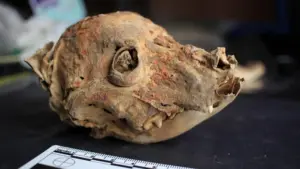
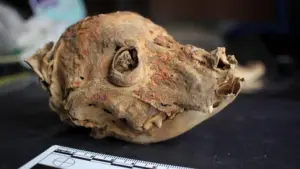
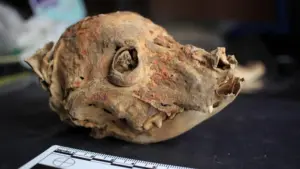
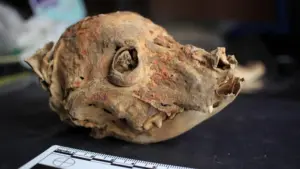
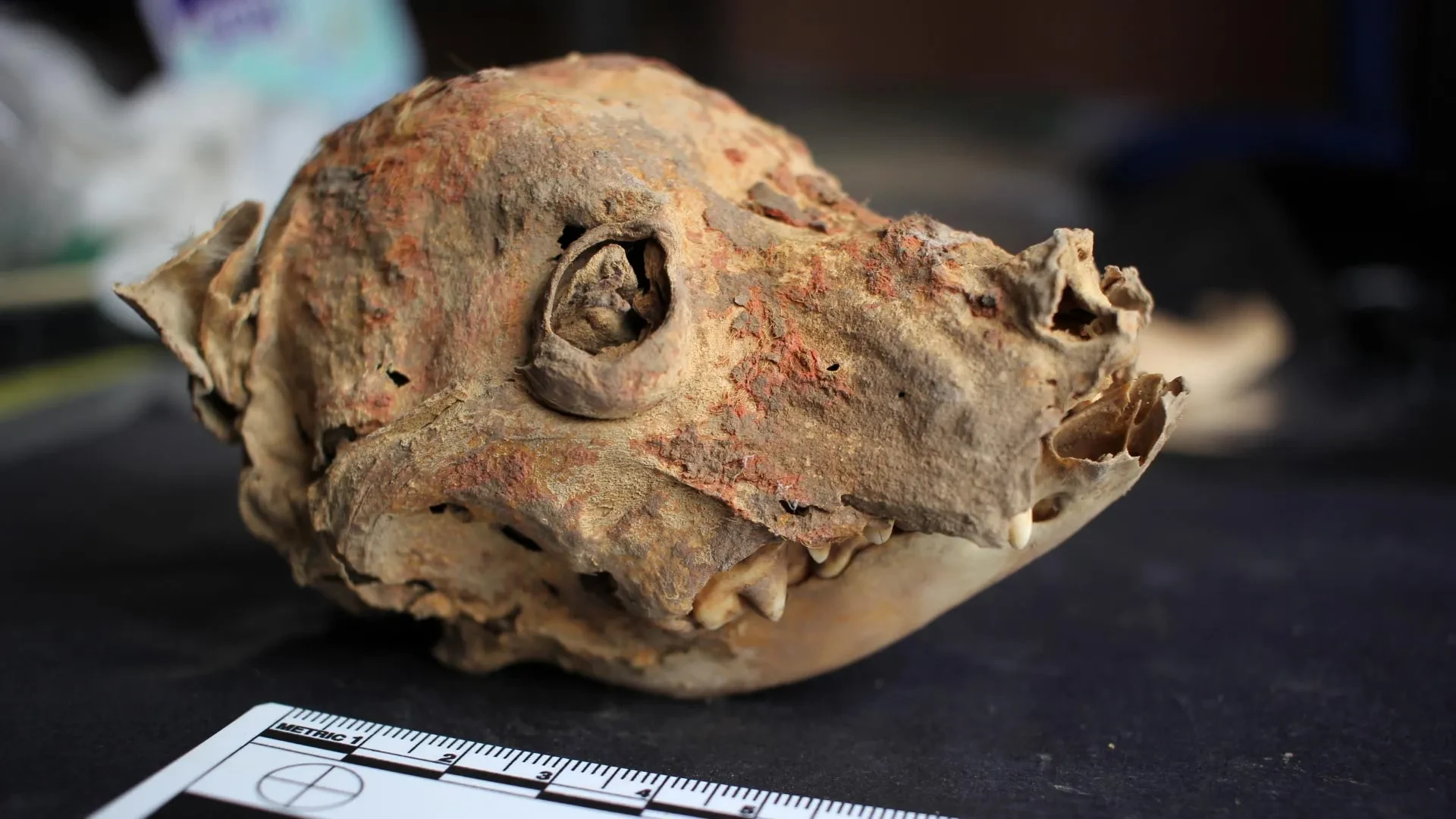
- The 2010–2025 Canine Excavations: Deep in the northern section of the main ceremonial area—beneath the disturbed upper layers—archaeologists systematically explored undisturbed strata. Here, they recovered 341 individual dog bone specimens representing at least 19 distinct canines, alongside an exceptionally preserved mummified male dog. Radiocarbon dating confirmed this mummified specimen to be at least 1,200 years old, establishing it as the oldest radiocarbon-dated biological sample retrieved from the site to date.
Supporting Context & Metrics: Genetics, Diets, and Burial Contexts
The identification of the dogs as Peruvian hairless—a distinctive Indigenous breed characterized by slender builds, alert pointed ears, and a lack of fur—relied on a combination of anatomical anomalies and advanced biochemical assays.
The Genetic Signature: Missing Teeth
At first glance, researchers operating in the upper, disturbed layers of Castillo de Huarmey questioned whether some of the animal remains were relatively modern intruders. However, lead analysts observed two unmistakable traits: the skin samples were entirely hairless, and the skulls consistently lacked specific teeth.
Rather than suffering from periodontal disease, physical trauma, or old age, the dogs had never developed their first premolars and, in some instances, their last molars. Genetic research confirmed that the precise mutation responsible for canine hairlessness is directly linked to hypodontia (a reduced number of teeth). This biological marker confirmed that the remains belonged to ancient Peruvian hairless dogs, linking them directly to the iconography frequently depicted on coastal Andean pottery and modern descendants such as the Peruvian Inca Orchid.
Isotopic Analysis: Reconstructing Ancient Diets
To understand how these animals lived, the research team employed zooarchaeological techniques alongside stable isotope analysis. By examining isotopes of carbon, nitrogen, oxygen, and strontium extracted from bones and teeth, scientists traced the geographic origins and dietary inputs of the canines:
- Teeth vs. Bone Timelines: Because dog teeth erupt rapidly during puppyhood, tooth enamel records the chemical signature of early life. Bone tissue, by contrast, undergoes continuous remodeling, reflecting the animal’s diet and environment over the final year of its life.
- Maize Consumption: Isotopic results revealed that the majority of the dogs consumed diets heavily reliant on maize (corn), matching the primary agricultural staple of the human population at Castillo de Huarmey.
- Puppy Diets and Organized Breeding: An intriguing anomaly appeared in the isotopic signatures of dogs identified as hairless. During puppyhood, their diets closely mirrored those of human children, transitioning to a more varied nutritional intake as they matured. This divergence suggests that young hairless puppies may have received targeted care, special provisions, or controlled feeding within domestic or breeding environments.
Contextualizing the Burials
The archaeological context of the canine remains demonstrates a sharp divergence in how animals were perceived and handled within Wari society:
- Elite Associations: A puppy aged just six to eight weeks was discovered buried directly alongside an elite craftsperson known as the "Master Basketmaker." Another puppy skeleton was interred with a male individual (designated as XY) interpreted as a sacrificed tomb guardian. An adult dog was recovered directly within the structural confines of the site’s primary palace.
- Everyday Discards: Conversely, other dog bones were recovered from general refuse areas, indicating that while some animals held ceremonial or high-status value, others were treated as mundane waste. Notably, very few bones exhibited butchery marks, proving that canine consumption for food was exceedingly rare at the site.
Official Statements and Academic Insights
The complexities of interpreting human-animal relationships across a millennium of history formed a central pillar of the research team’s commentary.
Weronika Tomczyk, a research associate in Dartmouth’s Department of Anthropology and a postdoctoral fellow in its Ecology, Evolution, Environment and Society Program, as well as the study’s first author, noted the profound challenge of ascribing emotional intent to ancient archaeological strata:
"Our findings indicate that humans and dogs coexisted at this Wari site, but reconstructing their bond is challenging, as past emotions are difficult to capture through archaeological methods. The goal of our study was to not only present data on Castillo de Huarmey’s dog burials, but also emphasize that people in the past had often contradictory relationships with the animals, just as they do today: a pet for one group of people could at the same time be considered a pest by their closest neighbors."
Commenting on the genetic and anatomical identification of the breed through dental anomalies, Tomczyk explained:
"What I noticed is that some of the dog skeletons were missing teeth, and not that they lost them during their lifespan; some teeth, especially first premolars and sometimes last molars, had just never erupted. And then I found in the literature that the same gene which is responsible for hairlessness in dogs is responsible for a reduced number of teeth, indicating that these were Peruvian hairless dogs."
Addressing the dietary signatures of the young hairless canines, Tomczyk added:
"We do not know if the dogs were intentionally fed maize or if perhaps, they were just eating leftovers or trash. Yet, the distinct dietary patterns of hairless puppies provide insights into what may have been organized breeding."
Summarizing the broader implications of the differential burial treatments observed across the Castillo de Huarmey complex, Tomczyk concluded:
"While we will never know if any of the three dogs were pets or how people treated them, it is evident they received different treatment than other dogs."
The collaborative international study also featured contributions from co-authors Miłosz Giersz, Wiesław Więckowski, and Roberto Pimentel Nita of the University of Warsaw, alongside Claire Ebert of the University of Pittsburgh. Together, their multidisciplinary approach bridged the gap between biological anthropology, chemistry, and classical archaeology.
Future Outlook
The identification of 1,200-year-old Peruvian hairless dogs at Castillo de Huarmey marks a significant milestone in Andean archaeology, but it also opens critical avenues for future investigation.
As researchers continue to process the extensive bone assemblages and ceramic shards recovered from the northern ceremonial sectors, upcoming analytical phases will likely focus on:
- Ancient DNA (aDNA) Extraction: Future genetic sequencing aims to map the precise lineage of these pre-Inca hairless dogs, tracking how genetic traits have persisted or shifted across Andean populations over millennia.
- Broader Regional Comparisons: By contrasting isotopic and burial data from Castillo de Huarmey with other contemporary and later coastal sites, researchers hope to determine whether organized breeding programs for hairless dogs were widespread throughout the Wari Empire or localized to specific administrative hubs.
- Refining Chronological Frameworks: The successful radiocarbon dating of the mummified male dog provides a reliable benchmark for synchronizing the site’s biological remains with architectural phases, helping historians paint a clearer picture of urban life in pre-Hispanic Peru.
Ultimately, these findings challenge modern observers to look past simplistic binaries of ancient animal use. By demonstrating that ancient humans cherished, discarded, bred, and buried hairless dogs in remarkably diverse ways, the Castillo de Huarmey discoveries reveal that the complex, emotionally rich bond between humanity and its canine companions is an ancient, enduring heritage.