
Executive Overview
GARNER, NC — As the crisp winds of autumn begin to sweep down from the northern latitudes, the skies above North Carolina are bracing for one of nature’s most majestic and perilous spectacles: the annual fall songbird migration. Millions of avian travelers—ranging from the delicate Yellow-rumped Warbler to the hardy White-throated Sparrow—will soon embark on arduous journeys spanning hundreds, and sometimes thousands, of miles. Their destination: the rich, welcoming habitats of the American South and Central and South America, where they will spend the winter months.
However, this vital seasonal transit takes place against an increasingly hazardous backdrop. As these nocturnal voyagers navigate the night skies, relying on the ancient cues of the moon and stars, they are increasingly intercepted by a modern, man-made phenomenon: artificial light at night (ALAN). Glowing skylines, illuminated corporate campuses, and even residential porch lights cast an artificial brilliance that disorients migrating flocks, luring them off course and drawing them perilously close to human infrastructure.
In response to this escalating ecological crisis, Audubon North Carolina has officially issued its flagship autumn call to action. Conservationists, scientists, and community advocates are urging homeowners, renters, and commercial property managers across the state to participate in the "Lights Out" initiative by turning off all unnecessary outdoor lighting from dusk until dawn, now through November 30.
This campaign is not merely a localized recommendation; it is part of a growing, nationwide movement designed to mitigate a staggering conservation crisis. Recent landmark research confirms that building collisions claim the lives of more than one billion birds annually in the United States alone. While towering skyscrapers in major metropolitan centers often capture public attention, conservation experts emphasize that residential homes and low-rise commercial structures—by virtue of their sheer abundance and widespread geographic distribution—account for a massive share of these fatal impacts.
Through coordinated advocacy, municipal partnerships, and grassroots mobilization, Audubon North Carolina is proving that individual choices can collectively turn the tide for migratory populations. From Asheville to Wilmington, communities are stepping up to dim their lights, offering safe passage to the nocturnal wanderers that enrich our ecosystems and inspire our communities.
Detailed Chronology: The Fall Migration and the Nighttime Sky
To understand the urgency of the Lights Out campaign, one must first look to the biological clock that dictates the lives of North America’s migratory species. The transition from summer breeding grounds to winter habitats is a complex, finely tuned process orchestrated by changing photoperiods, shifting temperatures, and an innate genetic program.
The Nocturnal Flight Strategy
By late summer and early autumn, forests, wetlands, and backyards across Canada and the northern United States experience a quiet exodus. An overwhelming majority of North American landbirds—including warblers, sparrows, thrushes, vireos, and flycatchers—migrate exclusively at night.
This nocturnal flying strategy offers several distinct evolutionary advantages:
- Thermal Efficiency: Nighttime temperatures are cooler, reducing the risk of overheating and dehydration during intense physical exertion.
- Predator Avoidance: Flying under the cover of darkness minimizes the threat of aerial predators, such as hawks and falcons.
- Atmospheric Stability: The air at night is generally less turbulent, allowing for smoother, more energy-efficient flight paths.
To navigate these immense distances in the dark, birds rely heavily on celestial cues, orienting themselves using the polarization of light at sunset, the position of the setting sun, and the patterns of constellations. Some species are also equipped with cryptochromes—specialized proteins in their eyes that allow them to sense the Earth’s geomagnetic field, acting as a biological compass.
The Urban Trap: How Artificial Light Disrupts Nature
When these nocturnal navigators encounter heavily illuminated human environments, their ancient guidance systems fail catastrophically. The glow of urban centers, highway interchanges, floodlit sports complexes, and residential security lights creates "skyglow" and direct glare that blinds and confuses migrating flocks.
Attracted to light in a phenomenon known as positive phototaxis, disoriented birds are drawn away from their natural flight paths and pulled directly into the built environment. Trapped within a disorienting dome of artificial illumination, they expend precious metabolic energy circling light sources until they are utterly exhausted.
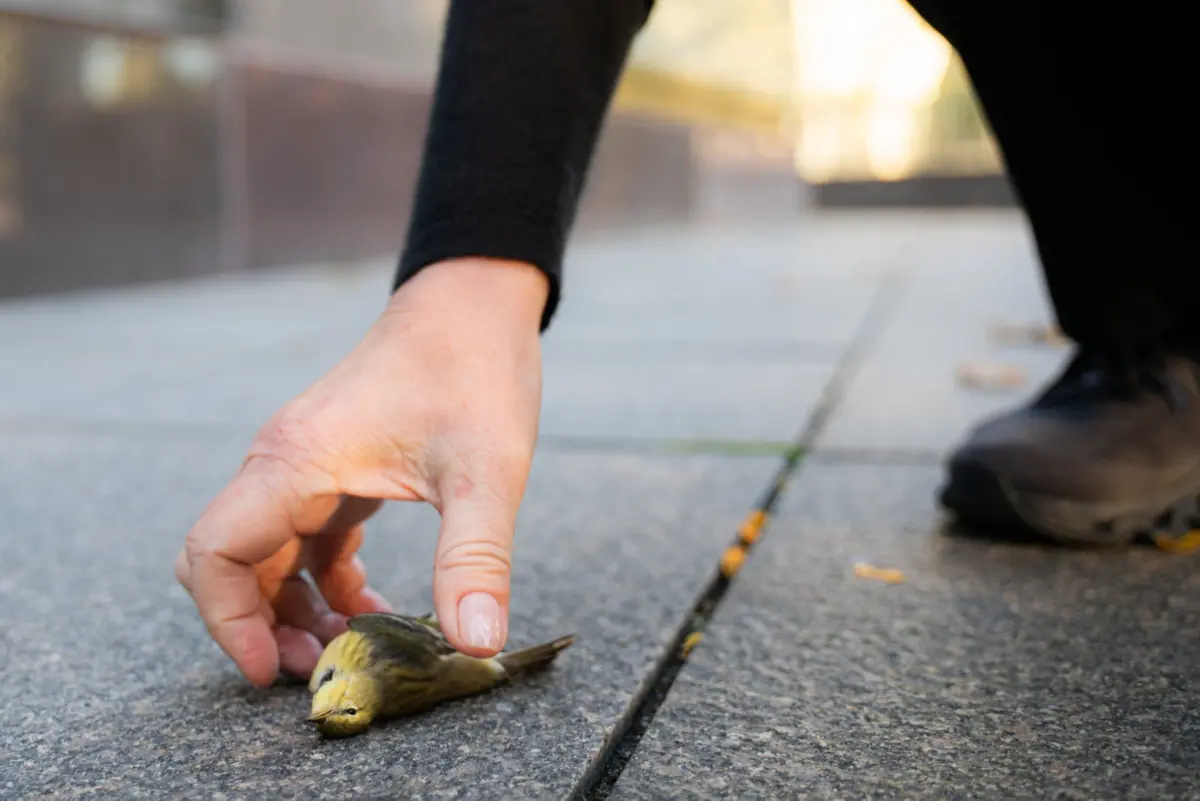
Once exhausted, these birds are forced to forage or rest in unfamiliar, highly urbanized or suburban settings rife with secondary hazards: free-roaming domestic cats, speeding vehicular traffic, and, most lethally, transparent and reflective architectural glass. Unable to perceive glass as a solid barrier—particularly when interior lights shine through windows or exterior vegetation is reflected in pane surfaces—birds strike structures at high speeds, resulting in trauma, injury, or death.
Supporting Context & Metrics: The Scale of the Crisis
The toll of artificial light and building collisions on bird populations is not a matter of anecdotal observation; it is a quantified, peer-reviewed conservation emergency.
The Billion-Bird Toll
A comprehensive, multi-year scientific study published by conservation biologists and research institutions revealed that more than one billion birds are killed annually in the U.S. through building collisions. This staggering figure underscores that glass and artificial light represent one of the leading direct anthropogenic (human-caused) threats to avian wildlife, rivaling habitat loss and feral cat predation.
While massive commercial towers with continuous overnight illumination present concentrated hazards during peak migration nights, researchers have uncovered a nuanced and sobering reality about where these collisions occur:
- High-Rise Buildings: Though responsible for massive mortality events when weather conditions ground migrating flocks into city centers, high-rises account for a smaller percentage of overall deaths due to their comparative scarcity.
- Low-Rise Buildings (4–11 stories): These structures strike a balance between height and frequency, causing a substantial number of collisions, particularly when surrounded by landscaped vegetation that reflects in their windows.
- Residential and Small Structures (1–3 stories): Representing the vast majority of buildings across the American landscape, residential homes, apartment complexes, and low-rise suburban offices account for the vast majority of total annual bird-building collisions.
Because residential properties are ubiquitous, the cumulative impact of an unshielded porch light, a decorative yard lamp, or an all-night garage floodlight across millions of neighborhoods creates a vast, fragmented web of deadly hazards for migrating birds.
Ecosystem Impacts of Declining Bird Populations
The loss of over a billion birds annually is not merely an aesthetic or moral tragedy; it carries profound ecological consequences. Birds play irreplaceable roles in maintaining healthy, functional ecosystems:
- Pest Control: Insectivorous species, such as the Yellow-bellied Sapsucker and various warbler species, consume staggering quantities of agricultural pests and forest insects, naturally regulating populations that might otherwise devastate crops and timberlands.
- Seed Dispersal and Pollination: Many fruit-eating and nectar-feeding birds are vital agents in plant reproduction, ensuring the genetic diversity and regeneration of forests and native flora.
- Bioindicators: Because birds are sensitive to environmental shifts, their population health serves as a primary barometer for the overall vitality of our environment, signaling broader ecological degradation long before it impacts human communities.
Official Statements and Grassroots Action
Recognizing that systemic change requires both top-down policy and bottom-up community engagement, Audubon North Carolina has worked tirelessly to build a statewide network of active "Lights Out" programs.
Municipal Mobilization Across North Carolina
Thanks to relentless advocacy by local Audubon chapters and dedicated conservationists, towns and cities throughout the Tar Heel State have formally embraced Lights Out initiatives. Municipalities with active programs now include:
- Asheville
- Cary
- Chapel Hill
- Durham
- Charlotte
- Cumberland County
- Greensboro
- Matthews
- Raleigh
- Winston-Salem
These programs encourage municipal buildings to dim non-essential exterior and interior architectural lighting during peak migration windows, setting a powerful leadership example for private businesses and residential communities alike.
Practical Steps: What Property Owners and Individuals Can Do
The beauty of the Lights Out movement lies in its accessibility. Unlike complex habitat restoration projects or massive infrastructural overhauls, protecting migrating birds requires actions that are immediately within the reach of everyday citizens. Audubon North Carolina outlines several high-impact steps that homeowners, renters, and business operators can implement today:
- Turn Off Unnecessary Outdoor Lights: Extinguish all decorative, architectural, and landscape lighting from dusk until dawn, particularly during peak migration months (September 1 through November 30).
- Install Motion Sensors and Timers: If outdoor lighting is required for security or safety, equip fixtures with motion detectors or automated timers so they are only illuminated when activity is detected.
- Use Smart Shielding: Direct outdoor light downward toward the ground rather than allowing it to project outward into the night sky or horizontally across the landscape.
- Draw Blinds and Curtains: For urban and suburban residents alike, closing window coverings at night prevents interior lights from escaping and disorienting passing birds.
- Retrofit Windows: Apply bird-friendly window treatments—such as external UV-patterned films, fritted glass, or exterior screens—to make reflective and transparent glass visible to avian eyes.
"Every spring and fall we make one of our biggest calls to action—turn off unnecessary outdoor lights at night for migrating birds," notes the leadership team at Audubon North Carolina. "As fall migration brings greater bird traffic to our area, join the growing Lights Out movement. Individuals don’t have to do this work alone."
Residents wishing to get involved are encouraged to connect with their local Audubon chapters to learn about community-specific initiatives, volunteer opportunities, and educational workshops. Furthermore, advocates can leverage the official social media toolkit provided by conservation networks to raise awareness, share collision-prevention tips, and encourage neighbors to take the Lights Out pledge.
Future Outlook: A Brighter Future Through Darkness
As the scientific community continues to refine its understanding of how artificial light interacts with wildlife, the conservation landscape is shifting toward proactive, preventative urban planning and architectural design.
The success of the Lights Out movement demonstrates that humanity can coexist harmoniously with the natural world without sacrificing public safety or urban vitality. By simply flipping a switch, dimming a floodlight, or drawing a blind, citizens can dramatically alter the survival odds for billions of wild animals.
Looking ahead, the momentum generated by Audubon North Carolina and its partners points toward a broader cultural appreciation for the nocturnal environment. Beyond protecting migratory birds, reducing artificial light at night yields co-benefits that align with modern sustainability goals: significant energy conservation, lowered carbon emissions, reduced light pollution, and the restoration of our nocturnal skies for astronomical observation and human psychological well-being.
As millions of wings beat steadily through the autumn darkness in the weeks ahead, every darkened window and extinguished porch light represents a beacon of hope. By embracing the ethos of Lights Out, North Carolinians are ensuring that the ancient, vital rhythm of bird migration endures for generations to come—proving that sometimes, the most profound contribution we can make to the natural world is to simply step back, turn off the lights, and let nature find its way home.
About Audubon North Carolina & The National Audubon Society
- Audubon North Carolina, a state program of the National Audubon Society, operates dedicated regional offices in Durham, Boone, Corolla, and Wilmington. For more information, updates, and resources, visit nc.audubon.org or follow their outreach channels on Twitter, Facebook, and Instagram.
- The National Audubon Society has been a dedicated nonprofit conservation organization since 1905, protecting birds and the habitats they require across the Americas using science, policy advocacy, environmental education, and on-the-ground conservation. Learn more at audubon.org and across social media platforms @audubonsociety.