
Executive Overview
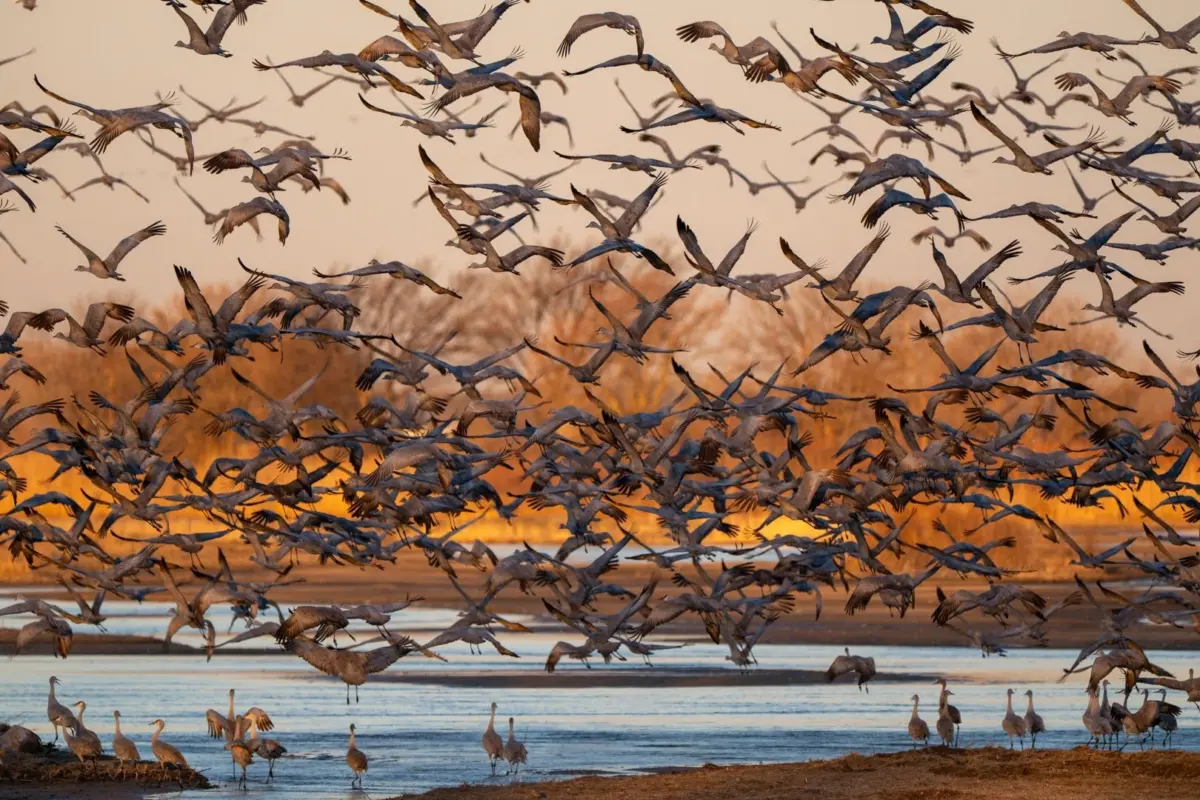
For more than half a century, the Iain Nicolson Audubon Center at Rowe Sanctuary has operated under a singular, deeply focused North Star: "Dedicated to the conservation of Sandhill Cranes, Whooping Cranes and other migratory birds and their habitat along the Platte River." Nestled in the heart of Central Nebraska, the sanctuary is an irreplaceable ecological crossroads. Every spring, the shallow, braided channels of the Platte River play host to one of the greatest wildlife spectacles on the planet: the staging of hundreds of thousands of Sandhill Cranes and millions of waterfowl preparing for their northern migrations, alongside the rare, haunting presence of endangered Whooping Cranes.
Yet, conservation in the 21st century cannot rely on local passion alone. The threats facing migratory birds—ranging from accelerating climate change and habitat fragmentation to shifting agricultural practices and land-use pressures—are vast, systemic, and interconnected. To confront these challenges head-on, Rowe Sanctuary has unveiled a comprehensive new strategic plan for 2025–2030.
This newly minted blueprint bridges the gap between grassroots sanctuary management and the National Audubon Society’s overarching hemispheric strategy, known simply as the Flight Plan. The ultimate objective of this ambitious framework is to "bend the bird curve"—a rallying cry to halt and reverse the dramatic, alarming declines in North American bird populations documented since 1970. By translating four core pillars—Habitat Conservation, Climate Action, Policy, and Community Building—into hyper-local, boots-on-the-ground actions along the Platte River, Rowe Sanctuary is ensuring that its next fifty years are just as impactful as its first.
Detailed Chronology: Evolving Strategy Along the Platte
The Foundations of Stewardship (1970s–Early 2000s)
To understand the significance of Rowe Sanctuary’s modern strategic direction, one must look back at its origins. Established in the decades following the environmental awakening of the 1970s, the sanctuary was born out of an urgent need to protect the central flyway corridor of the Central Platte River Valley. Early efforts were largely reactive and acquisition-focused: securing riverfront acreage, clearing invasive woody vegetation from river channels to maintain the wide, open roosting sightlines that cranes require for safety, and establishing basic public access points for education and viewing.
Throughout the late 20th century, the sanctuary grew as a trusted regional voice, managing wet meadows, restoring native grasslands, and building public awareness around the economic and ecological value of the Platte River ecosystem. However, as external pressures—such as water diversion, upstream development, and changing climate baselines—intensified, staff and leadership recognized that ad-hoc conservation would no longer suffice.
The Hemispheric Pivot: The Birth of Audubon’s "Flight Plan"
As ecological monitoring data revealed staggering losses across North American bird populations—with a net loss of nearly three billion birds over the last half-century—the National Audubon Society underwent a massive organizational realignment. The result was the Flight Plan, a bold strategic roadmap designed to unite Audubon’s vast network of chapters, centers, and sanctuaries across North, Central, and South America.
The Flight Plan shifted the organization from isolated, site-specific conservation toward coordinated, landscape-scale impact. It established that local sanctuaries could no longer view their boundaries as ecological islands. Instead, a sanctuary in Nebraska must actively contribute to hemispheric flyway health, connecting breeding grounds in the Arctic and Canada to wintering grounds in the Southern United States and Latin America.
The 2025–2030 Local Integration
In late 2025, recognizing the urgent need to operationalize the Flight Plan at the regional level, Rowe Sanctuary’s staff and stewardship board members embarked on an intensive internal review and planning process. Over several months, they audited past successes, evaluated emerging ecological threats, and systematically aligned their local priorities with the four core pillars of the national Flight Plan.
The resulting strategic plan—now finalized and active—serves as both a philosophical compass and a practical work plan. It explicitly connects daily operational tasks, such as spring river clearing and educational tour scheduling, to macro-level climate and biodiversity goals.
Supporting Context & Metrics: The Four Pillars in Action
Rowe Sanctuary’s strategic plan is structured around four core operational areas, each designed to address distinct facets of conservation along the Platte River.
1. Habitat Conservation
The bedrock of Rowe Sanctuary’s existence is the physical landscape of the Platte River Valley. Under the updated strategic framework, habitat conservation is defined not just by land ownership, but by active ecological management and proactive community guidance.
- River Maintenance for Crane Season: Every spring, millions of visitors—both avian and human—converge on the Platte. To accommodate Sandhill Cranes, which rely on unobstructed views to detect predators while roosting in the river shallows, staff execute rigorous habitat maintenance. This involves mechanical removal of invasive trees (such as eastern red cedar and cottonwood) that choke the river channels, ensuring a wide, unvegetated watercourse.
- Agricultural and Grassland Integration: Habitat loss in Nebraska is frequently driven by intensive land-use changes. Rowe Sanctuary’s strategic plan incorporates a proactive outreach mandate to "provide guidance and assistance to local communities on how to support native wildlife in agricultural fields, grasslands, and public/private property." A prime example of this is the sanctuary’s recent work offering science-based guidance on local county regulations, ensuring that zoning and development decisions respect the ecological thresholds of the valley.
2. Climate Action
Climate change is altering the timing and availability of vital resources across the Central Flyway. Droughts reduce spring water flows in the Platte, while shifting weather patterns disorient migratory species. Rowe Sanctuary’s strategic plan integrates climate resilience by focusing on water resource advocacy, the restoration of resilient wet meadows that can absorb extreme precipitation events, and the promotion of regenerative agricultural practices that lock carbon into the soil while preserving avian foraging grounds.
3. Policy
Conservation cannot succeed solely within the fence lines of a sanctuary. Public policy dictates water allocation, land development, and environmental protections across the entire Platte River basin. Rowe Sanctuary leverages its scientific expertise and decades of community trust to engage with local, county, and state policymakers. By providing transparent data and participating in watershed planning, the sanctuary ensures that the ecological needs of migratory birds are represented in legislative and administrative decisions.
4. Community Building
No conservation strategy can endure without the deep-seated support of the local community. For generations, Rowe Sanctuary has been a cultural and economic anchor for Central Nebraska, drawing tens of thousands of eco-tourists, bird enthusiasts, and researchers to the region every spring.
The strategic plan treats community building not as an ancillary public relations exercise, but as a core conservation strategy. By hosting world-class crane viewing experiences, offering comprehensive K-12 and adult educational programs, and partnering with local landowners, Rowe fosters a culture of shared stewardship. When local residents view the Platte River not just as a resource, but as a living natural heritage, the long-term security of the sanctuary is immensely strengthened.
Official Statements and Institutional Vision
The integration of local stewardship with hemispheric ambition marks a maturing of Rowe Sanctuary’s institutional identity. In internal briefings and public releases accompanying the launch of the 2025–2030 strategic plan, sanctuary leadership emphasized the dynamic, living nature of the document.
"Our strategic plan serves as a guidepost, helping us focus our limited resources and attention where they can make the greatest difference," notes the sanctuary’s leadership team. "It is both a practical tool and a source of inspiration, connecting the work we do each day to a larger vision for birds and the habitats they depend on."
This sentiment is echoed throughout the National Audubon Society. The transition from static mission statements to dynamic, adaptive frameworks represents a philosophical evolution across the organization. Rather than viewing conservation as a defensive holding action against encroaching threats, Audubon’s leadership frames the Flight Plan—and by extension, Rowe’s localized iteration—as an offensive strategy for ecological restoration.
Furthermore, the sanctuary’s stewardship board stresses that the plan is designed to be highly responsive. In an era defined by rapid environmental and socio-economic shifts, a rigid conservation plan is a failing plan. By mandating regular staff engagement and formal annual updates based on measurable accomplishments and emerging hurdles, Rowe Sanctuary ensures that its strategies remain agile, relevant, and effective.
Future Outlook: The Platte River as a Lifeline of Wonder
As Rowe Sanctuary looks toward the horizon, the challenges facing the Central Flyway are undeniable. Increasing demands on Great Plains water supplies, pressures from commercial and residential development, and the cascading impacts of a warming climate pose ongoing tests to the resilience of the Platte River ecosystem.
Yet, the implementation of the 2025–2030 strategic plan provides a clear, actionable pathway forward. By anchoring every daily task—whether it is clearing a sandbar for roosting cranes, advising a county zoning board on wildlife-friendly land use, or welcoming a wide-eyed student to their first blind-viewing session—to the overarching hemispheric goals of the Flight Plan, Rowe Sanctuary is future-proofing its operations.
The ultimate vision of this work is profound yet simple: a future where the Platte River remains a roaring, vibrant lifeline for millions of migratory birds, and an enduring place of natural wonder for generations of Nebraskans and global visitors alike. Through disciplined planning, community collaboration, and an unwavering commitment to the birds that define its legacy, Rowe Sanctuary is well-equipped to guide the path forward for the next fifty years and beyond.
For those interested in exploring the framework in full detail, the complete Rowe Sanctuary Strategic Plan (2025–2030) is publicly available through the Audubon Media Library.