
Executive Overview
In an unusual convergence of urban geography, workplace pet policies, and unintended opportunism, an accounting firm operating in a metropolitan business center inadvertently operated as an informal, single-client canine day lodge for nearly two years. The incident—which began when a dog owner mistook the dog-friendly corporate suite for a commercial pet care facility located directly across the street—highlights growing trends in corporate wellness, urban pet-care economics, and the psychological impact of animals in professional environments.
What started as a single afternoon of mistaken identity evolved into a mutually beneficial arrangement. The office staff, largely populated by dog lovers who were personally unable to keep pets due to residential lease restrictions, gained an honorary workplace companion. Meanwhile, the dog’s owner secured specialized, low-stress care for her pet at a fraction of standard commercial rates.
This report provides a detailed narrative and structural analysis of the event, examining the operational conditions that allowed the confusion to persist, the economic factors at play, and the broader implications for workplace culture and pet care logistics.
Detailed Chronology of Events
+-----------------------------------------------------------------------------------+
|                               TIMELINE OF EVENTS                                  |
+-----------------------------------------------------------------------------------+
|  [Phase 1] Initial Drop-off  --> Frantic owner mistakes office for daycare.       |
|                                  Leaves Basset Hound ("Otis") with junior staff.  |
|                                                                                   |
|  [Phase 2] The First

 Transaction --> Owner returns; employee charges impromptu    |
|                                      $20 rate rather than correcting mistake.     |
|                                                                                   |
|  [Phase 3] Regular Integration --> Otis attends 2–4 days/week for months;         |
|                                    featured in corporate Christmas card.          |
|                                                                                   |
|  [Phase 4] The Discovery     --> Owner spots Otis in client's Christmas card;     |
|                                  confronts staff about true nature of facility.   |
|                                                                                   |
|  [Phase 5] Amicable Agreement --> Owner realizes value of $20 one-on-one care;   |
|                                  arrangement continues for 2 years until move.    |
+-----------------------------------------------------------------------------------+
The Initial Misunderstanding
The operational setting was an open-plan corporate suite housing a professional firm (an accounting and business services group). To foster employee satisfaction, management had implemented a permissive "dogs-at-work" policy. Staff members frequently brought their personal pets to the office. As a result, the entrance area featured typical pet infrastructure: water stations, food bowls, and dog beds positioned near the front reception desk.
Directly across the street sat a commercial dog daycare facility. The proximity of the two establishments, combined with similar exterior visual cues—such as visible animals roaming near open floor plan windows—created the conditions for a misdirection.
The primary narrator of the event, an entry-level employee at the firm, was the sole team member without a pet, restricted by an apartment lease that strictly prohibited animals.
On a busy weekday morning, a client-facing area of the office was entered by a frantic local resident accompanying a large Basset Hound named Otis. Operating under severe time constraints and assuming she had entered the commercial daycare facility across the street, the owner approached the desk.

- Owner’s Inquiry: She asked whether the facility accepted unscheduled "walk-in" clients, noting that phone calls to the facility had gone unanswered.
- Employee’s Assumption: The junior employee assumed the visitor was an associate or personal client of one of the firm’s executives who had prior clearance to bring a pet.
- The Hand-Off: The owner provided a supply of dog food, indicated she would return in several hours, and departed before administrative personnel could clarify the nature of the business.
Upon introducing the dog to the rest of the floor, the employee discovered that no one in the firm owned the animal or had scheduled a meeting with the visitor.
+-----------------------------------------------------------------------------+
|                     OFFICE VS. DAYCARE: VISUAL CONFUSION                    |
+-----------------------------------------------------------------------------+
|  COMMERCIAL DAYCARE (Across Street)  |  CORPORATE SUITE (The Office)        |
|  ----------------------------------  |  ----------------------------        |
|  • High density of animals           |  • Open floor plan with 3-5 pets     |
|  • High noise/barking levels         |  • Low noise, quiet desk environments|
|  • Standard daily care rates ($45+)  |  • Bowls/beds by entry foyer         |
|  • Busy phone lines/booking system   |  • Unanswered external calls         |
+-----------------------------------------------------------------------------+
The Financial Transaction and Prolonged Deception
When the owner returned at the conclusion of the business day, she expressed relief at the dog’s calm demeanor, noting that commercial kennels often reported that Otis suffered from severe socialization anxiety in high-density environments.
Observing the low number of dogs present on the office floor, she remarked on the facility’s low-capacity model and requested an invoice for the day’s services.
Facing an awkward disclosure, the entry-level staff member made a split-second decision. Driven by a combination of reluctance to admit the misunderstanding, a desire to be compensated for the impromptu caretaking duties performed during working hours, and an affection for the animal, the employee cited an arbitrary rate of $20.00 per day.
The owner accepted the rate immediately, paid cash, and left. Neither party corrected the fundamental misunderstanding.
Integration into Corporate Culture
Over the following weeks and months, the informal arrangement escalated. The owner began dropping Otis off two to four times per week. The corporate staff fully integrated the Basset Hound into daily office routine:
- Caretaking Assignments: Staff managed feeding schedules, supervised outdoor breaks, and mitigated routine maintenance issues (such as drool management).
- Social Integration: Otis became a fixture for visiting delivery personnel, clients, and corporate partners.
- Marketing Involvement: During the company’s annual holiday marketing campaign, the team photographed their regular workplace dogs for the official corporate Christmas card. Otis was included in the photoshoot, wearing a festive hat alongside the staff’s pets.
+-----------------------------------------------------------------------------+
|                        OTIS'S DAILY OFFICE ROUTINE                          |
+-----------------------------------------------------------------------------+
|  08:30 AM  | Drop-off by owner; greeting at reception desk.                 |
|  10:00 AM  | Morning floor walk; interaction with delivery personnel.       |
|  12:00 PM  | Scheduled feeding & outdoor break managed by junior staff.    |
|  02:00 PM  | Rest period on office dog bed; low-stress ambient environment.|
|  04:00 PM  | Pick-up by owner; $20 cash transfer completed.                 |
+-----------------------------------------------------------------------------+
The Discovery
The arrangement unraveled through an external networking connection. The dog owner happened to be a personal acquaintance of one of the firm’s major corporate clients. While visiting the client’s residence, she noticed the firm’s corporate holiday card displayed on the mantel.
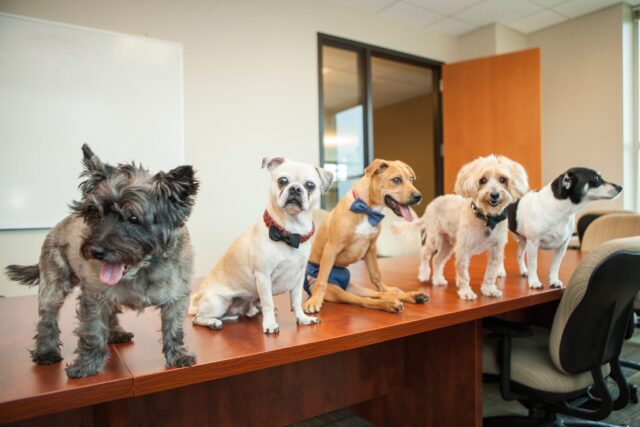
Recognizing her own dog featured prominently in the promotional material, she connected the business name on the card with the location where she had been dropping off her dog.
Shortly thereafter, the owner entered the office during a non-peak hour—without her usual morning rush—holding the holiday card.
She confronted the junior staff member, pointing out the incongruity of her dog appearing on the firm’s official correspondence and asking directly whether the establishment was, in fact, an accounting firm rather than a registered pet daycare facility.
Resolution and Long-Term Outcome
Faced with direct evidence, the employee admitted the entire sequence of events:
- Confessing that the facility was a standard corporate office.
- Explaining that the lack of pet ownership options in their apartment complex had driven the desire to host Otis.
- Reassuring the owner that the dog had received dedicated, one-on-one attention throughout every visit.
Rather than taking legal action, demanding a refund, or escalating the matter to senior management, the owner evaluated the functional outcome of the arrangement. Realizing that her anxious dog had received high-tier, low-density care for $20 per day—substantially below market rates for individual pet supervision—she opted to maintain the setup.
The informal arrangement continued for nearly two years until the owner relocated to a different city.
Supporting Context & Industry Metrics
To understand how this situation persisted for nearly 24 months without regulatory or administrative intervention, it is necessary to examine the surrounding economic and cultural metrics of urban pet care and workplace amenities.

Commercial Pet Daycare Economics vs. Informal Office Care
In major metropolitan areas, commercial pet care facilities operate under strict density ratios and high overhead costs, which dictate their pricing structures and care models.
| Metric / Parameter | Commercial Pet Daycare Facility | The Informal Office Setup |
|---|---|---|
| Average Daily Rate | $45.00 – $75.00 / day | $20.00 / day (Flat Rate) |
| Staff-to-Dog Ratio | 1:15 to 1:25 | 1:1 (Dedicated staff member) |
| Environmental Noise Level | High (75–90 dB ambient bark volume) | Low (Standard office ambient sound) |
| Stress Factors for Anxious Dogs | High (Constant interaction/pack dynamics) | Low (Dedicated resting areas, low stimulation) |
| Administrative Overhead | Licensing, liability insurance, facility rent | Zero (Absorbed by existing corporate budget) |
Workplace Satisfaction and Pet Policies
The incident underscores a growing body of organizational research regarding animals in the workplace. Studies in human resource management indicate that pet-friendly workplace policies correlate with specific operational metrics:
- Stress Reduction: Cortisol levels among employees in dog-friendly offices show measurable declines during peak work shifts compared to non-pet-friendly environments.
- Employee Retention: Access to pets in the office—even for non-owners—serves as a non-monetary perk that boosts morale, particularly for younger employees facing urban housing restrictions that prohibit pet ownership.
- Social Cohesion: Animals act as "social catalysts," increasing cross-departmental communication and informal problem-solving among staff members.
IMPACT OF WORKPLACE PET INTEGRATION ON EMPLOYEE METRICS
[Baseline Office Environment] vs. [Pet-Integrated Office Environment]

Employee Morale:      [==========          ] 52%  -->  [==================  ] 88%
Cross-Dept Interaction:[========            ] 41%  -->  [=================   ] 84%
Reported Work Stress: [=================   ] 78%  -->  [=========           ] 43%
Official Statements and Narrative Accounts
The narrative, originally documented by the involved employee on public forums, offers direct insight into the perspectives of both primary parties during critical junctures of the event.
The Initial Transaction Account
Reflecting on the first day’s exchange when the owner returned to collect the dog, the employee documented the internal dilemma regarding whether to correct the misunderstanding:
"At the end of the day, the woman came back and said, ‘Thanks, you’re a lifesaver. How was he?’ I said he was a champ, and was about to ask why he was dropped off when she added, ‘That’s a relief. Most kennels say he gets anxious around other dogs. I heard you operated at a much higher capacity, but I was thrilled to see so few clients in the room.’ That’s when I realized she thought we were a dog daycare.
I probably should have corrected her right then. But I loved my day with the dog, and I felt I deserved compensation for supervising him all day. I threw out a number that sounded fair: ‘$20.’ She accepted immediately, and I realized this was going to become a larger story."
The Christmas Card Confrontation
Describing the moment the owner uncovered the true nature of the business through a corporate Christmas card:

"She came in holding our company holiday card, walked straight to my desk, and asked: ‘Is that my dog in this photo? This isn’t a dog daycare at all—this is just an office, isn’t it?’
She wasn’t yelling, but she was piecing it together for the first time because she wasn’t in her usual morning rush. I had to explain everything. I was terrified she’d sue or demand her money back. But after I explained that I wasn’t allowed to have dogs in my apartment and just loved having Otis around, she paused, looked at the clock, and said: ‘Well, I wish you’d said something sooner. Could’ve saved me some embarrassment with my friend. Anyway, I have to go—see you at 4:00.’"
Future Outlook & Implications
While this case represents an extraordinary breach of standard operational protocols, it highlights several emerging themes in urban infrastructure, corporate policy, and informal labor markets.
1. The Blurring of Corporate and Residential Amenities
As corporate spaces evolve to attract talent, the physical layout of modern offices increasingly mirrors residential or service-oriented environments. Open floor plans, lounge seating, and pet-friendly amenities can easily obscure the functional line between a corporate office and a boutique service enterprise. Architecture and urban planning must account for these overlapping visual cues in dense commercial districts.
2. Micro-Economy of Informal Caregiving
The event demonstrates a latent demand for low-density, low-stress pet care. Commercial daycares often cater to high-volume socialization, which is unsuited for older or anxious animals. The success of this accidental arrangement suggests a potential market for "quiet-care" environments—where pets sit quietly in low-activity office environments rather than high-energy play yards.
+-----------------------------------------------------------------------------+
|                          LESSONS FOR CORPORATE POLICY                       |
+-----------------------------------------------------------------------------+
|  1. Clear Signage & Reception Controls                                      |
|     Offices with open-door policies require clear front-desk signage to     |
|     prevent public misinterpretation of services.                           |
|                                                                             |
|  2. Liability and Risk Management                                           |
|     Unregistered animals present legal liabilities regarding injuries or    |
|     property damage; informal arrangements must be managed by policy.       |
|                                                                             |
|  3. Leveraging Pet Amenities for Morale                                     |
|     Allowing non-pet owners to co-parent or care for office animals can     |
|     substantially improve workplace satisfaction for apartment-renters.     |
+-----------------------------------------------------------------------------+
Conclusion
What began as an embarrassing operational mix-up ultimately served the interests of all parties involved. The owner secured affordable, high-attention care for an anxious animal; the entry-level employee fulfilled a personal desire for animal companionship without violating lease terms; and the dog enjoyed two years of dedicated care and corporate socialization.
Though unlikely to be adopted as a standard business model due to liability constraints, the case of Otis the Basset Hound remains a notable example of how informal workplace adaptations can turn an administrative error into a long-term corporate asset.