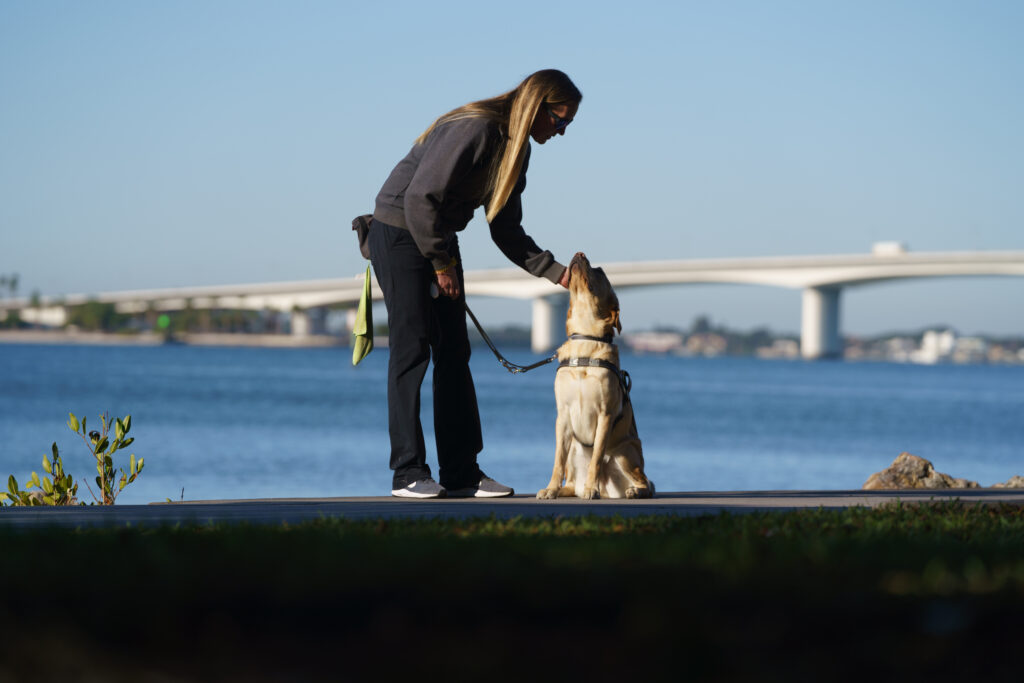
To the average commuter, a bustling airport terminal or a packed metropolitan restaurant is a sensory gauntlet—a chaotic symphony of rolling luggage, overhead announcements, clattering dishware, and unpredictable crowds. For most people, navigating these environments requires focus and patience. For individuals living with disabilities, moving through these spaces independently can feel entirely out of reach.
Enter the modern service dog: a canine professional navigating the world with unwavering confidence, laser-like focus, and profound poise.
However, the striking composure observed in a working service dog in public is far from accidental. It is the culmination of years of deliberate breeding, meticulous early-childhood socialization, rigorous task-specific education, and comprehensive public access training. While task training equips a dog with the mechanical skills required to mitigate a specific disability—such as retrieving dropped items, providing physical balance, or offering deep pressure therapy during a panic attack—public access training governs behavior. It dictates how an animal must conduct itself in complex, high-distraction human environments.
Under the legal framework of the Americans with Disabilities Act (ADA), a service animal must be individually trained to perform specific tasks directly related to a person’s disability. A dog’s mere presence or the provision of generalized emotional comfort does not meet this threshold. To cross the bridge from pet to working professional, a candidate must pass through a gauntlet of real-world simulations, distraction-proofing exercises, and psychological evaluations.
This comprehensive report explores the multifaceted world of public access training. It examines why environments like airports and restaurants pose unique challenges, how trainers systematically build canine resilience through positive reinforcement, and how the foundational efforts of puppy raisers shape the next generation of life-changing partnerships.
Detailed Chronology: From Neonate to Working Professional
The journey of a service dog spans years, moving through meticulously structured developmental phases designed to mold a playful puppy into a reliable, focused working partner.
Phase 1: Early Infancy and Foundational Socialization (Months 0–6)
Long before a dog ever steps foot inside a commercial airliner or a bustling shopping center, the groundwork for public confidence is laid during early puppyhood. Breeds historically renowned for their balanced temperaments, intelligence, and work ethic—most notably Labrador Retrievers and Golden Retrievers—dominate the service dog landscape.
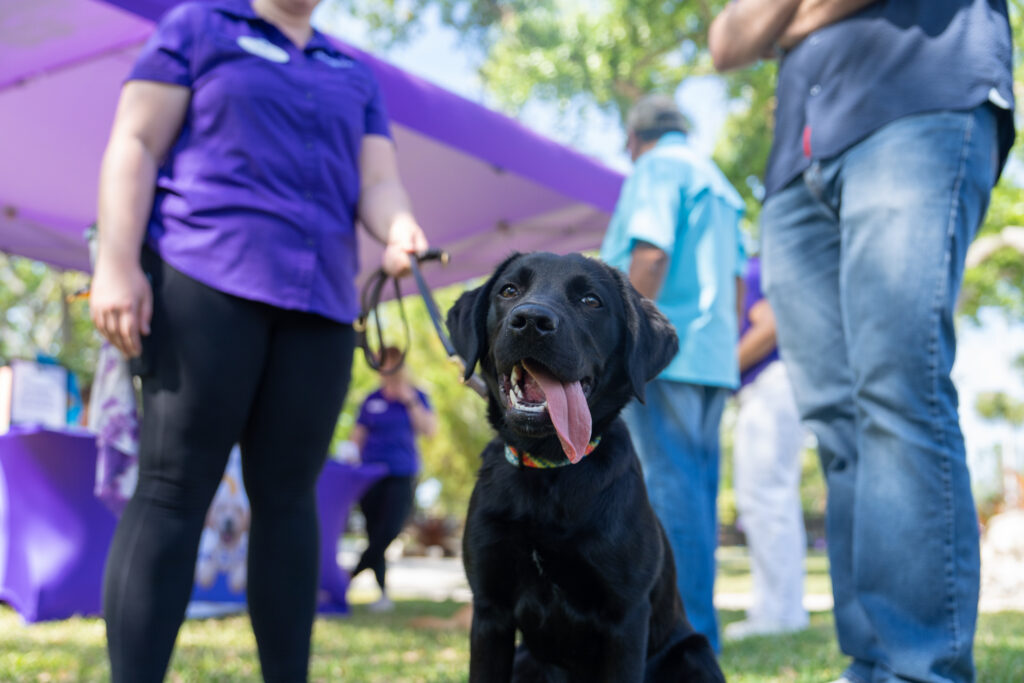
During the first few months of life, puppy raisers introduce these future canines to novel sights, sounds, textures, and surfaces. Puppies encounter novel experiences ranging from the hum of a household vacuum to walking across metal grates, slick tile floors, and uneven pavement. This stage focuses heavily on positive exposure rather than obedience, ensuring the puppy develops a curious, resilient mindset rather than a fearful one.
Phase 2: Adolescent Public Exposure and Basic Manners (Months 6–12)
As the puppy matures into adolescence, the training scope expands outward into the community. Under the guidance of professional instructors and dedicated volunteer raisers, dogs begin visiting pet-friendly stores, quiet parks, office buildings, and outdoor shopping plazas.
During this phase, basic obedience commands—such as sit, stay, down, and heel—are generalized beyond the controlled environment of a training facility. Instructors introduce mild distractions, teaching the young dog that paying attention to its handler is more rewarding than investigating a stray scent or watching a passing skateboard.
Phase 3: Advanced Public Access Training (Months 12–18+)
Once foundational obedience and environmental stability are established, candidates enter advanced public access training. This is where the curriculum pivots toward high-stimulus environments. Dogs are systematically exposed to challenging locations that simulate the realities of modern public accommodations:
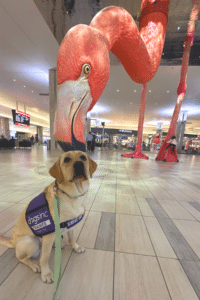
Airports: Navigating security checkpoints, sliding walkways, moving crowds, and echoing PA announcements.
Restaurants: Sifting through rich food odors, managing tight spaces under tables, and remaining completely composed while surrounded by dining patrons.
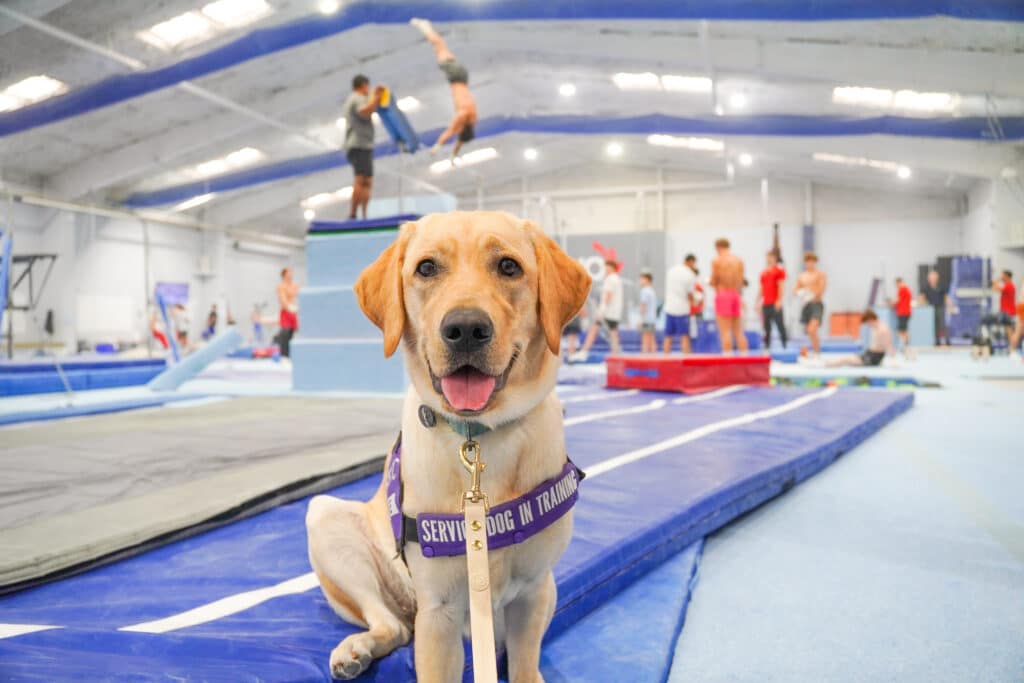
Crowded Public Venues: Traversing festivals, transit hubs, and commercial centers filled with children, shopping carts, and unexpected noises.
Throughout this stage, distraction training intensifies. Instructors intentionally stage distractions—such as dropping food on the floor or having another dog walk closely past—to test and refine the candidate’s impulse control.
Phase 4: Rigorous Evaluation and Placement
Before any dog is certified and matched with an individual with a disability, it must undergo comprehensive evaluations administered by senior training staff. Assessors test the dog’s focus, reliability, emotional stability, and public decorum across varied, unpredictable scenarios.
Once a candidate passes these exhaustive benchmarks, it is paired with a recipient. The duo undergoes specialized team training to ensure seamless communication, cementing a partnership built on mutual trust, operational synergy, and lifelong service.
Supporting Context & Metrics: The Science of Canine Resilience
Understanding the complexity of public access training requires examining the psychological principles that govern canine learning and behavior.
The Psychology of Distraction-Proofing
A successful service dog operates under a psychological framework known as stimulus discrimination and habituation. In simple terms, habituation is the diminishing of a physiological or behavioral response to a frequently repeated, harmless stimulus. When a service dog hears a fire alarm, a screeching subway train, or a dropped tray in a restaurant for the hundredth time, its nervous system recognizes the event as non-threatening.
Distraction-proofing leverages positive reinforcement to actively redirect the dog’s attention back to the handler when novel stimuli arise. Rather than using fear or punishment—which can induce anxiety and compromise a working dog’s reliability—modern training organizations rely entirely on reward-based markers. If a child drops a snack near a service dog-in-training, the dog is rewarded heavily for choosing to ignore the food and maintain eye contact with its handler.
Behavioral Demands Across Common Environments
Different public spaces test different facets of a service dog’s psychological endurance:
Environment
Primary Stimuli / Challenges
Core Skill Required
Airports & Transit Hubs
Rolling luggage, security lines, metallic noises, tight queues
Down-stay endurance, impulse control around food, calm resting posture
Retail & Shopping Centers
Moving crowds, shopping carts, children running, sliding doors
Steadfast focus, adaptability, avoidance of startle responses
Medical Facilities
Alarms, sterile odors, emotional human distress
Emotional resilience, calm compliance during medical emergencies
The Vital Importance of the "Settle"
While mobility support and medical alert tasks often capture public attention, one of the most physically demanding skills a service dog performs is the "settle." In many daily scenarios, a service dog’s job is simply to wait quietly for extended periods.
Whether resting beneath a restaurant table during a two-hour business meeting, sitting patiently in a medical waiting room, or accompanying a traveler on a cross-country flight, the dog must maintain a relaxed, unobtrusive posture. A dog that cannot settle comfortably is a liability; a dog that masters the settle becomes an invisible, stabilizing presence that enables its handler to participate fully in public life.
Official Statements and Industry Insights
The standardization and ethical execution of service dog training are matters of significant focus within the assistance animal community. Experts emphasize that public access training is as much about human education as it is about canine instruction.
"Public access training is not merely about teaching a dog to walk past a distraction without reacting," explains a senior curriculum director at a prominent service dog organization. "It is about building an unbreakable psychological anchor between the dog and its handler. When a person steps into a chaotic environment, their service dog acts as a calming buffer, filtering out the sensory noise of the world so the human can focus on living their life."
Industry leaders also emphasize the critical distinction between legal definitions under the ADA and public misconceptions surrounding emotional support animals (ESAs). While ESAs provide comfort through presence alone, they lack public access rights under federal law because they do not undergo rigorous task and public behavior training.
"The public often conflates pets, emotional support animals, and fully trained service dogs," notes an accessibility compliance advocate. "When an untrained animal is brought into a grocery store or restaurant under the guise of being a service dog, it threatens public safety, undermines the credibility of legitimate working teams, and creates hazardous conditions for disabled individuals who rely on operational animals."
Organizations stress that protecting the integrity of public access training relies heavily on community understanding, rigorous internal evaluation protocols, and a commitment to positive reinforcement methodologies that prioritize canine welfare alongside performance standards.
Future Outlook: The Evolution of Access, Technology, and Training
As society evolves, so too does the landscape of service dog training. Looking toward the future, trainers, researchers, and disability advocates are anticipating several key shifts in how service dogs are prepared for public life.
1. Adaptation to Modern Urban Infrastructures
Modern cities are changing rapidly, introducing new sensory challenges for working dogs. The proliferation of quiet electric vehicles, autonomous delivery robots, micro-mobility scooters (such as e-scooters left on sidewalks), and complex public transit networks means service dogs must be proofed against entirely novel stimuli. Training curricula are continuously updating to include exposures to these modern urban hurdles, ensuring canine partners remain unfazed by the changing technological footprint of our cities.
2. Technological Integration in Training Analytics
Forward-thinking training facilities are beginning to explore data-driven approaches to monitor puppy development and training progression. By utilizing wearable biometric monitors during high-stress environment simulations (such as airport visits), trainers can measure heart rate variability and cortisol responses in dogs-in-training. This data allows instructors to identify subtle signs of canine stress long before they manifest as behavioral issues, ensuring that training remains strictly within the bounds of positive, low-stress methodologies.
3. Expanding Access and Public Awareness Campaigns
Despite federal legal protections, handlers of legitimate service dogs frequently encounter illegal access denials and public friction due to widespread misunderstanding of the law. Future initiatives within the assistance animal community place a heavy emphasis on public education campaigns. By demystifying the intensive training process—showing the public the countless hours of airport drills, restaurant settling exercises, and distraction-proofing—organizations hope to foster greater empathy, awareness, and respect for working teams.
Conclusion
The remarkable composure displayed by a service dog walking through a crowded airport terminal or resting quietly beneath a restaurant table is the final product of an extraordinary journey. It is a journey built upon early socialization, relentless real-world practice, expert coaching by dedicated volunteers and professional instructors, and an unwavering commitment to positive reinforcement.
For the individuals whose independence, safety, and daily mobility depend on these remarkable animals, public access training represents far more than obedience—it represents an open door to a world that might otherwise remain closed. As breeding, training, and educational standards continue to advance, the bond between humans and their canine partners will only grow stronger, illuminating a future defined by accessibility, dignity, and partnership.