For centuries, canine training has relied on a foundational paradigm: compliance. From the basic domestic commands of "sit," "stay," and "come" to the intricate routines of competitive obedience trials, a dog’s value has traditionally been measured by its immediate, unhesitating adherence to human direction.
However, within the specialized realm of guide dogs for the blind and visually impaired, this paradigm undergoes a radical inversion. The pinnacle of a guide dog’s training is not blind obedience, but rather a sophisticated cognitive phenomenon known as intelligent disobedience.
Intelligent disobedience is the calculated, intentional refusal of a handler’s command when executing that command would place the handler—and the dog—in immediate physical peril. Far from being an act of defiance, stubbornness, or behavioral failure, intelligent disobedience represents the highest tier of service animal cognition. It is an active demonstration of environmental awareness, risk assessment, and autonomous decision-making.
This comprehensive report examines the mechanics of intelligent disobedience, tracing its development from early puppyhood socialization through rigorous professional evaluation. We will explore the neurological and behavioral milestones required for these canine guardians, the vital mechanics of trust within the human-animal team, and the profound ways in which this remarkable skill transforms the landscape of personal independence for individuals navigating a complex, unpredictable world.
Detailed Chronology: The Making of an Autonomous Guardian
Developing a guide dog capable of executing intelligent disobedience is not an overnight achievement; it is a meticulous, multi-year developmental journey that demands exceptional genetics, structured socialization, and expert professional training.
Phase 1: Foundations and Puppy Raising (Birth to 18 Months)
The journey begins well before a puppy ever steps foot in a formal training facility. Selected breeding programs focus on producing dogs with stable temperaments, high problem-solving capabilities, and emotional resilience.
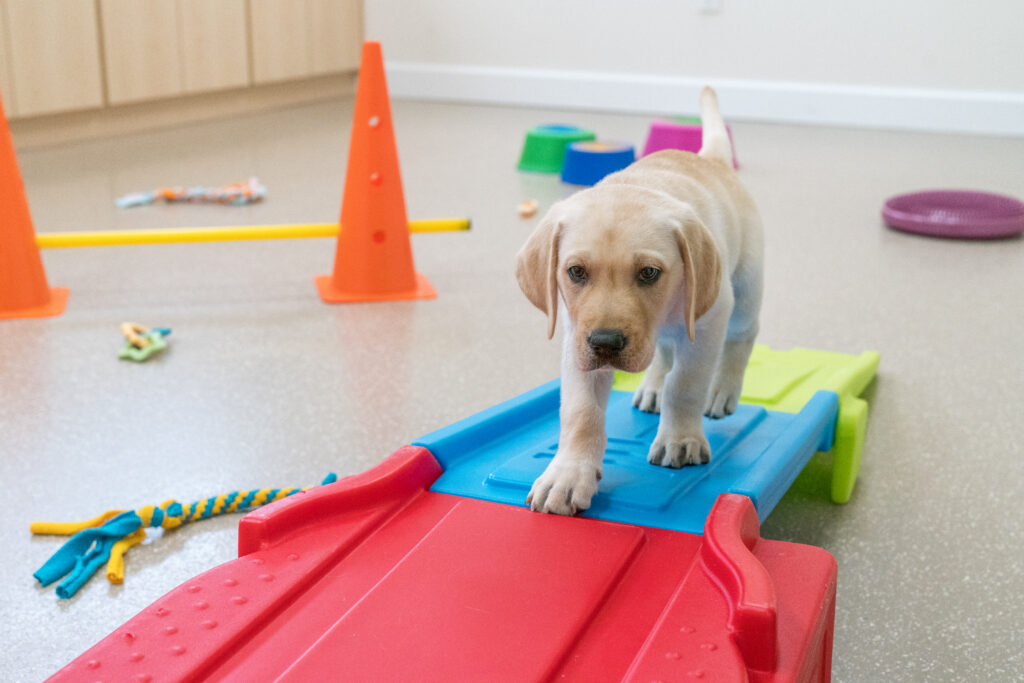
The Early Weeks: Puppies are introduced to novel textures, sounds, and environments from birth. This early neurological stimulation builds resilience against startling and panic responses.
The Puppy Raiser Period: Between the ages of 12 to 18 months, young dogs are placed with volunteer puppy raisers. During this critical window, the dogs are exposed to everyday civilian environments—grocery stores, public transportation, bustling city sidewalks, and chaotic school zones.
Basic Obedience: While living with their raisers, the dogs master foundational house manners and basic obedience cues, learning that listening to humans yields positive, rewarding outcomes.
Phase 2: Advanced Guide School (Minimum 5 Months)
Once the adolescent dogs return to professional training centers, such as Dogs Inc, they enter the intensive phase of advanced guide work. This period lasts a minimum of five months and shifts the focus from simple compliance to critical thinking.
Environmental Assessment Training: Instructors systematically expose dogs to complex, shifting hazards—construction zones, erratic cyclists, low-hanging tree branches, and obstructed sidewalks.
Reward-Based Risk Evaluation: Dogs are conditioned to evaluate the space ahead of them. If an instructor gives a "forward" cue while a simulated hazard is introduced, the dog learns that pausing, stopping, or steering around the obstacle is the correct, highly rewarded choice.
Refining the "No": Through positive reinforcement, the dogs learn that saying "no" to a handler’s command under hazardous conditions is not only permitted, but is actively celebrated and reinforced.
Phase 3: Team Matching and the Juno Walk
A well-trained dog is only half of the equation. Once the dog has mastered intelligent disobedience, it must be paired with a human handler whose lifestyle, walking pace, visual acuity, and everyday environment match the dog’s capabilities.
The Compatibility Assessment: Mobility instructors evaluate the prospective handler’s daily routes, physical stride, and navigational style.
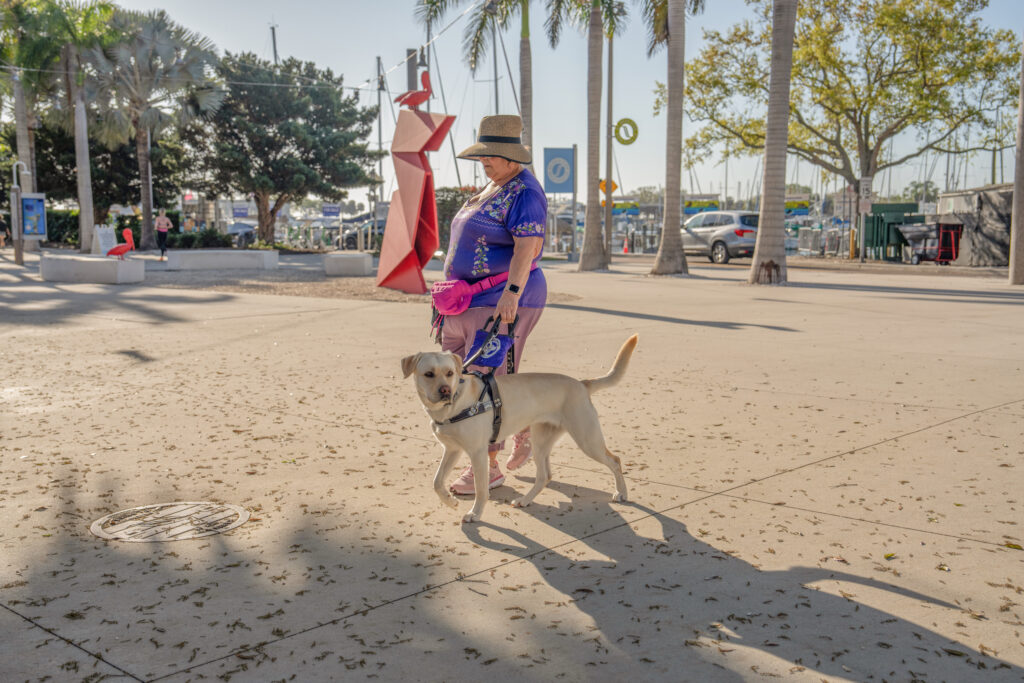
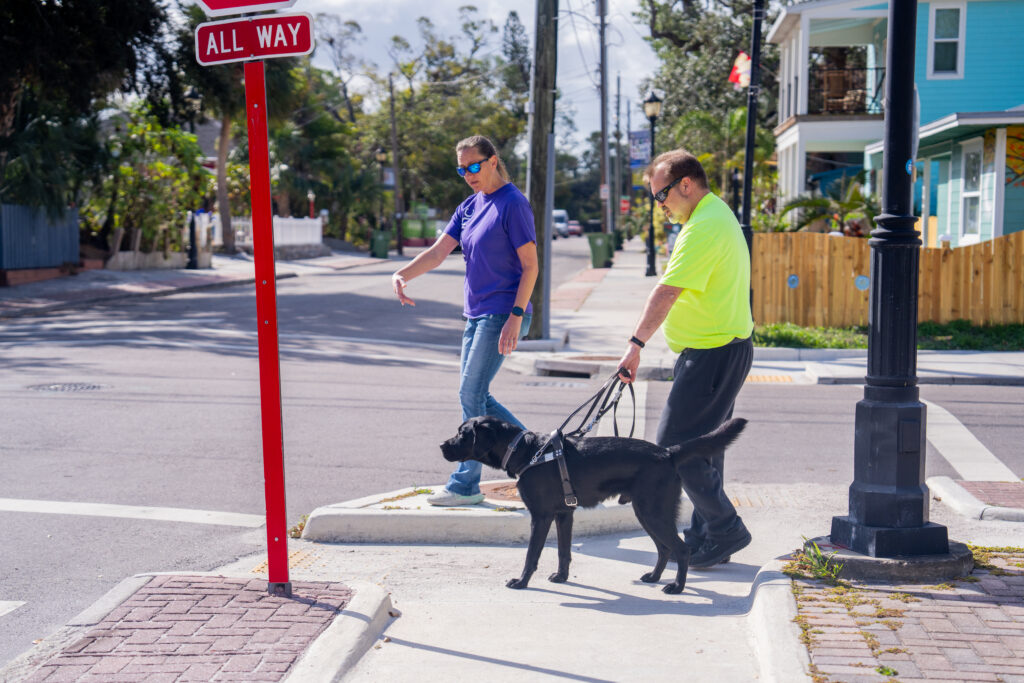
The Juno Walk: Before a match is finalized, candidates participate in a specialized evaluation walk (often referred to as a Juno Walk) to assess the dynamic flow, synchronization, and mutual responsiveness between the handler and the canine partner.
Supporting Context & Metrics: The Science of Canine Cognition
To truly appreciate intelligent disobedience, one must understand how guide dogs process sensory information compared to humans, and why human sensory limitations necessitate this unique canine adaptation.
The Sensory Partnership
Individuals who are blind or visually impaired navigate the world through extraordinary auditory, tactile, and kinesthetic awareness. They track the hum of traffic engines, the echolocation of building facades, and the texture of sidewalk pavers beneath a cane. However, certain environmental hazards exist entirely outside the reach of these sensory channels:
Overhead Obstacles: Low-hanging tree branches, scaffolding struts, and protruding commercial awnings are notoriously difficult to detect with a traditional white cane, yet they pose a severe threat to a handler’s face and head.
Silent Threats: Modern electric and hybrid vehicles produce very little engine noise, making auditory traffic detection increasingly unreliable at street crossings.
Dynamic Ground Hazards: Potholes, shifting construction barriers, exposed wiring, and sudden crowds cannot always be anticipated by a handler relying on linear navigation.
The Metrics of Success
Training centers evaluate thousands of working hours to ensure reliability. While exact attrition rates vary based on strict health and temperament standards, industry metrics indicate that only a fraction of dogs entering formal training ultimately graduate as certified guide dogs.
Training Stage
Average Duration
Primary Developmental Focus
Puppyhood & Socialization
12 – 18 Months
Environmental stability, basic obedience, public access behavior
Pace harmonization, route navigation, handler-dog trust building
The dogs that successfully navigate this gauntlet possess a rare psychological profile: they are biddable enough to follow commands consistently, yet confident enough to think independently and override human error when safety demands it.
Official Statements and Expert Perspectives
Mobility specialists, trainers, and researchers emphasize that intelligent disobedience is the defining characteristic separating a standard service animal from an elite guide dog mobility partner.
"People often view obedience as a one-way street: the human gives an order, and the dog executes it without question," notes a senior guide dog mobility instructor. "In guide work, that dynamic is fundamentally flawed. We are forging a partnership between two independent thinkers. When a handler says ‘forward’ into the path of an oncoming vehicle or an open construction trench, the dog is the ultimate safety net. If the dog simply obeyed blindly, the partnership would fail its most critical mission."
Behavioral researchers point out that teaching intelligent disobedience requires meticulous timing and emotional calibration. If a dog is punished for refusing a command, it develops learned helplessness—a state of fear where the animal becomes too timid to make any decisions at all. Conversely, if reinforcement is inconsistent, the dog may become unreliable.
"We are asking the dog to balance two opposing mental drives," explains an expert in canine cognitive development. "They must respect the authority of the handler’s cues while maintaining the situational awareness required to judge when that authority puts them in harm’s way. Achieving this balance is a masterclass in modern animal behavior science."
Handlers themselves frequently speak of the profound psychological shift that occurs when they learn to trust their dog’s independent judgment.
"The first time my dog planted his feet and refused to cross an apparently clear intersection—only for a speeding cyclist to run a red light seconds later—my entire perspective changed," shares a long-time guide dog handler. "He wasn’t just a helper; he was my teammate, protecting me in ways I couldn’t possibly manage on my own."
Future Outlook: The Evolution of Mobility and Canine Independence
As urban landscapes continue to evolve, the challenges faced by guide dog teams are shifting. The rise of silent electric vehicles, complex pedestrian-scooter shared spaces, and increasingly crowded metropolitan environments place unprecedented demands on both handlers and their canine partners.
Technological Integration and the Indispensable Canine Mind
While modern technology offers numerous assistive tools—such as GPS navigation apps, smart canes equipped with LiDAR sensors, and haptic feedback devices—none of these innovations possess the adaptive reasoning of a living partner. Technology can alert a user to data points, but it cannot dynamically negotiate a crowd, calculate the erratic trajectory of a turning delivery truck, or make a split-second moral calculation to shield a human from harm.
Intelligent disobedience remains a uniquely biological marvel. As training methodologies continue to refine positive reinforcement techniques and stress-inoculation protocols, future generations of guide dogs are expected to demonstrate even greater resilience and sophisticated decision-making skills.
Expanding Access and Awareness
Efforts are continually underway to educate the general public, municipal planners, and business owners about the realities of guide dog partnerships. Understanding intelligent disobedience helps communities recognize that a guide dog standing firm, refusing to move, or steering a handler off a designated path is not misbehaving or confused. Rather, it is actively performing its job at the highest possible level.
Supporting the Next Generation
The sustainability of these life-changing partnerships relies heavily on community involvement. Organizations like Dogs Inc depend on a vast network of dedicated volunteers, puppy raisers, financial supporters, and mobility specialists. By investing in the rigorous, multi-year pipeline required to cultivate intelligent disobedience, society ensures that individuals who are blind or visually impaired can continue to step out into the world with unshakeable confidence, freedom, and safety.
In a world defined by automation and rigid algorithms, intelligent disobedience stands as a testament to the remarkable depth of the canine mind and the unbreakable, trust-based bond between human and dog. It is a skill that saves lives, fosters true independence, and proves that sometimes, the most profound form of loyalty is knowing precisely when to say "no."