
By: Investigative Environmental Desk
Published: Special Conservation Report
Executive Overview
Along the sun-drenched white sands and emerald-green waters of Florida’s Panhandle, a quiet yet high-stakes battle for biodiversity unfolds every spring and summer. Navarre Beach, celebrated globally for its pristine shores and recreational appeal, serves as a vital seasonal nursery for some of the Gulf Coast’s most vulnerable marine-dependent species: the Least Tern (Sternula antillarum) and the Black Skimmer (Rynchops niger). These ground-nesting seabirds face an escalating gauntlet of environmental pressures, ranging from severe coastal weather events to intense anthropogenic disturbance and natural predation.
However, recent field data from the region highlights a powerful countermeasure to these threats: community-driven conservation.
According to frontline reports from Navarre Beach Seabird Monitor Kiara Roman Gonzalez, protecting imperiled coastal avifauna is no longer the sole purview of state agencies and environmental non-profits. Instead, it has evolved into a collaborative paradigm. By bridging the gap between scientific stewardship and public engagement, local conservationists, dedicated volunteers, law enforcement agencies, and everyday beachgoers have forged an effective defensive network.
This comprehensive report examines the mechanics of this collaborative conservation model. It explores the daily realities of monitoring vulnerable colonies, analyzes the biological and logistical challenges unique to the Emerald Coast, and outlines actionable frameworks for sustainable wildlife management in shared coastal spaces.
Detailed Chronology: A Season on the Front Lines of Seabird Monitoring
To understand the fragility and resilience of Florida’s coastal ecosystems, one must examine the nesting cycle through the lens of those stationed on the sand. The seasonal routine of a seabird monitor is defined by the blistering heat of the Gulf summer, unpredictable meteorological shifts, and constant surveillance of dynamic nesting sites.
Phase I: Arrival and Site Selection (Early Spring)
As spring temperatures rise across the Florida Panhandle, Least Terns and Black Skimmers arrive from their wintering grounds in Central and South America. These migratory birds exhibit a distinct preference for open, sandy habitats where camouflage is naturally optimized for their speckled eggs.
Historically, natural barrier islands provided these conditions undisturbed. However, modern coastal development has drastically reduced available nesting territory. Consequently, seabirds frequently select high-risk, human-altered locations—such as wide expanses of open sand near causeways, municipal parking lots, and heavily trafficked recreational beaches.
Phase II: Active Incubation and Public Engagement (Late Spring to Mid-Summer)
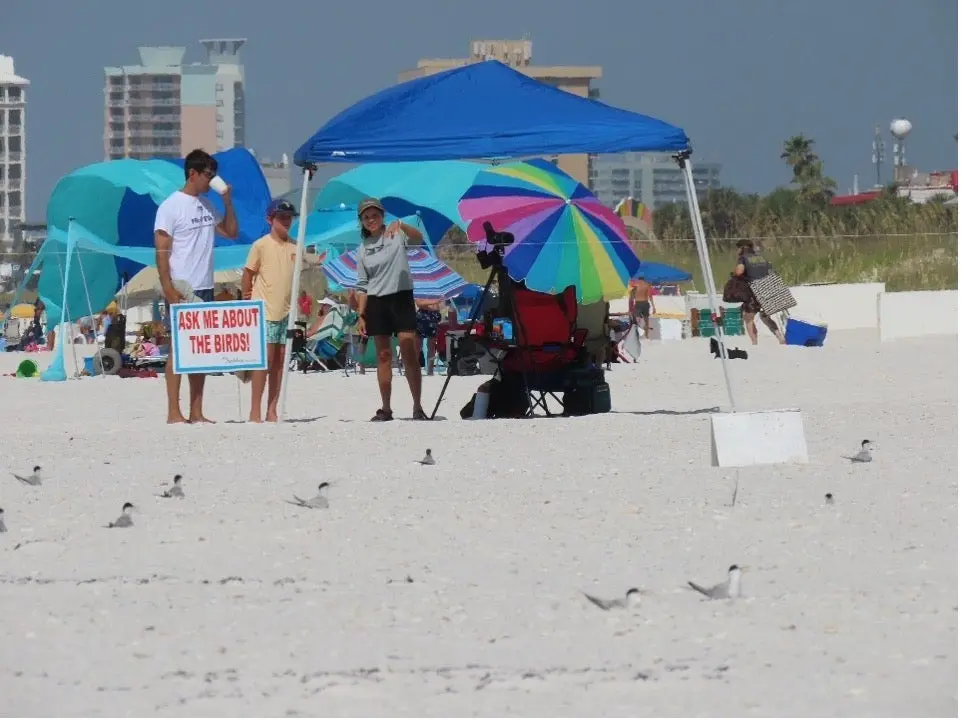
Once nesting territories are established, the monitoring phase shifts from observation to active management. For Gonzalez, this period was characterized by direct, daily interactions with the public. Wearing a field shirt emblazoned with the simple yet effective prompt, "Ask Me About the Birds," monitors transformed potential friction points with beachgoers into educational opportunities.
Rather than relying solely on restrictive signage and physical barriers—which often provoke annoyance among frustrated tourists—conservationists utilized interpersonal outreach. Visitors inquired about the evolutionary origins of the colonies, the rationale behind their chosen nesting locations, and the ecological significance of the local food web.
To bridge the gap between human curiosity and avian reality, field teams deployed high-powered spotting scopes near the nesting perimeters. This simple intervention yielded profound psychological shifts among beach visitors. Looking through the eyepiece, tourists could observe intimate, biological behaviors:
- An adult Least Tern returning with small baitfish to feed vociferous, well-camouflaged chicks.
- A Black Skimmer carefully adjusting its body weight to shield its clutch from thermal stress on superheated sand.
These up-close encounters demystified the avian populations, transforming anonymous wildlife into charismatic, relatable community members in the eyes of casual tourists.
Phase III: Managing High-Risk Environments (Peak Nesting Season)
Not all nesting sites share the scenic tranquility of Gulf-front dunes. A prime example during the recent monitoring cycle was a localized colony established along a narrow strip of open sand directly adjacent to the Navarre Causeway.
This site presented a distinct paradox for wildlife managers:
- The Risk: High vehicular traffic along the causeway created an immediate danger of avian road mortality. Fledgling chicks, lacking fully developed flight capabilities, frequently wandered into active roadways. Furthermore, stormwater runoff consistently compromised the integrity of temporary chick fencing.
- The Benefit: Paradoxically, the proximity of the busy roadway and human infrastructure acted as an effective deterrent against mammalian predators, such as raccoons, coyotes, and feral cats, which typically avoid high-noise, high-activity transportation corridors.
Managing this complex ecosystem required an intricate choreography of human intervention. Volunteers monitored the perimeter for compromised fencing, repaired structural breaches caused by heavy rain events, and cataloged incidents of wildlife mortality. Simultaneously, local law enforcement agencies stepped up patrols, actively enforcing reduced speed limits along the causeway to provide a buffer for wandering chicks.
Supporting Context & Metrics: The Anatomy of Coastal Vulnerability
The survival of Least Terns and Black Skimmers along the Florida coastline is statistically precarious. Understanding the metrics of coastal conservation requires a clear-eyed assessment of both the biological traits of these species and the compounding pressures they face in the Anthropocene.
Avian Biology and Nesting Ecology
Least Terns are the smallest members of the gull and tern family (Laridae) found in North America. Weighing barely over an ounce, they rely entirely on visual foraging, plunging into nearshore waters to capture small schooling fish. Because they nest in shallow depressions scraped directly into the sand (known as scrapes), their eggs and altricial chicks are exceptionally vulnerable to environmental hazards.
Black Skimmers, distinguished by their unique lower mandibles that extend significantly longer than their upper bills, employ a specialized foraging technique known as skimming. Flying low over calm estuarine waters, they drag their lower bill through the surface to scoop up aquatic prey. Like terns, skimmers nest in colonies on open sand, making them equally susceptible to ground-level disturbances.
The Triad of Coastal Threats
Conservation literature categorizes the pressures facing beach-nesting seabirds into three primary domains:
[Threat Matrix]
 ├── 1. Inclement Weather (Tropical storms, tidal surges, extreme heat)
 ├── 2. Anthropogenic Disturbance (Unleashed pets, foot traffic, vehicular strikes)
& └── 3. Predation Pressure (Native and invasive mammalian/avian predators)- Inclement Weather: Climate change has intensified weather patterns across the Gulf of Mexico. Sudden tropical depressions, unseasonable heavy rainfall, and king tides can inundate low-lying nesting colonies, washing away entire cohorts of eggs and newly hatched chicks in a matter of hours.
- Anthropogenic Disturbance: Human recreation is both an economic pillar of the Emerald Coast and a biological hazard for nesting birds. Unintentional flushing—where humans or unleashed domestic dogs wander too close to a colony—causes adult birds to panic and abandon their nests. This exposes vulnerable eggs to lethal solar radiation or avian predators like Fish Crows and Laughing Gulls.
- Predation: Human presence often attracts commensal predators (such as raccoons, foxes, and gulls) that thrive in human-modified landscapes. When beachgoers leave food waste unsecured, predator populations artificially inflate, creating localized population pressure on nearby nesting colonies.
Official Statements and Institutional Perspectives
Conservation organizations and public agencies emphasize that institutional oversight alone cannot secure the future of coastal wildlife. Resource limitations necessitate a decentralized model of stewardship.
"Protection of imperiled beach-nesting birds cannot be achieved behind a desk or through top-down enforcement alone," notes a regional coordinator for Audubon Florida. "It requires an active, informed, and empathetic citizenry. When a beachgoer chooses to leash their dog, respect a posted buffer zone, or educate a neighbor about resting seabirds, they become an extension of our conservation team."
Local municipal leaders and law enforcement agencies have similarly embraced this integrated approach. By coordinating directly with environmental monitors, municipal departments have optimized trash management schedules near critical habitats, adjusted seasonal signage, and utilized electronic speed-monitoring boards along high-risk thoroughfares like the Navarre Causeway.
Public feedback from visitors who engaged with the spotting scope initiative underscores the psychological transition from passive observer to active stakeholder. Exit interviews conducted with beach visitors revealed a measurable increase in self-reported compliance with conservation signage among those who interacted with field monitors.
Future Outlook: Scaling Community-Based Conservation
As coastal populations in Northwest Florida continue to expand, the pressure on remaining natural habitats will inevitably intensify. The successes recorded during the recent nesting season on Navarre Beach offer a replicable blueprint for balancing human recreational demands with ecological preservation.
Strategic Recommendations for Future Seasons
- Expansion of Educational Infrastructure: Permanent or semi-permanent interpretive kiosks equipped with high-magnification viewing tools should be integrated into high-traffic public beach access points adjacent to known nesting grounds.
- Enhanced Volunteer Pipelines: Formalizing the volunteer network through structured training programs can scale up monitoring capacity without placing an unsustainable financial burden on state agencies. Volunteers can be certified to conduct standardized behavioral surveys, maintain protective fencing, and serve as peer educators on the beach.
- Smart Infrastructure and Traffic Management: Municipalities should explore the deployment of dynamic speed-control systems and automated wildlife warning signage along known avian migration and nesting corridors, minimizing road mortality risks without permanently disrupting commuter traffic.
- Digital Advocacy and Grassroots Outreach: Amplifying conservation messaging through hyper-local digital networks and social media platforms allows community members to extend the reach of field monitors, transforming everyday citizens into virtual ambassadors for wildlife protection.
Conclusion
The narrative of seabird conservation on Navarre Beach is ultimately a story of shared space. It demonstrates that large-scale ecological victories do not exclusively originate in legislative halls or corporate boardrooms; frequently, they begin on the open sand—sparked by a simple conversation, facilitated by a spotting scope, and sustained by a community that recognizes its role in protecting the natural heritage of the Emerald Coast.