
August 7, 2026 — Originally featured in the Alley Cat Action® 2026 Summer Newsletter.
Executive Overview
In the historic and picturesque coastal promenades of San Juan, Puerto Rico, a high-stakes battle is unfolding over the fate of the city’s beloved community cats. At the center of the controversy is the Paseo del Morro, a scenic walkway managed by the federal government where generations of cats have lived, watched over by dedicated local caregivers. Today, these vulnerable felines face an immediate and lethal threat of removal orchestrated by the U.S. National Park Service (NPS).
Stepping into the breach is Alley Cat Allies, the nation’s premier advocacy organization dedicated to the protection and humane treatment of cats. Working hand-in-hand with the prominent local animal welfare organization Save A Gato, Alley Cat Allies is currently on the ground in San Juan. Their mission is twofold: to provide immediate, daily care and protection for the Paseo cats, and to wage an aggressive, multi-pronged campaign—spanning legal action, legislative advocacy, and community outreach—to halt the National Park Service’s lethal removal plans.
The conflict escalated following a controversial federal court decision that greenlit the NPS removal scheme. Animal advocates argue that the ruling relies on a profound mischaracterization of Trap-Neuter-Return (TNR)—a protocol that was never legally on trial—and overlooks alleged violations of federal law committed by the NPS during the drafting of its removal strategy.
Yet, even as legal eagles fight the ruling in court, Alley Cat Allies is taking a holistic approach. The organization is forging powerful alliances with local Puerto Rican leaders, including Congressman Pablo José Hernández, to fund large-scale spay-and-neuter initiatives, expand evidence-based TNR programs, and implement humane education campaigns. Together, these stakeholders are championing a vision for San Juan where compassionate, science-based animal management replaces antiquated, lethal approaches.
Detailed Chronology: The Paseo del Morro Conflict
The confrontation between federal land managers and animal welfare advocates in San Juan did not happen overnight. It is the culmination of years of tension regarding how public lands should manage free-roaming animal populations—and a growing disconnect between federal bureaucracy and local cultural realities.
The Historic Sanctuary of the Paseo del Morro
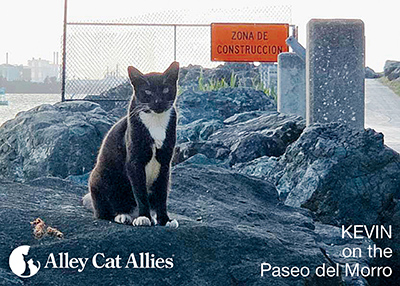
The Paseo del Morro is a breathtaking, half-mile pedestrian promenade that runs along the outer defensive walls of Old San Juan, hugging the Atlantic Ocean beneath the imposing shadow of the San Felipe del Morro Fortress. For decades, this rugged coastline has served as a safe haven for colonies of community cats. Fed, vetted, and monitored by dedicated volunteers, these cats have long been woven into the fabric of the local landscape, welcomed by residents and admired by tourists who visit the historic site.

The Federal Intervention and Legal Showdown
Conflict arose when the U.S. National Park Service—which holds jurisdiction over the historic grounds—sought to clear the area of its feline residents. Viewing the cats through an outdated and inflexible lens, the NPS pursued a plan aimed at the lethal removal of the population, ignoring the proven efficacy of population stabilization through TNR.
Save A Gato and allied advocates mounted a fierce legal defense to protect the felines. However, a recent federal judge’s decision handed a temporary victory to the federal agency, permitting the removal plan to move forward.
Legal experts and animal advocates have expressed profound disappointment and alarm over the ruling. According to Alley Cat Allies, the judicial decision is marred by a gross mischaracterization of Trap-Neuter-Return—a methodology that was never properly evaluated or placed on trial during the proceedings. Furthermore, animal rights attorneys contend that the NPS rushed its removal framework in ways that violated federal procedural laws, bypassing the rigorous environmental and stakeholder reviews required for such consequential federal actions.
On-the-Ground Mobilization
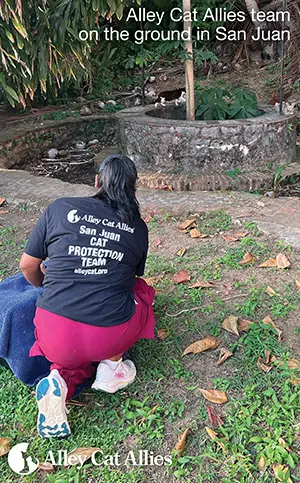
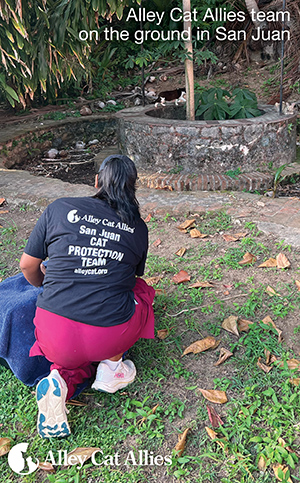
Rather than backing down in the face of the court ruling, Alley Cat Allies escalated its intervention. Deploying teams directly to San Juan, the organization joined forces with Save A Gato to establish a protective physical and logistical presence on the ground.
Today, caregivers and rescue workers are working around the clock at the Paseo del Morro. Their immediate focus is ensuring that every cat is accounted for, provided with veterinary care, and shielded from sudden, aggressive trapping efforts. Simultaneously, legal teams are aggressively pursuing all remaining appellate and injunctive steps to challenge the federal court’s ruling and secure a permanent injunction against the NPS removal order.
Supporting Context & Metrics: The Science of TNR vs. Lethal Removal
To understand the gravity of the struggle in San Juan, one must examine the broader science of community cat management. For decades, public land agencies and municipal governments across the United States have grappled with how to manage free-roaming cat populations. Historically, many agencies defaulted to "catch-and-kill" or lethal removal policies—methods that have been thoroughly debunked by animal behaviorists, ecologists, and public health experts alike.
The Vacuum Effect
Lethal removal does not solve the underlying issue of community cat populations; it exacerbates it through a phenomenon known to ecologists as the "Vacuum Effect." When cats are removed from a specific territory—whether through lethal means or relocation—surviving or unsterilized cats from surrounding areas quickly migrate into the newly available habitat. With an abundant food source (often provided by sympathetic visitors or natural prey) and shelter, the new arrivals rapidly reproduce, causing the population to rebound to or even exceed its original numbers within a short period.
In contrast, Trap-Neuter-Return (TNR) permanently halts population growth. Under a TNR protocol:
- Trapped: Community cats are humanely caught using specialized box traps.
- Neutered/Spayed: The cats are sterilized by licensed veterinarians, preventing future litters. They are also typically vaccinated against rabies and receive other essential preventative care.
- Eartipped: While under anesthesia, the tip of the cat’s left or right ear is cleanly removed (a universally recognized sign indicating a sterilized and vaccinated community cat).
- Returned: The cats are safely returned to their outdoor colony home, where they live out their natural lives without contributing to population growth.
The Economic and Social Case for TNR
Beyond its biological effectiveness, TNR is exponentially more cost-effective than continuous lethal removal cycles, which drain taxpayer funds without achieving permanent population reduction. Furthermore, TNR eliminates nuisance behaviors associated with unsterilized cats—such as yowling, roaming, and spraying—while maintaining the natural rodent-control benefits that these feline colonies provide in urban and coastal environments.
In San Juan, Save A Gato has successfully practiced and advocated for TNR for years, proving that a cooperative, community-driven approach can maintain healthy cat populations while respecting the historic integrity of the Paseo del Morro. The National Park Service’s insistence on a lethal removal plan represents not only a cruel approach to living creatures, but an obsolete methodology that flies in the face of modern ecological science.
Official Statements and Political Leadership
The fight for the Paseo del Morro cats has transcended local animal welfare circles, drawing the attention of high-ranking policymakers who recognize the issue as a matter of environmental justice, community respect, and humane governance.
Congressman Pablo José Hernández Weighs In
Among the most vocal political leaders stepping up to support the cats and their human caregivers is Congressman Pablo José Hernández. Recognizing the deep bond between the residents of Puerto Rico and their local wildlife, Congressman Hernández has strongly rebuked the National Park Service’s approach.
“[The NPS] plan is both inhumane and counterproductive, and my constituents know it,” declared Congressman Hernández. “I urge NPS to commit to a period of public outreach and stakeholder consultation to reach a solution that puts people and animals first.”
Hernández’s intervention highlights a crucial political dimension of the struggle: the disconnect between federal agencies operating from the mainland and the cultural values of Puerto Ricans, who overwhelmingly view community animals with compassion and expect their federal representatives to respect local wildlife management solutions.
Partnership for Lasting Change
Leveraging this political momentum, Alley Cat Allies is not merely fighting a defensive battle in the courts; they are building a sustainable infrastructure for animal care across San Juan. By partnering directly with civic leaders and funding extensive spay-and-neuter initiatives, Alley Cat Allies and Save A Gato are laying the groundwork for city-wide adoption of TNR.
These campaigns include comprehensive humane education initiatives aimed at schools and community centers. By teaching the next generation of Puerto Ricans about responsible pet ownership, the biology of community cats, and the ethics of humane population control, these programs ensure that the values of compassion and science-based animal care will take deep root in San Juan for decades to come.
Future Outlook: A Defining Moment for Animal Advocacy
As the legal battles continue and the boots-on-the-ground efforts in San Juan persist, the situation at the Paseo del Morro stands as a watershed moment for animal protection in the United States and its territories.
The outcome of this conflict will send shockwaves through federal land management agencies nationwide. If the National Park Service is permitted to override local community consensus, dismiss peer-reviewed population management science, and execute a lethal removal plan based on flawed legal premises, it could set a dangerous precedent for community cats living on federal properties across the country.
Conversely, a victory for Alley Cat Allies, Save A Gato, and Congressman Hernández will demonstrate that humane, science-based policies can triumph over bureaucratic inflexibility. It will prove that community cats have a legally defensible right to their homes, and that federal agencies must be held accountable to the communities they purportedly serve.
For now, the immediate mission remains clear: Protect the cats of the Paseo del Morro. Day and night, Alley Cat Allies and Save A Gato are standing watch on the historic coastline of San Juan, ensuring that every life is valued, every cat is protected, and the fight for humane treatment continues unabated.
To learn more about the campaign, support the ongoing legal and on-the-ground efforts, and read the full Alley Cat Action® 2026 Summer Newsletter, visit the Alley Cat Allies official website.