
Executive Overview
The introduction of a new pet into an established household is a delicate endeavor, fraught with unpredictable social dynamics, territorial anxieties, and, occasionally, pure comedic gold. Recently, a viral TikTok video shared by user @hctobin captured precisely this phenomenon, thrusting a bewildered resident tabby cat into the unexpected role of an older brother. Faced with a tiny, fluffy white kitten that he never asked for, the tabby’s reaction—marked by wide-eyed disbelief, cautious body language, and a profound sense of territorial betrayal—has captivated millions of animal lovers worldwide.
This report examines the viral encounter through an authoritative lens, detailing the chronological progression of the introduction, analyzing the behavioral psychology behind feline territorial integration, and providing actionable guidance for pet owners navigating multi-cat households. While the initial meeting was underscored by the resident cat’s unmistakable hesitation and the fearless persistence of the newcomer, the incident highlights broader themes of feline socialization, behavioral adaptation, and the complex emotional landscapes of our domestic animal companions.
Detailed Chronology of the Encounter
Act I: The Couchside Revelation
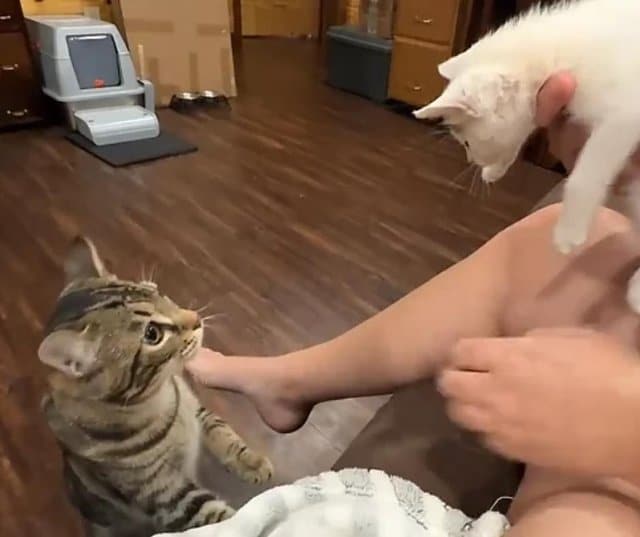
The viral narrative begins in the comfort of the family living room. The cats’ human guardian is seated comfortably on the couch, cradling the household’s newest addition—a diminutive, snow-white kitten that looks practically microscopic when compared to the established resident tabby.
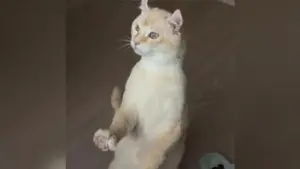
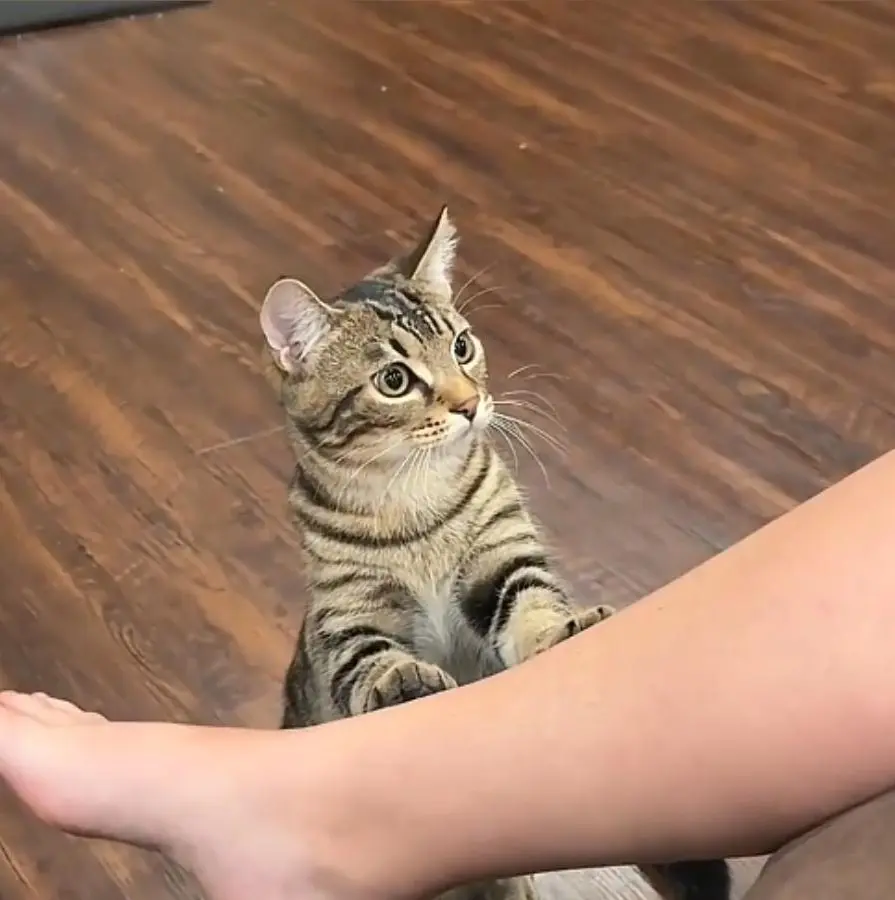
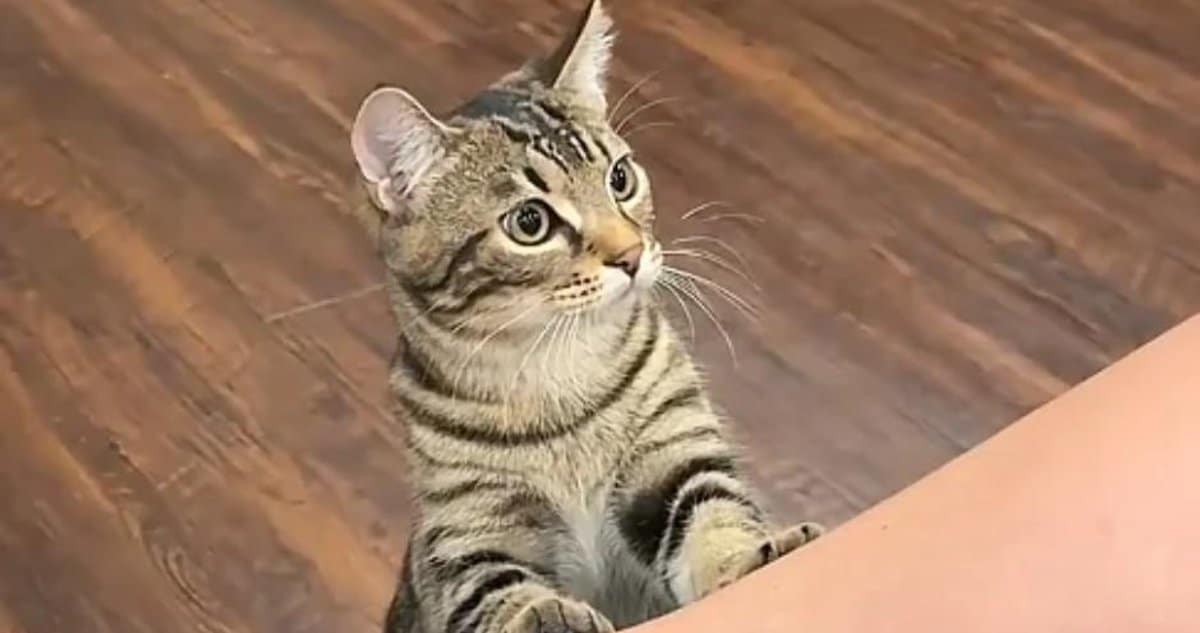
Drawn by unfamiliar scents and subtle domestic disturbances, the adult tabby approaches the sofa to investigate. Rather than maintaining a casual posture, the older cat stands squarely on his hind legs, pressing both front paws firmly against his owner’s legs to achieve maximum elevation. This vertical posture grants him a direct line of sight to the interloper resting in his human’s arms.
What follows is an instantly iconic expression of pure, unadulterated shock. The tabby’s eyes widen to cartoonish proportions as he stares down the unexpected feline arrival. Every line of his face communicates a singular internal monologue: How did this happen, and why was I not consulted?
The video’s on-screen text encapsulates the universal human interpretation of the moment: "When your parents get you a brother you never asked for." The accompanying caption dryly notes, "He’s not real impressed with the new addition." Indeed, the tabby’s body language radiates profound skepticism. Rather than leaning in for a friendly sniff, he freezes, uncertain of how to process the tiny creature occupying the throne of his primary human’s undivided attention.
Act II: The Floor-Level Standoff
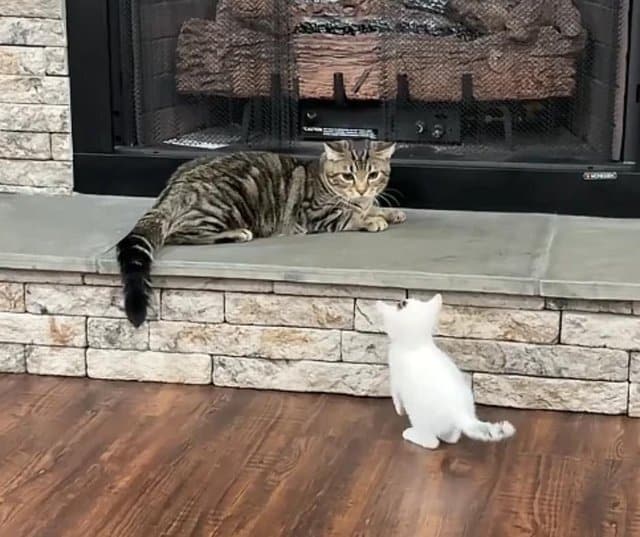
As the introduction transitions from the couch to the floor, the dynamic evolves from stunned disbelief to cautious negotiation. Placed on an even playing field, the stark physical disparity between the two animals becomes starkly apparent. The resident tabby towers over the newcomer, weighing roughly three times as much as his diminutive sibling.
Yet, despite his massive size advantage, the tabby exhibits extreme hesitation. He begins circling the area, maintaining a wide berth and watching the kitten’s every move with intense scrutiny.
Conversely, the tiny white kitten demonstrates an astonishing lack of fear. Unfazed by his older brother’s intimidating physical presence and wary demeanor, the youngster repeatedly marches forward, clearly interpreting the encounter as an invitation to play. To the kitten, the large, striped cat is not a territorial threat, but an oversized playmate waiting to be unlocked.
Act III: Boundaries and Persistence
Faced with the kitten’s unyielding advances, the tabby attempts to establish clear boundaries. As the white fluff-ball waddles persistently toward him, the older cat delivers a series of measured, warning swats. These gentle cuffs are designed to communicate a clear message: Maintain your distance.
However, the kitten’s resilience is matched only by his apparent innocence. Rather than retreating or fleeing in terror, the youngster absorbs the boundaries in stride, repeatedly bouncing back for another attempt at saying hello. This juxtaposition—the deeply skeptical, overwhelmed big brother versus the relentlessly optimistic, fearless baby—forms the core of the video’s viral appeal, leaving viewers both amused and eager to know how the sibling dynamic ultimately evolved.
Supporting Context & Metrics: Feline Social Dynamics and Viral Reach
The Mechanics of Feline Virality
The clip shared by @hctobin is part of a broader cultural phenomenon wherein domestic animal interactions serve as universal mediums for humor and relatability. Pet-centric content consistently dominates short-form video platforms like TikTok, driven by several distinct behavioral and algorithmic factors:
- Anthropomorphism: Human viewers readily project complex human emotions—such as sibling rivalry, betrayal, and bewilderment—onto animal expressions. The tabby’s wide-eyed stare is universally readable across species lines.
- Visual Contrast: The stark physical differences between a large, traditional tabby and a tiny, fluffy white kitten create an immediate visual punchline.
- Relatability: The universal experience of having an unexpected element disrupt one’s comfort zone resonates deeply with audiences, translating into high view counts, shares, and comment engagement.
Behavioral Psychology: Why Resident Cats React with Caution
To understand the tabby’s wide-eyed panic, one must examine feline territorial instincts. Domestic cats (Felis catus) are fundamentally territorial animals that rely heavily on predictability, scent profiling, and established routines. When a new cat enters the home, it represents several immediate disruptions:
- Resource Competition: The resident cat perceives a potential threat to primary resources, including food bowls, litter boxes, vertical territory (perches and cat trees), and, most importantly, human attention.
- Scent Disruption: Unfamiliar pheromones challenge the established scent map the resident cat has meticulously cultivated across the household.
- Predictability Shock: Adult cats operating in peaceful environments often view sudden additions as unpredictable variables that disrupt their sense of security.
According to feline behaviorists, an initial reaction characterized by staring, freezing, or defensive swatting is entirely normal. These behaviors do not inherently signal permanent aggression or hatred; rather, they represent the baseline data-gathering phase of feline socialization.
Expert Insights & Veterinary Guidance
While viral videos capture the instantaneous humor of first meetings, animal welfare organizations and veterinary behaviorists emphasize that long-term multi-cat harmony requires careful management. Experts consistently advocate for structured, gradual introductions rather than abrupt "cold turkey" meetings in common areas.
The Science of Slow Introductions
Dr. Sarah Jenkins, a prominent feline behavioral specialist, notes that abrupt introductions frequently trigger unnecessary stress:
"When an adult cat is suddenly confronted with a hyperactive kitten in their primary territory, their first instinct is often defensive. Cats process change through their olfactory systems first. Allowing them to smell one another under a closed door before ever seeing face-to-face drastically reduces the cortisol spikes associated with territorial defense."
Veterinary recommendations for introducing a new kitten to a resident cat typically involve a multi-step protocol:
- Territorial Separation: Keep the new kitten confined to a designated "safe room" (such as a spare bedroom or bathroom) equipped with its own food, water, litter box, and bedding for the first several days. This allows the resident cat to investigate the new scent from a safe distance.
- Scent Swapping: Exchange bedding or rub a clean sock on the kitten and place it near the resident cat’s feeding station. This pairs the new scent with positive associations like food.
- Visual Habituation: Utilize a baby gate or cracked door to allow visual contact without physical access, enabling both cats to observe each other’s body language in a controlled environment.
- Supervised Face-to-Face Interaction: Once overt signs of hostility (hissing, growling, puffed tails) subside, allow short, highly supervised meetings in neutral or familiar spaces, gradually increasing duration as mutual tolerance develops.
Recognizing Warning Signs Versus Normal Play
Cat owners must learn to differentiate between normal boundary-setting and dangerous aggression. As observed in the viral video, the resident tabby’s warning swats are a standard form of feline communication. A cat establishing boundaries will often use paw swats without extending claws, accompanied by stiff body language or turning away.
Conversely, true aggression involves flattened ears, low growling, vocal howling, unsheathed claws, and relentless stalking. If these signs appear, immediate separation is required to prevent escalation and psychological trauma to either animal.
Future Outlook: The Evolution of Multi-Cat Households
As multi-pet households become increasingly common, understanding the nuances of feline integration is more critical than ever. While the viral video leaves the immediate future of the tabby and his new white-furred sibling unresolved, behavioral trajectories in similar cases lean overwhelmingly toward positive adaptation.
In the vast majority of households, resident cats who initially display wide-eyed shock or aloof annoyance eventually develop one of three dynamic states:
- The Tolerant Co-existence: The cats maintain distinct social circles, sharing physical space peaceably without engaging in direct play or grooming.
- The Dynamic Play-Partners: Driven by the persistent, fearless energy of the younger cat (as demonstrated by the white kitten in the video), the older cat eventually relents, leading to wrestling matches, mutual grooming, and shared sleeping spots.
- The Bonded Pair: Through weeks of shared routine and scent-blending, the adult cat assumes a protective, mentor-like role over the younger feline.
Ultimately, the viral moment shared by @hctobin serves as both a source of lighthearted entertainment and a poignant reminder of the complexities of animal companionship. Beneath the humor of the tabby’s bewildered expression lies a universal truth about family: sometimes, the best relationships begin with a healthy dose of skepticism and a kitten who simply refuses to take no for an answer.