
Executive Overview
Across the dense deciduous forests of eastern North America, the resonant, flutelike song of the Wood Thrush (Hylocichla mustelina) has long been celebrated as a defining soundtrack of the summer months. Yet, beneath this ethereal exterior lies a creature undertaking one of the most perilous and demanding feats in the avian world. As a quintessential neotropical migrant, the Wood Thrush spends its summers breeding in the United States and Canada before embarking on a grueling biannual journey across thousands of miles to its wintering grounds in Central America.
Today, this iconic songbird faces an existential crisis. According to the North American Breeding Bird Survey, the Wood Thrush population has plummeted by an estimated 1% each year between 1966 and 2023, resulting in a staggering cumulative decline of 45% over that period. This steep downward trajectory is primarily driven by habitat loss, forest fragmentation on both breeding and wintering grounds, and environmental stressors encountered along migratory flyways.
To combat this alarming decline, conservationists are increasingly recognizing that protecting breeding habitats alone is insufficient. Safeguarding the Wood Thrush requires a "full-lifecycle conservation" framework—an approach that connects the ecological dots between the places birds need across an entire hemisphere. Understanding the precise pathways, stopover sites, and wintering destinations of these migratory birds is the foundational step required to protect them.
In response to this urgent conservation imperative, Audubon Vermont partnered with the U.S. Fish and Wildlife Service (USFWS) and the University of Vermont (UVM) for a comprehensive, range-wide migration tracking project spanning 2024 and 2025. By deploying advanced radio telemetry technology known as nanotags, researchers successfully tracked the harrowing transcontinental odysseys of 18 individual Wood Thrush in Vermont, contributing crucial localized data to a broader study encompassing more than 1,000 tagged birds across the species’ range. The findings are shedding unprecedented light on the migratory routes of these neotropical travelers, offering a vital roadmap for future conservation strategies.
Detailed Chronology: The Odyssey of Vermont’s Wood Thrush
The mechanics of tracking a bird weighing barely 50 grams—roughly the weight of a golf ball—across international borders once seemed technologically out of reach. Traditional banding provides only two fixed points: where a bird was banded and where it was recovered. However, the advent of the Motus Wildlife Tracking System has revolutionized avian research.
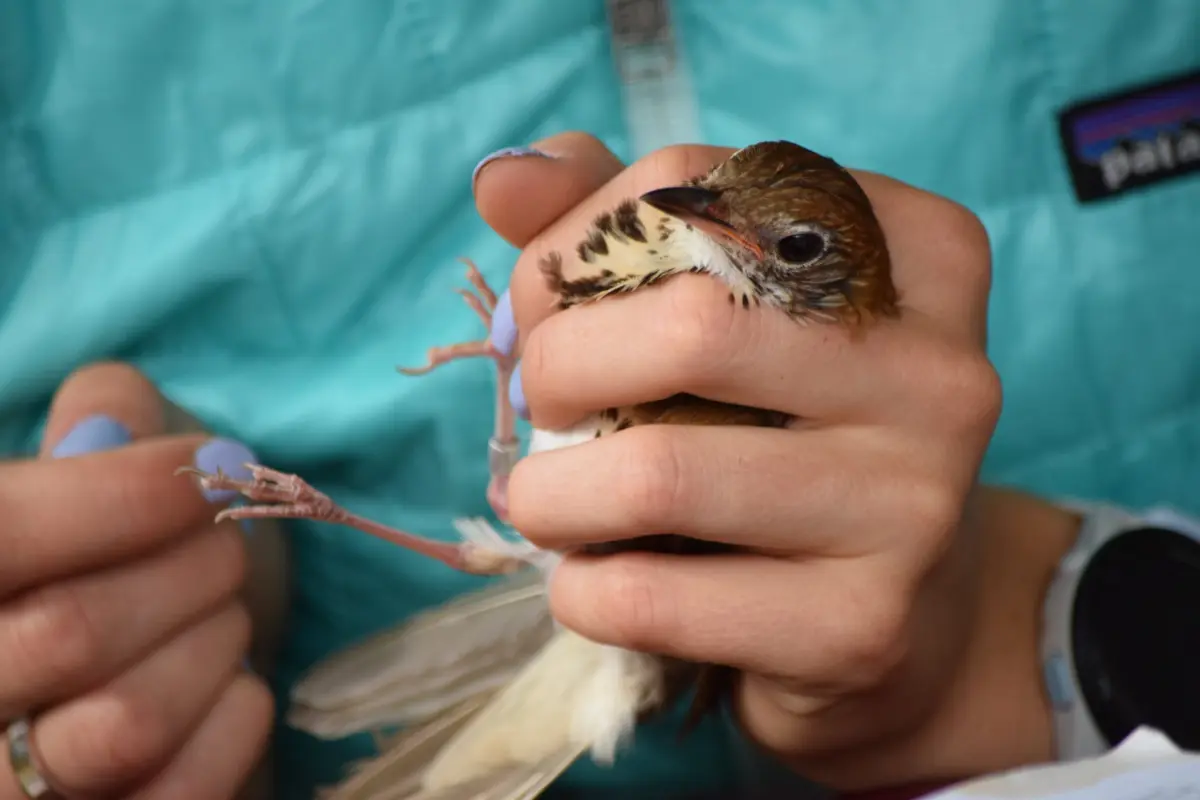
During the summers of 2024 and 2025, Audubon Vermont Biologist Mark LaBarr, aided by Audubon Conservation Interns sponsored by the University of Vermont, meticulously affixed lightweight nanotags to 18 Wood Thrush in Vermont. These nanotags emit unique, coded radio signals that are picked up by specialized automated antennas and receivers stationed across the Motus network. Whenever a tagged bird flies within range of a Motus tower, its unique ID, exact location, date, and time are automatically recorded.
Out of the 18 birds tagged across the two-year span, distinct success stories emerged. Three of the six Wood Thrush tagged during the summer of 2024 successfully completed the round-trip journey—leaving Vermont in the fall and returning to their breeding grounds the following spring. Similarly, four of the 12 individuals tagged in 2025 completed the round-trip circuit by 2026. Furthermore, numerous other individuals were detected intermittently by towers along the flyway, yielding invaluable partial migration routes.
To truly grasp the magnitude of these migrations, researchers closely followed the detailed tracking logs of two standout individuals: "Debby" and "Pete."
The Journey of Debby (Tag #56656)
In June 2024, at Shelburne Farms, researchers tagged a second-year male Wood Thrush. He was affectionately named "Debby" in honor of Debby Bergh, the former Board Chair of Audubon Vermont.
Debby’s migratory adventure provides a textbook example of the eastern North American flyway:
- Fall Departure (Late September 2024): After spending the summer breeding season establishing territory and raising young in Vermont, Debby initiated his southward trek. His nanotag was picked up sequentially by Motus towers as he moved down the eastern seaboard, charting a course through New York, Pennsylvania, Washington D.C., and Georgia.
- The Wintering Grounds (October 2024 – April 2025): After crossing the Gulf of Mexico, Debby settled into his wintering territory in the tropical forests of Central America, specifically spending considerable time in Belize. For months, the forest fell silent regarding his whereabouts as he weathered the tropical dry season.
- The Northward Return (Late April 2025): Spring triggered the biological impulse to return north. In late April 2025, Debby’s signal flickered back to life as he departed Belize, braving the treacherous oceanic gulf crossing once more.
- Homecoming: Within a single week of re-entering the United States, Debby’s signal was detected in Ohio, followed swiftly by New York. Finally, in a remarkable display of site fidelity, his tag pinged the Motus tower at Shelburne Farms—just a stone’s throw from the exact spot where he was originally fitted with his transmitter the previous year.
The Journey of Pete (Tag #64897)
The second focal bird, tagged in June 2025 at the Green Mountain Audubon Bird Banding Station, was a second-year female named "Pete" in honor of Audubon Conservation Intern Pete Patrick.
Pete’s journey underscored the diverse yet parallel pathways utilized by these songbirds:
- Fall Migration (Late 2025): Pete initiated her autumn departure slightly later in the season. Her southward trajectory took her through Pennsylvania, North Carolina, and Georgia. Her final detections of the 2025 migration season placed her moving steadily southward through the Florida peninsula, preparing for her leap across the Gulf.
- Spring Return (Early May 2026): By early May 2026, the Motus network registered Pete’s return as she pushed northward through Georgia, Washington D.C., and Pennsylvania.
- Arrival in Vermont: Pete successfully completed her transcontinental voyage, arriving back at the Green Mountain Audubon Center. While precise wintering coordinates for Pete remain partially obscured compared to Debby’s tracked stops, tracking data strongly implies she completed a parallel journey across the Gulf of Mexico to winter within the Central American neotropical zone.
Supporting Context & Metrics: The Science of Survival
To contextualize the work done by Audubon Vermont, one must examine the broader metrics governing the Wood Thrush population and the mechanics of the Motus Wildlife Tracking System.
Population Metrics and Conservation Status
- 45% Decline: The cumulative population loss recorded by the North American Breeding Bird Survey between 1966 and 2023.
- 1% Annual Drop: The steady, compounding yearly rate of decline that has categorized the Wood Thrush as a species of high conservation concern.
- 1,000+ Birds: The total number of Wood Thrush tagged across their entire breeding range as part of the overarching USFWS initiative.
- 18 Individuals: The cohort successfully monitored by Audubon Vermont across the 2024 and 2025 breeding seasons.
The Motus Advantage
Traditional tracking methods, such as archival light-level geolocators, require scientists to recapture the exact same bird to retrieve data—a difficult feat given high mortality rates and vast search areas. Satellite tags, while powerful, remain too heavy for songbirds under 100 grams.
Nanotags bridge this technological gap. Operating on very high frequency (VHF) radio signals, these minuscule transmitters weigh less than 5% of the bird’s total body weight, ensuring natural flight mechanics and survival rates are unimpaired. The automated Motus network—consisting of hundreds of cooperative stations operated by conservation organizations, universities, and government agencies—acts as a passive listening post. As long as a tagged bird flies within roughly 10 to 15 kilometers of a tower, its data is captured automatically, creating a collaborative, continent-wide tracking grid.
Official Statements & Collaborative Vision
The success of the Audubon Vermont and USFWS tracking project underscores the power of institutional collaboration in modern conservation biology.
Biologist Mark LaBarr, who spearheaded the tagging efforts in the field, emphasized the profound shift in perspective that these tracking technologies provide. "For decades, we could only guess at the specific corridors our local birds used once they left the boundaries of Vermont," LaBarr noted. "Seeing data points light up from Pennsylvania, Georgia, and ultimately Belize transforms an abstract migration into a concrete journey. We are no longer just protecting a summer resident; we are safeguarding a traveler with connections spanning thousands of miles."
The integration of university students into the project has likewise been hailed as a critical success. Through the partnership with the University of Vermont, Audubon Conservation Interns gained hands-on experience in cutting-edge avian telemetry, ornithological handling, and data analysis. This mentorship pipeline ensures that the next generation of conservation scientists is equipped with the technical skills required to tackle complex, multi-jurisdictional wildlife challenges.
Furthermore, the data harvested from Vermont’s 18 tagged thrushes will feed directly into the U.S. Fish and Wildlife Service’s comprehensive range-wide analysis. By synthesizing data from Vermont alongside parallel studies in states like Ohio, Maryland, and Virginia, wildlife managers can identify "bottlenecks"—specific geographic areas where migrating Wood Thrush concentrate, making them disproportionately vulnerable to habitat destruction, light pollution, and structural collisions.
Future Outlook: Safeguarding the Song of the Forest
As the global climate shifts and human development continues to fragment critical ecosystems, the fate of the Wood Thrush remains delicately balanced. The insights gleaned from Debby, Pete, and their cohort mark a turning point in regional conservation strategy, but they also signal an immense amount of ongoing work.
Audubon Vermont intends to continue releasing updates as the USFWS finalizes its comprehensive range-wide report. The implications of this study extend far beyond academic curiosity; they serve as an actionable blueprint for targeted conservation interventions:
- Protecting Stopover Habitat: Knowing the exact corridors traveled by birds like Debby and Pete allows conservationists to advocate for the preservation of vital forest fragments along the eastern seaboard that serve as essential refueling stations during migration.
- International Cooperation: Because Wood Thrush winter in Central America, regional U.S. conservation efforts must be paired with international initiatives that combat deforestation in tropical wintering strongholds.
- Local Stewardship: On the breeding grounds in Vermont, landowners and municipalities will be encouraged to implement bird-friendly forestry practices—such as maintaining mature deciduous canopies and minimizing understory disturbance—to reverse the local drivers of population decline.
The haunting, flute-like cadence of the Wood Thrush has echoed through North American forests for millennia. Thanks to the dedicated efforts of Audubon Vermont, the U.S. Fish and Wildlife Service, and an innovative web of automated tracking towers, humanity is finally learning how to follow these birds every step of the way—ensuring their migratory song continues to ring out for generations to come.