
Executive Overview
In the heart of northern Illinois, an intersection of community outreach, youth education, and environmental advocacy has yielded a striking visual testament to the fragility of our ecosystems. Through an ambitious partnership between the free summer youth art initiative SPARK! Mosaic and the nationally recognized Audubon Mural Project, local students have spent their summer transforming shattered pieces of glass, mesh, cement, and styrofoam into a stunning aviary of climate-threatened bird species.
Led by artist and educator Susan Burton alongside Jennifer Kuroda, president of Sinnissippi Audubon, the 2025 SPARK! Mosaic program challenged young participants—many of whom initially identified as "not artists"—to study, design, and construct intricate mosaics of native birds. Grounded in data from the National Audubon Society’s landmark Survival by Degrees report, the resulting collection is much more than a showcase of technical artistic skill. It is an urgent, highly visible warning about the compounding pressures of climate change on biodiversity.
From a gallery-style exhibition of 29 meticulously crafted bird portraits at a local magnet school to a sweeping public mural adorning a downtown parking garage, and finally to a towering, nine-foot-tall three-dimensional sculpture affectionately named "Woodrow the Woodpecker," these young creators have injected a vital ecological conversation into the public sphere. This initiative underscores a powerful pedagogical intersection: by learning to observe the subtle feather patterns and unique morphological traits of birds facing existential environmental threats, students are not only discovering their own creative potential; they are becoming the frontline stewards of a rapidly changing natural world.
Detailed Chronology of the 2025 SPARK! Mosaic Initiative
The realization of the 2025 SPARK! Mosaic and Audubon Mural Project collaboration was not born overnight. It was the product of months of logistical planning, artistic mentorship, and community-wide engagement that unfolded across several distinct phases during the summer session.
Phase One: The Seed of Collaboration and Species Selection
The project’s genesis trace back to a personal connection: Jennifer Kuroda’s daughter had previously attended and worked at the SPARK! program. Knowing the caliber of Susan Burton’s community art initiatives and their shared commitment to environmental education in northern Illinois, Kuroda approached Burton with a visionary proposition: weave avian conservation directly into the curriculum of the upcoming summer session.
Burton, captivated by Kuroda’s advocacy, eagerly agreed. Before a single piece of glass was cut, the students were introduced to the ecological realities facing North American avifauna. Utilizing Audubon’s Survival by Degrees climate report as a foundational textbook, the young artists were tasked with selecting a subject from a curated list of species vulnerable to extinction due to shifting climate patterns, rising temperatures, and habitat loss.
Rather than relying on abstract interpretations, the students were held to a rigorous standard of biological accuracy. Under Burton’s guidance, they learned the art of ornithological observation. They spent hours analyzing field guides, scrutinizing subtle color gradients, mapping out complex feather patterns, and understanding the evolutionary shapes that define unique species. While the birds themselves demanded scientific fidelity, the students were granted creative liberty over their backgrounds and frames, marrying biological precision with personal artistic expression.
Phase Two: The Gallery Exhibition at STEAM Academy at Haskell
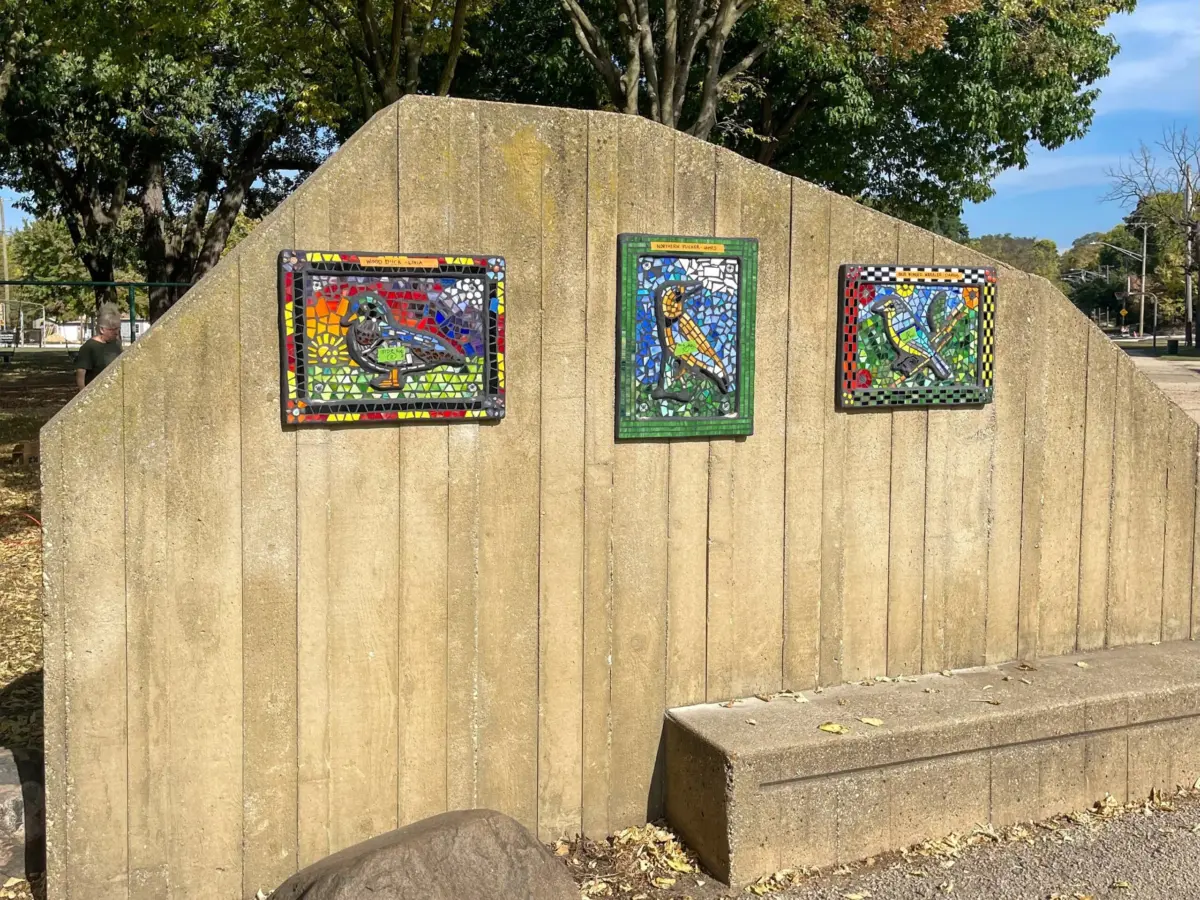
The first major milestone of the program culminated in a series of 29 detailed mosaic bird portraits. These works were formally installed and placed on public display at the STEAM Academy at Haskell, a prominent local magnet school in Rockford.
To bridge the gap between static art and interactive education, the installation was equipped with QR codes adjacent to each portrait. When scanned by curious visitors using a smartphone, these codes direct viewers to deep-dive resources detailing the ecological status, migration habits, and specific climate threats facing each individual species.
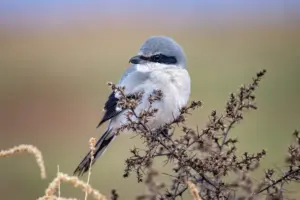
Among the featured works is the Common Loon (Gavia immer), whose low-slung lakeside nests are increasingly imperiled by erratic, climate-fueled spring and summer floods that wash eggs away before they can hatch. Another striking portrait highlights the Cerulean Warbler (Setophaga cerulea), a brilliant migratory songbird facing severe population declines driven by extreme spring heat waves that disrupt insect food webs and forest canopies. Also featured is the Northern Shrike (Lanius borealis), an intrepid predatory songbird whose southern wintering and breeding ranges face northward contraction, potentially pushing them into the remote, unforgiving stretches of northern Canada if global temperature trends continue unchecked.
Phase Three: Scaling Up – The Downtown Parking Garage Mural
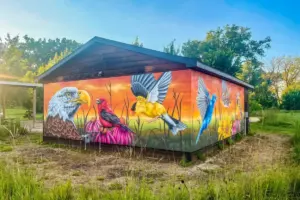
Having mastered micro-scale precision in their portrait work, the students were challenged to scale up their ambition for their second major undertaking. Moving from the intimate gallery setting to the urban canvas, the group tackled a massive public art installation on the exterior wall of a downtown Rockford parking garage.
This sprawling mural features three larger-than-life representations soaring across the concrete facade: the brilliant Indigo Bunting (Passerina cyanea), the cheerful American Goldfinch (Spinus tristis), and the distinctively masked Hooded Warbler (Setophaga citrina).
According to Burton, this phase of the project served as an invaluable masterclass in composition, teaching the young artists how to visually communicate motion, structural depth, and textural continuity across a massive plane. The finished mural serves as a vibrant urban landmark, transforming a utilitarian, industrial structure into a dynamic celebration of local wildlife that greets downtown commuters and visitors alike.
Phase Four: The Birth of "Woodrow" – Three-Dimensional Conservation
For their grand finale, the students transitioned from two-dimensional surfaces into the realm of sculpture, engineering a towering, nine-foot-tall monumental artwork that quickly transcended its physical boundaries to become the undisputed mascot of the entire initiative.
"Woodrow the Woodpecker," a magnificent and brightly colored Red-headed Woodpecker (Melanerpes erythrocephalus), was engineered through a labor-intensive, multi-step construction process. First, the monumental avian shape was painstakingly carved out of rigid blocks of Styrofoam. This core was then sealed and reinforced with an outer skin of heavy-duty wire mesh and structural cement.
Once the foundational shell cured, the students set to work on the textural skin, hand-cutting and meticulously placing hundreds of vibrant, colorful glass mosaic tiles across the entire surface. The woodpecker was mounted onto an ornate pedestal decorated with whimsical, nature-inspired patterns.
Today, Woodrow stands proudly at Nature at the Confluence, a dynamic nature preserve and environmental education center situated in South Beloit, Illinois. The sculpture serves a dual purpose: it is both a breathtaking work of art and an intuitive wayfinding beacon. As Julie Uram, executive director of the center, notes, the bird’s meticulously angled beak points like an unerring arrow directly toward the front entrance, welcoming and guiding visitors into the facility.
Supporting Context & Metrics: The Intersection of Art and Avian Ecology
To fully appreciate the weight of the Rockford student mosaics, one must examine the broader ecological crisis facing North American birds. The initiatives draw direct inspiration from the National Audubon Society’s Survival by Degrees report, a comprehensive scientific assessment modeling the future of 604 North American bird species under various global warming scenarios.
The Survival by Degrees Framework
Audubon’s research indicates that roughly two-thirds of North American birds are vulnerable to extinction if global temperatures rise by 3 degrees Celsius. As warming alters seasonal temperatures, shifts precipitation patterns, and transforms native habitats, birds face compounding stressors:
- Habitat Mismatch: Migratory birds arriving at historical breeding grounds only to find that the peak insect blooms they rely on have already passed due to early warm springs.
- Range Contraction: Species adapted to specific climatic niches are forced northward or to higher elevations, running out of geographic space.
- Extreme Weather Events: Increased frequency of severe droughts, unseasonal freezes, and catastrophic flooding directly destroy nests and decimate fledgling survival rates.
The Plight of the Red-headed Woodpecker
Woodrow the Woodpecker represents more than just a whimsical community mascot; he is an ambassador for a species in quiet, alarming decline. Once exceptionally common across the eastern and midwestern United States, the Red-headed Woodpecker has experienced steep population drops over the last half-century.
While these striking black, white, and red birds still successfully nest in parts of Illinois today, Audubon’s predictive climate models suggest that continued warming will render the state largely uninhabitable for their breeding cycles, pushing their viable ranges significantly northward. By immortalizing the Red-headed Woodpecker in unbreakable glass and cement, the students have created a permanent reminder of a species whose presence in Illinois skies is increasingly precarious.
Educational Metrics and Youth Impact
Beyond the physical art installations left across northern Illinois, the SPARK! Mosaic program achieved profound qualitative impacts on its participants:
- Demystifying Birding: According to project organizers, the vast majority of participating students had never engaged in birdwatching, nor had they ever considered ornithology as an area of personal interest. By integrating field guides and binoculars into camp downtime, educators successfully cultivated a new generation of young naturalists.
- Overcoming Imposter Syndrome: Burton’s leadership philosophy centers on dismantling self-doubt. The transformation of students who arrived declaring "I’m not an artist" into confident creators of public-facing monuments underscores the profound self-efficacy fostered by community art programs.
Official Statements & Expert Perspectives
The success of the 2025 SPARK! Mosaic initiative has drawn praise from local leaders, environmental advocates, and the artists who guided the process.
Susan Burton, Artist and Lead Instructor of SPARK! Mosaic:
"My favorite part is always watching kids who say, ‘I’m not an artist,’ slowly forget they ever believed that… Honestly, Jennifer’s passion was contagious. They learned to really observe—to notice the subtle colors, feather patterns, and shapes that make each species unique.
Whether it’s creating art, helping their community, or protecting wildlife, small actions add up. That’s what a mosaic teaches. One tiny piece by itself doesn’t seem like much, but when everyone contributes, something amazing happens."
Jennifer Kuroda, President of Sinnissippi Audubon:
"Most of these kids had never, ever birded, or even thought about birding… We hope all of the new mosaics can inspire more action to support birds and the environment—both from the people who admire the finished artworks, and for the students who worked on them."
Julie Uram, Executive Director of Nature at the Confluence:
"Woodrow quickly became more than a sculpture… He became the mascot of the project. It helps welcome and guide people. The beak strategically points toward our front door like an arrow."
Future Outlook: A Mosaic Legacy for Northern Illinois
As the summer dust settles and the physical installations take their permanent places across Rockford and South Beloit, the legacy of the 2025 SPARK! Mosaic and Audubon Mural Project partnership continues to ripple outward.
The project has established a powerful blueprint for how environmental advocacy can be successfully integrated into youth education through the arts. By replacing traditional, didactic lectures on climate change with hands-on, highly collaborative artistic creation, the initiative has bypassed environmental fatigue and inspired genuine emotional investment.
Community leaders and environmental advocates are already looking toward the future, exploring ways to expand the public art trail to encompass additional climate-threatened species identified in Audubon reports. For the students who spent their summer breaking, shaping, and gluing fragments of glass into magnificent birds, the lesson extends far beyond the gallery walls or the parking garage facade. They have learned that while environmental crises like climate change can feel overwhelming and fractured—much like a pile of unformed mosaic tiles—collective action, focused vision, and community dedication can piece together a vibrant, enduring future for the natural world.