
By the Investigative Archaeology Desk
Published in partnership with global historical research reviews
Executive Overview
Deep within the hyper-arid coastal desert of Peru, roughly 190 miles north of Lima, lies Castillo de Huarmey—an expansive, 110-acre archaeological complex that once served as a vital administrative and ceremonial heart for the pre-Inca Wari Empire. Long before the rise of the majestic Inca civilization, the Wari people inhabited this coastal stronghold between 600 and 1050 CE, leaving behind architectural wonders, elite burial chambers, and immense troves of cultural artifacts.
Yet, recent excavations at the site have illuminated an entirely different dimension of ancient Andean life: the profound, complex, and sometimes paradoxical relationship between humans and canines.
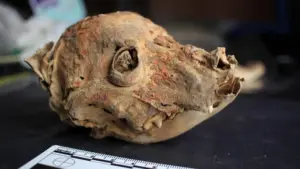
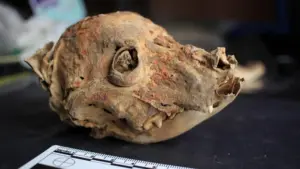
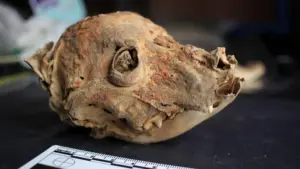
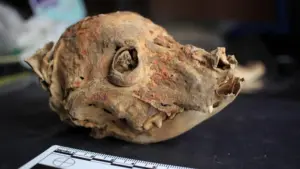
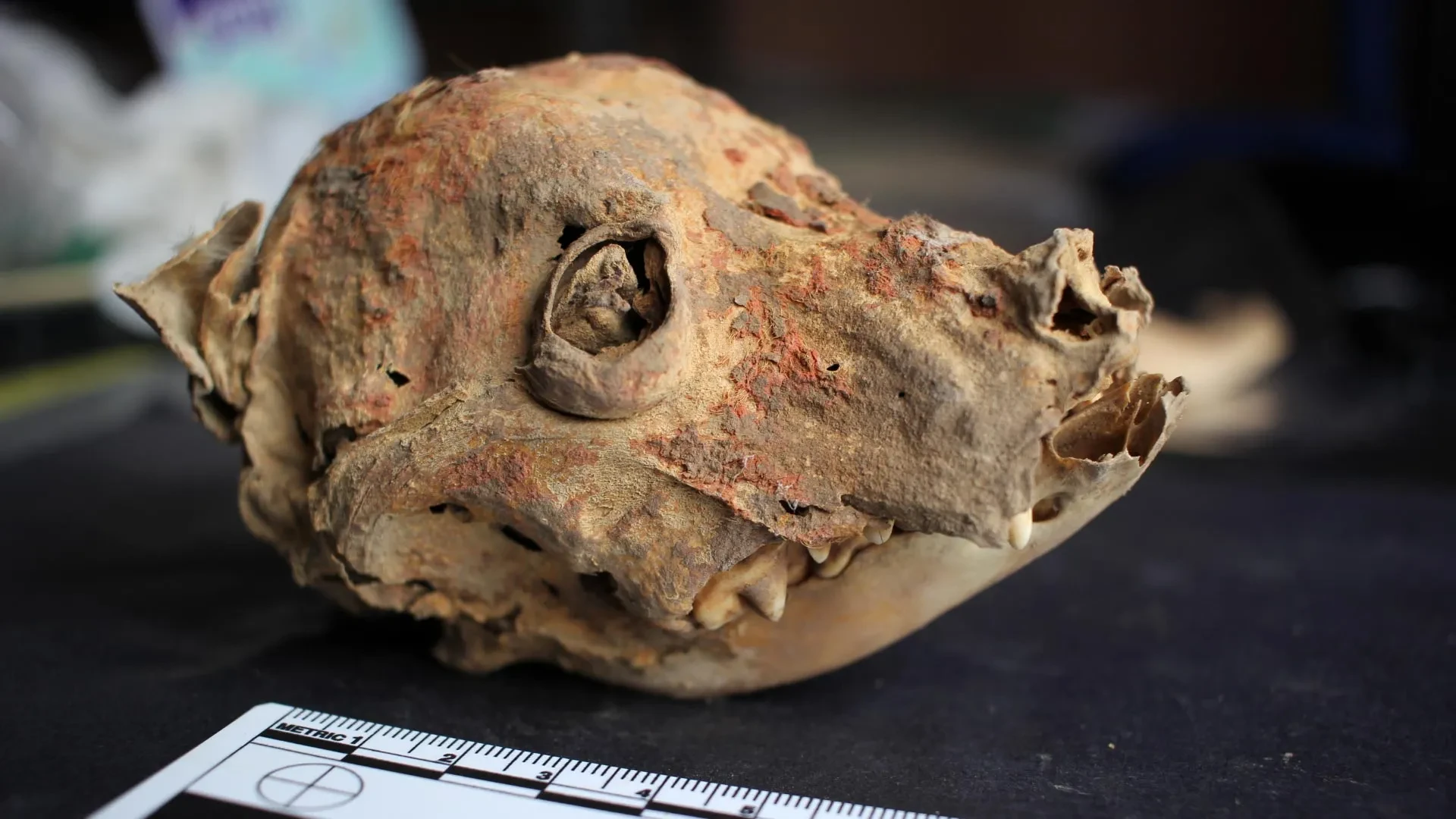
According to a landmark study published in the Journal of Anthropological Archaeology, researchers have uncovered the first definitive physical evidence of Peruvian hairless dogs at a Wari Empire site. These aren’t merely scattered bone fragments. The extraordinary finds include naturally mummified remains complete with visible hairless skin, intact ears, and vibrant red cinnabar pigment coatings, alongside distinct skeletal anomalies.
By combining traditional zooarchaeology with advanced isotopic testing, an international team of researchers has mapped out a timeline dating these canines back more than 1,200 years. This discovery not only pushes back the established historical timeline for the widespread presence of these distinct dogs in northern Peru, but it also sheds light on ancient breeding practices, societal hierarchies, and the varied roles animals played in the daily lives of ancient civilizations.
Detailed Chronology: Unraveling the Secrets of Castillo de Huarmey
To fully grasp the significance of the canine remains, one must understand the chronological tapestry of Castillo de Huarmey itself. Built and occupied centuries before the Incas consolidated power in the Andes, the site has long been a focal point for Andean archaeology, marked by a series of monumental discoveries that continue to reshape our understanding of imperial governance.
The Decades of Discovery (2012–2022)
- 2012: Archaeologists announced a watershed moment in Andean studies by uncovering the first completely undisturbed elite Wari tomb at Castillo de Huarmey. Hidden beneath layers of debris and stone, the chamber contained the opulent remains of 58 high-status women, six human sacrifices, and approximately 1,300 precious artifacts made of gold, silver, and precious stones.
- 2022: A subsequent breakthrough revealed elite craftspeople’s burials adjacent to the central complex. These tombs were accompanied by a trove of specialized bronze, silver, and gold working tools, proving that Castillo de Huarmey was not just a political nexus, but a bustling hub of high-end manufacturing and artistry.
- 2010–2025: Ongoing, methodical excavations across the broader ceremonial and residential zones continually brought forth South American camelid remains (domesticated llamas and alpacas), alongside animal bones that hinted at a rich fauna population coexisting with the human inhabitants.
The 1970 Earthquake and the Challenge of Stratigraphy
Interpreting the site’s layers has not been without its hurdles. In 1970, a devastating earthquake shook the region, causing portions of Castillo de Huarmey to collapse. This structural failure exposed subterranean burial chambers, which unfortunately triggered waves of illegal looting that disturbed the upper archaeological strata.
However, deeper, untouched contexts remained pristine. When archaeologists zeroed in on the northern section of the main ceremonial area, they hit a jackpot of preserved animal remains. The upper layers—though historically churned by natural disaster and human interference—yielded three sets of dog remains that immediately baffled and fascinated the research team.
The Breakthrough of the Mummified Dog
Among the most stunning finds was a naturally mummified male dog, preserved in a shallow pit thanks to the relentless aridity of the Peruvian desert. Featuring taut, mummified skin and remarkably intact structural features, the dog was initially suspected by field researchers to be a relatively modern intrusion—perhaps a modern pet buried within the last half-century of looting activity.
That hypothesis evaporated when lead researchers inspected the anatomical features of the specimens. The dogs displayed the trademark biological signatures of the Peruvian hairless breed: a total lack of fur, distinct skull structures, and a very specific dental anomaly.
Supporting Context & Metrics: Genetics, Diets, and Dental Clues
The identification of these ancient canines as Peruvian hairless dogs hinged on a fascinating biological quirk linking skin type to dental development.
The Genetics of Hairlessness and Missing Teeth
When examining the skull specimens, lead author Weronika Tomczyk and her team noticed a peculiar pattern: the animals were missing specific teeth, not due to trauma, disease, or old age, but because the teeth had never erupted from the jawbone.
"What I noticed is that some of the dog skeletons were missing teeth… some teeth, especially first premolars and sometimes last molars, had just never erupted," explains Tomczyk, a research associate at Dartmouth College. "And then I found in the literature that the same gene which is responsible for hairlessness in dogs is responsible for a reduced number of teeth, indicating that these were Peruvian hairless dogs."
This genetic linkage provided an undeniable scientific anchor, separating these remains from standard ancient mixed-breed dogs and confirming their identity as direct ancestors of the modern Peruvian Inca Orchid—a breed officially recognized as part of Peru’s national cultural heritage in 2000.
Quantitative Breakdown of the Findings
- Total Specimen Count: Excavations yielded 341 individual dog bone specimens.
- Minimum Individual Count: These bones represent at least 19 distinct dogs recovered across the complex.
- Age Distribution: While most recovered dogs were adults at the time of death, a significant number of juvenile remains—including a puppy aged just 6 to 8 weeks old—were discovered in elite contexts.
- Radiocarbon Dating: The complete mummified male dog was scientifically dated to be at least 1,200 years old, making it the oldest radiocarbon-dated canine specimen recovered from the site to date.
Isotopic Analysis: Reconstructing Ancient Diets
To understand how these animals lived and what kind of care they received, the research team deployed advanced zooarchaeological techniques, including stable isotope analysis. By extracting chemical signatures from the bones and teeth of the dogs, scientists mapped out the nutritional intake of the animals across different life stages.
- Tooth enamel acts as a chemical snapshot of a dog’s early life and puppyhood, because canine teeth erupt rapidly.
- Bone tissue records a cumulative chemical signal representing roughly the final year of the animal’s life.
The results revealed a startling dietary overlap between the dogs and the human population at Castillo de Huarmey. The vast majority of the canines had consumed significant amounts of maize (corn), the agricultural staple of pre-Hispanic Andean societies.
Even more intriguing, isotopic profiles of the hairless puppies revealed a diet closely mirroring that of human children during their early developmental stages. As the dogs matured into adulthood, their dietary sources diversified. This shift strongly suggests that these specific puppies may have received targeted care, specialized provisioning, or deliberate human feeding—pointing toward structured, controlled breeding practices within Wari society.
Official Statements & Expert Perspectives
The dual nature of human-animal relationships in antiquity is a central theme of the published study. Researchers emphasize that ancient people, much like modern humans, held deeply varied and sometimes contradictory views toward the animals in their communities.
"Our findings indicate that humans and dogs coexisted at this Wari site, but reconstructing their bond is challenging, as past emotions are difficult to capture through archaeological methods," notes Weronika Tomczyk.
"The goal of our study was to not only present data on Castillo de Huarmey’s dog burials, but also emphasize that people in the past had often contradictory relationships with the animals, just as they do today: a pet for one group of people could at the same time be considered a pest by their closest neighbors."
The spatial context of the burials further underscores this complex social standing:
- The Master Basketmaker’s Companion: A young puppy (6–8 weeks old) was laid to rest directly alongside an elite craftsperson known in archaeological literature as the "Master Basketmaker."
- The Palace Inhabitant: An adult dog’s remains were discovered deeply embedded within the structural footprint of the site’s primary palace zone.
- The Tomb Guardian: Part of a puppy skeleton was found buried alongside an adult male individual designated as "XY," believed to have been ritually sacrificed to serve as a perpetual guardian of the tomb.
Despite these intimate placements, the researchers remain cautious about romanticizing the bond. While a small subset of bones displayed butchery marks—indicating that dogs were occasionally consumed—the vast majority were either carefully interred or found mixed with general refuse.
"While we will never know if any of the three dogs were pets or how people treated them, it is evident they received different treatment than other dogs," Tomczyk concludes.
The collaborative study represents a massive international effort, featuring co-authors Miłosz Giersz, Wiesław Więckowski, and Roberto Pimentel Nita from the University of Warsaw, alongside Claire Ebert from the University of Pittsburgh.
Future Outlook: The Next Frontier in Andean Archaeology
The unearthing of these 1,200-year-old hairless dog mummies opens expansive new avenues for historical and biological research in South America. As archaeological science advances, the methodologies applied at Castillo de Huarmey are setting a new benchmark for how researchers study ancient fauna.
Moving forward, the research team aims to expand genetic sequencing on the preserved tissue samples of the mummified dogs. Extracting ancient DNA (aDNA) could unlock unprecedented details regarding the evolutionary lineage of the Peruvian hairless dog, mapping out how the breed’s genetic markers shifted over the centuries from the Wari Empire, through the subsequent rise and fall of the Inca Empire, and into the modern era.
Furthermore, comparative isotopic studies across other coastal and highland Wari sites will help historians determine whether the specialized breeding and dietary practices observed at Castillo de Huarmey were isolated local customs or widespread imperial policies.
Ultimately, these hairless canines—preserved by the unforgiving sands of the Peruvian desert—serve as a bridge across the millennia. They remind us that our ancestors’ lives were richly complicated, deeply intertwined with the animal kingdom, and populated by loyal companions whose echoes still resonate in the silent, sun-baked ruins of the Andes.