
Executive Overview
In November 2024, a violent domestic ambush in Shoreline, Washington, ended in physical trauma, legal prosecution, and an extraordinary display of canine bravery. Lauren Wiggins was shot twice by her former fiancé, Garren Hunter, outside her apartment. As the attack unfolded, her seven-year-old dog, Judah, launched himself into harm’s way, biting the assailant and drawing gunfire away from his owner. While Wiggins survived the attack with permanent physical injuries, Judah suffered a direct gunshot wound to the head.
Nearly two years after the incident, the bond between the survivor and her protector faces a new, critical test. Veterinary neurosurgeons initially determined that extracting bullet fragments from Judah’s skull presented too high a mortality risk, choosing instead to monitor the metal lodged within his head. Recent diagnostic examinations, however, reveal that these fragments have shifted position, causing swelling and threatening vital neurological pathways.
Today, Wiggins—who lives with partial paralysis resulting from her own bullet wounds—is engaged in an urgent race against time to fund and secure high-risk cranial surgery for her dog. This investigative report details the full timeline of the assault, the ongoing medical and neurological challenges faced by both victim and canine, the court proceedings surrounding the perpetrator, and the complex legal and financial realities confronting domestic violence survivors and their pets.
Detailed Chronology
[November 2024] ─── Domestic ambush in Shoreline, WA; Lauren Wiggins shot twice; Judah intervenes & takes bullet to head.
        │
[Post-Incident] ─── Emergency response; Hunter arrested; initial veterinary care leaves fragments in Judah's skull.
        │
[Legal Process] ─── Hunter pleads guilty to 3rd-degree assault; Judge Oishi sentences him to 20 months in prison.
        │
[2 Years Later] ─── Wiggins copes with lower-leg paralysis; Judah develops severe head swelling.
        │
[Current Status]─── Imaging confirms bullet fragment migration; urgent cranial surgery required; GoFundMe launched.
Phase I: The Ambush in Shoreline
In November 2024, Lauren Wiggins was preparing to leave her apartment complex in Shoreline, Washington, when she was confronted by her former fiancé, Garren Hunter. The encounter escalated rapidly into lethal violence. Hunter drew a handgun and opened fire at close range, striking Wiggins twice—once in the leg and once near her pelvis.
At the moment the shooting began, Wiggins was on a phone call with her father. Court records show that her father heard Hunter make explicit verbal threats before distinct gunshots rang out, followed immediately by Wiggins screaming that she had been shot.
Phase II: The Canine Intervention
As Wiggins lay incapacitated, Judah—her seven-year-old dog—acted instinctively to protect her. Leaping toward the shooter, Judah bit Hunter on the ear, disrupting the attack. In response, Hunter redirected his firearm toward the dog and fired at point-blank range, striking Judah directly in the head.
Wiggins later stated that Judah’s intervention disrupted the assailant long enough to prevent additional, likely fatal, shots from being fired into her body. Deprived of the opportunity to continue his assault, Hunter fled the immediate scene, leaving Wiggins and Judah bleeding in the building’s hallway.
Phase III: Emergency Response and Initial Medical Assessments
Disoriented neighbors responding to the sound of gunfire discovered Wiggins severe injuries in the hallway and dialed 911. Law enforcement officers from the Shoreline Police Department arrived shortly thereafter, securing the scene and initiating emergency medical aid before locating and arresting Hunter.
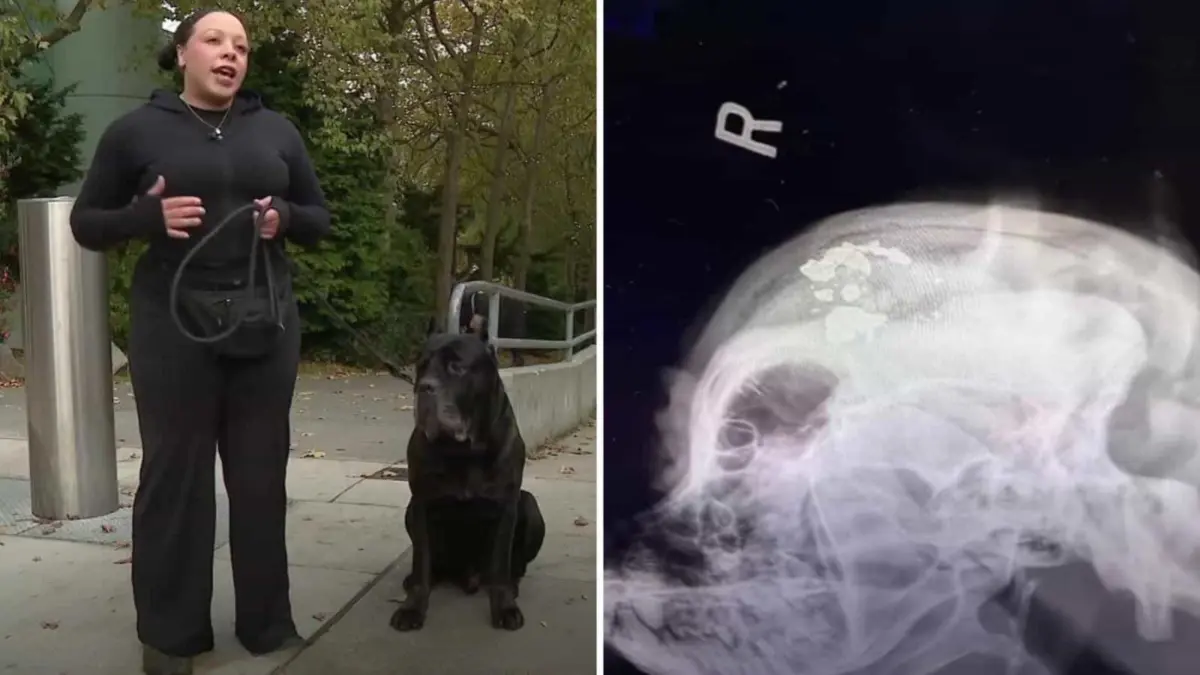
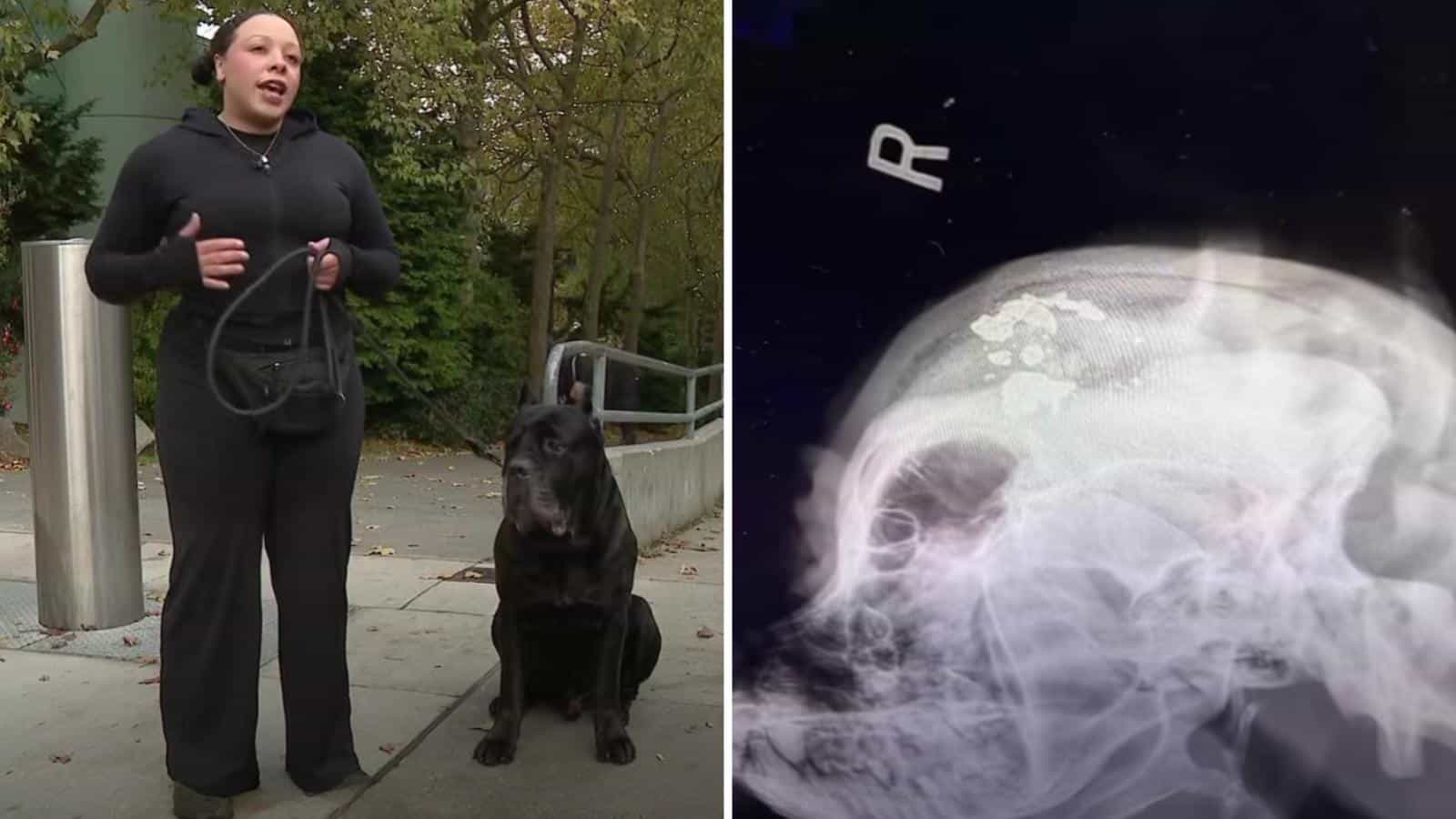
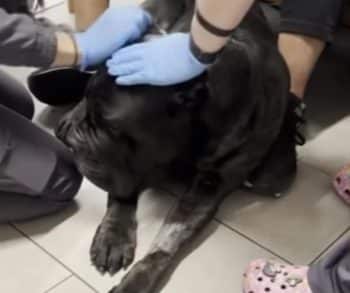
Wiggins was rushed to a trauma center, where surgeons stabilized her life-threatening injuries. Concurrently, Judah received emergency veterinary treatment. Radiographs confirmed that bullet fragments were embedded deep within his cranial structure. Because surgical removal posed a high risk of catastrophic brain damage or death, the veterinary team decided against immediate extraction, opting instead to leave the fragments encapsulated in surrounding tissue while monitoring the dog for long-term complications.
Phase IV: Delayed Complications and Emerging Crisis
In the years following the attack, Wiggins underwent extensive physical rehabilitation. She suffered permanent nerve damage, resulting in paralysis in her right leg from the knee down, requiring the daily use of a specialized orthotic walking device.
Judah initially recovered from his superficial wounds, remaining a steady companion throughout Wiggins’s physical and emotional rehabilitation. However, nearly two years after the shooting, Wiggins noticed abnormal localized swelling on Judah’s head, accompanied by signs of discomfort. Subsequent veterinary evaluations and imaging revealed a severe development: the encapsulated bullet fragments had dislodged and begun migrating through tissue toward critical regions of his brain and optic pathways.
Supporting Context & Metrics
Ballistic Trauma and Fragment Migration Mechanics
The secondary crisis facing Judah highlights a complex phenomenon in veterinary medicine: delayed foreign body migration. When high-velocity projectiles shatter upon impact with skeletal structures, micro-fragments can remain suspended within soft or connective tissue. Over time, physical activity, changes in intracranial pressure, or localized inflammatory reactions can breakdown the fibrous tissue encapsulating the metal.
+-------------------------------------------------------------------+
|               CRANIAL BALLISTIC TRAUMA ANALYSIS                   |
+-------------------------------------------------------------------+
|  [Initial Impact]  --> Projectile fractures upon hitting tissue   |
|                                 │                                 |
|                                 ▼                                 |
|  [Encapsulation]   --> Fibrous tissue isolates metal fragments    |
|                                 │                                 |
|                                 ▼                                 |
|  [Delayed Shift]   --> Tissue breakdown / pressure changes cause  |
|                        fragment migration toward central brain    |
+-------------------------------------------------------------------+
In Judah’s case, the physical displacement of these metallic fragments carries distinct risks:
- Neurological Impairment: Encroachment on motor or sensory cortex areas.
- Optic Nerve Damage: Compression of optic pathways, threatening total vision loss.
- Intracranial Hemorrhage: Potential laceration of delicate blood vessels during fragment movement.
- Infection and Encephalitis: Chronic inflammation triggered by toxic trace elements or foreign tissue introduction.
Trauma and Recovery Indicators
| Parameter | Lauren Wiggins | Judah (Hero Dog) |
|---|---|---|
| Primary Injury | Gunshot wounds to leg and pelvis | Point-blank gunshot wound to skull |
| Long-Term Impact | Paralysis (right leg below knee); orthotic dependency | Brain tissue compression; shifting fragments |
| Immediate Treatment | Emergency trauma surgery; intensive physical therapy | Wound stabilization; non-surgical monitoring |
| Current Status | Permanent mobility restriction | Requires high-risk cranial surgery |
| Role in Incident | Victim / Target | Active protector / Intervener |
The Financial Strain on Domestic Violence Survivors
The dynamic between domestic violence trauma and pet ownership often involves acute financial strain. Specialized veterinary neurosurgery, advanced magnetic resonance imaging (MRI), CT scans, post-operative intensive care, and specialized medications can range from $8,000 to over $15,000.

For survivors managing their own ongoing medical bills, disability care, and lost wages, unexpected specialized veterinary costs pose a substantial hurdle. In response, Wiggins turned to public crowdfunding, establishing a dedicated GoFundMe campaign to cover Judah’s upcoming surgical procedures and recovery expenses.
Official Statements and Judicial Proceedings
Legal Outcome and Sentencing
The criminal case against Garren Hunter proceeded through the King County Superior Court system. Initially charged with first-degree assault—a felony carrying severe mandatory prison time—Hunter ultimately entered a negotiated plea agreement, pleading guilty to reduced charges of third-degree assault with a firearm enhancement.
During the sentencing hearing, King County Superior Court Judge Patrick Oishi sentenced Hunter to 20 months in state prison. The judicial order mandated that following his release, Hunter be placed under formal Department of Corrections (DOC) supervision with strict conditions:
- Complete mandatory psychiatric and mental health treatment.
- Adhere to a strict, permanent no-contact order protecting Lauren Wiggins.
+------------------------------------------------------------------+
|                    LEGAL CASE SUMMARY                            |
+------------------------------------------------------------------+
| Jurisdiction      : King County Superior Court                   |
| Presiding Judge   : Hon. Patrick Oishi                           |
| Defendant         : Garren Hunter                                |
| Initial Charge    : Assault in the First Degree                  |
| Final Disposition : Guilty Plea to 3rd-Degree Assault            |
|                     (with Firearm Enhancement)                   |
| Sentence          : 20 Months Imprisonment + DOC Supervision     |
+------------------------------------------------------------------+
Prosecutorial Insights
Senior Deputy Prosecutor David Martin addressed the rationale behind the charge reduction, citing complex evidentiary and psychological factors preceding the assault. According to prosecutorial statements, Hunter was experiencing an acute psychiatric episode at the time of the shooting, an element that introduced significant legal complexity regarding intent and competency during trial preparation.
Statements from Lauren Wiggins
Speaking on her dog’s intervention and his current health crisis, Wiggins emphasized the depth of her debt to Judah and the weight of her survivor’s guilt:
"If I had gotten two extra shots to me, I would’ve died that night. He’s literally my lifeline. Without him, I probably would’ve crumbled and fallen apart."
Expressing her distress over Judah’s deteriorating condition, she pointed to the urgency of his impending surgery:
"If the fragments that have already shifted kept on moving around, it could go to his brain. It could affect his eyes, and I don’t want that to happen to him. He doesn’t deserve that. He really is my soul dog, he’s literally everything to me."
Future Outlook
Medical Risks and Surgical Prognosis
Judah’s upcoming surgical procedure presents significant surgical risks. Operating within the canine skull requires precise neuro-navigation to extract metal fragments without damaging surrounding brain tissue or key vascular structures. The primary objectives of the neurosurgical team are to:
- Safely remove dislodged metallic fragments.
- Relieve localized tissue swelling and intracranial pressure.
- Prevent permanent loss of sight or irreversible cognitive decline.
Post-operative recovery will require strict immobilization, neurological monitoring, and long-term anti-inflammatory therapy to manage brain swelling.
+-------------------------------------------------------------------+
|               POST-SURGICAL RECOVERY ROADMAP                      |
+-------------------------------------------------------------------+
|  [Stage 1: Intensive Care]  --> Intracranial pressure monitoring  |
|                                 & anti-inflammatory treatment     |
|                                 │                                 |
|                                 ▼                                 |
|  [Stage 2: Diagnostics]     --> Post-op CT/MRI to confirm full   |
|                                 fragment removal                  |
|                                 │                                 |
|                                 ▼                                 |
|  [Stage 3: Rehabilitation]  --> Physical therapy & controlled     |
|                                 environment for bone healing      |
+-------------------------------------------------------------------+
Long-Term Healing and Community Support
For Lauren Wiggins, Judah’s survival and recovery are inextricably linked to her own long-term healing process. As she continues to adapt to her physical disability, saving the dog that preserved her life remains her paramount focus.
The story highlights the critical role pets play during violent crises, as well as the long-term support systems required by victims of severe trauma. As the campaign to cover Judah’s medical costs continues, his journey stands as a powerful example of canine devotion—and the dedicated efforts of a grateful owner fighting to save her protector.