
By Don Vaughan
Special to Veterinary Practice News
Executive Overview
In the modern landscape of zoological medicine, a quiet revolution is taking place behind the scenes. As top-tier institutions provide increasingly sophisticated, proactive healthcare, exotic animals are living significantly longer lives than their wild counterparts. However, this extended longevity introduces a familiar biological challenge: age-related degenerative conditions, most notably osteoarthritis, spinal degeneration, and joint stiffness.
To combat these issues, major zoological parks—including the San Diego Zoo Wildlife Alliance, Brookfield Zoo Chicago, and the Smithsonian’s National Zoo and Conservation Biology Institute—have successfully imported advanced physical rehabilitation techniques from the domestic veterinary sector. Far from being a mere novelty, animal physical therapy has evolved into a vital, evidence-based standard of care. Utilizing modalities ranging from canine-derived radioactive isotope injections and cold laser therapy to custom obstacle courses and balance boards, veterinary specialists are dramatically improving the quality of life for everything from five-year-old tamanduas to 44-year-old gorillas and ancient Galapagos tortoises.
Detailed Chronology: The Case of Mani the Tamandua
The tangible benefits of this cross-species medical translation are best illustrated through individual patient journeys. Consider Mani, a five-year-old male tamandua residing at the San Diego Zoo. Despite being only middle-aged for his species, Mani’s keepers noticed a concerning decline in his daily agility. He was slowing down, experiencing noticeable limb stiffness, struggling to pull his body weight up from a tail hang, and demonstrating uncharacteristic hesitation and instability when descending sloped perches. Compounding these symptoms were a couple of alarming falls within his habitat.
Diagnostic Evaluation and Imaging
Recognizing that Mani’s symptoms pointed toward an underlying structural pathology, the zoo’s veterinary team intervened.
- Advanced Imaging: A comprehensive computed tomography (CT) scan revealed caudal lumbar spondylosis deformans, alongside localized spondylosis within his cervical and thoracic spine.
- Mobility Assessment: Senior veterinarian Deena Brenner, DVM, DACZM, performed a detailed physical evaluation. Dr. Brenner noted moderate stiffness in Mani’s rear legs, a mild kyphosis (humpback curvature) at the thoracolumbar junction, and reduced extension and stiffness in his hips—particularly problematic when the animal attempted to stand upright. Furthermore, Mani demonstrated an uncharacteristically slow and deliberate utilization of his prehensile tail, a critical balancing and climbing tool for the species.
Tailored Rehabilitation Protocol
Referred for formal physical rehabilitation to restore his strength, functional movement, and overall mobility, Mani was placed on a specialized, progressive exercise regimen:
- Vertical Weaves: A series of vertical poles through which Mani had to weave his body, encouraging lateral flexibility and coordination.
- Cavalletti Rails: Raised ground obstacles that required him to lift his limbs with heightened awareness and precision.
- Specialized Tunnel Navigation: A tunnel designed specifically to promote spinal extension and core stabilization.
- Balance Boards and Incline Ramps: Dynamic equipment utilized to build core strength and re-establish proprioception.
Outcomes and Long-Term Recovery
Following seven months of dedicated physical therapy, Mani’s transformation was profound. Wildlife care staff reported that the tamandua had returned to his old self. According to Dr. Brenner—who holds a specialty certification in veterinary physical rehabilitation—Mani moves far more comfortably today, exhibits a stronger rear-limb posture, maintains better traction without slipping, and has experienced zero subsequent falls. The physical rehabilitation protocol proved to be the decisive factor in preserving his quality of life and ambassador status at the zoo.
Supporting Context & Metrics: The Parallels Between Zoo and Domestic Medicine
The integration of physical therapy into zoology highlights a fascinating convergence in comparative medicine. According to James Steeil, DVM, DACZM, a supervisory veterinarian at the Smithsonian’s National Zoo and Conservation Biology Institute, the clinical philosophy governing a zoo patient is fundamentally indistinguishable from that applied to a house pet.
"I can have the same conversation about the treatment of arthritis in my cat and in a tiger at the zoo," Dr. Steeil observes. "The outcomes might be slightly different because of limitations based mostly on safety, but what we provide is eerily similar to what the general practitioner is doing in terms of diagnostics, treatments, and collaboration with specialists."
Translating Canine Techniques to Exotic Species
This sentiment is echoed by Dr. Brenner, who marvels at the sheer adaptability of canine and feline rehabilitation protocols. While the underlying anatomy varies vastly from a domestic dog to an anteater, a gorilla, or a tortoise, mammalian and reptilian biological aging processes share striking similarities. Consequently, the therapeutic pillars—analgesia, targeted exercise, and structured range-of-motion activities—remain universal.
The Spectrum of Species-Specific Interventions
While rehabilitation therapy is carefully evaluated against the stress thresholds and fragility of each species, the current roster of zoo patients receiving therapy is remarkably diverse:
- Aardvarks: At the San Diego Zoo, a young female aardvark named Zola—who sustained a severe neck injury early in life—receives twice-weekly therapeutic exercises, supplemented by analgesics, acupuncture, and manual soft-tissue therapy.
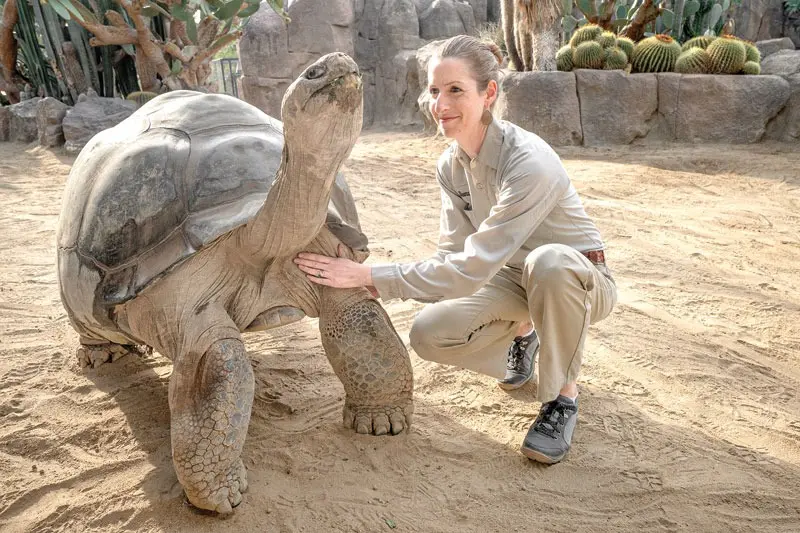
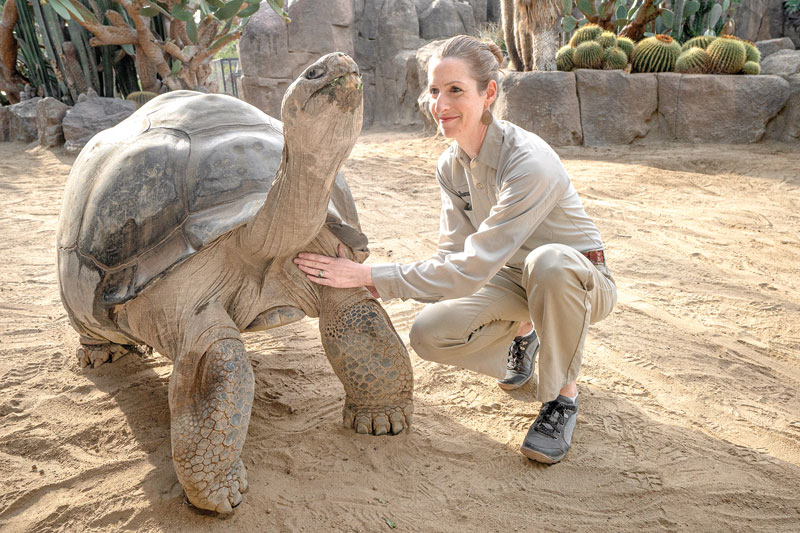
- Galapagos Tortoises: Three geriatric tortoises at San Diego undergo weekly manual therapy for osteoarthritis. Practitioners utilize the structural rigidity of the shell much like a clinician would use the ribs and spine, manipulating the body across different planes while applying targeted manual massage to the limbs.
- Leopard Tortoises: At Brookfield Zoo Chicago, a female leopard tortoise named Kaya has undergone frequent rehabilitation sessions to manage a severe spinal deformity that previously impaired her hind-leg strength and defecation. Kaya’s customized regimen features core stabilization exercises on a balance ball, obstacle courses demanding deliberate limb elevation, and incline training for muscular hypertrophy.
- Komodo Dragons: In one of the most innovative cross-disciplinary collaborations, the Smithsonian’s National Zoo treated a popular male Komodo dragon named Murphy, who suffered from severe joint arthritis. Dr. Steeil partnered with Dr. Matt Brunke, DVM, DACVSMR (Canine), CCAT—a specialist in canine sports medicine and rehabilitation—to administer Synovetin OA, a radioactive isotope originally developed for dogs, directly into Murphy’s joints to suppress local inflammation and swelling. Though Murphy’s advanced age ultimately necessitated humane euthanasia in December 2024 despite measurable improvements in gait and comfort, the case proved that advanced biologic therapies could be safely and effectively adapted for reptilian physiology.
Official Statements and Collaborative Animal Care
Behind every successful rehabilitation case lies a deeply integrated partnership between veterinary specialists and animal care professionals. Because wild and exotic animals cannot be managed through traditional domestic handling methods, zoo programs rely heavily on voluntary participation and mutual trust.
The Role of Animal Care Specialists
Jennifer McGee, Director of Wildlife Experiences at Brookfield Zoo Chicago, emphasizes that animal care specialists form the frontline of preventative and rehabilitative medicine. Because these professionals work daily with the animals over spans of years or decades, they develop an intimate baseline understanding of normal movement, temperament, and behavioral nuances.
"Animal care specialists have a really good eye as a result of their relationship with the animals under their care," says McGee. "These animals are our colleagues. Many times, we work with them throughout their entire lives, which builds deep, respectful relationships."
Positive Reinforcement and Volitional Care
To execute physical examinations, collect diagnostic metrics, and deliver hands-on therapies without inducing chronic stress, zoos employ advanced operant conditioning. Animals are systematically trained to present specific body parts upon request using positive reinforcement methodologies. Behaviors are broken down into manageable micro-steps, and successful completion is rewarded with preferred food items, enrichment toys, or tactile praise.
"Because welfare is our top priority, it’s important an animal have a choice in their participation, and it’s a positive experience for them," McGee explains. "It’s all about making learning fun."
This approach was instrumental in managing Mandara, a 44-year-old female gorilla at the Smithsonian’s National Zoo. When caretakers observed her slowing down and demonstrating early signs of foot-shuffling, Mandara’s prior training—which taught her to voluntarily present her feet for inspection—allowed the veterinary team to rapidly diagnose ankle osteoarthritis and seamlessly institute physical therapy.
Future Outlook: Technology, Knowledge Transfer, and Community Impact
As veterinary medicine continues to evolve, the tools utilized in zoo rehabilitation mirror those found in cutting-edge human and canine sports medicine clinics. Beyond physical exercises, contemporary zoos routinely deploy:
- Advanced Diagnostics: High-resolution radiography, CT imaging, goniometry (joint angle measurement), and precise muscle girth measurements to establish baseline health profiles and monitor therapeutic efficacy.
- Interventional Modalities: Epidural steroid injections, cold laser therapy, shockwave therapy, and targeted pharmaceutical interventions.
The Two-Way Street of Knowledge Transfer
While zoos have historically adapted domestic veterinary protocols for exotic species, the flow of information is increasingly bidirectional. Zoos regularly publish their findings in peer-reviewed medical journals and present case studies at international veterinary conferences. Furthermore, public outreach campaigns—such as the Smithsonian’s viral video documenting Murphy the Komodo dragon’s arthritis treatment—serve an unexpected educational purpose for the general public.
Dr. Brunke notes that within a month of the Komodo dragon video’s release, he received direct consultations from pet owners inquiring about similar therapies for their dogs and cats. Intriguingly, many viewers also asked if such regenerative and rehabilitative interventions could be applied to human joint pain.
Looking forward, veterinary experts anticipate that as public awareness grows, client expectations will shift. As Dr. Brenner concludes:
"There are a lot more physical rehabilitation opportunities for small animals than there were just five years ago, and I think community veterinarians will be asked for rehabilitation therapy more as a standard of care moving forward."
By pushing the boundaries of what is possible for a tamandua, a tortoise, or a dragon, modern zoological rehabilitation is not only safeguarding the welfare of endangered and ambassador species—it is simultaneously elevating the entire continuum of veterinary practice for companion animals worldwide.