
Executive Overview
In an era defined by the urgent race to decarbonize global economies and transition toward renewable energy, local municipalities are frequently caught at the bleeding edge of land-use conflicts. On Tuesday, August 18, 2026, the Kearney County Board of Commissioners in Nebraska resolved one such complex dilemma, taking a monumental step that bridges the seemingly disparate worlds of wildlife conservation and sustainable rural economic development. The Commission unanimously approved a comprehensive set of wind energy regulations designed to explicitly safeguard the Central Platte River’s internationally celebrated Sandhill Crane migration.
The newly enacted framework establishes a robust, science-backed setback of seven miles from the Platte River, effectively prohibiting the placement of large-scale wind energy infrastructure within a vital ecological buffer zone. This decisive action has drawn widespread acclaim from conservation organizations, most notably the National Audubon Society’s Rowe Sanctuary, which spent months collaborating with local officials, providing scientific data, and engaging in public discourse.
Far from being an impediment to green infrastructure, Kearney County’s ruling serves as a masterclass in smart, forward-thinking regional planning. It proves that the deployment of renewable energy technologies—crucial weapons in the fight against catastrophic climate change—does not have to come at the expense of irreplaceable natural wonders. By safeguarding the delicate riparian ecosystems of the Platte River, Kearney County is not only protecting a globally significant avian phenomenon but also shielding a localized ecotourism economy that pours tens of millions of dollars into Central Nebraska every single year.
This article explores the multi-month legislative journey, the rigorous scientific methodologies that informed the final boundaries, the broader socio-economic stakes, and the evolving blueprint for how rural American communities can successfully balance clean energy ambitions with robust ecological stewardship.
Detailed Chronology: The Path to Policy
The enactment of Kearney County’s milestone wind regulations was far from an overnight decision. It was the culmination of a deliberate, months-long administrative process characterized by public hearings, rigorous debate, stakeholder engagement, and the careful synthesis of peer-reviewed ecological science.
The Genesis of the Regulatory Review
As renewable energy developers increasingly set their sights on the vast, windy expanses of the American Great Plains, counties throughout Nebraska found themselves grappling with outdated or nonexistent zoning laws regarding wind turbine siting. Kearney County, bordered to the north by the life-giving artery of the Platte River, faced unique pressures. The county lines encompass segments of a landscape that is globally recognized as an irreplaceable bottleneck for migratory birds. Recognizing that ad-hoc permitting processes left both developers and landowners in a state of regulatory uncertainty—while exposing sensitive ecosystems to potential hazards—the Kearney County Board of Commissioners initiated a formal review of the county’s wind energy oversight framework earlier in 2026.
Rowe Sanctuary’s Proactive Engagement
Sensing both a vulnerability and an opportunity, the team at Audubon’s Rowe Sanctuary integrated themselves into the municipal policy-making pipeline from the earliest stages. Rather than adopting an adversarial posture against renewable energy expansion, Rowe Sanctuary positioned itself as a constructive scientific resource.
Over several months of public workshops and Board of Commissioners meetings, sanctuary representatives presented empirical research, mapping data, and behavioral studies detailing how migrating Sandhill Cranes utilize the Platte River corridor. They laid out the case that while the transition away from fossil fuels is non-negotiable for planetary survival, the physical location of wind infrastructure must be dictated by ecological sensitivity rather than mere convenience or transmission line proximity.
The Deliberation and the Compromise
Throughout the legislative process, the debate frequently centered on distance: How far back from the river must industrial wind turbines be placed to ensure that migrating birds do not alter their flight paths, abandon critical roosting sites, or face heightened collision risks?
Initial scientific modeling presented by conservationists suggested that a minimum separation of six miles was necessary, based on the spatial ecology of the cranes. As negotiations progressed and public comments were thoroughly vetted, the Kearney County Board of Commissioners elected to push the envelope even further.
On Tuesday, August 18, 2026, the Commission officially voted to approve a mandatory seven-mile setback from the Platte River for all major wind energy developments. This decisive vote marked the end of months of localized civic engagement and established a new precedent for how rural Nebraska counties can exercise local governance to protect natural assets of international significance.
Supporting Context & Metrics: Ecology and Economics
To fully appreciate the gravity of Kearney County’s decision, one must examine the staggering ecological scale of the Central Platte River ecosystem and the profound economic ecosystem that has blossomed alongside it.
The Ecological Significance of the Central Platte River
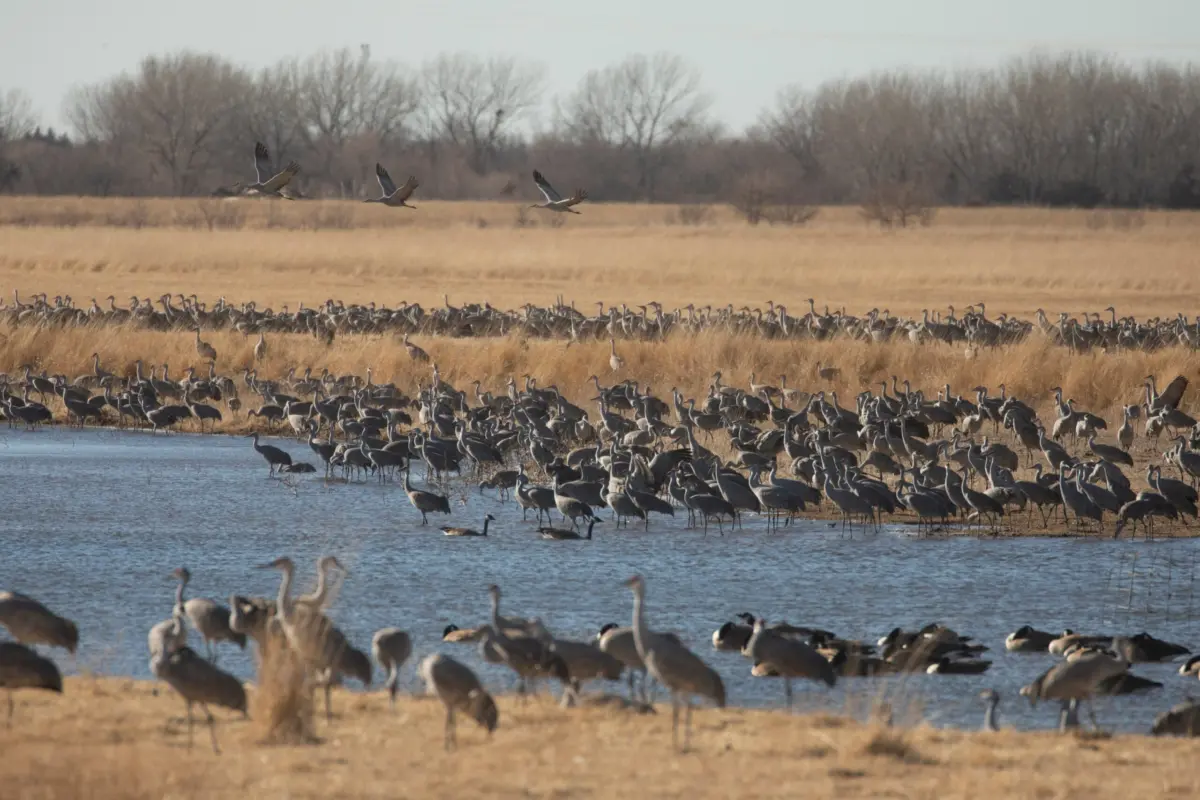
Every spring, the skies and riverbanks of Central Nebraska transform into one of the most magnificent wildlife spectacles on planet Earth. More than a million Sandhill Cranes—representing the vast majority of the continent’s population—converge upon the Platte River valley. For these majestic birds, which undertake grueling migrations from wintering grounds in the southern United States, Mexico, and even parts of South America to breeding grounds in the Arctic and sub-Arctic, the Platte River is an indispensable pitstop.
Here, the wide, shallow river channels offer safe nocturnal roosting sites protected from mammalian predators, while the surrounding wet meadows and agricultural fields provide the high-calorie food sources (such as waste corn and macroinvertebrates) required for the birds to double their body weight before completing their journey north.
However, Sandhill Cranes are notoriously sensitive to anthropogenic visual and acoustic disturbances. Decades of wildlife biology research have demonstrated that large industrial structures—such as commercial wind turbines towering hundreds of feet into the air—can profoundly alter avian behavior. Cranes frequently exhibit "displacement behavior," actively avoiding otherwise suitable foraging and roosting habitats within several miles of tall vertical obstructions. Furthermore, rotating turbine blades introduce collision risks during low-visibility conditions, such as the heavy spring fogs characteristic of the Platte River valley.
The Economic Engine of Ecotourism
While the moral and ecological imperatives to protect wildlife are self-evident, conservation victories in rural America often hinge on local economic realities. In Central Nebraska, nature is big business.
A landmark economic impact study released by Audubon examined the financial footprint of the spring wildlife migration and revealed staggering figures:
- Annual Economic Output: The spring migration pumps approximately $28 million directly into the regional economy of Central Nebraska.
- Job Creation and Small Businesses: This financial influx is not an abstract macroeconomic statistic; it directly supports local motels, restaurants, outfitters, guides, photography tours, and retail establishments.
- Global Attraction: Visitors from all 50 states and dozens of foreign countries descend upon Kearney County and neighboring jurisdictions each spring, booking guided crane-viewing blinds at Rowe Sanctuary and contributing to a thriving agritourism sector.
The economic data exposes a profound truth: healthy, intact ecosystems and thriving rural human communities are not mutually exclusive; rather, they are inextricably linked. By passing the seven-mile wind setback, Kearney County protected its local businesses and preserved an invaluable tourism asset that generates reliable revenue year after year.
Official Statements and Stakeholder Perspectives
The passage of the Kearney County wind regulations has reverberated across environmental, agricultural, and industrial policy circles, prompting strong statements from key stakeholders.
Audubon’s Rowe Sanctuary: A Model of Collaborative Conservation
Leaders at the National Audubon Society were quick to praise the commissioners for their foresight, framing the decision as a triumph of collaborative problem-solving over polarization.
"At Rowe Sanctuary, we frequently state that conservation succeeds when people come together around shared values," a spokesperson for the organization noted following the August 18 vote. "This decision is a shining, positive example of that principle in action. We are deeply grateful to the Board of Commissioners for actively engaging the public, considering the best available science, and recognizing that protecting our natural heritage does not mean halting progress—it means guiding it intelligently."
Rowe Sanctuary’s involvement underscores Audubon’s nuanced, science-driven approach to the clean energy transition. The organization maintains that combating climate change is an absolute prerequisite for bird conservation, as warming temperatures threaten the habitats of hundreds of North American bird species. Consequently, Audubon is a staunch advocate for renewable energy deployment. However, that advocacy is strictly conditional on responsible siting.
The Science of Setbacks: Bridging Data and Policy
The advocacy strategy employed by conservationists was rooted in empirical spatial science. Research cited during the county hearings showed that Sandhill Cranes regularly utilize habitat extending roughly three miles outward from the Platte River corridor. Concurrently, independent behavioral studies revealed that cranes tend to avoid large vertical structures by a similar three-mile threshold.
By combining these two distinct avoidance and utilization radii, scientists calculated that a minimum six-mile buffer was required to insulate the core migration habitat from disruptive fragmentation. Kearney County’s final adoption of a seven-mile setback goes above and beyond these baseline scientific recommendations, signaling an exceptional level of municipal commitment to ecological preservation.
Future Outlook: A Blueprint for Rural Renewable Development
As the United States continues its multi-decade march toward a decarbonized grid, the intersection of renewable energy infrastructure and land conservation will remain a critical flashpoint. Kearney County, Nebraska, has provided a compelling blueprint for how local governments can navigate these turbulent waters.
The Replication Potential for Other Municipalities
The regulatory framework established in Kearney County offers a scalable template for counties across the Great Plains and beyond. As wind and solar developers scout new territories, local zoning boards often lack the technical expertise or legal frameworks to evaluate cumulative environmental impacts.
By demonstrating that rigorous, science-based setbacks can be implemented without alienating the clean energy sector or violating property rights, Kearney County has empowered neighboring jurisdictions to draft proactive zoning laws. This shifts the paradigm from reactive crisis management—where local communities find themselves divided over individual, highly controversial turbine projects—to systematic, predictable regional planning.
Looking Ahead: The Dual Imperatives of Climate Action and Biodiversity Protection
The overarching lesson of the Kearney County wind regulations is that society must learn to walk and chew gum at the same time. The climate crisis poses an existential threat to avian populations and human civilizations alike, making the rapid buildout of wind, solar, and energy storage technologies non-negotiable. At the same time, the ongoing biodiversity crisis means we cannot afford to bulldoze the last remaining strongholds of North America’s most iconic wildlife.
Through thoughtful compromise, civic participation, and a steadfast commitment to the best available science, Kearney County has proven that these two vital imperatives can coexist. The Sandhill Cranes will continue their ancient, awe-inspiring journey along the Platte River each spring, descending into the foggy dawn as their ancestors have done for millennia. And as they do, they will fly over a landscape that honors both the technological demands of the future and the natural wonders of the past—a future truly worth building together.