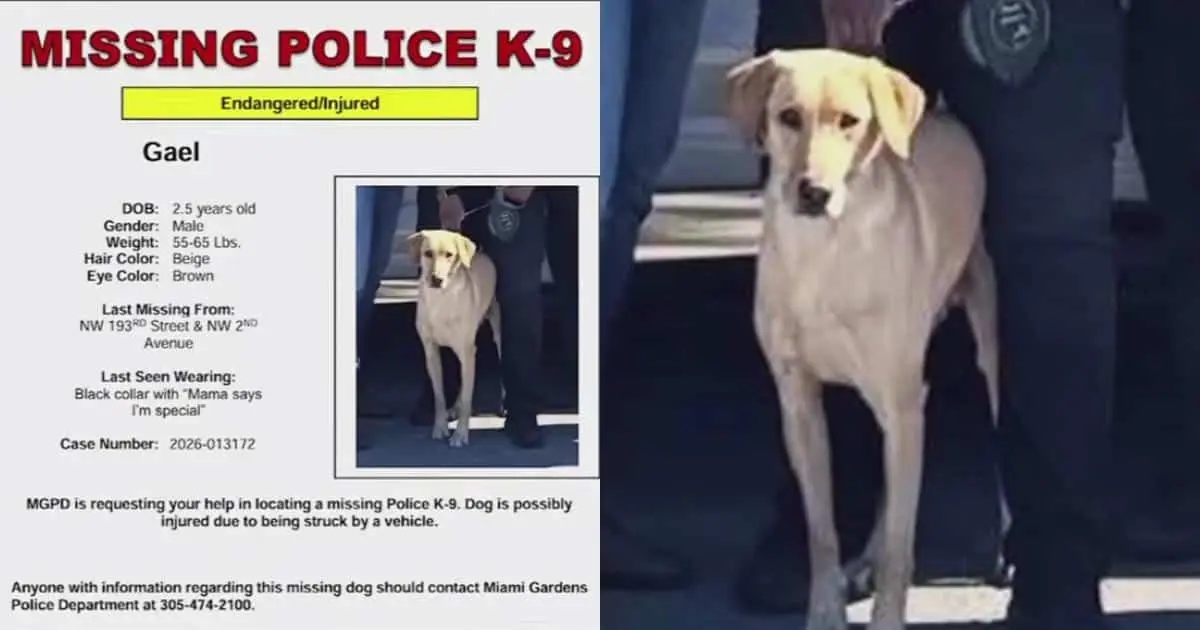
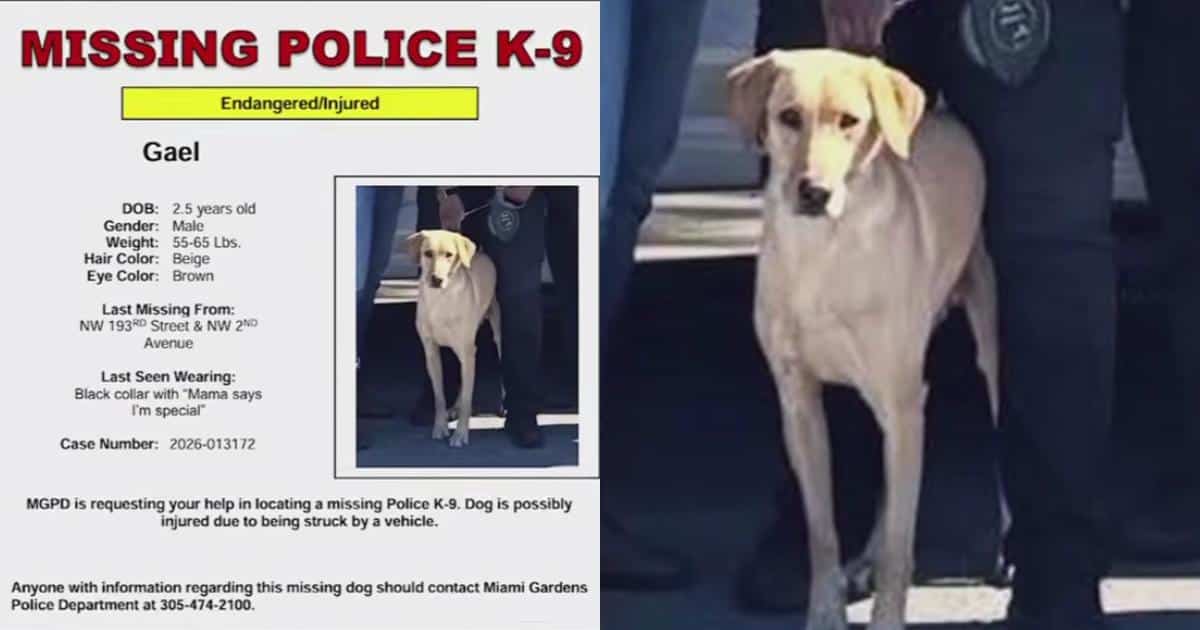
In an operation that transfixed the South Florida community and mobilized multiple law enforcement agencies, K-9 Gael, a two-and-a-half-year-old yellow Labrador Retriever belonging to the Miami Gardens Police Department, has been successfully recovered and found safe. The young canine officer had vanished on a Monday evening during a routine alarm response, sparking an intensive, multi-day search operation. The urgency of the search was compounded by chilling surveillance footage showing that Gael had been struck by a motor vehicle shortly after escaping his handler’s custody.
The search drew to a successful close following an outpouring of community support, citizen tips, and coordinated tactical sweeps. The Miami Gardens Police Department officially confirmed Gael’s safe return, praising the synergy between local residents, media outlets, and law enforcement personnel.
This report provides an exhaustive analysis of the incident, tracing the chronological sequence of Gael’s disappearance, the mechanics of the multi-agency tactical search, the physiological and psychological factors influencing the dog’s behavior, and the systemic implications for canine-handler protocols in suburban police departments.
Detailed Chronology
[Monday, 9:35 PM] K-9 Gael escapes during business alarm response on NW 195th St.
       │
       ▼
[Monday Night] Surveillance captures Gael running through a nearby tire shop.
       │
       ▼
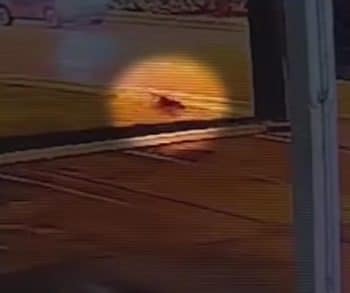
[Monday Night (Later)] Unreleased footage shows Gael struck by a vehicle; continues running east.
       │
       ▼
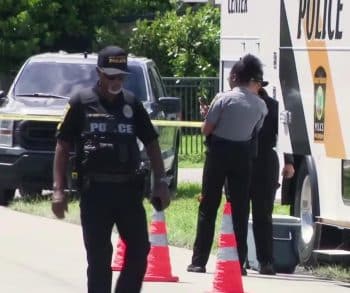
[Tuesday] Multi-agency search deployed (Ground units, Drones, Miami-Dade Aviation).
       │
       ▼
[Tuesday Night] Search temporarily paused; cordoned areas reopened to traffic.
       │
       ▼
[Wednesday Morning] Tactical search resumes with door-to-door flyer distribution.
       │
       ▼
[Post-Wednesday] Community tips lead to the successful recovery and medical evaluation of Gael.
The Disappearance: Monday, 9:35 p.m.
The incident began as a routine patrol assignment on the night of Monday. Officer K. Stanley and her canine partner, Gael, responded to a commercial burglar alarm near the 200 block of Northwest 195th Street in Miami Gardens.
Upon arriving at the scene, Officer Stanley executed standard deployment protocols. However, as she opened the rear transport door of her marked patrol vehicle, Gael unexpectedly bypassed his handler and bolted from the utility enclosure. The young Labrador ran east, crossing the busy lanes of Northwest Second Avenue. Despite immediate verbal recall commands from Officer Stanley, the dog did not respond and quickly disappeared into the surrounding commercial and residential grid.
The Investigative Lead: Surveillance Analysis
Detectives immediately began canvassing local businesses for closed-circuit television (CCTV) footage to establish Gael’s initial direction of travel.
The Tire Shop Footage: Investigators secured footage from a nearby automotive tire business. The video captured Gael running at high speed through the property’s open lot, confirming he was still in a high-arousal state shortly after escaping.
The Vehicle Collision Footage: A second, highly sensitive piece of surveillance footage—which authorities opted not to release to the general public—captured a critical and distressing development. The video showed Gael being struck by an unidentified vehicle as he crossed an intersection. Despite the force of the impact, the canine managed to regain his footing and continued fleeing eastward.
The revelation of the traffic collision transformed the incident from a standard missing-property recovery into an urgent rescue mission. Officers faced the reality that Gael was likely injured, highly disoriented, and experiencing a severe physiological flight response.
The Search Escalation: Tuesday through Wednesday
The Miami Gardens Police Department initiated an "all-hands-on-deck" search configuration. Because injured animals instinctively seek out dark, confined spaces to hide, the tactical parameters of the search had to be meticulously managed.
Air Support Integration: The Miami-Dade Sheriff’s Office Aviation Unit deployed helicopters equipped with Forward-Looking Infrared (FLIR) thermal imaging cameras to scan open fields, canal banks, and industrial yards.
Unmanned Aerial Systems (UAS): Tactical drone units were utilized to navigate tight alleyways and low-altitude zones inaccessible to helicopters.
Ground Grid Sweeps: K-9 handlers and patrol officers conducted systematic grid searches of the immediate area. By Tuesday night, after hours of unsuccessful scouring, the physical perimeter was temporarily dismantled to ease local traffic, though active investigative leads remained open.
Resumption and Community Canvas: On Wednesday morning, ground forces returned with renewed focus. Officers initiated a door-to-door canvas, distributing informational flyers, interviewing residents, and reviewing private residential smart-camera footage (such as Ring and Nest doorbells) to trace any subsequent movements.
The Recovery
The operation reached its successful conclusion when community tips, generated by widespread media coverage and social media mobilization, guided officers to Gael’s location. The dog was secured without further incident, brought in for immediate veterinary evaluation, and subsequently reunited with a relieved Officer Stanley.
Supporting Context & Metrics
Subject Profile: K-9 Gael
To understand the dynamics of the search and the public’s rapid mobilization, it is necessary to examine the profile of the canine officer:
Attribute
Details
Breed
Yellow Labrador Retriever
Age
Approximately 2.5 years
Weight
55 to 65 pounds
Physical Markers
Beige/yellow coat, brown eyes, athletic build
Identification
Microchipped; wearing a distinctive black collar inscribed with the phrase: "Mama says I’m special"
Specialization
Typically detection/tracking (non-apprehension breed)
The behavior exhibited by Gael—bolting from a patrol vehicle and ignoring commands—is a recognized phenomenon in animal behavior science, even among highly trained working dogs.
While police K-9s undergo rigorous environmental conditioning, they are still subject to instinctual survival mechanisms. The combination of a sudden environmental trigger (such as a loud noise or unexpected stimulus upon exiting the vehicle) can initiate an acute "fight-or-flight" response.
Once struck by the vehicle, Gael’s endocrine system would have flooded his body with adrenaline and cortisol. This hormonal surge temporarily masks physical pain, enabling the animal to run significant distances despite sustaining soft-tissue or skeletal trauma. In this state, a dog’s cognitive processing is severely restricted; they do not recognize familiar commands or voices and instead focus entirely on finding a secure hiding spot. This explained why standard verbal recalls from Officer Stanley were ineffective.
Official Statements
The successful recovery of K-9 Gael elicited strong statements of gratitude and relief from both departmental leadership and labor representatives.
The Miami Gardens Police Department issued a formal statement expressing deep appreciation for the collective civic response:
"Great news for everyone who followed the search for K9 Gael. Gael has been found and is safe after a community-wide effort to bring the missing police dog home. We want to thank everyone who shared posts, called in tips, provided leads, kept watch, and helped spread the word during the search. Gael is back where he belongs, and we couldn’t be more thankful. This successful search showed just how much of a difference a community can make when people come together."
Steadman Stahl, President of the Florida Police Benevolent Association, spoke extensively during the active search phase, highlighting the profound emotional weight these incidents carry for the law enforcement community:
"This is an all-hands-on-deck approach. These dogs are not just tools or pieces of equipment; they are family members to the handlers and crucial assets to our departments. The bond between Officer Stanley and Gael is incredibly deep, built through thousands of hours of joint training and shared danger. When a K-9 goes missing, there is an empty place beside the handler that is felt by the entire department. We are incredibly grateful to the residents of Miami Gardens who kept their eyes open and helped us bring Gael home safely."
Future Outlook
The safe recovery of K-9 Gael marks the end of a tense chapter, but it also initiates a period of administrative and medical review designed to prevent similar occurrences.
Medical Rehabilitation and Return-to-Duty Protocols
Having survived a confirmed vehicle strike, Gael must undergo a rigorous medical assessment before he can be cleared to return to active service:
Diagnostic Imaging: Full-body X-rays and ultrasound scans to detect internal bleeding, organ damage, or hairline fractures that may not have been immediately apparent due to shock.
Orthopedic Evaluation: Assessment of joint integrity and gait analysis to ensure no permanent mobility impairment resulted from the collision.
Psychological Re-conditioning: Working dogs involved in traumatic incidents can develop situational anxieties (e.g., fear of vehicles or specific loud environments). Behavioral specialists will work with Officer Stanley to evaluate Gael’s confidence levels during simulated deployments.
Tactical and Equipment Adaptations
In the wake of this incident, the Miami Gardens Police Department, along with neighboring agencies, will likely review their canine transport and deployment protocols.
GPS Telemetry Integration: While Gael was microchipped, microchips are passive RFID devices that require close-range scanning once the animal is already recovered. The department may explore the deployment of active GPS-tracking collars for all working K-9s. These collars utilize cellular and satellite networks to provide real-time location data, which would instantly mitigate the challenge of a fleeing canine.
Vehicle Safety Interlocks: Reviewing the mechanical design of patrol vehicle K-9 transport doors. Some modern units feature remote-release systems or secondary catch-gates to ensure that even if the primary door is opened, the dog cannot exit until the handler manually disengages a secondary barrier.
Refined Handler Training: Handlers may undergo updated training focusing on high-distraction exit protocols to ensure the dog remains in a "stay" or "heel" position before being fully released from the transport cabin.
Ultimately, the resolution of K-9 Gael’s disappearance stands as a premier example of modern community policing. The rapid, positive outcome was not achieved through tactical isolation, but through the transparent sharing of information, mutual trust, and a shared commitment to the safety of a beloved four-legged officer.