
EXECUTIVE SUMMARY
Long before a puppy takes its first clumsy steps on a leash, learns to sit on command, or prepares to navigate a complex human world as a life-changing partner, an invisible architecture of neurological growth is already being laid down. In the specialized realm of working dog breeding and training, the margin for error is razor-thin. Guide dogs and service dogs must possess a unique psychological resilience, emotional equilibrium, and cognitive adaptability to thrive amidst the chaotic stimuli of modern urban environments.
At Dogs Inc, an internationally recognized leader in the breeding and training of elite assistance canines, this rigorous preparation begins not at six months of age, nor even at six weeks—it starts on day one. Through the systematic application of science-backed methodologies such as Early Neurological Stimulation (ENS), handlers and canine development specialists harness the extreme plasticity of the neonatal period. This comprehensive report investigates the biological mechanisms, developmental milestones, and structural philosophies that transform helpless newborns into confident, unflappable working partners.
1. Executive Overview: The Science of Starting Early
The journey of a service dog is often visualized through the lens of formal obedience, harness work, and public access training. However, contemporary animal behavior science dictates that behavioral outcomes are deeply rooted in the earliest chapters of a puppy’s life. During the neonatal stage—spanning from birth through approximately two weeks of age—puppies are entirely blind, deaf, and incapable of independent thermoregulation. To the casual observer, they appear to be little more than fragile, sleeping bundles of potential, wholly dependent on their mother and littermates.
Beneath this quiet exterior, however, the central nervous system is undergoing a period of hyper-acceleration. The brain is actively forming neural pathways at an unprecedented rate, highly sensitive to internal and external stimuli. Organizations like Dogs Inc understand that these foundational weeks represent a critical window of vulnerability and opportunity.
By introducing controlled, non-invasive stressors via Early Neurological Stimulation (ENS), handlers stimulate the developing neurological system in a safe, repeatable manner. This process is designed to optimize cardiovascular performance, strengthen the adrenal glands, improve tolerance to stress, and enhance disease resistance. ENS is not a training regimen; it is a physiological tune-up. It acts as an early catalyst, preparing the nervous system for the rich tapestry of socialization, environmental enrichment, and formal training that lies ahead.

2. Detailed Chronology: The Stages of Canine Development
To understand why early intervention matters, one must examine the distinct chronological phases every puppy traverses on the path to maturity. Canine development is a sequential unfolding of biological windows, each carrying specific milestones, behavioral shifts, and developmental responsibilities.
The Neonatal Stage (Birth to 2 Weeks)
During this initial phase, puppies exist in a sensory-deprived state. Their eyes and ear canals remain tightly sealed, leaving them to navigate their immediate world primarily through the senses of touch, taste, and smell. Their primary activities are nursing, sleeping, and seeking out the thermal warmth of the maternal pile.
Despite their lack of sensory input, the neonatal period is the prime window for Early Neurological Stimulation. Because the neurological and cardiovascular systems are immature, the brief, gentle handling exercises of ENS provide mild physiological stress that triggers accelerated development. Research indicates that this controlled stimulation helps accelerate neurological growth, leading to greater stress tolerance later in life.
The Transitional Stage (2 to 4 Weeks)
As puppies cross the threshold into the transitional stage, a dramatic sensory awakening occurs. Around two weeks of age, the eyes and ears begin to open, flooding the puppy’s world with unprecedented sights and sounds. By week four, puppies are attempting to walk, engaging in playful vocalizations like barking, and experiencing the eruption of their deciduous (baby) teeth.
Dietary shifts also begin during this phase, as puppies transition from exclusive nursing to soft weaning foods. Socially, they begin recognizing their mother and littermates as distinct individuals, initiating the earliest forms of canine-to-canine communication and rudimentary bite inhibition.
The Socialization Period (3 to 12 Weeks)
Widely considered the most critical psychological window in a dog’s life, the socialization period is when the brain is maximally receptive to forming permanent associations with its environment.

- Weeks 3 to 8: Puppies learn vital social boundaries from their mother and littermates. They begin exploring novel objects, surfaces, and sounds under controlled conditions.
- Weeks 8 to 12: The puppy is typically placed with a volunteer puppy raiser or permanent owner. During this period, exposure to diverse human populations, unfamiliar environments, varying auditory stimuli, and other domestic animals is paramount.
Failing to provide rich, positive experiences during this window can result in fear-based behaviors, phobias, and chronic anxiety in adult dogs. Conversely, structured exposure builds robust coping mechanisms.
The Juvenile and Adolescent Stage (6 Months to 12+ Months)
As puppies mature into adolescence, they begin testing boundaries—mirroring the developmental behavior of human teenagers. Most canines reach reproductive maturity between six and 12 months. In females, this includes the onset of the first heat cycle and the broader hormonal shifts associated with estrus. Males experience surges in testosterone that can trigger new, hormone-driven behaviors, such as increased marking or testing hierarchical structures.
Concurrently, puppies navigate an average of four distinct "fear periods" throughout their maturation process. During these transient phases, even familiar objects or harmless noises may trigger sudden, intense startle responses. Recognizing these milestones allows handlers to adjust training protocols, relying heavily on positive reinforcement to navigate hormonal turbulence without damaging the dog’s self-esteem.
3. Supporting Context & Metrics: Isolating the Variables of Success
The architecture of a successful service dog cannot be attributed to a single miracle exercise. Rather, it is the cumulative result of a multi-factorial equation where genetics, health care, environmental enrichment, early stimulation, and progressive training intersect.
Early Neurological Stimulation vs. Socialization: A Critical Distinction
A common misconception among breeders and puppy raisers is that ENS and socialization are interchangeable terms. Chronologically and functionally, they are distinct:
- Early Neurological Stimulation (ENS): Executed exclusively during the neonatal stage (birth to 2 weeks). It focuses on physical, tactile, and thermal exercises designed to stimulate the neurological system prior to sensory opening.
- Socialization: Executed primarily from 3 to 12 weeks and beyond. It relies on active sensory engagement—introducing the puppy to people, sounds, sights, and complex environments once their eyes and ears are fully functional.
| Feature | Early Neurological Stimulation (ENS) | Socialization Period |
|---|---|---|
| Timeframe | Neonatal Stage (Days 3–16) | Socialization Window (Weeks 3–12) |
| Sensory State | Eyes and ears closed (blind/deaf) | Eyes and ears open (active sensory processing) |
| Primary Goal | Neurological optimization & stress tolerance | Environmental confidence & social competence |
| Execution | Brief, standardized tactile/positional exercises | Guided exploration, positive exposure, handling |
Core Exercises of ENS
Under strict protocols managed by trained personnel, neonatal puppies undergo a series of five distinct exercises, each lasting approximately three to five seconds per puppy, once daily:

- Tactile Stimulation: Tickling a foot gently between the toes using a Q-tip.
- Head Up: Holding the puppy perpendicular to the ground, with the head pointing upward.
- Head Down: Holding the puppy so that its head is gently pointed downward toward the ground.
- Supine Position: Holding the puppy comfortably on its back, allowing paws to point upward.
- Thermal Stimulation: Placing the puppy on a damp, cool towel for a brief, controlled duration.
These brief maneuvers introduce mild thermal, vestibular, and tactile stress. According to canine development studies, this controlled stress stimulates the endocrine system, improves cardiovascular performance, enhances the stress-coping mechanisms of the adrenal glands, and increases resistance to certain diseases.
4. Official Statements & Organizational Philosophy
At organizations like Dogs Inc, the commitment to canine welfare and operational excellence begins in the whelping box and extends across the lifespan of the animal. Leadership and veterinary specialists emphasize that producing elite assistance dogs requires an unwavering dedication to science-based husbandry.
"We do not leave the temperament, resilience, or capability of our future guide and service dogs to chance," notes a senior canine development specialist at Dogs Inc. "Every touch, every environmental introduction, and every structured challenge is intentionally designed. ENS gives us a biological head start, but it is our holistic, lifelong commitment to positive reinforcement and emotional well-being that ensures these dogs can ultimately partner with individuals who rely on them for independence and safety."
Experts underscore that early development is not about manufacturing a fearless, unfeeling robot. The objective is to foster a resilient, adaptable animal that possesses "situational awareness" and emotional buoyancy—a dog that can process an unexpected loud noise, recover rapidly, and maintain its focus on its handler. By combining pioneering neonatal protocols with comprehensive adolescent training, organizations set a gold standard for the assistance dog industry globally.
5. Future Outlook: The Lifelong Continuum of Learning
The transition from a neonatal puppy experiencing its first tactile exercises to a fully certified guide dog navigating a crowded metropolitan crosswalk is a multi-year continuum. Development does not halt when the puppy leaves the whelping box; rather, it evolves through increasingly sophisticated phases of education.
As puppies progress past the transitional stage and enter early puppyhood, training paradigms shift toward short, engaging positive reinforcement sessions. By three months of age, foundational cues are introduced. Around 16 months and beyond, structured puppy classes and advanced obedience curricula refine their technical skills. Furthermore, techniques such as intentional crate training establish vital routines, independence, and emotional self-regulation.
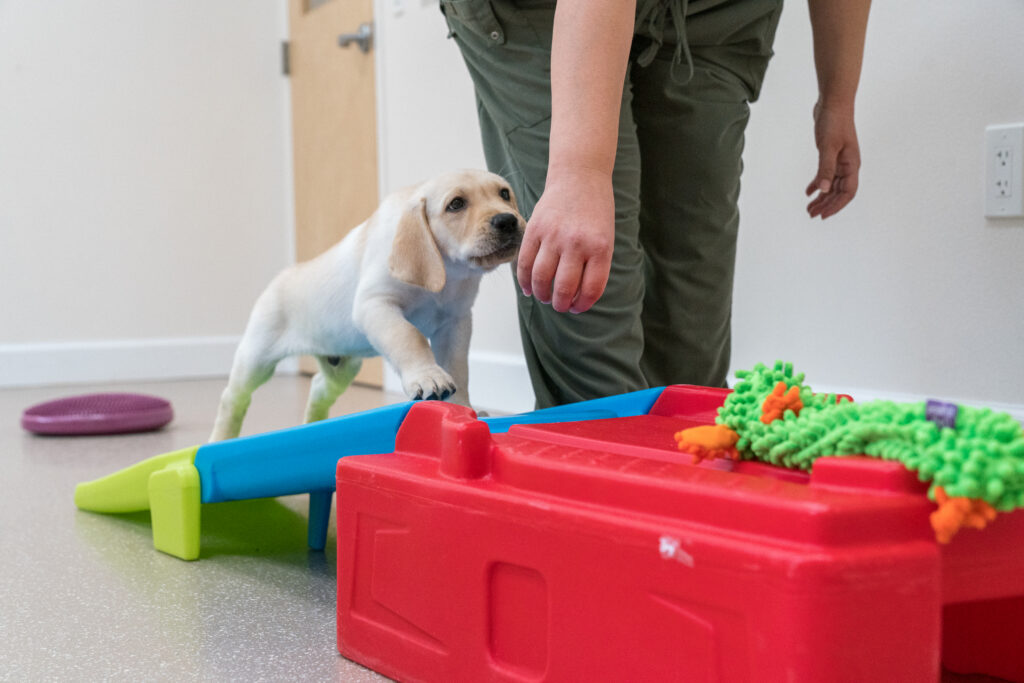
As these dogs mature, their exposure expands to include multi-species interactions, complex public transportation systems, and unpredictable urban hazards. Every developmental milestone—from navigating adolescent fear periods to mastering advanced task execution—builds upon the meticulous foundation laid during the neonatal and socialization phases.
Ultimately, the rigorous application of Early Neurological Stimulation and structured socialization proves that greatness in assistance dogs is engineered from day one. By investing deeply in the earliest moments of life, organizations like Dogs Inc ensure that their graduates are not merely trained, but fundamentally prepared to change lives.