
Executive Overview
For decades, the traditional framework of evolutionary biology viewed viruses primarily as opportunistic pathogens—molecular freeloaders that lack cellular machinery, depend entirely on hosts for replication, and sit outside the traditional tree of life. However, a growing body of scientific research is upending this orthodox view. Emerging evidence suggests that viruses may not merely be biological footnotes, but rather central architects in the origin and diversification of complex life on Earth.
At the vanguard of this paradigm shift is Professor Masaharu Takemura of the Tokyo University of Science (TUS). Alongside international colleagues, Professor Takemura has championed the "viral eukaryogenesis" hypothesis, which posits that the nucleus of eukaryotic cells—the defining feature of complex organisms, from fungi and plants to animals and humans—may trace its evolutionary lineage directly to ancient giant DNA viruses.
This revolutionary hypothesis has received a massive empirical boost with the discovery of a novel giant DNA virus: ushikuvirus. Named after Lake Ushiku in Ibaraki Prefecture, Japan, where it was isolated, ushikuvirus was detailed in a recent study published in the Journal of Virology by Prof. Takemura’s research team, in collaboration with the National Institute of Natural Sciences (NINS), Japan. This newly characterized entity infects Vermamoeba, a genus of single-celled amoebae, displaying a unique suite of morphological and replication characteristics that bridge the evolutionary gap between disparate viral families.
Beyond rewriting our understanding of cellular evolution, the study of giant viruses like ushikuvirus carries profound implications for medicine. Because certain amoebae act as vectors or causative agents for severe human pathologies—such as amoebic encephalitis—understanding how giant viruses target, manipulate, and destroy these single-celled organisms could unlock novel therapeutic avenues. This comprehensive report explores the chronology of viral eukaryogenesis, examines the structural mechanics of ushikuvirus, contextualizes the broader impact of giant DNA viruses, and outlines the future trajectory of this groundbreaking virological research.
Detailed Chronology: From Viral Parasites to the Viral Eukaryogenesis Hypothesis
To appreciate the significance of ushikuvirus, one must retrace the historical milestones that challenged conventional wisdom regarding the origin of viruses and their interplay with cellular evolution.
The Enigma of Viral Origins
Since the dawn of virology, scientists have struggled to place viruses neatly into the tree of life. Unlike bacteria, archaea, and eukaryotes, viruses are structurally minimalist. Consisting primarily of genetic material (DNA or RNA) encased in a protein capsid, they cannot synthesize proteins independently. They are obligate intracellular parasites, requiring the metabolic machinery of a host cell to replicate.
Historically, this dependence led scientists to view viruses as degenerate cellular entities that had lost genes over time, or as ancient molecular escapees that had broken free from host genomes. However, these models failed to explain the profound genetic and structural complexity discovered in the late 20th and early 21st centuries.
The 2001 Hypothesis: Viral Eukaryogenesis
The plot thickened in 2001 when Professor Masaharu Takemura (then advancing his independent research) and Dr. Philip Bell of Macquarie University independently formulated a bold proposition: the cell nuclear virus origin theory, famously termed viral eukaryogenesis by Dr. Bell.
This hypothesis posited a radical alternative to traditional endosymbiotic models of nuclear origin. Instead of viewing the eukaryotic nucleus as emerging from gradual internal membrane foldings or the engulfment of a bacterium, the theory suggested that the nucleus originated from a large DNA virus—resembling a modern poxvirus—that established a persistent, non-lethal infection inside an ancient archaeal ancestor.
Rather than destroying its host, this ancient viral symbiont set up a stable residence in the cytoplasm. Over evolutionary epochs, it purportedly absorbed critical metabolic and structural genes from the host cell, gradually transforming into the membrane-bound nucleus that defines all eukaryotic life today. If proven correct, this theory fundamentally flips the script on evolutionary biology: viruses did not just infect complex cells; they helped build them.
The 2003 Turning Point: The Discovery of Giant DNA Viruses
For two years, the viral eukaryogenesis hypothesis remained a compelling but theoretically isolated idea. That changed dramatically in 2003 with the monumental discovery of giant DNA viruses—microorganisms so massive that they rivaled bacteria in physical size and genomic capacity.
When these giant viruses infect host cells, they construct complex intracellular structures known as virus factories. In several documented cases, these factories are enclosed by lipid membranes and serve as dedicated sites for viral DNA replication, bearing an uncanny structural and functional resemblance to a primitive cell nucleus. This empirical discovery provided the physical blueprint needed to validate the structural plausibility of the viral eukaryogenesis model.
The Isolation of Ushikuvirus
Over the ensuing two decades, researchers cataloged a diverse array of giant DNA viruses, including members of the Mamonoviridae family (which infect Acanthamoeba) and clandestinoviruses (which infect Vermamoeba).
The momentum culminated in the recent isolation and description of ushikuvirus. Gathered from the waters of Lake Ushiku, this novel giant virus was thoroughly analyzed by a multidisciplinary team from the Tokyo University of Science and the National Institute of Natural Sciences. Led by Prof. Takemura, along with Master’s students Jiwan Bae and Narumi Hantori, and senior researchers Dr. Raymond Burton-Smith and Prof. Kazuyoshi Murata, the discovery of ushikuvirus introduces a critical new data point into the phylogenetic puzzle of giant viruses and eukaryotic ancestry.
Supporting Context & Metrics: Unpacking the Anatomy of Ushikuvirus
To understand why ushikuvirus has generated such excitement in the virological community, one must examine its unique architecture, replication cycle, and phylogenetic relationships.
+-----------------------------------------------------------------+
               COMPARATIVE GIANT VIRUS TRAITS
+----------------------+-------------------+----------------------+
| Trait                | Medusavirus       | Ushikuvirus          |
+----------------------+-------------------+----------------------+
| Host                 | Acanthamoeba      | Vermamoeba           |
| Shape                | Icosahedral       | Icosahedral/Spiked   |
| Nuclear Interaction  | Intact Nucleus    | Disrupted Membrane   |
| Cytopathic Effect    | Standard lysis    | Cellular hypertrophy |
+----------------------+-------------------+----------------------+
Morphology and Capsid Architecture
Giant viruses are notoriously difficult to isolate from natural environments due to their sheer diversity and the specific ecological niches they occupy. While ushikuvirus shares a host preference with clandestinovirus (targeting Vermamoeba) and exhibits structural affinities with the Mamonoviridae family—particularly Medusavirus—it possesses distinct morphological innovations.
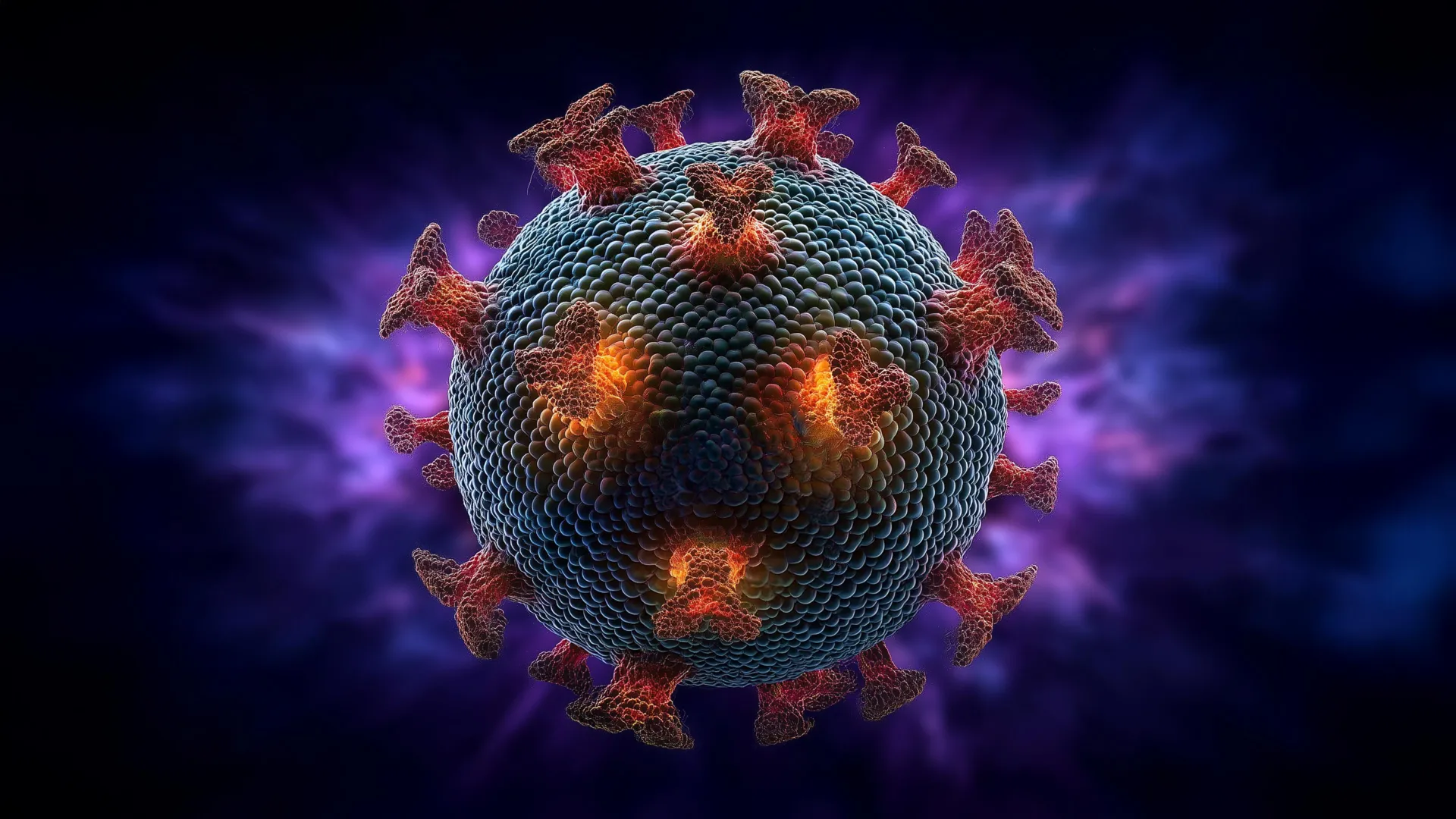
Medusavirus is widely recognized in scientific literature for its distinct icosahedral geometry and a dense armor of short spikes covering its capsid surface. Similarly, ushikuvirus features an icosahedral capsid adorned with multiple specialized spike structures. However, ushikuvirus spikes are topped with unique caps, some of which feature delicate, filament-like extensions that have never been documented in medusaviruses. These structural elaborations likely play a vital role in host recognition, attachment, or immune evasion.
Cytopathic Effects: Cellular Gigantism
Upon infecting a host amoeba, most viruses induce rapid cell lysis or degeneration. Ushikuvirus, however, triggers a fascinating and distinct cytopathic effect: infected Vermamoeba cells grow unusually, abnormally large. This cellular hypertrophy suggests that the virus alters host metabolism, cell cycle regulation, and growth pathways in ways that maximize viral progeny production before cellular breakdown occurs.
A Divergent Replication Strategy
Perhaps the most significant difference between ushikuvirus and its relatives lies in how it manages replication.
- Medusavirus and Clandestinovirus: These viruses typically replicate within the intact nucleus of their host amoeba, hijacking the host’s nuclear infrastructure.
- Ushikuvirus: In stark contrast, ushikuvirus actively breaks down the host’s nuclear membrane during the replication phase to synthesize and assemble new viral particles.
This behavioral split provides a crucial evolutionary bridge. Scientists believe that ushikuvirus reflects an intermediate or adaptive evolutionary trajectory, linking viruses that utilize an intact nucleus as a viral factory (such as members of the Mamonoviridae family) with other giant viruses—like Pandoravirus—that actively disrupt the nuclear membrane. These variations highlight how giant viruses dynamically adapt their replication strategies in response to different host pressures over evolutionary time.
Official Statements and Expert Perspectives
The discovery and analysis of ushikuvirus open up vast horizons for theoretical biology. The researchers behind the study emphasize that giant viruses represent an underexplored frontier in modern science.
Reflecting on the broader implications of the work, Professor Masaharu Takemura noted:
"Giant viruses can be said to be a treasure trove whose world has yet to be fully understood. One of the future possibilities of this research is to provide humanity with a new view that connects the world of living organisms with the world of viruses."
Elaborating on how ushikuvirus specifically impacts our understanding of evolution, Prof. Takemura added:
"The discovery of a new Mamonoviridae-related virus, ‘ushikuvirus,’ which has a different host, is expected to increase knowledge and stimulate discussion regarding the evolution and phylogeny of the Mamonoviridae family. As a result, it is believed that we will be able to get closer to the mysteries of the evolution of eukaryotic organisms and the mysteries of giant viruses."
These statements underscore the interdisciplinary nature of the research. By mapping the genetic and structural contours of viruses like ushikuvirus, scientists are not merely cataloging microscopic novelties; they are assembling the missing pieces of Earth’s evolutionary history.
Future Outlook and Practical Implications
As research into giant DNA viruses accelerates, the implications extend far beyond theoretical phylogenetics, touching upon education, medicine, and practical biotechnology.
Resolving the Eukaryotic Tree of Life
The primary academic goal of Prof. Takemura’s ongoing research is to firmly establish or refute the viral eukaryogenesis hypothesis. By sequencing the genomes of newly discovered giant viruses, comparing their protein structures to those of modern eukaryotes, and mapping their replication mechanics, scientists hope to trace the precise molecular pathways that allowed ancient viruses to merge with cellular life. This could ultimately rewrite standard biology textbooks, elevating viruses from simple biological parasites to foundational pillars of complex life.
Clinical and Public Health Applications
While amoeba-infecting giant viruses are not direct pathogens of humans, their natural hosts (Acanthamoeba and Vermamoeba) certainly are. Certain species of Acanthamoeba are notorious opportunistic pathogens capable of causing severe, life-threatening human diseases, including Acanthamoeba keratitis (a painful corneal infection often linked to contact lenses) and granulomatous amoebic encephalitis (a devastating infection of the central nervous system).
A deeper understanding of how giant viruses interact with, infect, and dismantle amoebic cells could pave the way for breakthrough biocontrol strategies. Researchers envision a future where engineered giant viruses or their replication-inhibiting proteins could be deployed as precision biological agents to control pathogenic amoebic populations in medical settings and water systems.
Educational Outreach and Virus Literacy
Beyond the laboratory, Prof. Takemura maintains a strong commitment to public science communication. Having published more than 120 scientific papers and garnered over 2,500 citations throughout his distinguished career, his long-term vision includes developing advanced educational curricula. By improving global "virus literacy," he aims to dispel the pervasive cultural myth that all viruses are exclusively agents of disease, fostering a more nuanced public appreciation of their vital ecological and evolutionary roles.
Conclusion
The isolation of ushikuvirus from the tranquil waters of Lake Ushiku is far more than a routine taxonomic addition to virology databases. It represents a vital physical and functional link in the grand mosaic of evolutionary biology. By showcasing unique morphological spikes, distinctive cytopathic cellular hypertrophy, and an unconventional nuclear-membrane-disrupting replication strategy, ushikuvirus bridges the gap between disparate giant virus families.
As researchers at the Tokyo University of Science, the National Institute of Natural Sciences, and institutions worldwide continue to decode the genetic secrets of giant DNA viruses, humanity edges ever closer to solving one of science’s greatest enduring mysteries: how complex life emerged from a primordial soup, and the surprising, foundational role that viruses played in making us who we are.