
Executive Overview
In the concrete landscape of Harlem, New York, where danger often lurks in the shadow of towering architecture, a tiny young cat named Sparrow scripted a narrative of survival that defies both biological probability and the laws of physics. Falling an astonishing 16 stories—the equivalent of plummeting more than 150 feet to the pavement below—should have resulted in a tragic end. Instead, it became the harrowing prologue to a remarkable journey of resilience, exceptional veterinary medicine, and compassionate intervention.
Found motionless and gravely injured on the street, Sparrow’s life hung by a thread. Yet, through the combined efforts of a compassionate Good Samaritan, the specialized trauma team at The Schwarzman Animal Medical Center (AMC), and a dedicated veterinary professional who opened her home to foster and eventually adopt her, Sparrow lived to tell her tale.
This in-depth investigative feature explores the anatomy of Sparrow’s survival, the critical role of philanthropic veterinary care funds in saving urban strays, the surgical complexities of managing high-rise syndrome in felines, and the broader implications of urban animal welfare. Through a detailed chronology and expert contextual analysis, we examine how a cat once facing insurmountable odds transformed into a thriving, joyful pet living her best life on three legs.
Detailed Chronology
The Fall: Surviving the Unsurvivable
The incident occurred on an ordinary day in Harlem, transforming instantly into a life-or-death crisis. How Sparrow managed to slip from a 16-story vantage point remains a mystery, but the consequences of her descent were immediate and catastrophic. In veterinary medicine, falls from great heights are categorized under "High-Rise Syndrome," a phenomenon where cats falling from high altitudes frequently sustain severe facial trauma, fractures, and internal injuries.
Despite the tremendous kinetic energy generated by a 16-story fall, Sparrow did not die on impact. Instead, she lay broken, terrified, and utterly helpless on the asphalt below. Her fragile young body had absorbed an impact that would prove fatal to most living creatures, yet her heartbeat—though faint—persisted.
The Rescue and Emergency Admission
Fortune intervened when a passing Good Samaritan noticed the motionless feline. Recognizing the urgency of the situation, the individual did not hesitate. Understanding that every second counted, the rescuer scooped up the injured cat and rushed her directly to the 24/7 emergency room at The Schwarzman Animal Medical Center (AMC), one of the premier veterinary trauma facilities in the country.
Upon arrival, AMC’s emergency veterinary team immediately initiated trauma protocols. Sparrow was in critical condition, requiring intensive stabilization, oxygen therapy, and comprehensive pain management. Because she was a stray with no known owner at the time, her prospects for receiving expensive, high-level medical care could have been bleak were it not for a vital institutional safety net: AMC’s Fund for Hope. This philanthropic program provides free or subsidized veterinary treatment specifically designated for stray and shelter animals in acute distress, ensuring that financial limitations never dictate whether a salvageable life is saved.
Diagnosis and Major Surgical Intervention
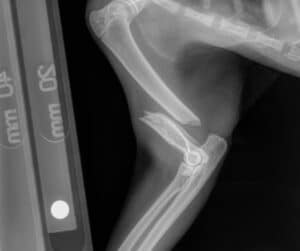
Once stabilized, diagnostic imaging revealed the full extent of Sparrow’s internal and skeletal devastation. The list of injuries was extensive:
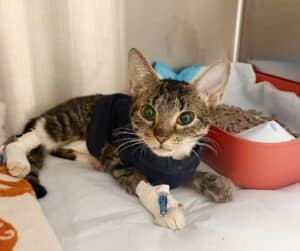
- Severe Front Leg Fracture: The impact had shattered bones in her front limb beyond the point of orthopedic reconstruction.
- Diaphragmatic Hernia: The sheer force of the fall had driven her abdominal organs through a rupture in her diaphragm, severely compromising her lung capacity and putting immense pressure on her heart.
The surgical team at AMC faced a complex, high-risk operational challenge. First, they needed to repair the life-threatening diaphragmatic hernia, repositioning her abdominal organs and stitching the muscle wall to allow normal respiration. Simultaneously, surgeons performed a routine spay procedure.
However, the most difficult decision involved her fractured front limb. Given the severity of the bone fragmentation and the impossibility of a functional recovery, the surgical team made the decisive call to perform a limb amputation. For a young cat already reeling from massive systemic trauma, undergoing both internal thoracic surgery and an amputation was a monumental hurdle. Yet, Sparrow’s inner vitality carried her through the operations.
The Road to Recovery and Fostering
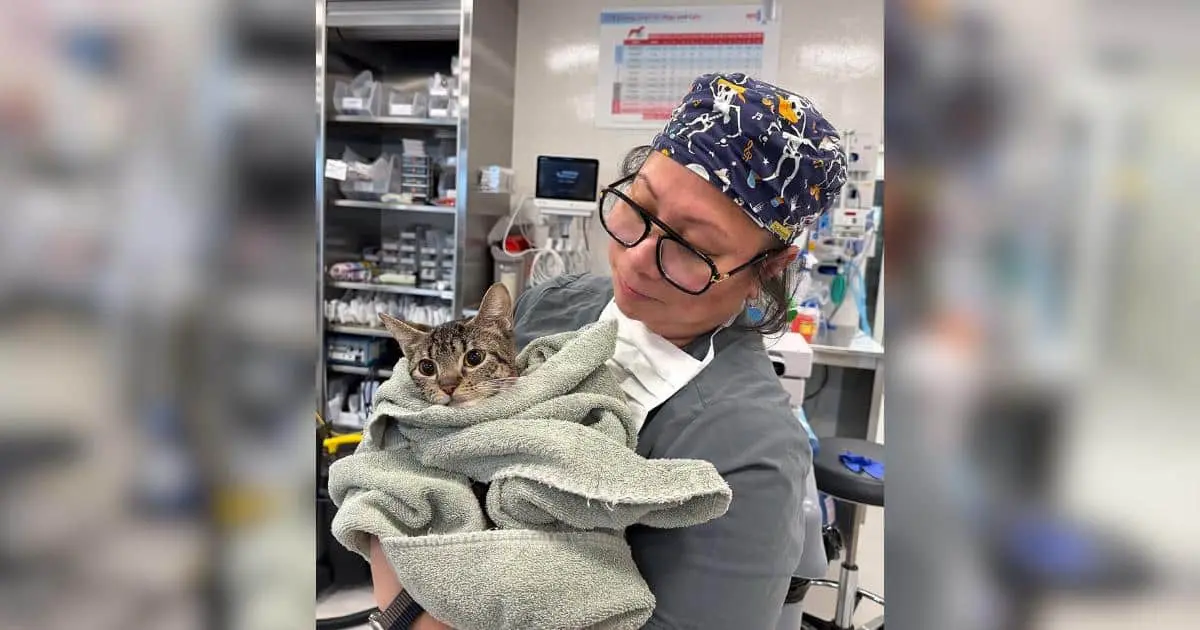
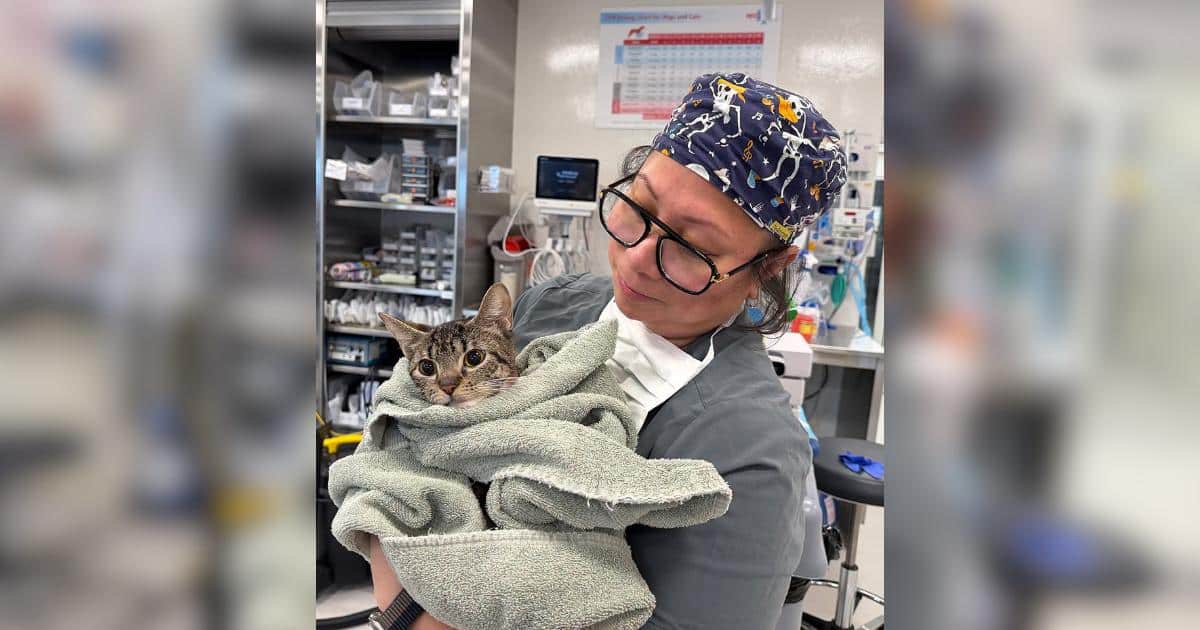
Surgery was only the first battle; rehabilitation required equal dedication. As Sparrow began her weeks of postoperative healing, she captured the heart of Alexa, a licensed veterinary technician with AMC’s Urgent Surgery Service. Recognizing the cat’s sweet disposition and indomitable spirit, Alexa stepped forward to foster Sparrow, offering a quiet, secure, and medically monitored home environment.
In the comfort of a proper home, away from the clinical hum of hospital machinery, Sparrow began to decompress. The terror of the street and the trauma of the fall slowly melted away. Within this sanctuary, she learned to navigate her world on three legs, proving that feline agility and psychological resilience are remarkably adaptable.
A New Beginning
Today, Sparrow’s transformation is complete. No longer defined by her injuries, she shares her living space with a feline housemate named Frisky, playing, leaping, and exploring with renewed confidence. What began as a catastrophic descent on a Harlem street has evolved into an inspiring testament to the power of timely rescue, advanced veterinary science, and enduring human compassion.
Supporting Context & Metrics: High-Rise Syndrome and Urban Animal Welfare
To fully appreciate Sparrow’s survival, one must examine the clinical reality of high-rise syndrome in veterinary science. Urban environments like New York City, characterized by high-density residential towers, apartment complexes, and brownstones, present unique hazards for companion animals.
The Physics of Feline Falls
Veterinary researchers have long studied the mechanics of cats falling from multi-story buildings. Interestingly, studies show that cats falling from greater heights (between 7 and 9 stories, and sometimes higher) often sustain fewer fatal injuries than those falling from intermediate heights (2 to 6 stories). This counterintuitive statistic is attributed to the cat’s vestibular system, which allows them to right themselves in mid-air (the "air-righting reflex") and spread their bodies like a parachute to increase air resistance and reach terminal velocity—after which they relax, minimizing rigid impact trauma.
However, a 16-story fall pushes the boundaries of this biological adaptation. At that height, the velocity accumulated is immense, making internal organ rupture, severe orthopedic trauma, and pulmonary contusions nearly ubiquitous. Sparrow’s survival of a 16-story drop places her in an elite statistical minority of high-rise trauma survivors.
The Economic Engine of Animal Rescue: Funds for Hope
Stories like Sparrow’s highlight a critical infrastructure within modern veterinary medicine: institutional charity care. Emergency veterinary medicine is costly, requiring advanced diagnostic imaging (CT scans, digital radiographs), specialized surgical suites, continuous monitoring, and potent analgesics.
Without philanthropic initiatives like AMC’s Fund for Hope, thousands of stray animals presenting with severe trauma would face euthanasia due to prohibitive treatment costs. The fund acts as a vital bridge between disaster and rehabilitation, absorbing the financial burden of complex cases and allowing veterinary professionals to focus exclusively on healing.
Official Statements and Professional Perspectives
The triumph of Sparrow’s recovery is a collective victory shared by the medical professionals who treated her and the caretakers who nurtured her back to health.
"When animals arrive at our emergency room having suffered catastrophic trauma, our first priority is stabilization, but our ultimate goal is restoring their quality of life," notes a representative from The Schwarzman Animal Medical Center. "Sparrow’s case tested the limits of our surgical capabilities, from repairing a life-threatening diaphragmatic hernia to managing complex limb trauma. Her survival is a testament not only to our team’s expertise but to the incredible resilience inherent in these animals when they are given a fighting chance."
The human-animal bond was further underscored by Alexa, the veterinary technician who fostered and ultimately adopted Sparrow:
"Working in urgent surgery, we see the worst of what trauma can do to an animal, but we also witness incredible miracles every single day," Alexa shared during Sparrow’s rehabilitation. "From the moment Sparrow came into our care, despite everything she had endured, her eyes communicated a fierce desire to live. Taking her home to foster was an easy decision, watching her learn how to be a normal, playful cat on three legs has been one of the most rewarding experiences of my career."
Future Outlook: Advocacy and Prevention
While Sparrow’s story has a fairy-tale ending, veterinary experts and animal welfare advocates emphasize that high-rise syndrome is entirely preventable. As urban centers continue to grow vertically, pet owners living in high-rise apartments must take proactive safety measures to protect their animal companions.
Key Recommendations for High-Rise Pet Safety:
- Window Guards and Screens: Standard insect screens are not designed to hold the weight of an inquisitive cat leaning against them. Secure, heavy-duty pet-proof window guards and reinforced screens should be installed on all open windows.
- Balcony Restrictions: Cats should never be allowed unsupervised access to high-rise balconies. Even a secured balcony can present risks if a cat is startled by a bird, loud noise, or wind gust.
- Environmental Enrichment: Providing indoor climbing trees, window perches with secure netting, and interactive play helps satisfy a cat’s natural curiosity and hunting instincts, reducing the impulse to escape or perch precariously on window ledges.
A Legacy of Hope
Sparrow’s journey from a broken, helpless kitten lying on a Harlem pavement to a vibrant, three-legged survivor living in a loving home serves as more than just a heartwarming human-interest story. It stands as a powerful reminder of the fragility of life, the lifesaving importance of emergency veterinary infrastructure, and the boundless capacity of animals to heal, adapt, and forgive.
In a world where urban strays frequently slip through the cracks of society, Sparrow’s light shines as proof that when compassion meets capability, miracles are possible—one life, one floor, and one heartbeat at a time.