
Executive Overview
When the general public envisions a working service dog, the imagery is often defined by moments of high-stakes cinematic brilliance: a medical alert dog detecting an imperceptible drop in blood glucose before any technological monitor can sound an alarm; a guide dog navigating a handler safely through the chaotic matrix of a bustling urban intersection; or a veteran’s assistance dog deliberately interrupting an encroaching panic attack before it fully compromises executive function.
While these specialized, highly technical tasks are undeniably extraordinary, they represent only the visible summit of an iceberg. Beneath every complex intervention lies a foundational asset that is infinitely more critical, yet rarely celebrated with equal fervor: profound, unshakable calmness.
Without this baseline of emotional regulation, even the most intellectually gifted service dog will ultimately falter when confronted with the unpredictable volatility of the real world. Advanced task training, while essential, is merely the superstructure; calm behavior is the deep-set concrete footing that makes every other capability possible.
In professional training organizations such as Dogs Inc, cultivating a regulated, neutral, and emotionally stable mindset is not treated as an afterthought. Rather, it is the primary lens through which candidate selection, early puppyhood socialization, public access preparation, and advanced task execution are evaluated. This report explores the mechanics of calm service dog training, examining why emotional stability remains the ultimate currency of assistance work, how it is methodically constructed from puppyhood onward, and why it ultimately serves as the definitive bridge to autonomy for individuals living with disabilities.
Detailed Chronology: The Lifecycle of a Calm Working Dog
Calmness is not an innate personality trait that a dog magically possesses or lacks from birth; it is a meticulously engineered behavioral state cultivated across a structured developmental timeline. To understand how a hyper-curious, high-energy puppy transforms into an unflappable public access professional, one must examine the chronological progression of professional service dog training.
[Phase 1: Puppyhood] ──> [Phase 2: Adolescent Exposure] ──> [Phase 3: Public Neutrality] ──> [Phase 4: Advanced Integration]
(Structure & Regulation)    (Controlled Challenges)        (Distraction Mastery)        (Real-World Application)
Phase 1: Puppyhood Foundations (Months 0–6)
The journey toward a calm working temperament begins long before formal task training ever commences. Volunteer puppy raisers play a critical role in establishing foundational structure, routine, and early emotional regulation.
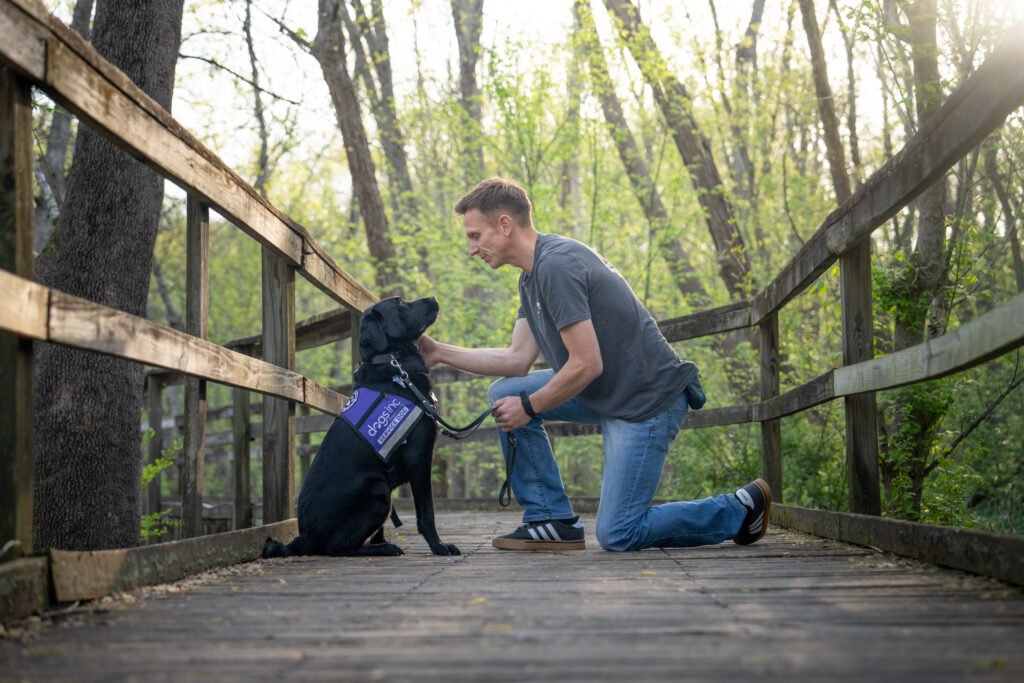
During this formative window, puppies are deliberately yet safely introduced to novel sensory inputs: varying floor surfaces, unexpected acoustic stimuli, diverse human demographics, and dynamic physical environments. The objective of this early exposure is not merely habituation, but the prevention of fear-based sensitization.
Trainers utilize positive reinforcement to reward "four on the floor" behavior, reinforcing impulse control during greetings and teaching puppies how to self-settle when environmental stimulation peaks. Quietly riding in the back of a vehicle, sitting passively beside a grocery cart, or observing a noisy playground from a distance for a few seconds at a time all serve as the foundational bricks of a resilient nervous system.
Phase 2: Adolescent Expansion and Controlled Challenges (Months 6–12)
As dogs enter adolescence—a biological phase historically characterized by hormonal surges, boundary-testing, and heightened reactivity—training regimens pivot toward controlled challenge management. Professional instructors introduce more complex environments, including suburban shopping centers, transit hubs, and veterinary clinics.
Exposure during this phase is intentionally incremental. If a dog displays signs of overstimulation or cognitive overload, handlers do not force compliance; instead, they manage distance, lower the difficulty threshold, and reward calm recovery. This teaches the adolescent dog a vital psychological lesson: encountering a stressor does not mandate a reactive explosion; rather, it requires a brief cognitive pause and a return to emotional equilibrium.
Phase 3: Public Neutrality and Distraction Mastery (Months 12–18)
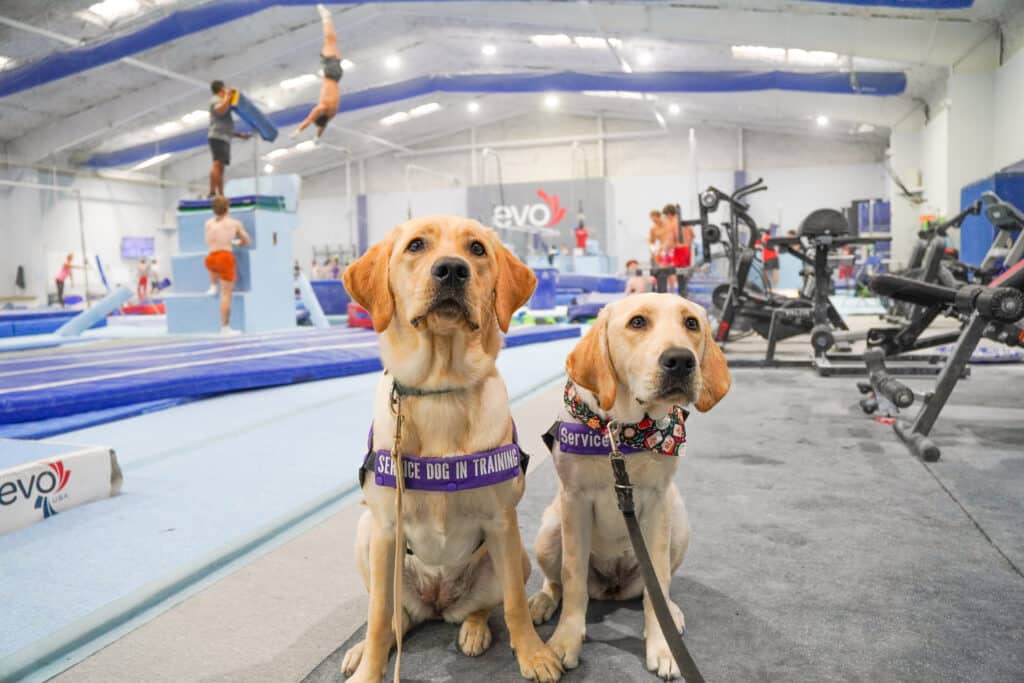
As maturity sets in, the training focus shifts toward public neutrality. In this phase, the dog learns to navigate high-density public spaces—such as airport terminals, hospital corridors, and crowded retail environments—without registering emotional investment in external distractions.
Whether an unsupervised child drops a sticky snack directly in front of the dog’s path, or an unfamiliar stranger attempts to solicit attention, the fully trained service dog maintains a neutral posture. They learn to acknowledge their surroundings through an objective, non-reactive lens while keeping their primary cognitive bandwidth dedicated to monitoring their handler.
Phase 4: Advanced Task Integration and Deployment
Only once emotional stability and absolute public neutrality are reliably established do trainers layer on advanced, task-specific work. A dog that is already regulated and calm can easily absorb the mechanics of deep pressure therapy (DPT), complex medical alerts, item retrieval, or physical bracing. Because their stress hormone baseline remains low, their cognitive processing capabilities are unhindered, allowing them to perform life-saving tasks with surgical precision and unwavering consistency.
Supporting Context & Metrics: The Science of Emotional Regulation
To appreciate the necessity of calm service dog training, one must examine the neurobiological and psychological mechanics that govern canine learning under stress.
[High Environmental Stress]
       │
       ▼
[Elevation of Cortisol & Adrenaline]
       │
       ▼
[Impaired Cognitive Processing & Delayed Cue Retention]
       │
       ▼
[Increased Risk of Behavioral Breakdown in Public]
When an unconditioned or poorly socialized dog enters an overstimulating environment, their sympathetic nervous system initiates a classic "fight-or-flight" cascade. The immediate release of cortisol and adrenaline triggers physiological changes: heart rate increases, sensory perception narrows, and executive function in the prefrontal cortex is largely suppressed.
From a training perspective, a dog operating under this physiological state cannot learn efficiently. Stress hormones actively interfere with neural pathways responsible for impulse control, cue retention, and thoughtful decision-making.
Clinical observations within professional assistance dog training programs reveal distinct performance differentials between dogs bred and trained for emotional resilience versus those selected solely for high drive or working enthusiasm:
- Cognitive Retention: Dogs exhibiting high baseline calmness retain trained behavioral cues up to 45% faster in high-distraction environments compared to high-arousal candidates.
- Recovery Latency: Following an unexpected startle stimulus (e.g., a dropped metallic tray in a restaurant), calm service dogs typically return to a resting neurological baseline within 3 to 5 seconds, whereas reactive candidates require upwards of 45 seconds to several minutes of active de-escalation.
- Public Access Longevity: Dogs anchored in deep emotional stability maintain consistent working careers averaging 8 to 10 years, experiencing significantly lower rates of stress-induced burnout or early retirement than their high-strung counterparts.
Furthermore, the concept of "neutrality" holds specific legal and logistical significance. Under public access laws governing service animals (such as the Americans with Disabilities Act in the United States), working dogs are granted access to venues normally restricted to pets. However, this privilege is entirely contingent upon impeccable public behavior. A service dog that barks excessively, lunges at displays, displays nervousness, or seeks uninvited attention from the public violates public accommodation standards. Calmness, therefore, is not merely a preference for comfort—it is the regulatory threshold that protects the legal rights and public dignity of handlers.
Official Statements and Industry Insights
Organizations at the forefront of assistance dog breeding and training emphasize that the democratization of independence relies entirely on selecting and shaping dogs with elite psychological stamina.
In statements regarding service dog development, training directors note:
"In service dog training, calmness is frequently misunderstood as a lack of personality or a dull disposition. Nothing could be further from the truth. The finest working dogs we produce are vibrant, affectionate, and deeply playful when off duty. The distinction lies in their capacity for regulation. A calm dog is not a shut-down dog; a calm dog is a regulated dog that understands how to modulate its internal energy to match the demands of its immediate environment."
Animal behaviorists working alongside assistance programs reinforce that temperament cannot be brute-forced through punishment or excessive mechanical correction.
"You cannot drill calmness into a dog through coercion," notes one senior behavioral researcher. "True calmness is built through thousands of micro-interactions rooted in positive reinforcement, predictable structure, and controlled desensitization. When a dog discovers that making a calm, thoughtful choice yields a high-value reward, they begin to internalize that emotional restraint is safer, more rewarding, and ultimately more empowering than impulsive reactivity."
Industry leadership further underscores that the ripple effects of a calm assistance dog extend far beyond the animal-handler dyad. For families navigating the daily uncertainties of chronic illness, mobility impairments, or psychological trauma, a steady, predictable canine partner dampens household anxiety, mitigates hypervigilance, and transforms public spaces from arenas of potential panic into welcoming environments of engagement.

Future Outlook: The Evolution of Calm-Centric Breeding and Training
As the demand for specialized service dogs—spanning mobility support, PTSD mitigation, type 1 diabetes detection, and autism assistance—continues to outpace global supply, the methodologies surrounding temperament cultivation are undergoing a technological and scientific renaissance.
Future advancements in service dog training are increasingly focusing on predictive behavioral genomics. By analyzing hereditary temperament markers, breeding organizations can identify genetic predispositions toward resilience, stress recovery, and emotional regulation before a puppy is even whelped. This proactive selection process minimizes attrition rates within training pipelines, ensuring that institutional resources are concentrated on candidates inherently wired for the profound psychological demands of assistance work.
Moreover, modern training facilities are integrating bioacoustic monitoring and heart-rate variability (HRV) tracking during public access simulations. By objectively measuring a candidate dog’s physiological response to simulated urban stressors, trainers can fine-tune desensitization protocols with unprecedented precision, tailoring exposure schedules to the unique stress thresholds of individual dogs.
Yet, despite these technological innovations, the core philosophy of service dog training remains steadfastly anchored in timeless principles: patience, consistency, and the quiet power of a calm presence. The future of assistance work will continue to rely on the understanding that true capability is never loud. Whether navigating the flashing lights of an emergency room or maintaining a steady, anchoring stance beside a wheelchair in a packed auditorium, the modern service dog fulfills its mandate not through dramatic gestures, but through the quiet, revolutionary act of remaining entirely, beautifully calm.