
Executive Overview
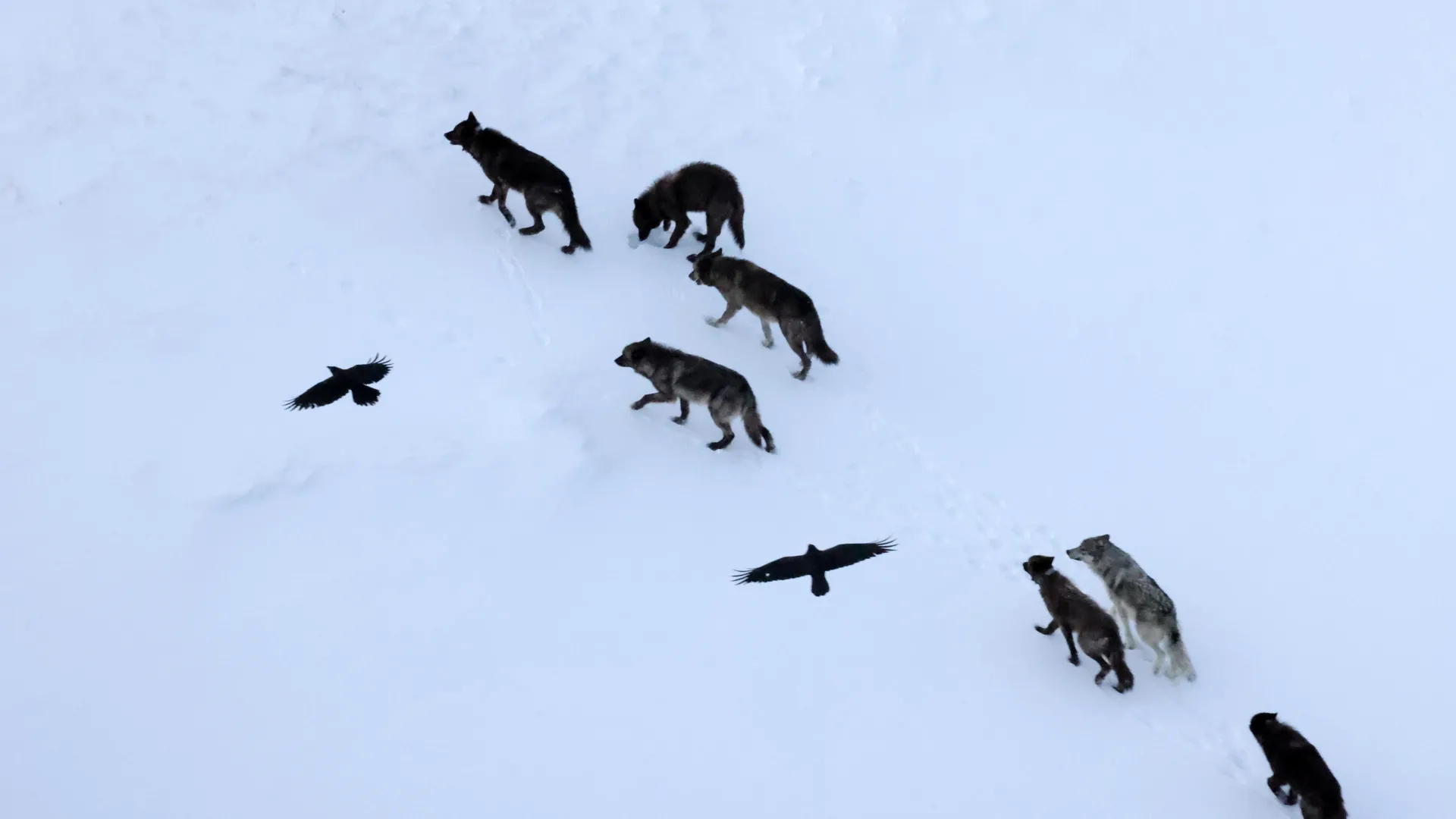
For centuries, the relationship between the grey wolf (Canis lupus) and the common raven (Corvus corax) has been romanticized, mythologized, and observed with a mixture of awe and misunderstanding. In the crisp wilderness of Yellowstone National Park, winter paints a brutal canvas where survival depends on calories. Traditionally, folklore and biological assumption alike painted a simple picture: ravens are the ultimate hitchhikers, shadowing wolf packs day in and day out, waiting patiently for the apex predators to bring down an elk, bison, or deer so they can scavenge the leftovers.
It is a theatrical partnership deeply embedded in the ecological lore of the American West. Yet, a landmark study published in the prestigious journal Science has shattered this simplistic narrative. Following a rigorous, two-and-a-half-year tracking initiative, an international coalition of scientists has revealed that ravens do not routinely follow wolves at all. Instead, these corvids possess an astonishing cognitive map of the landscape, relying on advanced spatial memory, long-range navigation, and historical pattern recognition to pinpoint carcasses from distances spanning up to 155 kilometers.
Led by the Research Institute of Wildlife Ecology at the University of Veterinary Medicine Vienna and the Max Planck Institute of Animal Behavior in Germany—alongside institutional heavyweights including the Senckenberg Biodiversity and Climate Research Centre, the University of Washington, and Yellowstone National Park—this research fundamentally alters our understanding of avian intelligence and scavenger ecology. Rather than serving as passive shadows to the wolf, ravens operate as highly strategic, independent operators who harness the predictability of top-tier predators from afar.
Detailed Chronology: Unraveling the Scavenger’s Secret
The journey to decoding this avian strategy required years of meticulous fieldcraft, high-tech engineering, and an unprecedented scale of data collection within one of the world’s most closely monitored ecosystems.
Phase 1: Re-evaluating the Yellowstone Paradigm
The research took place against the backdrop of Yellowstone National Park, where grey wolves were famously reintroduced in the mid-1990s after a 70-year absence. This ecological restoration breathed new life into the park, providing a steady, reliable pulse of carrion that transformed the local scavenger guild. For decades, biologists observed ravens swirling above traveling wolf packs or hopping nervously around a fresh kill site just moments after an elk was brought down.
Dr. Dan Stahler, a Yellowstone wildlife biologist who has studied the park’s wolves since their return, noted how deeply ingrained the assumption of shadowing had become. "You see them flying directly above traveling packs or hopping close behind wolves as they take down prey," Stahler explained. Because wolves create reliable feeding opportunities, researchers naturally assumed the birds operated under a simple behavioral rule: stick close to the wolves. Yet, this hypothesis had never been empirically tested. The scavenger’s point of view had been entirely overlooked in favor of predator-centric studies.
Phase 2: The Art and Science of Capturing Elusive Minds
To properly investigate raven behavior, the research team faced a daunting logistical hurdle: capturing enough birds to generate statistically significant data. Ravens are notoriously wary, intelligent, and observant of their surroundings.
"Ravens are so observant of the landscape that they don’t step into traps easily," noted Dr. Matthias Loretto, the study’s first author. To bypass the birds’ keen suspicion, the scientific team had to employ creative deception. Traps placed near human campsites, for instance, were meticulously disguised with urban debris, trash, and fast-food wrappers. "Or else the ravens would suspect that something was off and wouldn’t come near it," Loretto recalled.
Through this patient, highly specialized effort, the team successfully fitted an extraordinary 69 ravens with miniature, high-precision GPS tracking backpacks. Simultaneously, movement patterns from 20 collared wolves within the park were integrated into the dataset, allowing researchers to cross-reference the locations and behaviors of both species with granular precision.
Phase 3: The Winter Tracking Grid and the Big Surprise
The study focused intensely on the brutal Yellowstone winter—the season when raven-wolf interactions peak and resources are scarcest. During this period, the GPS units recorded raven movements every 30 minutes, while wolf positions were logged hourly. Researchers also cataloged the exact temporal and spatial coordinates of every prey kill made by the wolves, predominantly elk, bison, and mule deer.
When the data began rolling in, the research team faced an immediate, confounding mystery. Over two and a half years of continuous monitoring, they recorded only a single instance of a raven following a wolf for more than one kilometer or for longer than an hour.
"At first, we were puzzled," admitted Loretto. "Once we realized that ravens are not following wolves over long distances, we couldn’t explain why the birds still arrive so quickly at wolf kills."
Phase 4: Decoding the "Resource Landscape"
The breakthrough came when researchers shifted their analytical lens from real-time tracking to spatial-temporal mapping. Rather than shadowing individual packs, ravens were repeatedly flying straight lines to specific, historically productive sectors of the park. Some individual birds covered up to 155 kilometers in a single day, executing non-stop flights lasting up to six hours straight to reach areas where carcasses were statistically likely to materialize, despite the exact timing of a hunt remaining entirely unpredictable.
Wolf kills, it turns out, are not distributed randomly across the topography. They cluster heavily in specific geographic zones, such as flat valley bottoms where wolves can successfully maneuver and corner prey. Ravens visited these high-yield zones with disproportionate frequency compared to rugged, unproductive terrain. They had memorized the landscape’s economic geography, utilizing a long-term "resource landscape" to optimize their survival without expending the energy required to constantly tail dangerous predators.
Supporting Context & Metrics
To appreciate the scale and significance of this study, one must examine the hard metrics and ecological mechanics that underpin the research.
| Research Parameter | Data / Metric |
|---|---|
| Duration of Study | 2.5 years (focusing primarily on winter conditions) |
| Tagged Ravens | 69 individuals equipped with high-precision GPS loggers |
| Tracked Wolves | 20 individuals from Yellowstone’s collared population |
| Data Resolution | Raven locations recorded every 30 minutes; Wolf locations every hour |
| Maximum Daily Travel Distance | Up to 155 kilometers in a single day for individual ravens |
| Max Non-Stop Flight Time | Up to 6 hours flown directly to potential kill sites |
| Observed Long-Distance Shadowing | Only 1 documented instance exceeding 1 kilometer or 1 hour |
The Cognitive Mechanics of Corvid Navigation
The corvid family (which includes ravens, crows, and jays) possesses an encephalization quotient (brain-to-body mass ratio) comparable to that of chimpanzees. This neural horsepower manifests as advanced episodic-like memory, forward planning, and sophisticated spatial cognition.
While landfills and human-derived garbage represent stable, predictable food sources that ravens have long been known to map out, wildlife carcasses represent a moving target. An elk herd is mobile; a wolf pack shifts its hunting grounds based on snowpack, elk migration, and pack dynamics. By recognizing that certain valleys act as persistent ecological traps for ungulates, ravens bypass the need for real-time surveillance. They combine historical memory with micro-environmental cues—such as listening for distant wolf howls or scanning for other scavenging birds once they arrive in a familiar region—to close the final gap.
Official Statements from Lead Researchers
The implications of this study extend far beyond Yellowstone, challenging fundamental ecological dogmas regarding predator-scavenger dynamics. The principal architects of the research shared their insights into the discovery:
Dr. Matthias Loretto (First Author, University of Veterinary Medicine Vienna & Max Planck Institute):
"They can fly six hours non-stop, straight to a kill site. Ravens can cover large distances by flying, and they seem to have a good memory, so they don’t need to constantly follow wolves in order to profit from the predators… We already knew that ravens can remember stable food sources, like landfills. What surprised us is that they also seem to learn in which areas wolf kills are more common. A single kill is unpredictable, but over time some parts of the landscape are more productive than others—and ravens appear to use that pattern to their advantage."Dr. Dan Stahler (Yellowstone National Park Wildlife Biologist):
"We all assumed that the birds had a very simple rule; just stick close to the wolves. We didn’t know what ravens were capable of because nobody had ever put them at the center; nobody had taken the scavenger’s point of view… You see them flying directly above traveling packs or hopping close behind wolves as they take down prey, which made our initial assumptions feel entirely natural, but the data told a vastly more sophisticated story."Prof. John M. Marzluff (Senior Author, University of Washington):
"What our study clearly shows is that ravens are flexible in where they decide to feed. They don’t stay tied to a particular wolf pack. With their sharp senses and memory of past feeding locations, they can choose among many foraging opportunities far and wide. This changes how we think about how scavengers find food—and suggests we may have underestimated some species for a long time."
Future Outlook: Reimagining Avian Ecology and Conservation
The findings published in Science open thrilling new avenues for ecological research and wildlife management. For decades, community ecology treated scavengers as secondary, dependent satellites orbiting apex predators. This research flips that paradigm, demonstrating that avian scavengers function as independent spatial strategists capable of macro-level ecological navigation.
Implications for Global Scavenger Networks
As ecosystems around the world face unprecedented fragmentation and climate disruption, understanding how species track shifting resources becomes vital. If ravens rely on deeply ingrained spatial memories of resource landscapes, rapid human-induced landscape changes—such as deforestation, agricultural expansion, or energy development—could disrupt these cognitive maps. If traditional hunting grounds or ungulate migration corridors are altered, resident scavenger populations may experience severe cognitive dissonance, struggling to locate unpredictable food sources until new resource landscapes are learned.
Next Steps in Behavioral Research
Encouraged by the success of tagging 69 ravens in Yellowstone, behavioral ecologists are now turning their attention to other scavenger systems across the globe. Researchers are eager to test whether other corvid species, bald eagles, or even mammalian scavengers like wolverines and hyenas employ similar memory-driven spatial mapping rather than simple reactive tracking.
Furthermore, technological advancements in lightweight satellite telemetry will allow scientists to map entire multi-species interaction networks in real-time. By tracking the cognitive decisions of individual animals, conservationists can better protect not just the apex predators, but the vast, intelligent networks of scavengers that depend on them.
Ultimately, the humble raven emerges from this study not as a mere camp follower of the wolf, but as an intellectual titan of the avian world—a creature that reads the topography of the wilderness like a master cartographer, turning memory into survival in one of North America’s most unforgiving landscapes.