As seasonal transitions bring significant temperature drops across the Northern Hemisphere, veterinary scientists and pet welfare advocates are issuing renewed guidance on a critical, yet frequently overlooked, aspect of domestic animal care: canine microclimates. Thermoregulation is not merely a matter of comfort; it is a physiological necessity that directly influences a dog’s metabolic rate, immune function, and joint health. For vulnerable canine populations—specifically geriatric dogs, breeds with low body fat or thin coats, and those suffering from chronic degenerative joint diseases like osteoarthritis—the absence of an insulated, supportive sleeping surface can exacerbate chronic pain and accelerate physical decline.
This investigative report examines the mechanical, material, and physiological dimensions of thermal dog bedding. By analyzing the market’s leading thermal solutions, we evaluate how various designs—ranging from passive self-warming reflective layers to high-density orthopedic memory foams—address the biological demands of dogs during colder months. The goal is to provide pet owners, veterinary professionals, and industry stakeholders with an authoritative, data-driven guide to selecting optimal thermal environments for domestic canines.
Detailed Chronology: The Evolution of Thermal Pet Bedding
The transition from outdoor working animals to indoor family companions over the last century has radically altered the environmental demands placed on domestic dogs. Below is a historical timeline tracing how the pet industry and veterinary science have responded to canine thermal needs:
The Pre-1970s Era (Utility Bedding): Historically, domestic dogs were largely relegated to uninsulated outbuildings, porches, or basic floor mats. Bedding consisted of raw agricultural materials (straw, hay) or discarded household textiles. These materials offered minimal thermal resistance ($R$-value) and served as breeding grounds for parasites and moisture retention.
The 1980s to 1990s (Synthetic Innovation): The commercialization of synthetic polymers led to the introduction of polyester fleece and high-loft fiberfills. During this period, basic electric heating pads designed for humans began being adapted for pets, though these early models lacked crucial safety features such as low-voltage adapters and chew-proof cord shielding.
The 2000s to 2010s (The Orthopedic & Self-Warming Revolution): Veterinary orthopedics gained mainstream traction, highlighting the link between cold floors and joint stiffness. Manufacturers began incorporating medical-grade memory foam and borrowing radiant heat technology from the aerospace industry—specifically, utilizing aluminized Mylar-style sheets to reflect a pet’s natural body heat back to them without using electricity.
The Present Era (Smart Materials and Biomimicry): Modern thermal bedding utilizes advanced structural engineering. Current designs focus on high-loft bolsters for spinal alignment, heavy-duty denier bases to block drafty floors, and advanced synthetic furs that mimic maternal heat retention.
Supporting Context & Metrics: Technical Evaluations of Leading Thermal Beds
To understand how these products perform under cold-weather conditions, we have classified and analyzed eleven of the market’s leading thermal beds. These evaluations focus on structural integrity, insulation mechanism, target demographic, and maintenance protocols.
These beds leverage a dog’s natural nesting instinct. By trapping air within a semi-enclosed dome or blanket attachment, they create an insulated pocket of warm air.
1. Furhaven 27″ Round Calming Donut Dog Bed
Structural Mechanics: This bed features a circular donut shape integrated with an attached, lined blanket hood. The interior sleep surface is composed of high-pile faux fur designed to mimic maternal nesting conditions.
Thermal Retention Method: Passive air trapping. The attached hood acts as a physical barrier against drafts, allowing the dog’s respiratory heat and body heat to warm the micro-chamber.
Target Metrics: Ideal for small to medium dogs up to 45 lbs.
Key Consideration: The soft structure is highly compressible; it is not recommended for dogs displaying destructive chewing or teething behaviors.
2. Himax Dog Bed with Attached Blanket
Structural Mechanics: Similar to the classic donut shape but featuring an oversized, integrated cover that allows for deep burrowing.
Thermal Retention Method: Dual-layer insulation. The high-loft bolster edges contain convective heat loss, while the plush blanket cover reduces radiative heat transfer to the ambient air.
Target Metrics: Tailored for small dogs prone to cold-induced shivering (e.g., Chihuahuas, Italian Greyhounds).
Key Consideration: Fully machine-washable, making it highly practical for managing dander and environmental allergens.
3. Pet House / Yunnarl Cat & Dog Cave Bed
Structural Mechanics: A fully structured, enclosed micro-cabin or "cave" constructed from high-density fiber fabrics with a reinforced, waterproof bottom.
Thermal Retention Method: Convective isolation. By minimizing the volume of air that must be heated by the dog’s body, the enclosed structure maintains a stable, elevated temperature far more efficiently than open-format beds.
Target Metrics: Excellent for small-breed dogs and cats requiring a dedicated, draft-free sanctuary.
Key Consideration: Features a lightweight, collapsible design suitable for travel, paired with a non-slip, moisture-resistant base.
These beds utilize specialized internal thermal reflection layers to redirect the dog’s own body heat back into their coat, completely eliminating the risks associated with electrical cords.
4. Furhaven 23″ Round Self-Warming Pet Bed
Structural Mechanics: A circular bed featuring high, fiber-filled bolster walls and deep tufted cushioning wrapped in high-grade Sherpa fleece.
Thermal Retention Method: Self-warming core technology. An internal reflective thermal mat reflects infrared radiation emitted by the dog, significantly increasing the bed’s surface temperature without external power.
Target Metrics: Rated for indoor cats and small-to-medium dogs up to 45 lbs.
Key Consideration: Comes with a 90-day limited warranty against material defects and is machine washable for straightforward maintenance.
5. Hollypet Sherpa Fleece Dog Bed
Structural Mechanics: Compact rectangular bolster design constructed from thick, high-elasticity foam and covered in premium Sherpa fleece.
Thermal Retention Method: High thermal resistance ($R$-value) fibers paired with self-warming insulation cores that isolate the animal from cold subfloors.
Target Metrics: Designed for toy breeds, puppies, and small cats.
Key Consideration: Highly portable and lightweight. However, due to its compact foam structure, the manufacturer recommends periodic replacement rather than aggressive machine washing to maintain structural loft over time.
Category C: Orthopedic & Large-Breed Support Systems
For larger breeds and senior dogs, thermal comfort must be paired with mechanical joint support. Cold temperatures increase synovial fluid viscosity in joints, leading to stiffness; these beds address both issues simultaneously.
6. Laifug Luxury Faux Fur Orthopedic Bed
Structural Mechanics: A premium flat-profile mattress featuring high-density, medical-grade orthopedic memory foam. It includes a double protective cover layer: a waterproof internal liner and a removable, washable luxury faux fur outer cover.
Thermal Retention Method: Conduction block. The dense memory foam prevents the dog’s body weight from bottoming out onto cold concrete or hardwood floors, while the heavy faux fur outer layer retains heat.
Target Metrics: Sized for medium, large, and giant breeds, as well as dogs suffering from hip dysplasia or osteoarthritis.
Key Consideration: Provides exceptional orthopedic support that prevents pressure sores while maintaining a stable thermal profile.
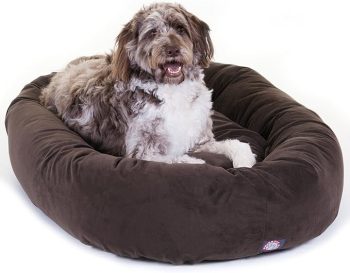
7. Majestic Pet 52″ Suede Bagel Dog Bed
Structural Mechanics: An oversized, heavy-duty "bagel" bolster bed stuffed with premium high-loft polyester fill. The base is constructed from a heavy, waterproof 300/600 Denier material.
Thermal Retention Method: Mass insulation. The thick polyester fill traps a large volume of air, while the dense denier base acts as an effective thermal and moisture barrier against cold subfloors.
Target Metrics: Designed for large and extra-large breeds weighing between 70 and 110 lbs.
Key Consideration: The heavy bolster acts as a continuous neck and spine support, allowing larger dogs to rest their heads and align their skeletal structure comfortably.
8. BFPETHOME Orthopedic Bed for Large Dogs
Structural Mechanics: A flat, mattress-style bed featuring a thick, highly resilient egg-crate foam core covered in plush faux fur. It is equipped with a non-slip, textured bottom.
Thermal Retention Method: The egg-crate foam design creates small pockets of stagnant air beneath the sleeping surface, which act as natural insulative cells to prevent convective cooling from below.
Target Metrics: Specifically optimized for large breeds prone to joint pain and cold stress.
Key Consideration: The cover is fully removable and machine-washable, simplifying the care process for larger, heavy-use beds.
Category D: Versatile & Multi-Format Loungers
These beds offer balanced performance, combining general cushioning, ease of maintenance, and comfortable materials for everyday household environments.
9. Furhaven Soft & Cozy Bean Bag-Style Bed
Structural Mechanics: A nesting bed filled with soft, conforming polyurethane foam pieces, mimicking a traditional bean-bag chair.
Thermal Retention Method: High-loft air entrapment. The loose-fill interior allows the pet to mold the bed around their body, effectively wrapping themselves in insulating foam.
Target Metrics: Suitable for medium to large dogs up to 55 lbs.
Key Consideration: Features a fully removable and washable dual-zipper cover and liner, though it is not recommended for dogs with destructive chewing habits.
10. JOEJOY Faux Fur & Suede Dog Bed
Structural Mechanics: A classic donut-style bed featuring raised suede outer walls and a soft, faux fur interior lining.
Thermal Retention Method: Combined material thermal resistance. The dense suede exterior blocks drafts, while the soft interior faux fur traps body heat.
Target Metrics: Tailored for small to medium dogs that prefer to sleep curled up.
Key Consideration: Machine washable on a gentle cycle; tumble dry on low heat to maintain the plush texture of the fibers.
11. MFOX Calming Bolster Bed
Structural Mechanics: Features extra-tall, highly stuffed bolster walls around a central cushion, constructed from durable nylon and premium faux fur.
Thermal Retention Method: Deep nesting insulation. The high bolsters provide excellent protection against low-level room drafts, keeping cold air from moving across the sleeping dog.
Target Metrics: Available in multiple sizes to accommodate medium to large breeds.
Key Consideration: The durable nylon backing increases wear resistance on abrasive surfaces, while the entire unit is machine-washable.
Technical Specifications Comparison
The following table summarizes the key engineering and material differences across the evaluated categories:
Bed Type
Primary Insulation Mechanism
Best For
Key Maintenance Protocol
Safety Profile
Hooded / Burrower (e.g., Furhaven Hood, Himax)
Passive convective air trapping
High-anxiety, nesting, small breeds
Machine washable cover/unit
High (No cords or heating elements)
Self-Warming (e.g., Furhaven 23", Hollypet)
Infrared reflection (Mylar/Reflective layer)
Senior dogs, thin-coated breeds
Spot clean core, wash cover
High (No electrical risk)
Orthopedic Mattress (e.g., Laifug, BFPETHOME)
High $R$-value foam, conduction block
Large breeds, arthritic dogs
Removable cover machine wash
High (Provides joint relief)
Oversized Bolster (e.g., Majestic Pet 52")
Mass insulation & draft barriers
Giant breeds, sprawl sleepers
Commercial machine wash
High (Durable base materials)
Official Statements & Veterinary Insights
To provide a professional perspective on the biological necessity of thermal pet bedding, we consulted veterinary literature and clinical guidelines regarding canine thermoregulation.
On Canine Osteoarthritis and Cold Sensitivity
According to veterinary orthopedic consensus statements, cold temperatures do not directly cause joint disease, but they significantly alter the biomechanics of joint pain.
"When ambient temperatures drop, the barometric pressure often changes, causing tissues within joint capsules to expand and contract. In a dog with osteoarthritis, this leads to increased pressure on highly sensitive, inflamed nerve endings. Furthermore, cold drafts cause muscles to contract and tighten, leading to overall stiffness. Providing an elevated, thermally insulated bed is a critical clinical recommendation for managing chronic arthritis pain during winter."
On Active (Electric) vs. Passive Thermal Bedding
Veterinary safety advocates urge caution when choosing active heating systems (such as electric plug-in pads) over passive systems (such as self-warming or high-loft beds).
The American Veterinary Medical Association (AVMA) and animal safety groups emphasize that while electric pads are highly effective, they require strict safety compliance:
Low-Voltage Operation: Systems should operate on low-voltage DC power (typically 12V or 24V) to minimize shock hazards.
Chew-Proof Shielding: Power cords must be fully wrapped in flexible steel conduit to prevent electrocution from chewing.
Automatic Thermal Regulation: Electric beds must feature automatic shut-off switches or precise thermostats set to match a dog’s normal internal body temperature (~101.5°F / 38.6°C) to prevent thermal skin burns, which can occur even at low temperatures during prolonged contact.
For unsupervised use or for puppies prone to teething, veterinary professionals almost universally recommend passive self-warming beds or orthopedic foam beds over electric options.
Future Outlook: Innovations in Pet Bedding Technology
The pet bedding market is undergoing a significant shift driven by advancements in textile engineering, smart home integration, and sustainable manufacturing practices.
       [Smart Pet Bed of the Future]
                     │
     ┌───────────────┼───────────────┐
     ▼               ▼               ▼
[IoT Sensors]  [Biomimetic]    [Eco-Friendly]
Pressure &     Phase-Change    Biodegradable
Temp Tracking  Materials (PCM) Core Materials
1. IoT-Enabled Thermal Monitoring
The next generation of pet beds will move beyond simple insulation to include smart home technology. Prototype beds currently in development feature integrated, low-profile pressure sensors and thermal monitors that connect to smartphone apps. These systems can track a pet’s weight, monitor their sleep patterns, and automatically adjust low-wattage heating elements to maintain an optimal temperature. This data can also be shared with veterinarians to help monitor the progression of joint diseases.
2. Biomimetic and Phase-Change Materials (PCMs)
Innovations in human sportswear are making their way into the pet industry. Future thermal dog beds will likely utilize Phase-Change Materials (PCMs). These microencapsulated waxes absorb heat when a dog’s body temperature rises and release it when their body temperature drops. This creates a self-regulating thermal microclimate that prevents both hypothermia in winter and hyperthermia (overheating) in summer.
3. Circular Economy and Ecological Sustainability
As consumers demand more eco-friendly products, manufacturers are transitioning away from virgin petroleum-based foams and synthetics. The future of pet bedding lies in circular design: utilizing ocean-bound plastics for high-loft fiberfill, natural latex cores derived from sustainable rubber trees, and organic cotton or hemp covers treated with non-toxic, water-based moisture barriers. These innovations ensure that providing warmth and comfort for our pets does not come at the expense of the planet.