
Date: August 5, 2026
Author: Investigative Veterinary Desk
Executive Overview
As veterinary professionals navigate an increasingly complex landscape of emerging and re-emerging animal diseases, client education remains the front line of defense. In response to mounting concerns regarding the regional spread and biological threat of the New World screwworm (Cochliomyia hominivorax), veterinary practices are being equipped with new resources to combat misinformation and promote proactive care.
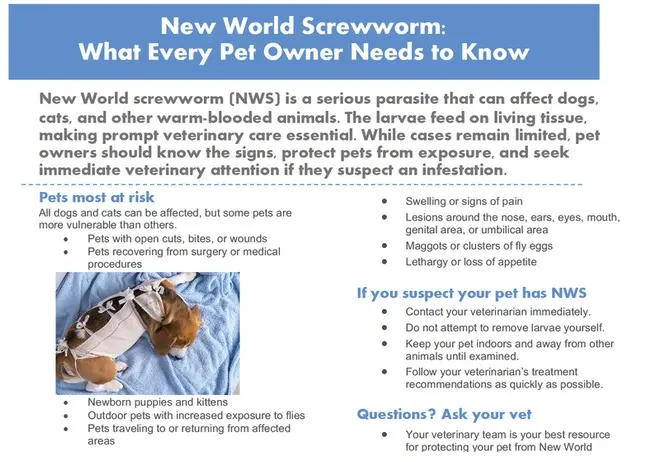
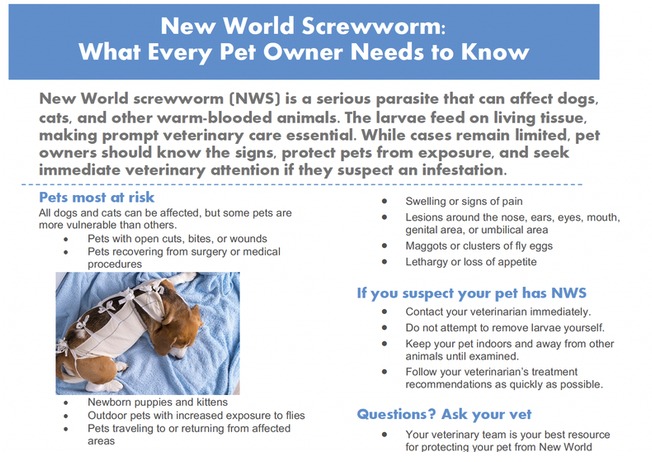
To bridge the communication gap between clinical diagnostics and pet owner awareness, a newly released, highly detailed infographic has been made available for veterinary clinics. Designed for deployment across multiple communication channels—ranging from physical waiting rooms to digital newsletters and social media feeds—this visual guide arms clients with the essential tools needed to identify, prevent, and respond to potential infestations.
The New World screwworm is not a typical nuisance parasite; it is a destructive, obligate parasite capable of devastating livestock, wildlife, and companion animals alike. Because larval stages feed exclusively on the living tissue of warm-blooded mammals, an infestation moves with terrifying speed, often resulting in severe systemic trauma, secondary infections, or mortality if left untreated. This article provides a comprehensive overview of the current epidemiological landscape, the clinical realities of screwworm infestations, strategies for veterinary communication, and the broader implications for animal health policy in 2026.
Detailed Chronology: The Re-Emergence and Spread of Cochliomyia hominivorax
To fully grasp the urgency of current veterinary advisory campaigns, one must examine the historical and modern timeline of the New World screwworm and the relentless efforts required to keep it at bay.
Mid-20th Century: The Eradication Campaign
For decades, the agricultural and veterinary sectors regarded the New World screwworm as one of the most economically devastating livestock pests in the Western Hemisphere. Native to tropical and subtropical regions of the Americas, the parasite historically caused billions of dollars in losses to the livestock industry.
The turning point in veterinary entomology arrived in the 1950s with the development and deployment of the Sterile Insect Technique (SIT) by pioneers Edward F. Knipling and Raymond C. Bushland. By mass-rearing male screwworm flies, sterilizing them via irradiation, and releasing them in massive numbers into the wild, scientists induced sterile matings. Because female screwworm flies mate only once in their lifetime, this biological disruption caused wild populations to plummet. Through coordinated international efforts led by the United States Department of Agriculture (USDA) and regional partners, the screwworm was successfully eradicated from the United States by the 1960s, followed by progressive eradication pushes through Mexico and Central America, establishing a biological barrier zone in Panama.
The Modern Threat Landscape
Despite decades of successful containment, the ecological stability of the biological barrier has faced continuous pressure. Climate shifts, increased global movement of livestock, and wildlife migration patterns have led to sporadic resurgences in border regions and vulnerable tropical ecosystems.
- 2023–2024: Entomological surveillance detected northward expansions of screwworm populations in parts of Central America, prompting heightened alert statuses among veterinary regulatory bodies in North America.
- 2025: Increased border interceptions of livestock bearing larval infestations triggered emergency preparedness protocols across southern tier states in the U.S. and independent veterinary networks.
- August 2026: Recognizing that pet owners and small-scale livestock producers represent critical surveillance nodes, veterinary authorities have prioritized grassroots education. The release of specialized infographics and client-facing educational assets marks a strategic pivot toward community-level vigilance, ensuring that early signs are caught before regional outbreaks can establish a foothold.
Supporting Context & Metrics: Understanding the Parasite’s Biology and Impact
To communicate risk effectively to clients, veterinary teams must understand the biological mechanisms that make Cochliomyia hominivorax uniquely dangerous compared to common blowflies or maggots.
The Life Cycle and Pathology
Unlike common blowflies—which typically deposit eggs in necrotic, decaying tissue—the female New World screwworm is attracted to living flesh. Even the smallest scratch, tick bite, surgical incision, or umbilical cord stump on a newborn animal serves as an invitation for oviposition.
- Oviposition: A single female fly can lay upwards of 200 to 400 eggs at the edge of a wound.
- Larval Eclosion: Within 12 to 24 hours, the larvae (maggots) hatch and immediately begin burrowing into the living tissue using sharp mouth hooks and specialized spines.
- Feeding Phase: The larvae feed aggressively for 4 to 7 days, expanding the wound and creating deep, pocketed cavities. This feeding process releases fluids that attract more female flies, leading to compounding infestations.
- Pupation: Once mature, the larvae drop from the wound to the ground, burrow into the soil, and pupate, eventually emerging as adult flies to restart the cycle.
At-Risk Populations and Clinical Metrics
Veterinary data indicates that while any warm-blooded animal can contract the parasite, certain factors dramatically elevate risk:
- Geographic Proximity: Animals residing in or traveling through endemic or border-adjacent regions face exponential exposure risks.
- Species Vulnerability: Canines and felines with outdoor access, working dogs, livestock (cattle, sheep, goats), and wildlife are primary targets.
- Health Status: Animals with chronic skin conditions, untreated wounds, poor hygiene, or mobility impairments are disproportionately affected.
Clinical metrics emphasize time-to-treatment: If an infestation goes unmanaged for even 48 to 72 hours, the tissue destruction transitions from a localized dermatological issue to a systemic crisis characterized by severe pain, secondary bacterial sepsis, myiasis-induced shock, and potential fatality.
Official Statements and Veterinary Guidelines
As veterinary associations and regulatory bodies respond to the 2026 climate, leadership has emphasized that clinical intervention alone is insufficient. Client compliance and early reporting are mandatory components of biosecurity.
Perspectives from Veterinary Leadership
In a recent briefing by public health entomologists and veterinary epidemiologists, the consensus underscored the necessity of public awareness:
"The New World screwworm is a biological adversary that thrives in the shadows of delayed detection. Veterinarians are our diagnostic anchors, but pet owners are our eyes and ears on the ground. When a client notices a suspicious wound or unusual larval activity and brings it to a clinic immediately, it alters the epidemiological trajectory of an entire region."
Recommended Clinic Protocols for August 2026 and Beyond
Veterinary practices are being urged to implement a standardized response workflow:
- Proactive Educational Distribution: Utilize waiting room displays, digital signage, and automated email campaigns to share the newly released New World screwworm guide. Visual aids significantly improve client retention of complex parasitic concepts.
- Enhanced Triage Screening: Train front-desk staff and veterinary technicians to screen incoming pets for travel history, especially if they originate from southern or tropical regions.
- Rigorous Physical Examinations: During routine wellness checks or emergency intake, perform thorough skin and coat inspections, paying close attention to skin folds, ears, tail bases, and healing surgical sites.
- Mandatory Reporting: Familiarize clinical staff with state and federal reporting channels. Suspected cases of New World screwworm must be reported immediately to state veterinarians or USDA-APHIS officials to ensure rapid containment and genetic tracking.
Future Outlook: Vigilance, Innovation, and Community Resilience
Looking ahead, the veterinary community faces both challenges and technological opportunities in managing parasitic threats like the New World screwworm.
Technological Advancements in Surveillance
The future of pest eradication relies heavily on genomic tracking and enhanced satellite-based environmental monitoring. Researchers are currently refining molecular diagnostic tools that allow laboratories to identify the exact strain and geographic origin of intercepted screwworm samples within hours rather than days. Furthermore, improvements in the mass-rearing and genetic optimization of sterile insect strains promise to make biological control barriers even more resilient against climate-driven expansions.
The Ongoing Role of General Practice
While high-tech solutions develop in research laboratories, the day-to-day battle will continue to be won or lost in local veterinary clinics. Empowering pet owners with accessible, clear, and actionable information transforms passive clients into active guardians of animal health.
By downloading, posting, and distributing the new New World screwworm guide, veterinary practices establish a culture of safety, education, and preparedness. As we move through the latter half of 2026, maintaining this high standard of communication will ensure that our domestic animal populations remain shielded from one of nature’s most formidable parasitic threats.