
Executive Overview
Long before a puppy ever learns to sit on command, heel neatly beside a handler, or navigate a bustling city street to guide a person with visual impairments, an intricate, high-stakes developmental symphony is already underway behind the scenes. In the specialized world of assistance and guide dog breeding and training, excellence is not merely taught; it is engineered from the earliest, most delicate moments of life.
At Dogs Inc, preparing future guide dogs and service dogs begins long before formal training ever commences. It starts in the neonatal box, within the first hours and days of a puppy’s existence. At this fragile juncture, science-based protocols such as Early Neurological Stimulation (ENS) are deployed to optimize physical and psychological resilience. While these exercises are just one small piece of a much larger puzzle, they reflect a rigorous, thoughtful approach designed to support healthy development from the absolute beginning.
This comprehensive report explores the science of early canine neurological growth, the distinct phases of puppy development, the critical differences between neurological stimulation and socialization, and how elite organizations like Dogs Inc lay the groundwork for life-changing partnerships.
Detailed Chronology: From Neonatal Vulnerability to Adolescent Maturity
Understanding how a service dog is shaped requires looking at the sequential milestones of canine development. Every stage presents unique windows of opportunity—and distinct biological vulnerabilities—that dictate how handlers, trainers, and breeders must interact with the growing animal.
1. The Neonatal Stage (Birth to 2 Weeks)
During the neonatal stage, newborn puppies are entirely dependent on their mother and littermates. At this juncture, puppies spend the vast majority of their time sleeping and nursing. They are physically blind and deaf, and their bodies cannot yet regulate internal temperatures.

Despite their seemingly fragile and inactive appearance, profound physiological changes occur inside the puppy. The brain and central nervous system are forming foundational pathways at an astonishing rate. It is precisely during this window—typically spanning from birth through day fourteen—that Early Neurological Stimulation is introduced. The goal is not to teach skills or accelerate obedience, but to offer gentle, highly controlled sensory inputs that encourage neurological growth.
2. The Transitional Stage (2 to 4 Weeks)
As puppies cross the threshold into the transitional stage, sensory worlds expand dramatically. Eyes and ears open, allowing newborns to finally see and hear their surroundings. By four weeks of age, puppies begin to walk, explore, and even emit tentative barks.
Simultaneously, baby teeth begin to emerge, signaling a biological shift away from exclusive nursing toward soft foods and, eventually, solid nutrition. Interactions broaden beyond the mother to include littermates in more dynamic ways, establishing the earliest building blocks of canine communication and social hierarchy.
3. The Socialization Period (3 to 12 Weeks)
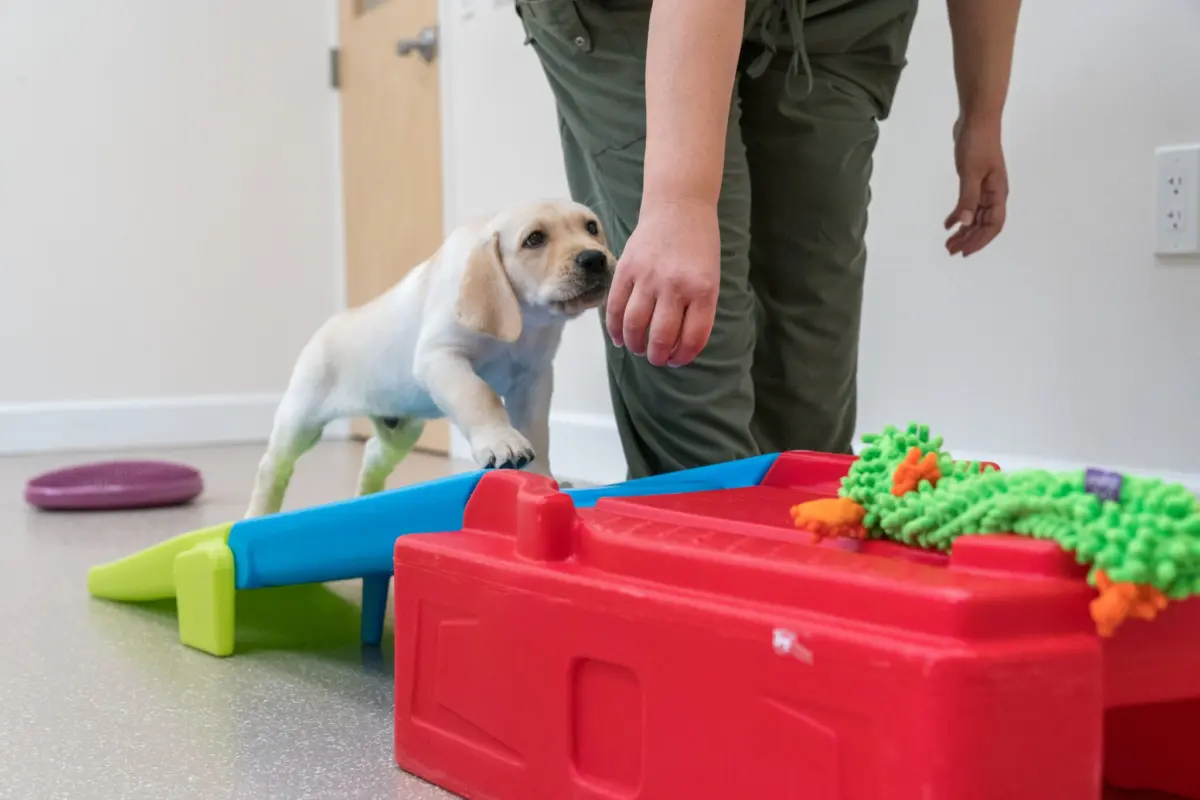
Arguably the most critical window in a dog’s psychological life, the socialization period bridges early infancy with active exploration. Starting around three weeks and peaking through the twelfth week, puppies begin interacting actively with humans, novel sounds, diverse surface textures, and other dogs.
By week eight, many of these experiences solidify the baseline for a friendly, adaptable adult dog. By week twelve, proper exposure to various environmental stimuli becomes paramount. Meeting diverse people, navigating unfamiliar physical spaces, and experiencing varied environments help young dogs gain confidence, build social competence, and preemptively mitigate fear, anxiety, and aggression.

4. Juvenile and Adolescent Stages (6 Months to 12 Months and Beyond)
As dogs mature past puppyhood, they encounter new hormonal and behavioral milestones. The adolescent stage can begin as early as six months of age, during which canine teenagers frequently test boundaries—much like their human counterparts.
Most dogs reach reproductive maturity between six and 12 months. In female dogs, this often involves the onset of the first heat cycle and the broader estrus cycle, while young males experience distinct hormone-driven behavioral shifts. Throughout these adolescent phases, early foundational work pays dividends, helping puppies navigate boundary-testing and adjust smoothly to complex, changing environments.
Supporting Context & Metrics: The Mechanics and Philosophy of ENS
To understand why organizations like Dogs Inc invest heavily in neonatal protocols, one must examine the specific mechanics of Early Neurological Stimulation and contextualize its role within broader canine science.
What is Early Neurological Stimulation?
Originally developed for military canine programs and later popularized across elite working dog sectors, ENS consists of a series of brief, highly specific, and gentle tactile exercises. These exercises are administered once daily during the neonatal window (days 3 through 16).
The routine typically involves a series of five distinct positioning and tactile movements, each lasting approximately three to five seconds:

- Tactile Stimulation: Tickling a foot gently between the toes using a Q-tip.
- Head Up: Holding the puppy perpendicular to the ground, with its head pointing upward.
- Head Down: Holding the puppy perpendicular to the ground, with its head pointing downward toward the floor.
- Supine Position: Holding the puppy calmly on its back, resting in the palm of the handler’s hand.
- Thermal Stimulation: Placing the puppy feet-down on a damp, cool towel for a brief moment.
The Science Behind the Stressors
Each exercise introduces mild, temporary physiological stress to a puppy’s developing system. While it sounds counterintuitive to stress a newborn, controlled, mild stressors in safe environments stimulate the endocrine system, improve cardiovascular performance, enhance adrenal gland function, and increase tolerance to stress later in life.
Studies and decades of practical application by puppy-raising communities indicate that dogs subjected to ENS protocols often demonstrate:
- Improved cardiovascular performance (heart rate stability).
- Stronger adrenal gland responses.
- Greater tolerance to psychological stress and environmental novelty.
- Enhanced disease resistance.
However, experts caution that ENS is not a magic bullet. A puppy’s ultimate temperament and professional viability rely on a complex matrix of genetics, maternal health, early nutrition, comprehensive socialization, and structured positive reinforcement training.
ENS Versus Socialization: Knowing the Difference
A common misconception in canine husbandry is that ENS and socialization are interchangeable terms. They are distinct phases serving entirely different developmental purposes:
- ENS occurs during the neonatal stage (birth to 2 weeks), when puppies are blind, deaf, and entirely dependent. It targets the neurological and endocrine systems through passive, highly controlled physical handling.
- Socialization occurs during the socialization period (3 to 12 weeks), when puppies are active, sensory-aware participants exploring the external world through deliberate, positive exposures to people, places, and objects.
Both phases are vital, but they must occur in proper sequence. ENS acts as a biological priming mechanism, while socialization builds the psychological map of the world.

Official Statements & Institutional Insight: The Dogs Inc Philosophy
The journey of a guide or service dog demands extraordinary resilience. These animals cannot simply be well-behaved pets; they must function as calm, highly focused navigational partners and steady medical anchors in chaotic, unpredictable environments.
"Guide dogs and service dogs need more than advanced technical skills," notes canine development literature from Dogs Inc. "They also need the innate capacity to navigate high-stress urban environments, adjust rapidly to shifting human needs, and remain completely composed alongside the people who depend on them. Those qualities do not appear overnight."
Organizations dedicated to breeding elite service animals recognize that intervention cannot wait until a puppy is old enough for a leash.
"Strong service dog development begins with a solid biological foundation," representatives explain. "Early experiences help prepare puppies for later socialization, volunteer puppy raising, and formal professional training. Each stage builds meticulously on the last, equipping puppies with the emotional resilience they will need for life-changing work."
By acknowledging that development is a lifelong continuum—stretching from neonatal stimulation to transitional open-world exploration, specialized puppy classes around 16 weeks, and continued adult reinforcement—Dogs Inc ensures that every animal receives targeted, empathetic care tailored to its exact stage of neurological growth.
Future Outlook: The Evolution of Elite Canine Breeding and Training
As veterinary behavioral science advances, the methodology behind service dog development continues to evolve. Modern breeding programs are increasingly data-driven, utilizing behavioral tracking metrics, genetic mapping, and standardized neonatal assessments to monitor how early interventions like ENS translate into long-term operational success.
The future of guide and service dog training points toward greater individualization. While standardized protocols like ENS provide a proven baseline, upcoming methodologies focus heavily on recognizing individual puppy thresholds during the critical fear-imprint periods—which typically occur multiple times as a puppy matures. By introducing new environmental stimuli thoughtfully during these sensitive windows, trainers can preemptively curb reactivity and foster lifelong adaptability.
Ultimately, the rigorous care invested during a puppy’s first two weeks reverberates for years to come. Whether guiding a person safely across a busy intersection or providing life-saving medical alerts, the elite service dogs of tomorrow are forged in the quiet, careful moments of today—long before their eyes are even open to see the world they will one day help navigate.