
By the Environmental & Wildlife Desk
Special Series: The Architecture of Migration
Executive Overview
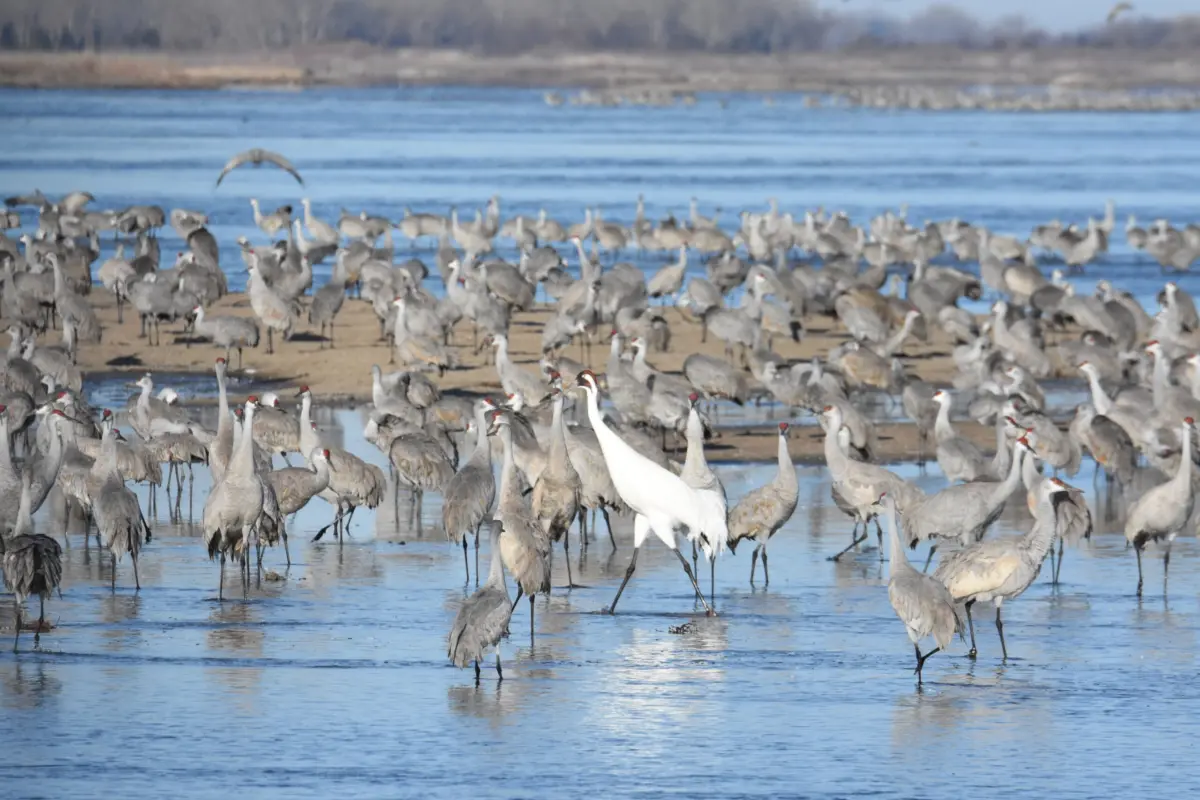
Every spring, the Central Nebraska sky transforms into a living tapestry. Half a million Sandhill Cranes—accompanied by a precious handful of endangered Whooping Cranes—descend upon the Platte River valley in a primordial ritual as old as the continent itself. This breathtaking spectacle pumps an estimated $28 million annually into the regional economy, drawing eco-tourists, ornithologists, and photographers from across the globe.
Yet, beneath the postcard-perfect imagery of dawn silhouetted against a shimmering river lies a stark, less-told reality: the Platte River does not take care of itself anymore.
Without intensive, expensive, and year-round human intervention, this globally renowned wildlife phenomenon would effectively vanish within a generation. Modern infrastructure—ranging from upstream dams and reservoirs to agricultural diversions—has fundamentally altered the hydrology of the Platte. Without constant ecological restoration, the wide, braided, treeless river channels that cranes have trusted for millennia would quickly choke with dense thickets, invasive weeds, and encroaching forests.
This is the story of the silent guardians of the Platte: a coalition of non-governmental organizations (NGOs), state and federal agencies, and dedicated land managers who wage a relentless, 365-day-a-year war against ecological degradation. It is a chronicle of heavy machinery, controlled burns, multi-million-dollar water management strategies, and an unyielding commitment to ensuring that Nebraskans never have to look back and say, "You should have seen the Sandhill Cranes."
Detailed Chronology: From Pristine Wilderness to Engineered Basin
The Ancient Paradigm
For thousands of years, the Platte River operated as a self-sustaining ecosystem. Fed by heavy winter snowpacks in the Rocky Mountains and spring rains, the river experienced massive, scouring seasonal floods. These natural torrents served as a grand architectural reset. Roaring spring flows swept away vegetation from shifting sandbars, polished the riverbeds, and maintained the wide, shallow, braided channels that Sandhill Cranes instinctively seek out for nighttime roosting.
Bordering these dynamic channels were sprawling, fertile wet meadows. These wetlands brimmed with the exact nutritional profile cranes required: a rich smorgasbord of tubers, roots, and protein-rich insects necessary to fuel their grueling northward journey to breeding grounds.
The Turning Point: The Settlement Era
The ecological clock of the Platte began to tick backward with the arrival of European settlers in the 19th and early 20th centuries. As the American West was settled, the region’s waterways were systematically harnessed. Upstream reservoirs were constructed to tame the wild river, re-timing water releases to suit agricultural irrigation and municipal power generation rather than the natural rhythms of wildlife.
By interrupting the natural hydrograph—severely dampening spring peak flows and starving the river of sediment-moving floods—the natural forces that kept the Platte Valley open and unblemished were suppressed. Trees began to colonize the dry sandbars. Willows, cottonwoods, and invasive species took root where shifting sands once dominated. The very sanctuary that drew the cranes to the Platte for centuries was slowly, silently disappearing.
The Awakening of the 1970s
Realizing that the window for saving the Platte was rapidly closing, a wave of conservation-minded visionaries initiated a paradigm shift in the early 1970s. The National Audubon Society, alongside an expanding network of environmental partners, began sounding the alarm. They stepped into the arena as advocates, litigators, and land stewards, fighting to legally and physically protect what remained of the historic river channel.
The Modern Collaborative Era
The past two decades have witnessed an unprecedented evolution in regional conservation: the transition to massive, multi-state, cross-sector collaboration. The establishment of the Platte River Recovery Implementation Program (PRRIP) marked a watershed moment. Bringing together irrigation districts, power authorities, conservation groups, and the states of Colorado, Wyoming, and Nebraska, this coalition pools resources to manage the critical 80-mile stretch of the river known as the "critical reach"—running from Lexington to Chapman, Nebraska.
Today, organizations like the National Audubon Society, The Nature Conservancy, and The Crane Trust invest millions of dollars annually into direct habitat management, proving that corporate, agricultural, and environmental interests can converge around the survival of a shared natural treasure.
Supporting Context & Metrics: The Mechanics of Modern Conservation
Maintaining the Platte River is not a passive endeavor; it is an industrial-scale ecological restoration project. The sheer financial and physical investments required to keep the river viable for wildlife are staggering.
1. Water Management and Artificial Floods
Historically, the Platte in spring could surge past 35,000 cubic feet per second (cfs). Today, natural peak flows of that magnitude are virtually non-existent due to upstream water capture.
To compensate, conservationists rely on limited allocations of water stored in upstream reservoirs. The U.S. Fish and Wildlife Service and its partners strategically release this supplemental water to mimic natural flows. However, supplies are critically constrained:
- Duration: Stored water typically provides only one to two months of artificial flows.
- Volume: Flows are generally capped at around 1,500 cfs—a fraction of the river’s historic capacity.
- Function: These controlled flows provide vital early-season predator warnings, as cranes strictly select nighttime roosting sites surrounded by deep, moving water.
2. Mechanical Scouring and Sandbar Maintenance
Without spring floods to naturally clear vegetation, conservation managers must step in with heavy machinery.
- The Cost: Disking sandbars to physically rip out encroaching vegetation costs up to $16,000 per mile.
- Frequency: This labor-intensive mechanical treatment must be repeated continuously to prevent sandbars from permanently transforming into stabilized islands and woody thickets.
3. The Invasive Phragmites Crisis
Perhaps no single threat looms larger over the modern Platte River than Phragmites australis (common reed). This aggressive invasive species spreads rapidly via lateral roots that can stretch dozens of feet underground, aggressively choking out native flora and narrowing river channels at an alarming speed.
- The Financial Burden: Organizations like the Platte Valley Weed Management Area—a cooperative weed control entity—spend nearly $600,000 annually just to combat Phragmites. Left unchecked, this single invasive plant could completely alter the hydrology and morphology of the Platte River within a decade.
4. Terrestrial Sanctuary Management: Rowe Sanctuary
Conservation does not stop at the water’s edge. At Audubon’s Rowe Sanctuary, land managers meticulously engineer the surrounding terrestrial landscape to replicate historical prairie "disturbance events"—primarily through prescribed burns and managed cattle grazing.
- Target Habitat Structure: Land managers strive to maintain roughly one-third of the sanctuary in open short grasses.
- Nutritional Balance: While cranes spend a considerable amount of time feeding on high-calorie, nutrient-poor waste corn in adjacent agricultural fields, short-grass prairies and wet meadows provide the essential micro-nutrients, tubers, and insects critical for successful migration and breeding.
- Line of Sight: Crews aggressively remove trees encroaching upon prairies and riverbanks. Whooping Cranes, in particular, are exceptionally cautious and require wide, unobstructed visual horizons to select safe riverine roosting sites.
Official Statements & Expert Insights
To understand the stakes of this ongoing conservation battle, one must listen to the voices on the ground—the land stewards, scientists, and policy advocates dedicating their lives to the valley.
"The Sandhill Crane migration is not merely a seasonal event we passively observe; it is an active ecological contract," notes a senior conservation strategist at the National Audubon Society. "For thousands of years, the Platte River kept its side of the bargain by remaining wide, braided, and welcoming. Today, because human development has altered the natural baseline, we must actively manufacture the conditions that allow these birds to survive. If we stop working, the river stops working."
Local agricultural partners and water managers echo the sentiment of shared stewardship. Through the Platte River Recovery Implementation Program, agricultural and municipal water users have learned that environmental health and economic vitality are inextricably linked.
"Water management in the Platte basin is a delicate balancing act," explains a regional resource coordinator. "We have to balance the water needs of growing communities and farms in Colorado, Wyoming, and Nebraska with the absolute biological necessities of endangered Whooping Cranes and migrating Sandhills. The survival of the migration proves that cooperative conservation is not just an ideal—it is a practical necessity."
Furthermore, the economic data underscores the community-wide investment in the birds. As highlighted by the 2025 Economic Impact Study of the Spring Wildlife Migration on Central Nebraska, the $28 million annual infusion is a direct dividend of pristine habitat management. Local hoteliers, restaurateurs, tour operators, and retail merchants recognize that the economic health of Central Nebraska flows directly from the health of the Platte River.
Future Outlook: Protecting the Marvel in Perpetuity
As we look toward the horizon, the challenges facing the Platte River valley are manifold. Climate variability, shifting agricultural demands, and the relentless pressure of invasive species mean that conservationists can never afford to rest on their laurels.
The strategy for the future relies on three core pillars:
- Defending Natural Flows: Continuing aggressive policy advocacy to protect existing streamflows and prevent damaging upstream diversions that starve the critical reach.
- Expanding Cooperative Frameworks: Strengthening multi-state partnerships through PRRIP and local weed management groups to pool financial and technical resources.
- Intensive Adaptive Management: Utilizing cutting-edge ecological data to refine prescribed burning, mechanical sandbar disking, and invasive species eradication protocols at sanctuaries like Rowe.
The stakes could not be higher. The spectacle of half a million Sandhill Cranes dancing across the Nebraska dawn is more than a tourism driver or an ornithological wonder; it is a barometer of environmental health for the entire Central Flyway.
Organizations like Audubon and their myriad partners are locked in a generational mission: to ensure that the Platte River remains a living, breathing echo of its historic self. Through sweat, science, and sustained financial commitment, they are working tirelessly to guarantee that the ancient thunder of crane wings continues to echo across the Nebraska plains for generations yet unborn—ensuring that Nebraskans will never have to speak of the migration in the past tense.