
Executive Overview
In an era defined by rapid urbanization, habitat fragmentation, and the steady erasure of historical landscapes, conservation often reveals itself in the most unexpected places. On a warm October morning at the historic Woodlawn Cemetery in downtown Fort Myers, Florida, family historian and preservation advocate Ramona D. Miller experienced a convergence of ecology and ancestry. While tending to her genealogical research and advocacy work, Miller encountered a trio of Crested Caracaras—striking, falcon-like raptors typically reserved for wide-open prairies, rangelands, and remote pastures—patrolling the sacred grounds.
This rare sighting highlights a profound truth often overlooked in modern land management: historic green spaces protect far more than the tangible artifacts of human history. They serve as vital urban refuges, offering ecological havens for threatened wildlife in regions where natural habitats are vanishing beneath asphalt and concrete. Woodlawn Cemetery, established circa 1915 as a segregated burial ground for African American families across Southwest Florida—including residents of Immokalee denied burial access in Collier County during the Jim Crow era—stands today as a dual monument. It is both a solemn archive of resilience and an unexpected sanctuary for biodiversity.
This feature explores the intersection of historic preservation and wildlife conservation at Woodlawn Cemetery. By examining the fragile coexistence of ancestral memory and modern ecological stewardship, we investigate how the defense of sacred Black burial grounds inadvertently safeguards vulnerable Florida ecosystems. Through firsthand accounts, expert ornithological insights, and historical context, this article uncovers the broader implications of viewing cemeteries not merely as landscapes of the dead, but as living, breathing ecosystems essential for the survival of the living.
Detailed Chronology: The October Discovery at Woodlawn Cemetery
The sequence of events that brought Ramona D. Miller face-to-face with one of Florida’s most charismatic and elusive raptors began innocently enough. Miller, a dedicated family historian deeply rooted in the agricultural community of Immokalee in neighboring Collier County, has spent years navigating archives, oral histories, and overgrown landscapes to piece together the narratives of African American families who shaped Southwest Florida.
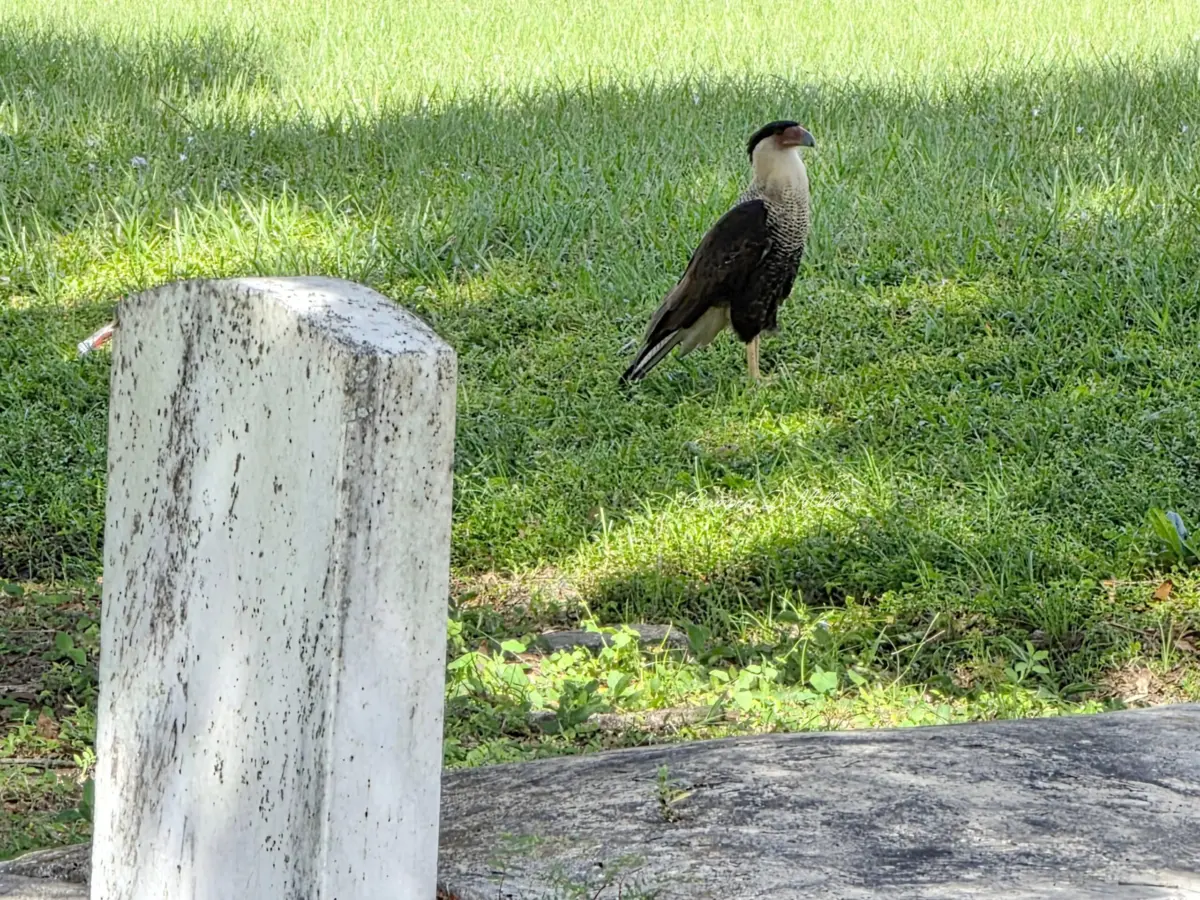
On October 9, Miller’s archival work brought her to Woodlawn Cemetery, a municipal burial ground owned by the City of Fort Myers. The cemetery holds the remains of generations of Black families who endured the systemic injustices of segregation. While walking the grounds, scanning the canopy and the open turf between historic headstones, Miller noticed three large, unfamiliar birds moving across the grass.
"Protecting historic green space protects more than history. It protects habitat. Shade for the owl. A perch for the hawk. Open ground for the caracara. Sky for a young eagle to grow into its crown."
— Ramona D. Miller
Growing up in Immokalee—an inland farming region where Crested Caracaras are theoretically part of the local fauna—Miller had never previously encountered the species, let alone a trio of them gathered in such close proximity. Intrigued by their distinct appearance, she paused to observe their behavior.
"A black cap like a crown. A bright face. Long legs built for walking the earth," Miller recalled, describing the moment she raised her smartphone to consult an identification application. As the digital search confirmed the birds as Crested Caracaras (Caracara plancus), an immediate symbolic resonance settled over her. To Miller, these resilient raptors moving quietly across a segregated burial ground felt deeply poetic: they were survivors on sacred ground.
This October sighting was not an isolated ecological event for Miller, who is also an active beekeeper accustomed to observing Northern Cardinals, red-shouldered hawks, and Blue Jays visiting her hives and gardens. Just days prior to encountering the caracaras, she spotted a subadult Bald Eagle soaring over the cemetery grounds. Recognizing the ecological weight of these observations, particularly regarding the Crested Caracara—a species facing mounting environmental pressures in Florida—Miller documented the moment with photographs and resolved to share her findings with Audubon Florida, officially stepping into the world of citizen science and bird conservation.
Supporting Context & Metrics: History, Ecology, and Habitat Pressures
The Historical Significance of Woodlawn Cemetery
To fully appreciate the significance of Miller’s discovery, one must understand the socio-historical landscape of Woodlawn Cemetery. According to documentation maintained by the Black Cemetery Network, the Woodlawn section of the Fort Myers Cemetery was established around 1915. During an era defined by rigid racial segregation, African American residents throughout Southwest Florida—including families from rural Immokalee—were legally and socially barred from burying their deceased loved ones in white cemeteries.
Consequently, Woodlawn became a repository of resilience, community history, and ancestral grief. Families poured their care into these grounds, creating a physical space to honor their dead despite systemic marginalization. Over the decades, however, many historic Black burial grounds across the United States have faced systemic neglect, urban encroachment, and the constant threat of erasure. The tireless work of advocates like Ramona D. Miller ensures that these spaces are recognized not only for the human histories they hold, but for the physical footprints they maintain in an increasingly paved world.
Ecological Realities of the Crested Caracara
The Crested Caracara is a fascinating subject of avian ecology. A member of the falcon family (Falconidae), the Audubon’s Crested Caracara (Caracara plancus audubonii)—the distinct subspecies native to Florida—is a non-migratory raptor historically tied to the dry prairies and open pastures of the state’s interior. Unlike traditional falcons that rely almost exclusively on aerial pursuits, caracaras are opportunistic scavengers and predators. Their long, unfeathered legs are built for walking on the ground, where they forage for carrion, small mammals, reptiles, amphibians, and insects.
The Florida population of the Crested Caracara is geographically isolated from populations in Texas, Arizona, and Central America, making it particularly vulnerable to regional environmental shifts. According to conservation metrics tracked by state and federal wildlife agencies, the species has experienced significant habitat contraction over the past half-century.
- Habitat Loss: The primary driver of caracara population stress is the conversion of native dry prairies and cattle ranches into residential subdivisions, commercial developments, and intensive agricultural monocultures. As open rangelands disappear, caracaras are forced into smaller, fragmented patches of green space.
- Geographic Range: While the core of the Florida caracara population remains concentrated in the Kissimmee River Valley and surrounding ranchlands of South-Central Florida, sightings in urbanizing coastal counties like Lee and Collier have occasionally surprised researchers, signaling either shifting foraging ranges or the displacement of pairs due to habitat loss.
- Conservation Status: The Florida subspecies of the Crested Caracara is currently listed as Threatened under the federal Endangered Species Act, highlighting the urgency of preserving every parcel of open ground that can support foraging, nesting, and roosting activities.
When a cemetery acts as an urban island of open canopy and mowed turf, it inadvertently mimics the open pastures favored by caracaras. The absence of dense structural development within historic cemeteries provides the unobstructed lines of sight and ground-level foraging areas that these birds require.
Official Statements and Expert Perspectives
The intersection of historic preservation and urban ornithology has drawn the attention of regional conservation leaders and birding experts, who view sightings like Miller’s as both an encouraging sign of adaptability and a stark warning regarding habitat fragmentation.
Keith Laakkonen, an avid birder and the director at Audubon’s Corkscrew Swamp Sanctuary in Naples, Florida, offers critical context regarding the shifting patterns of local wildlife.
"Their populations around here have been doing fairly well, and I have been seeing them in more and more places in Collier County that I never did before," Laakkonen notes, reflecting on the broader geographic distribution of Crested Caracaras in Southwest Florida.
While historical data archived on platforms like eBird indicates that a sparse handful of Crested Caracaras have been documented in the broader neighborhood of the Fort Myers cemetery over the decades, regular or multi-bird sightings within urban core boundaries remain exceptional events. Laakkonen emphasizes that as suburban sprawl encroaches upon traditional agricultural lands, adaptable raptors are increasingly forced to navigate human-dominated landscapes, utilizing parks, golf courses, and historic cemeteries as surrogate habitats.
Ramona D. Miller views her encounter through a deeply philosophical yet pragmatic lens, arguing that the stewardship of sacred spaces must expand to encompass environmental advocacy.
"Preservation is not only for the dead: It is for everything still living on that ground," Miller asserts.
Recognizing that her observations hold scientific value, Miller has begun logging her sightings from Woodlawn Cemetery into eBird—the global citizen-science database managed by the Cornell Lab of Ornithology. By contributing her data to eBird, Miller ensures that professional ornithologists, urban planners, and conservationists can track wildlife utilization within urban green spaces. This data collection plays a vital role in demonstrating to municipal leaders that historic cemeteries function as essential ecological corridors that deserve rigorous protection from commercial redevelopment and neglect.
Future Outlook: Integrating Heritage Conservation with Urban Ecology
As American cities densify to accommodate growing populations, municipal planners, historical preservationists, and environmental advocates face a shared challenge: how to protect the past while sustaining the natural systems of the future. The convergence of history and ecology at Woodlawn Cemetery offers a compelling blueprint for modern land stewardship.
1. Holistic Land Management
Cities that own and maintain historic cemeteries must begin to view these properties through an ecological lens. Vegetation management plans can be adjusted to balance respectful landscaping with the preservation of mature trees, native shrubbery, and open foraging areas. By avoiding excessive pesticide use and maintaining structural diversity in plant life, cemeteries can enhance their capacity to support migratory birds, resident raptors, and vital pollinators like bees and butterflies.
2. Cross-Disciplinary Advocacy
The experience of Ramona D. Miller illustrates the immense power of cross-disciplinary collaboration. Genealogical preservationists, civil rights historians, and conservation groups like Audubon must forge stronger alliances. When advocates for Black history join forces with environmental conservationists, they create a formidable coalition capable of protecting green spaces from the dual threats of urban blight and destructive commercial development. Protecting Woodlawn Cemetery is simultaneously an act of racial justice, historical reckoning, and environmental defense.
3. Expanding Citizen Science in Urban Sanctuaries
Encouraging community members, historians, and visitors to engage in citizen science—such as logging bird sightings on eBird during visits to historic sites—transforms everyday citizens into active conservationists. These grassroots data collection efforts fill critical gaps in scientific understanding, providing verifiable proof that urban green spaces are indispensable to local wildlife populations.
A Call to Slow Down
In a fast-paced world driven by constant acceleration, the lessons of Woodlawn Cemetery invite us to pause. The next time you walk past a quiet old burial ground, a historic churchyard, or an overgrown urban lot, remember Ramona D. Miller’s advice: slow down, study the canopy, and pay attention to the wildlife that calls these quiet refuges home.
You might just witness the quiet resilience of nature adapting to a changing world—surviving, and thriving, on sacred ground.