
Executive Overview
In an era dominated by high-definition digital databases, instantaneous mobile identification apps, and cloud-hosted biodiversity inventories, the physical field guide occupies an increasingly precarious space on our bookshelves. For generations, birdwatchers, botanists, and naturalists relied heavily on dog-eared paper volumes to identify everything from eastern North American songbirds to exotic Costa Rican butterflies. Today, however, many nature enthusiasts find themselves with overflowing shelves, housing duplicate copies, outdated editions gifted by well-meaning relatives, and specialized regional guides to places they have never visited.
Rather than relegating these beautiful, highly detailed volumes to recycling bins or thrift-store donation boxes, a growing movement of crafters, poets, and environmental artists is transforming discarded field guides into striking, mixed-media works of art. By combining vintage book pages, tactile fabric backings, embroidery, and minimalist blackout poetry—often referred to as "cross-out poems"—creatives are finding a sustainable and deeply personal way to honor the natural world. This trend sits at the intersection of the burgeoning upcycling movement, contemporary literary arts, and sustainable home decor, offering a hands-on method to repurpose print media while celebrating the rich heritage of ecological illustration.
Detailed Chronology: The Evolution from Print Identification to Creative Reclamation
To understand the contemporary phenomenon of field guide upcycling, it is essential to trace the trajectory of how naturalists document and interact with the natural world. The journey from field-bound paperbacks to framed fiber art involves several distinct evolutionary phases over the past century.
Phase 1: The Golden Age of Print Field Guides (Mid-to-Late 20th Century)
For decades, the field guide was the absolute gold standard for field identification. Landmark publications—such as Roger Tory Peterson’s revolutionary identification systems and comprehensive volumes published by the National Audubon Society—standardized how humans observed wildlife. These books were engineered for durability, packed with dense plates of illustrations, distribution maps, and detailed morphological descriptions. They were companions on countless hikes, bearing the stains of mud, rain, and enthusiastic thumb-flipping.
Phase 2: The Digital Disruption and the Shelf-Space Crisis (Early 2000s–Present)
As smartphones permeated daily life, the utility of carrying heavy physical volumes into the field began to wane. The rise of comprehensive web databases, geo-tagged photographic libraries like iNaturalist, and real-time acoustic recognition tools such as the Merlin Bird ID app fundamentally shifted consumer habits. Naturalists could instantly identify an unfamiliar call or plumage variation in milliseconds without flipping through three hundred pages of raptor profiles. Consequently, millions of physical field guides were transitioned from active utility tools to static shelf occupants. Outdated taxonomic names, revised geographical ranges, and duplicate gift copies compounded the issue, leading to an unprecedented accumulation of unused forestry, ornithology, and marine biology texts.
Phase 3: The Convergence of Craft, Literature, and Sustainability (2020s)
As sustainability initiatives gained mainstream momentum and modern consumers sought tactile, screen-free hobbies during times of widespread digital fatigue, the maker community began experimenting with discarded books. Erasing text to create blackout or cross-out poetry—a creative form rooted in the Dadaist traditions of the early 20th century—found a natural partner in the richly descriptive prose of natural history guides. Crafters realized that the concise, evocative language used to describe bird calls, flight patterns, and feather patterns could be reframed into poignant, poetic commentaries on conservation, beauty, and memory. The practice evolved from simple page-tearing into sophisticated mixed-media art featuring fiber arts, embroidery, and felt backing.
Supporting Context & Metrics: The Upcycling Economy and Digital Fatigue
The emergence of field guide art is not merely an isolated craft trend; it reflects broader cultural and economic shifts in how society values physical objects, waste reduction, and mental well-being.
The Rise of the Upcycling and Craft Economy
According to recent market analyses within the global handcraft and DIY sectors, consumer interest in sustainable crafting has surged exponentially. The global upcycling market, which encompasses everything from fast-fashion repurposing to paper arts and furniture restoration, is projected to scale significantly over the coming decade. Consumers are increasingly motivated by circular economy principles—diverting waste from landfills and finding creative utility in items deemed obsolete.
Print books, particularly encyclopedias, textbooks, and specialized regional field guides, represent a major segment of discarded paper waste as public libraries and private collectors digitize their archives. While old novels are frequently transformed into folded-page sculptures or hollowed-out storage books, scientific field guides offer a unique visual advantage: vibrant lithographic plates, detailed anatomical drawings, and specialized typographic layouts that lend themselves immediately to visual art.
The Psychology of Digital Fatigue and Tactile Engagement
Simultaneously, psychologists and cultural critics have documented the psychological toll of hyper-connectivity and screen fatigue. The impulse to tear paper, thread needles, and stitch tactile felt backings onto a vintage book page represents a deliberate return to analog engagement. Working with physical materials—feeling the weight of vintage paper, manipulating needle and thread, and carefully selecting words through manual cross-outs—activates cognitive pathways that digital interfaces simply cannot replicate. For birders and conservationists who spend hours staring at tracking apps, digital cameras, and online databases, creating physical art from outdated field guides serves as a meditative, grounding ritual.
Step-by-Step Methodology: Crafting Your Own Field Guide Cross-Out Poetry
For those looking to transform their dusty bookshelves into gallery walls or thoughtful handmade correspondence, the process requires minimal specialized equipment but rewards patience and an eye for design. Below is the definitive guide to creating your own field guide fiber-art poetry.
Step 1: Material Acquisition and Curation
Begin by auditing your collection to select a volume that you are willing to deconstruct. While rare first editions should always be preserved, common paperback guides, outdated regional directories, or heavily damaged copies are prime candidates.
Required Supplies:
- A discarded field guide or natural history book.
- A sharp pair of detail scissors or a precision craft knife.
- A sharp sewing needle.
- Embroidery thread or durable sewing thread in complementary colors.
- Felt backing material (easily sourced in various colors from craft stores or online retailers).
- Optional: Picture frames or cardstock blanks for mailing.
Step 2: Page Selection and Thematic Focus
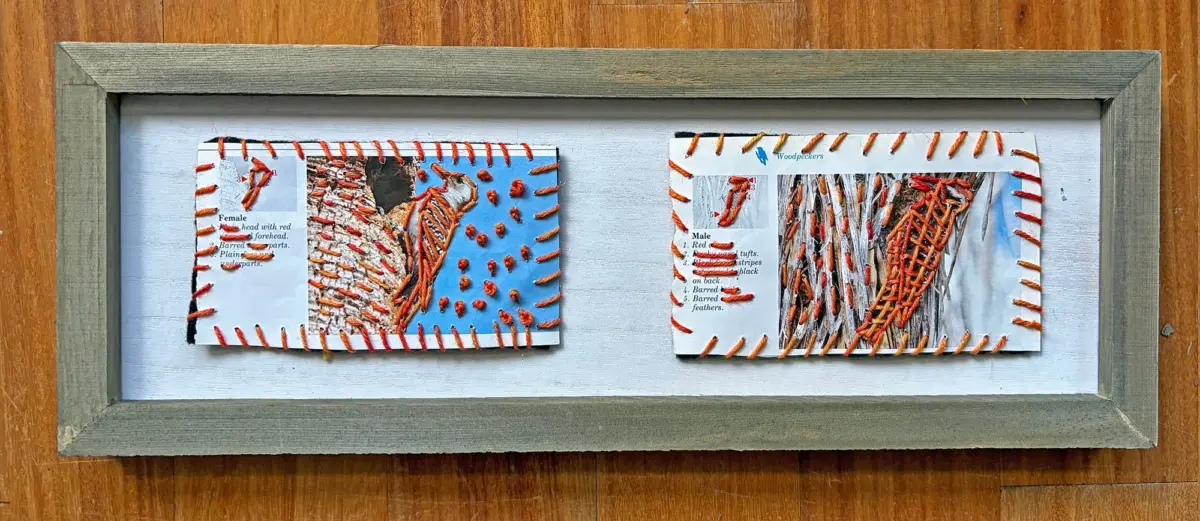
Flip through the volume to locate a page layout that balances striking visual imagery with rich descriptive text. For instance, an entry on North American woodpeckers—such as the Ladder-backed or Red-bellied Woodpecker—offers both dynamic photographic subjects and narrative descriptions of behavior, habitat, and vocalizations. Selecting a page with emotional or ecological resonance helps anchor the final artwork.
Step 3: Precision Extraction and Backing Preparation
Carefully excise the chosen page from the book spine. Using your scissors, trim around the selected photograph and the accompanying text block, leaving approximately one centimeter of white space along the borders to allow room for stitching. Next, cut a piece of felt backing to match the exact dimensions of your cut-out paper block. The felt not only provides structural rigidity and a clean finish but also protects the delicate paper from tearing over time.
Step 4: Stitching and Textual Subtraction (The Cross-Out Poem)
Secure the paper front to the felt backing by stitching a running stitch or blanket stitch around the perimeter. Perfection is secondary to personal aesthetic; rustic, visible stitching often enhances the handmade charm of the piece.
Once the foundational structure is complete, examine the remaining text block. The objective of a cross-out poem is to use thread to physically obliterate the words you wish to discard, allowing the surviving words to form a new poetic statement. Consider what the birds, the landscape, or the natural world communicate through these isolated fragments.
To elevate the artwork further, incorporate decorative embroidery directly onto the photographic plate itself. Techniques such as French knots, back-stitching, or delicate woven patterns can highlight specific features of the bird’s plumage, mimic floral elements in the background, or add a vibrant textural dimension to the flat printed page.
Step 5: Display, Framing, and Distribution
The finished pieces can be mounted in small, elegant frames to create a gallery wall celebrating biodiversity and literary reuse. Alternatively, because standard field guide pages are compact, these fiber-art creations fit comfortably inside standard greeting card envelopes, offering a unique, handmade way to send a thoughtful message to fellow nature lovers.
Future Outlook: The Sustainable Future of Natural History Art
As environmental consciousness continues to reshape consumer behavior, the intersection of traditional craft, literary upcycling, and ecological appreciation is poised for sustained growth. The practice of turning obsolete field guides into art addresses a fundamental tension in modern conservation culture: how to honor the tangible history of field science while embracing a digital future.
Moving forward, community workshops, local craft guilds, and environmental education centers are expected to increasingly adopt upcycling projects of this nature. By teaching participants how to rescue discarded educational materials and recontextualize them as personal expressions of poetry and design, communities can divert valuable paper waste from landfills while fostering a deeper, more imaginative connection to the natural world.
Ultimately, these stitched and crossed-out field guide pages prove that obsolescence is rarely the end of a book’s story. With a bit of thread, a sharp pair of scissors, and a creative eye, yesterday’s outdated identification manual can become tomorrow’s cherished wall art—reminding us that nature, much like literature, is always open to reinterpretation.