
Executive Overview
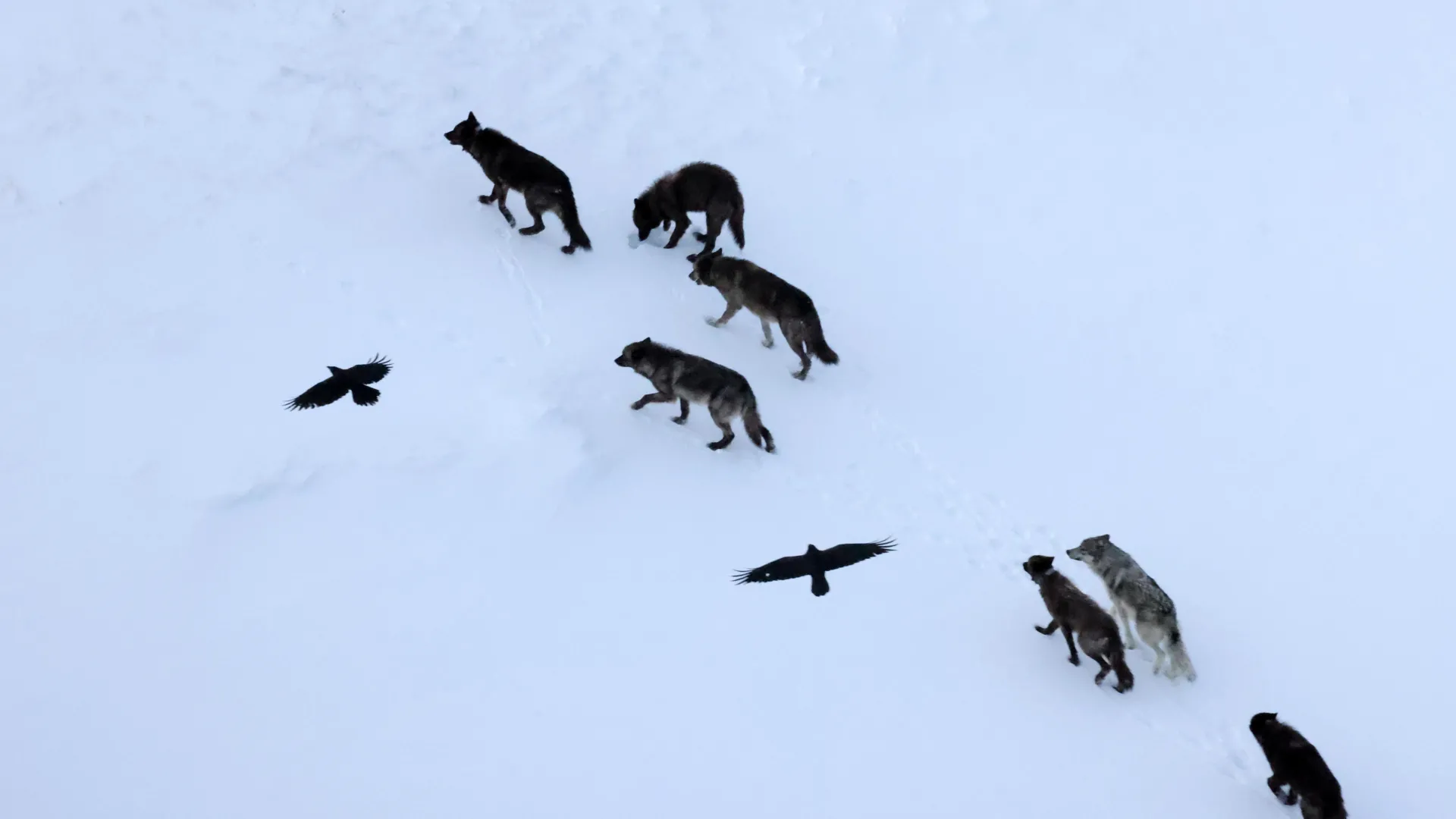
For generations, the classic winter tableau of the American West has featured a familiar, almost symbiotic supporting cast: the gray wolf pack bringing down its quarry, flanked immediately by the obsidian silhouettes of ravens. Long before the apex predators can even tear into their freshly secured meal, these clever corvids are already gathered on nearby branches, biding their time for a chance at the scraps.
Because of this uncanny, clockwork-like timing, naturalists, wildlife biologists, and casual observers alike long operated under a straightforward assumption: ravens simply shadow wolves. The conventional wisdom dictated that if you wanted to find a wolf kill, you needed only to follow the raven, or conversely, that the raven survived by keeping a watchful, dependent eye on the movements of the pack. It was a narrative of passive dependence—a clever bird hitching a ride on the apex predator’s hunting success.
However, a landmark new study published in the prestigious journal Science has shattered this long-held ecological dogma. Tracking the intricate movements of ravens and wolves across the rugged, snow-swept wilderness of Yellowstone National Park over a rigorous two-and-a-half-year period, an international team of researchers has uncovered a far more sophisticated strategy. Instead of playing the role of the perpetual stalker, ravens rely on a remarkable combination of advanced spatial memory, cognitive mapping, and environmental navigation.
They do not follow wolves across the landscape; rather, they remember where kills are statistically likely to happen and navigate directly to those hotspots, sometimes flying continuously for hours across massive distances.
"They can fly six hours non-stop, straight to a kill site," notes Dr. Matthias Loretto, the study’s first author, who conducted the research alongside institutions including the Research Institute of Wildlife Ecology at the University of Veterinary Medicine Vienna, the Max Planck Institute of Animal Behavior in Germany, and the University of Washington.
This revelation fundamentally reshapes our understanding of avian intelligence, scavenger ecology, and the complex invisible webs that govern predator-prey dynamics in one of the world’s most scrutinized ecosystems. By taking the scavenger’s point of view for the very first time, scientists have unlocked a masterclass in cognitive ecology, proving that the raven’s success relies not on mere surveillance, but on a deeply internalized mental map of its world.
Detailed Chronology: Unraveling the Mystery in Yellowstone
To appreciate the scale and precision of the new study, one must first understand the unique laboratory that Yellowstone National Park provides. Following their systematic eradication in the early-to-mid 20th century, gray wolves were triumphantly reintroduced to the park in the mid-1990s after a 70-year absence. This ecological restoration set off a massive cascade of scientific inquiry, transforming Yellowstone into the premier global site for studying large carnivore re-colonization.
For decades, biologists tracked the shifting dynamics between reintroduced wolves and the park’s abundant ungulate populations—primarily elk, bison, and deer. Among these observers was Dr. Dan Stahler, a veteran Yellowstone biologist who has dedicated his career to studying the park’s wolf packs. Stahler and his colleagues watched year after year as ravens materialized out of seemingly empty skies the moment a carcass hit the snow.
"You see them flying directly above traveling packs or hopping close behind wolves as they take down prey," Stahler explains.
Because wolves consistently generate reliable, albeit unpredictable, feeding opportunities for secondary carnivores and scavengers, the "shadowing hypothesis" became the default scientific consensus. Yet, despite its widespread acceptance, the hypothesis had never been rigorously tested.
"We all assumed that the birds had a very simple rule; just stick close to the wolves," Stahler admits. "We didn’t know what ravens were capable of because nobody had ever put them at the center; nobody had taken the scavenger’s point of view."
Capturing the Elusive Minds
Shifting the scientific lens to the scavenger required an unprecedented field operation. Capturing and tracking ravens is notoriously difficult; these corvids possess an evolutionary wariness and high cognitive capacity that makes them exceptionally resistant to standard trapping methods.
"Ravens are so observant of the landscape that they don’t step into traps easily," Dr. Loretto explains.
To overcome this hurdle, the research team had to resort to psychological warfare of their own, carefully blending traps into the surrounding human and natural environments. Near park campsites, for instance, capture units were meticulously disguised with common refuse and fast-food wrappers.
"Or else the ravens would suspect that something was off and wouldn’t come near it," Loretto notes.
Through immense patience and ingenuity, the team successfully fitted 69 wild ravens with advanced, miniaturized GPS trackers—an exceptionally large sample size for an avian telemetry study of this complexity. Simultaneously, researchers collared approximately a quarter of Yellowstone’s total wolf population, maintaining roughly 20 active tracking collars per year.
The primary observational window was concentrated during the brutal Rocky Mountain winters. Winter is the crucible for scavenging dynamics; deep snows impede ungulate movement, wolf packs hunt with heightened frequency and success, and food resources become both critical and ephemeral. During these freezing months, the GPS units recorded raven locations every 30 minutes and wolf locations every hour, while field crews meticulously mapped the exact temporal and spatial coordinates of every wolf-induced kill.
The Plot Twist in the Data
When the researchers first began processing the mountain of telemetry data, they anticipated seeing neat lines of raven coordinates tracking tightly behind migrating or hunting wolf packs. Instead, they found an astonishing statistical anomaly.
Over the entire two-and-a-half-year span of intensive monitoring, the research team recorded only one clear, definitive instance of a raven following a single wolf for more than one kilometer or for longer than an hour.
"At first, we were puzzled," Loretto recalls. "Once we realized that ravens are not following wolves over long distances, we couldn’t explain why the birds still arrive so quickly at wolf kills."
The paradox was profound. If the ravens were not shadowing the wolves, how did they consistently manage to arrive at fresh kills within minutes, sometimes beating competing scavengers and even the wolves themselves to the feast?
The answer lay hidden within the macro-level movement patterns of the birds. When the researchers mapped out the daily travel vectors of the tagged ravens, they discovered that the birds were not reacting to the live movements of specific wolf packs. Instead, they were executing purposeful, highly directed flights across vast expanses of the Yellowstone landscape, frequently returning to precise geographic locations where kills had historically occurred.
Some individual ravens were documented traveling up to 155 kilometers (nearly 100 miles) in a single day, charting direct, unswerving flight paths toward zones where carcasses were statistically prone to appearing—all without any real-time visual or auditory cues pointing to a fresh hunt.
Supporting Context & Metrics: The Science of the Resource Landscape
To fully contextualize these findings, one must examine the physical geography of Yellowstone National Park and how it dictates predator behavior. Wolf packs do not hunt with uniform success across every square foot of the park. Their hunting strategies rely heavily on topography, snow depth, and the distribution of their primary prey—elk, bison, and deer.
Consequently, wolf kills are not randomly distributed. They tend to cluster heavily in specific, high-yield zones of the landscape, most notably flat valley bottoms, riparian corridors, and transitional winter ranges where ungulates concentrate and maneuverability is restricted.
Key Metrics and Research Parameters
- Study Duration: 2.5 years of continuous, intensive seasonal tracking (primarily winter focus).
- Tagged Avian Subjects: 69 wild ravens fitted with high-resolution GPS telemetry units.
- Tagged Canine Subjects: Approximately 20 collared wolves monitored annually (representing roughly 25% of the park’s total wolf population).
- Data Granularity: Raven locations logged at 30-minute intervals; wolf locations logged at 60-minute intervals.
- Maximum Daily Flight Distance: Up to 155 kilometers (approx. 96 miles) traversed by individual ravens in search of food.
- Observed Long-Distance Shadowing Events: Exactly 1 documented instance of a raven following a wolf pack beyond 1 kilometer or 1 hour.
The Mental "Resource Landscape"
What the Yellowstone data reveals is that ravens have mentally mapped this ecological grid. They learn and internalize what behavioral ecologists term a long-term "resource landscape."
While an individual kill remains an unpredictable, stochastic event—a wolf pack cannot guarantee it will bring down an elk at 2:00 PM in a specific meadow—the macro-pattern of productivity is stable over time. Certain valleys are simply more lethal to ungulates than others, season after season.
"We already knew that ravens can remember stable food sources, like landfills," Dr. Loretto points out, referencing urban-adapted corvid behavior. "What surprised us is that they also seem to learn in which areas wolf kills are more common. A single kill is unpredictable, but over time some parts of the landscape are more productive than others—and ravens appear to use that pattern to their advantage."
This capacity requires an immense cognitive toolkit. It demands episodic memory, spatial orientation, topographical navigation across complex mountain terrain, and the ability to abstract historical probability into current behavioral decisions. The raven, in essence, operates like a seasoned financial investor or a master chess player: it doesn’t need to watch every single move of its opponent to know where the board’s high-value squares are located.
Official Statements and Institutional Perspectives
The collaborative nature of this research brought together world-class institutions spanning multiple continents, uniting expertise in avian biology, large carnivore ecology, and spatial modeling. The implications of their findings have resonated widely through the scientific community.
Dr. Matthias Loretto, currently based at the University of Veterinary Medicine Vienna and formerly of the Max Planck Institute of Animal Behavior, emphasizes the sheer physiological and navigational prowess required for this lifestyle:
"They can fly six hours non-stop, straight to a kill site… Ravens can cover large distances by flying, and they seem to have a good memory, so they don’t need to constantly follow wolves in order to profit from the predators."
Dr. Dan Stahler, reflecting on decades of observing Yellowstone’s carnivores, underscores how deeply entrenched the old assumptions were, and how humbling it is to view the ecosystem through the eyes of its most intelligent avian resident:
"We all assumed that the birds had a very simple rule; just stick close to the wolves… We didn’t know what ravens were capable of because nobody had ever put them at the center; nobody had taken the scavenger’s point of view."
Prof. John M. Marzluff of the University of Washington, a globally recognized authority on corvid intelligence and senior author on the Science paper, points out that this discovery fundamentally alters our baseline understanding of avian autonomy and foraging flexibility:
"What our study clearly shows is that ravens are flexible in where they decide to feed. They don’t stay tied to a particular wolf pack. With their sharp senses and memory of past feeding locations, they can choose among many foraging opportunities far and wide. This changes how we think about how scavengers find food—and suggests we may have underestimated some species for a long time."
Future Outlook: Redefining Animal Intelligence and Ecosystem Dynamics
The publication of this study in Science marks a definitive turning point in behavioral ecology, but it also opens up vast new avenues for future research. If ravens are utilizing long-term spatial memory and probability maps to locate ephemeral food sources created by apex predators, to what other ecological interactions might this cognitive framework apply?
Micro-Cues vs. Macro-Memory
Researchers are careful to note that memory does not entirely replace local observation. When ravens arrive in a high-yield valley, they do not simply guess blindly; they switch scales.
"To find wolf kills locally, ravens likely use short-range cues, like monitoring wolf behavior or listening to wolf howling," Dr. Loretto explains.
The strategy is therefore hierarchical: ravens use macro-scale spatial memory to cross vast distances and position themselves within productive resource landscapes, and then deploy micro-scale sensory cues—such as auditory monitoring of vocalizing packs or visual scans for circling scavengers—to pinpoint the exact carcass once they are in the neighborhood.
Broader Implications for Conservation and Science
This dual-layer foraging strategy forces a re-evaluation of how we model multi-species interactions within protected ecosystems. Traditionally, trophic cascades—such as the famous wolf-elk-vegetation dynamics in Yellowstone—are viewed through a top-down, linear lens. Predators suppress herbivores, which allows flora to recover.
However, studies like this one inject a much-needed layer of behavioral complexity, demonstrating that scavengers are not passive beneficiaries riding the coattails of carnivores, but active, highly intelligent agents whose cognitive maps allow them to navigate complex landscapes independently.
As climate change and human development continue to fragment wildlife corridors across the globe, understanding how animals encode and remember resource landscapes becomes critically important. If species like ravens rely on stable geographical cues and long-term memory of predator activity, alterations to the landscape—such as fencing, habitat destruction, or shifts in ungulate migration routes—could disrupt cognitive frameworks that took centuries to evolve.
Ultimately, the Yellowstone raven study serves as a humbling reminder of the hidden cognitive depths within the natural world. Beneath the glossy black feathers of a scavenging bird lies a mind capable of mental mapping, historical calculation, and strategic endurance that rivals our own. The next time a traveler in the American wilderness watches a raven drop silently from a freezing sky onto a fresh wolf kill, they are witnessing not the simple act of a follower, but the masterclass of an intellectual equal navigating a landscape it has learned by heart.