
Executive Overview
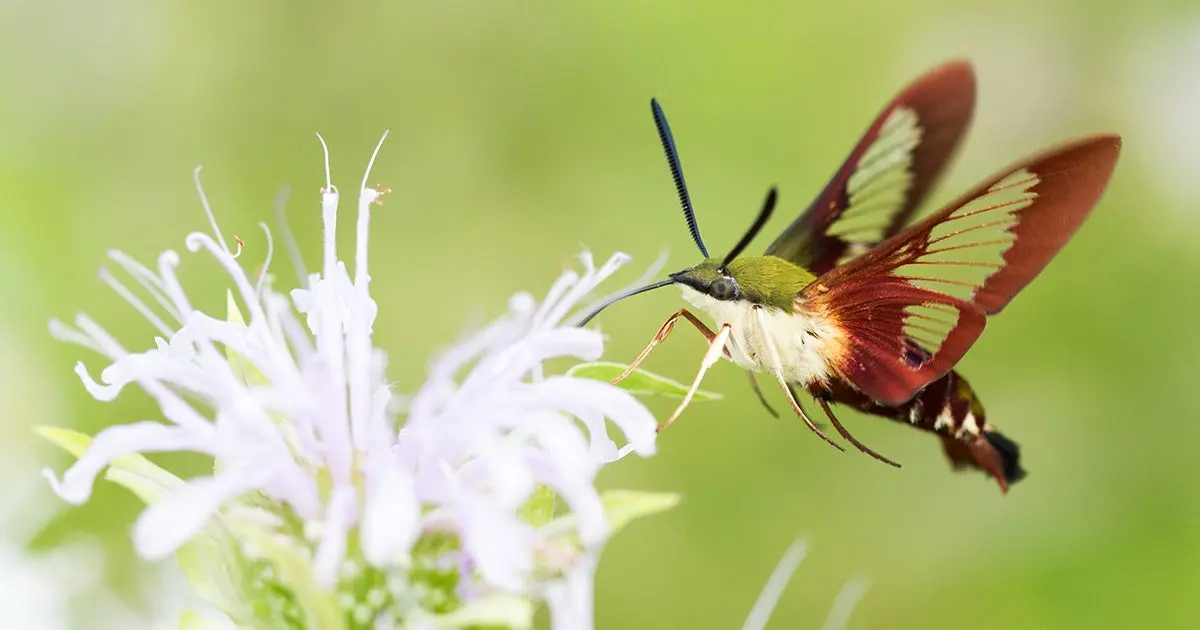
To the casual observer standing in a sunlit summer garden, the darting, iridescent flash of red and green hovering at a blossom’s edge is immediately cataloged as a hummingbird. The erratic yet precise maneuvers, the furious hum of displaced air, and the methodical extraction of nectar all fit the classic avian archetype. Yet, upon closer inspection, the feathered blur dissolves into something far more astonishing: an insect.
This masterclass in biological mimicry belongs to the hummingbird moth, a specialized subset of the sprawling hawkmoth family (Sphingidae). Despite sharing neither evolutionary lineage nor anatomical class with birds, these robust Lepidoptera have independently converged on a lifestyle, flight mechanic, and feeding apparatus nearly identical to those of their feathered doppelgängers.
The phenomenon offers a profound window into the mechanics of convergent evolution—a process where unrelated organisms independently evolve strikingly similar adaptations to exploit the same ecological niche. Beyond the sheer novelty of nature playing an evolutionary game of copycat, hummingbird moths and their avian counterparts serve as vital cogs in the machinery of North American ecosystems. As elite pollinators capable of hovering flight, they sustain diverse floral networks that might otherwise fail to reproduce.
However, these charismatic daytime flyers face mounting modern pressures, from pervasive habitat fragmentation to the indiscriminate use of chemical pesticides. This report explores the biological architecture of hummingbird moths, the evolutionary pressures that shaped them, their critical role in pollination networks, and the actionable conservation strategies required to protect them in an increasingly urbanized world.
Detailed Chronology: Unraveling the Evolutionary History of the Hawkmoth
To understand how a moth came to mimic a bird, scientists must look back hundreds of millions of years into the divergence of life on Earth.
The Divergence of Lineages
The evolutionary paths of birds (class Aves) and moths (class Insecta, order Lepidoptera) parted ways over half a billion years ago. Their last common ancestor was a simple, wormlike marine organism that predated the terrestrial explosion of both groups. Consequently, any behavioral or morphological similarities we observe today are not the result of shared heritage, but rather of separate evolutionary journeys spanning deep geological time.
The Rise of the Hawkmoth (Sphingidae)
The hawkmoth family, encompassing roughly 1,400 species worldwide—with approximately 115 species native to North America—boasts a rich fossil record stretching back millions of years. Characterized by stout, spindle-shaped bodies and powerful, streamlined wings, these insects earned their family name from their exceptionally strong, steady flight patterns, reminiscent of predatory hawks. Furthermore, their larval stage—the caterpillar—often displays a distinct defensive posture when threatened, rearing up the front of its body in a manner that ancient taxonomists likened to the Egyptian Sphinx, giving rise to their alternative moniker: sphinx moths.
The Shift to Diurnal Foraging
While the vast majority of hawkmoths are nocturnal or crepuscular (active at dawn and dusk), a small, specialized minority underwent a profound behavioral shift. Abandoning the safety of the night, these lineages transitioned to daylight foraging. This evolutionary gamble exposed them to increased predation from diurnal hunters like birds and lizards, but it unlocked an abundant, untapped resource: flowers that rely strictly on daytime pollinators.
To survive this high-risk lifestyle, these diurnal hawkmoths—collectively known as hummingbird moths—refined their flight dynamics, feeding apparatuses, and even their physical appearances. Among the most successful of these adaptations are North America’s four "clearwing" species:
- The Hummingbird Clearwing (Hemaris thysbe): The most widespread and commonly observed species, recognized by its reddish-brown and olive coloration and transparent central wing panels.
- The Snowberry Clearwing (Hemaris diffinis): Distinguished by its black-and-yellow bumblebee-like or clear-winged framing, prevalent across broad North American ranges.
- The Slender Clearwing (Hemaris gracilis): A more localized woodland inhabitant with narrower wings.
- The Rocky Mountain Clearwing (Hemaris thetis): A western high-elevation specialist that bridges the visual gap between a moth, a hummingbird, and a bumblebee.
Supporting Context & Metrics: Anatomy, Energetics, and Convergent Evolution
The resemblance between a hummingbird and a hummingbird moth is not merely a superficial trick of the light; it is a profound functional convergence driven by physical laws and ecological demands.
Aerodynamics and Flight Mechanics
Both animals have solved the immense engineering challenge of hovering flight. To maintain position in mid-air, hummingbird moths beat their wings in a rapid, continuous figure-eight motion, achieving frequencies of up to 70 beats per second. For comparison, certain hummingbird species manage approximately 80 beats per second. This extreme expenditure of energy allows both creatures to execute complex aerial maneuvers, including flying backward—a rarity in the animal kingdom.
| Biological Metric | Ruby-Throated Hummingbird | Hummingbird Clearwing Moth |
|---|---|---|
| Taxonomic Class | Aves (Bird) | Insecta (Insect) |
| Wingspan | 3.0 to 4.3 inches | ~1.5 to 2.1 inches (Roughly half) |
| Wingbeat Frequency | Up to 80 beats per second | Up to 70 beats per second |
| Feeding Apparatus | Extendable, tubular tongue wrapped inside skull | Coiled proboscis twice the body length |
| Diet | Floral nectar, small insects/sap | High-sugar floral nectar |
The Mechanics of the Proboscis
To extract nectar from deep within tubular, brightly colored flowers, both creatures rely on hyper-specialized mouthparts. Hummingbirds utilize long, slender beaks housing extendable tongues, while hummingbird moths employ a proboscis that can measure twice the length of their own bodies. When not in use, this delicate strawlike organ is neatly coiled beneath the chin.
Entomologists often describe this style of feeding as analogous to trying to hit the opening of a drink can with a two-meter-long straw held entirely in your mouth. Yet, it affords the moth a distinct evolutionary advantage: the ability to feed safely while hovering, thereby avoiding ground-dwelling predators such as spiders and ambush bugs lurking on the petals.
The Science of Convergent Evolution
Akito Kawahara, director of the McGuire Center for Lepidoptera and Biodiversity at the Florida Museum of Natural History, emphasizes that this cross-kingdom doppelgänger act is a textbook case of convergent evolution.
"In convergent evolution, species independently evolve similar traits to suit the same ecological niche," Kawahara explains. "If you land on a plant, you’re prone to predation. If there’s a spider or lizard on the flower, you’ll get eaten. By hovering, you can avoid predation and move more quickly, systematically, and efficiently from flower to flower."
This evolutionary phenomenon is mirrored elsewhere in nature—such as the streamlined body shapes of sharks and dolphins, the opposable thumbs of primates and chameleons, or the convergent flight adaptations seen in swallows and swifts.
Official Statements and Ecological Insights
The ecological footprint of hummingbird moths extends far beyond their aesthetic charm. As apex invertebrate pollinators, they play a critical role in maintaining the structural integrity of native plant communities across North America.
The Pollination Powerhouse
Because of their exceptional endurance and high metabolic rates, hummingbird moths require vast amounts of sugar to sustain their high-energy flight styles. They are magnetically drawn to tubular, brightly colored, nectar-rich flowers—including bee balm, verbena, salvia, honeysuckle, phlox, and butterfly bush.
Their long proboscises allow them to access floral geometries that standard bees and butterflies cannot reach. In extreme evolutionary pairings, such as Darwin’s hawkmoth (Xanthpan morganii praedicta) of Madagascar—which features a staggering foot-long proboscis—the insect serves as the exclusive pollinator for deeply recessed flora like the star orchid.
The Image Problem of Invertebrates
Despite their vital ecosystem services, insects continue to battle deeply ingrained cultural biases. "There’s still tremendous negativity towards insects," notes Dr. Kawahara. "But it doesn’t have to be that way. To more deeply appreciate bugs, consider bugwatching. And if you’re already a convert, introduce your friends to invertebrate life. In hummingbird moths, they might just find their spark insect—and worlds of wonder will follow in its wake."
Conservationists argue that shifting public perception from fear or indifference to active fascination is essential for garnering grassroots support for habitat preservation initiatives.
Future Outlook: Threats, Conservation, and How to Support Pollinators
Like their avian counterparts, hummingbird moths are increasingly vulnerable to anthropogenic pressures. The degradation of native landscapes, unchecked suburban sprawl, and the widespread application of systemic insecticides pose severe threats to their survival across the United States.
Navigating Seasonal Vulnerabilities
Hummingbird moths are widely distributed throughout the United States, ranging from Alaska down to Florida. Midsummer marks the peak season for spotting them in gardens and meadows, coinciding with the return of migratory hummingbirds. This seasonal overlap frequently causes widespread public confusion, prompting delightful double-takes from backyard naturalists.
However, the life cycle of these insects requires careful seasonal stewardship, particularly during their vulnerable transitional phases.
Actionable Conservation Strategies
Homeowners and land stewards can take direct, measurable steps to protect and nurture hummingbird moth populations:
- Cultivate Native Flora: Replace sterile lawns and non-native ornamentals with native nectar-bearing plants. Species such as wild bergamot (bee balm), coral honeysuckle, ironweed, and native salvias provide the high-octane fuel these metabolic powerhouses require.
- Rethink Fall Yard Maintenance: Avoid the urge to meticulously rake and bag autumn leaves. Hummingbird moth larvae spin their cocoons in leaf litter during the colder months, frequently anchoring them beneath host plants like viburnum, wild cherry, and plum. Preserving leaf litter not only shelters overwintering moths but also supports beneficial ground-foraging birds.
- Eliminate Chemical Pesticides: Minimize or entirely eliminate the use of broad-spectrum insecticides, systemic neonicotinoids, and chemical weed killers in residential landscapes, as these toxins decimate fragile insect populations at every life stage.
- Embrace "Bugwatching": Foster a culture of invertebrate appreciation by spending time observing garden visitors through a macro lens or binoculars, transforming backyard conservation into an active, joyful pursuit.
By recognizing the intricate evolutionary wonders hiding in plain sight—from the whirring wings of a clearwing moth to the ancient laws of convergent evolution—society can foster a deeper, more resilient commitment to preserving the complex web of life that sustains our natural world.