
Executive Overview
For decades, selecting a cat litter was a simple chore: you visited the pet supply aisle, reached for whatever clay-based bag happened to be on sale, and lugged it home. Today, that transactional simplicity is entirely a thing of the past. The contemporary feline care market has evolved into a sophisticated science, driven by advancements in veterinary medicine, material sciences, and an increasing consumer demand for sustainability.
In 2026, the modern cat owner faces a dizzying array of alternatives: color-changing silica crystals capable of diagnosing underlying health issues, moisture-activated micro-granules designed for micro-apartment odor control, and plant-based, biodegradable mediums fashioned from whole-kernel corn, renewable wheat, and recycled paper.
Yet, this abundance of choice introduces high stakes. Feline behaviorists and veterinarians routinely stress that the wrong litter selection can trigger chronic stress, severe respiratory distress from particulate inhalation, or outright litter box avoidance—a leading behavioral cause of feline relinquishment to shelters.
This comprehensive review evaluates the leading cat litters available in 2026. By examining real-world performance metrics—including odor neutralization, clumping integrity, dust migration, tracking footprints, environmental lifecycle impact, and cost-to-value ratios—this guide aims to help single-cat owners and multi-cat households alike decode the modern marketplace and secure the optimal hygiene solution for their pets.
Detailed Chronology & Market Evolution: How We Reached the 2026 Litter Landscape
To understand why cat litter technology looks the way it does today, it is helpful to trace its evolution from simple origins to the high-tech formulations currently dominating the market.
- The Pre-1948 Era (The Ash and Sand Standard): Before commercial litters existed, cat owners relied on sand, dirt, fireplace ashes, or shredded paper. These materials were notoriously messy, tracked throughout homes poorly, and offered virtually no odor control.
- The 1948 Clay Revolution: Edward Lowe revolutionized the industry by introducing processed clay (fuller’s earth) as "Kitty Litter." For the next four decades, heavy, non-clumping clay was the undisputed king of feline sanitation, requiring frequent, complete box replacements.
- The 1990s Clumping and Silica Breakthroughs: The introduction of sodium bentonite clay allowed litters to form solid, scoopable clumps, drastically reducing waste and maintenance frequency. Concurrently, silica gel crystals entered the market, offering unprecedented moisture absorption and lightweight profiles.
- The 2000s–2010s Natural and Eco-Friendly Wave: Rising environmental consciousness and concerns over clay mining spurred the development of plant-based litters. Corn, wheat, recycled paper, wood shavings, and eventually tofu and coconut husks carved out significant market share, catering to eco-conscious consumers and cats with sensitivities.
- The 2020s–2026 Smart Diagnostics and Automation Era: The current market is defined by convergence. Smart litters like PrettyLitter use chemical indicators to monitor pH levels and screen for disease. Simultaneously, the proliferation of automatic, self-cleaning litter boxes has forced manufacturers to engineer litters specifically tailored to mechanical sifting systems, maximizing efficiency and minimizing mechanical jams.
Supporting Context & Metrics: Breaking Down Litter Categories
When evaluating cat litters, performance cannot be judged by marketing slogans alone. The industry relies on several core metrics to differentiate products:
- Dust Emission Levels: Measured in percentage reduction from baseline industrial clay. Premium litters boast 99% to 99.9% dust-free ratings, protecting both human and feline respiratory tracts from crystalline silica exposure.
- Odor Neutralization Kinetics: The speed and mechanism by which a product halts ammonia production. While cheap fragrances merely mask foul odors, advanced micro-granules and baking soda formulations neutralize volatile organic compounds (VOCs) at a molecular level.
- Clumping Density and Tensile Strength: The ability of a clump to withstand the mechanical stress of scooping without fracturing and leaving dirty residue behind.
- Tracking Indices: The distance and volume of granules carried away from the box via feline paws, heavily influenced by particle weight and surface texture.
Detailed Product Reviews: The Top Cat Litters of 2026
1. Best Crystal Cat Litter: PrettyLitter Color-Changing Cat Litter
- Primary Material: Silica gel crystals
- Dust Level: Virtually dust-free
- Best For: Health-conscious cat parents and early disease detection
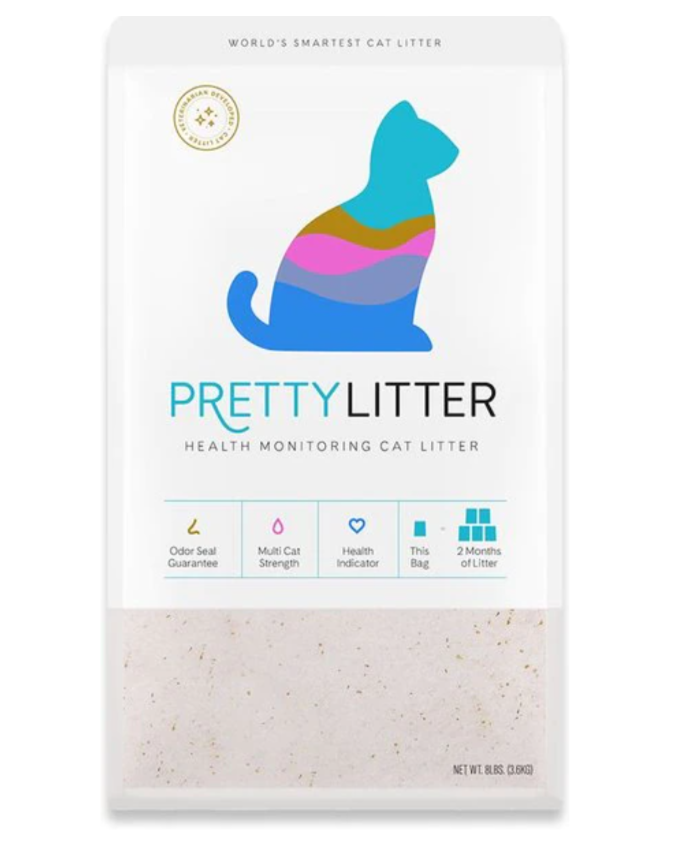
PrettyLitter stands apart from conventional litters because it functions as a passive diagnostic tool. The lightweight silica crystals utilize a proprietary chemical indicator that alters color in response to urinary abnormalities. Yellow-green signals normal pH; unusual acidity or alkalinity shifts the crystals toward bright yellow or blue, while the detection of red blood cells registers as dark red or brown.
Beyond its health-monitoring capabilities, PrettyLitter excels in everyday utility. Because it absorbs moisture and evaporates liquid rather than forming wet clay clumps, it is exceptionally lightweight. A single bag typically services one cat for an entire month.
- Pros: Early warning system for silent illnesses (such as urinary tract infections or kidney disease); low tracking; extremely lightweight; subscription convenience.
- Cons: Non-clumping nature requires daily stirring of solid waste; premium price point.
2. Best Heavy-Duty Odor Control: Fresh Step Crystals & Arm & Emblematic Formulations
- Primary Material: Advanced silica gel & baking soda matrices
- Dust Level: Low dust
- Best For: Multi-cat apartments and tight spaces
Fresh Step’s silica gel crystal line capitalizes on rapid-absorption technology. Liquid urine is wicked away instantaneously, while solid waste undergoes rapid desiccation. This dual-action drying process starves odor-producing bacteria of the moisture they require to proliferate.
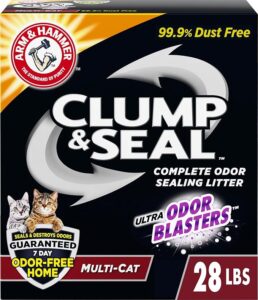
Similarly, Arm & Hammer Clump & Seal utilizes a heavy-duty moisture-activated micro-granule formula combined with baking soda. It seals microscopic voids around waste immediately upon contact, creating an airtight barrier that locks in ammonia smells before they escape into the ambient air.
- Pros: Industry-leading odor prevention; minimal tracking; long-lasting between full tray swaps.
- Cons: Requires daily manual intervention (stirring for crystals; diligent scooping for clay seals).
3. Best Clumping Clay Cat Litter: Dr. Elsey’s Ultra Clumping Cat Litter
- Primary Material: Heavy sodium bentonite clay
- Dust Level: 99.9% dust-free
- Best For: Multi-cat households and cats rejecting artificial scents
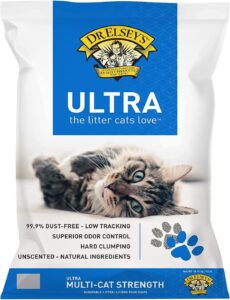
Developed by veterinarians, Dr. Elsey’s Ultra has earned a cult-like following among cat owners who demand raw, unadulterated performance. It utilizes a medium-grain heavy clay that forms rock-solid clumps instantly upon contact with moisture. These clumps resist crumbling, meaning they can be lifted out of the box in one piece without shedding dirty residue back into the clean litter.
Crucially, Dr. Elsey’s is 100% unscented. Because felines possess olfactory systems vastly more sensitive than our own, heavily perfumed litters frequently cause box rejection and behavioral elimination issues.
- Pros: Superior clumping tensile strength; zero artificial fragrances; excellent value-to-volume ratio.
- Cons: Heavy boxes can be difficult to lift and transport up stairs.
4. Best Natural Plant-Based Cat Litter: World’s Best Comfort Care Unscented
- Primary Material: Whole-kernel corn
- Dust Level: Low dust, chemical-free
- Best For: Eco-conscious homes, households with small children, and chemical sensitivities
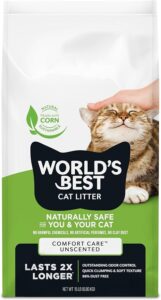
World’s Best proves that natural, plant-based litters do not have to sacrifice performance. Milled from whole-kernel corn, the starches naturally clump upon contact with moisture while plant proteins neutralize ammonia odors without synthetic additives.
Because it contains no silica dust, chemical deodorizers, or clay minerals, it provides a non-toxic environment for homes with crawling infants, curious dogs, or sensitive felines. Furthermore, it is biodegradable and flushable in small quantities.
- Pros: Excellent natural clumping; biodegradable and flushable; completely safe if accidentally ingested in small amounts.
- Cons: Corn-based litters can occasionally attract grain pests if stored in humid environments improperly.
5. Best Paper-Based Litter for Special Needs: Fresh News Recycled Paper Pellets
- Primary Material: 100% recycled paper
- Dust Level: Dust-free
- Best For: Kittens, declawed cats, and post-surgery recovery
When paw sensitivity is paramount—such as in the immediate aftermath of orthopedic or soft-tissue surgery—traditional clay and sharp crystals are contraindicated. Fresh News utilizes soft, absorbent pellets fashioned entirely from recycled paper.
The large pellet geometry practically eliminates tracking, ensuring granules do not leave the immediate perimeter of the litter box zone. While it lacks clumping properties, soiled pellets break down into a manageable pulp that sifts downward.
- Pros: Exceptionally gentle on sensitive or healing paws; zero tracking; eco-friendly recycled content.
- Cons: Non-clumping formula demands more frequent full-box sanitation cycles.
Future Outlook: What Lies Ahead for Feline Sanitation
As we look toward the latter half of the 2020s, the trajectory of the cat litter industry points directly toward hyper-personalization and IoT (Internet of Things) integration. Industry analysts project several emerging trends:
- Smart Litter Boxes and Sensor-Embedded Media: Moving beyond passive color-changing crystals, upcoming developments involve litters embedded with biocompatible nano-sensors capable of transmitting real-time biometric data—such as specific gravity, protein levels, and exact elimination frequency—directly to smartphone veterinary applications.
- Closed-Loop Sustainability Programs: With landfills growing increasingly burdened by millions of tons of discarded clay annually, manufacturers are aggressively developing compostable, municipal-pickup-friendly organic litters that break down entirely within weeks.
- Hypoallergenic and Immune-Supportive Additives: Future formulations are expected to incorporate natural prebiotics and botanicals designed to neutralize pathogen transmission directly at the litter surface, safeguarding both feline and human health in multi-species households.
Buyer’s Guide: How to Choose the Right Litter for Your Home
Choosing the right litter ultimately requires balancing your cat’s biological preferences with your own household logistics. Consider the following criteria before making a purchase:
- Assess Your Cat’s Health and Age: Kittens and senior cats often require softer textures (paper or fine natural grains) to protect developing or arthritic joints. Cats with a history of urinary tract issues benefit immensely from diagnostic crystal litters.
- Evaluate Your Living Space: If you live in a compact apartment with limited ventilation, prioritize 99.9% dust-free formulas (such as Dr. Elsey’s or Boxiecat) and high-performance odor neutralizers (like Arm & Hammer Clump & Seal).
- Match Your Maintenance Schedule: Busy professionals who travel frequently may find low-maintenance, long-lasting silica crystal systems (like Fresh Step or PrettyLitter) more manageable than daily-scooping clay regimens.
- Execute Gradual Transitions: Never switch cat litters abruptly. Felines are creatures of habit; a sudden change in texture or scent can prompt them to eliminate on expensive rugs or furniture. Transition over a 7-to-10-day period by blending 25% new litter with 75% old litter, slowly scaling up until the old medium is entirely phased out.
By approaching feline hygiene with the same care and discernment given to nutritional selection, cat owners can ensure a cleaner home, a healthier pet, and a harmonious domestic environment for years to come.