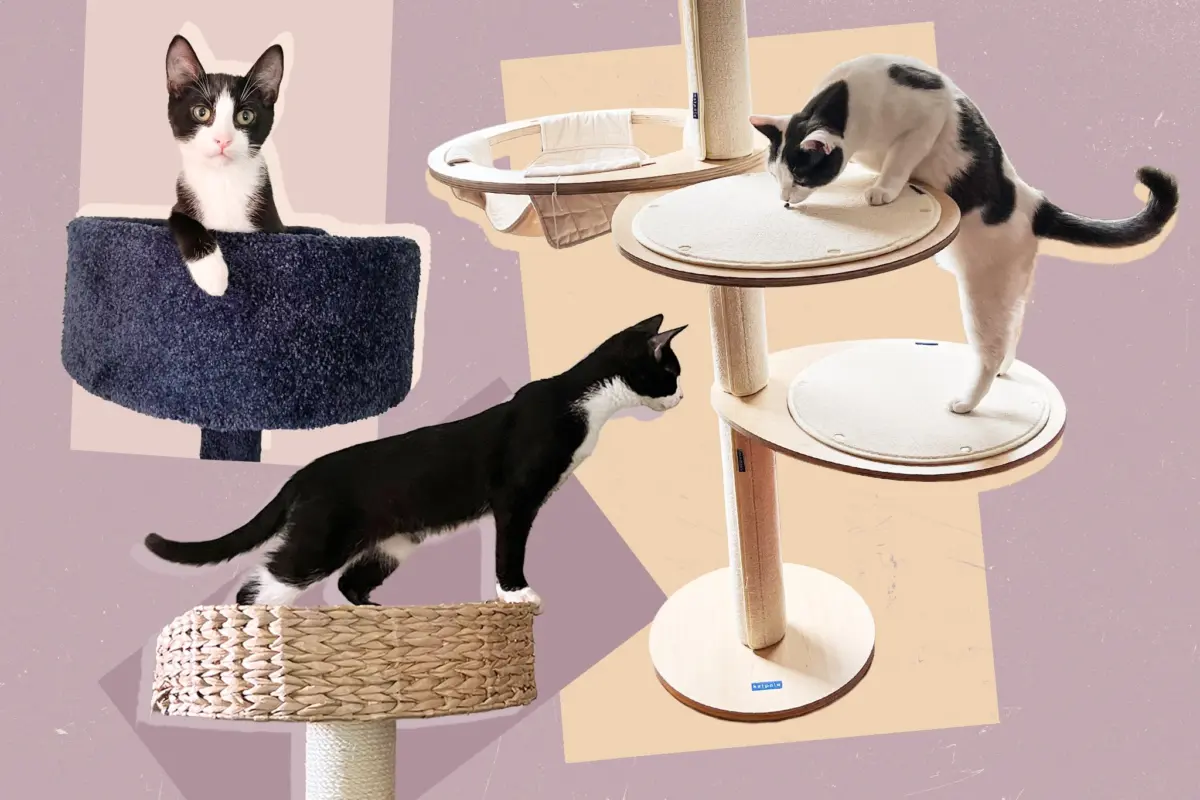

For nearly six decades, the cat tree has stood as an indispensable fixture in the modern household. Invented in 1968 to save human furniture from the daily onslaught of feline claws and to deter cats from scaling indoor drapery, the humble scratching post and climbing apparatus has undergone a quiet evolution. Today, behavioral scientists, veterinarians, and animal welfare experts consider vertical territory just as critical to a cat’s well-being as a clean litter box.
To help cat owners navigate the overwhelming modern market—which spans thousands of models ranging from $25 disposable budget builds to $1,600 artisanal statement pieces—expert reviewers recently evaluated 65 different cat trees. After narrowing the field down to 17 top contenders, these models were put through rigorous, multi-stage testing in real homes. Nineteen feline testers ranging from a 4-pound kitten to a 22-pound adult, including visually impaired and mobility-challenged cats, sat, slept, and scratched in judgment.
This deep-dive report breaks down the science of vertical spaces, examines the top-performing cat trees across multiple categories, and reveals which models offer genuine value versus those that fall flat.
Executive Overview: Why Vertical Territory Matters
According to Adi Hovav, senior feline behavior counselor at the ASPCA, providing a dedicated cat tree is non-negotiable. "A cat tree is as essential as a litter box when it comes to meeting your cat’s physical and behavioral needs," she notes.
In multi-cat households, or homes shared with dogs and energetic children, vertical space can act as a crucial peacekeeper. Certified applied animal behaviorist Dr. Mikel Delgado points out that high perches give cats an escape route and a secure vantage point well above household tension.
"Cat trees can make or break relationships by giving the cat the ability to stay out of reach of other creatures they might feel uncomfortable with," Delgado explains. Furthermore, a landmark 2017 study revealed a chilling correlation: cats deprived of vertical space faced an increased risk of stress-related urinary tract issues. For behaviorists, cat trees are not mere luxury items; they are therapeutic instruments for anxiety reduction and behavioral correction.
The Testing Methodology: How 17 Trees Were Put Through the Wringer
Testing cat trees requires more than unboxing them in a pristine studio. The evaluation process was split into two rigorous phases:
- Safety and Structural Screening: Every model spent a week in a primary testing home to screen for basic safety hazards, stability issues, and assembly roadblocks.
- Real-World Feline Trials: Surviving models were distributed across six homes housing 19 diverse feline testers. Testers included multi-cat environments, foster homes, and cats with special needs, such as Gulliver and Clover, two fully blind cats who expertly navigated the test courses.
Core Evaluation Criteria
- Stability: Reviewers hurled an 18-pound bag of rice at each tree to simulate a heavy, sudden feline launch. They tracked wobbling, sliding, and whether the units included wall-anchoring hardware.
- Material Quality: Testers assessed the durability of components—ranging from cheap cardboard cores wrapped in thin polyester to solid maple and heavy sisal rope—and monitored how well they withstood weeks of aggressive scratching.
- Cleanliness and Maintenance: Reviewers deployed a simulated "cat vomit" mixture (made from wet cat food) onto fabric surfaces to test spot-cleaning efficacy. Removable cushions were run through washing machines, and shedding levels were logged.
- Assembly and Modularity: Assembly times, clarity of instructions, tool requirements, and the availability of replacement parts or warranties were heavily weighed.
- Accessibility: Reviewers measured the vertical drop between steps, aiming for the behavioral sweet spot of 8 to 12 inches to accommodate aging or low-mobility cats.
Category-by-Category Review of the Winning Cat Trees
1. Best Overall Traditional Tree: New Cat Condos Large Cat Tree for Multiple Cats
- Cat Weight Limit: 20 lbs | Max Capacity: 80 lbs | Dimensions: 64 x 24 x 24 inches (HWD)
- The Verdict: Built by a company manufacturing cat furniture for over 40 years, this 65-inch traditional carpeted model is remarkably sturdy. While it won’t win any avant-garde design awards, its build quality far surpasses generic online competitors. It took a mere five minutes to assemble by simply spinning posts and perches into place. Crucially, its robust engineering easily supports large breeds like Maine Coons and safely accommodates cats with limited mobility or vision, as proven by blind tester Gulliver, who made it to the summit with ease.
- Flaws: Carpet colors can vary slightly due to sourcing complexities, and it lacks wall-anchoring straps out of the box (though it remains stable when pushed against a wall).
2. Best Premium Design: Mau Cento
- Cat Weight Limit: 23 lbs | Dimensions: 45.5 x 23.5 x 18 inches (HWD)
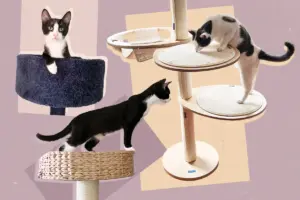
- The Verdict: If you detest the look of traditional carpeted cat boxes, the Mau Cento is an attractive, branch-style alternative priced around $300. Constructed with real tree branches, woven high-grade paper baskets, and plush faux-fur cushions, it blends seamlessly into modern home decor. Mau also sells replacement parts, extending the lifespan of the unit indefinitely.
- Flaws: It lacks a wall-anchoring strap, has a relatively small base that could tip under extreme force, and comes with confusing instructions regarding its locking washers.
3. Runner-Up Modern Natural Tree: Easyego Modern Cat Tree
- Cat Weight Limit: 28 lbs | Dimensions: 45.6 x 35.5 x 16.5 inches (HWD)
- The Verdict: Featuring a similar tree-branch aesthetic to the Mau Cento at roughly half the price, the Easyego stands out with a much wider base (35.5 inches) that successfully prevents tipping. Its shorter steps make it exceptionally friendly for older or stiff joints, and its machine-washable cushion features a dual-sided design with a plush side and a smooth "cooling" side.
- Flaws: The 100% natural pear wood posts are slightly thinner and wobblier than the Mau’s, and the faux fur experienced some initial shedding.
4. Runner-Up Compact Model: Tangkula Modern Cat Tree
- Cat Weight Limit: 22 lbs | Max Capacity: 44 pounds | Dimensions: 41 x 17.5 x 17.5 inches (HWD)
- The Verdict: A surprisingly stable, narrow-profile tree that is easy to assemble in roughly 10 minutes. It offers a neutral aesthetic that avoids being an eyesore and carries a budget-friendly price tag.
- Flaws: The water hyacinth straw baskets proved irresistible to a 6-month-old kitten tester who gnawed on them aggressively, and the top cushion is non-removable, requiring spot-cleaning only.
5. Best Budget Option: Feandrea 33.1-Inch Cat Tower
- Cat Weight Limit: 16 lbs | Dimensions: 33.1 x 23.6 x 15.7 inches (HWD)
- The Verdict: In a sea of generic, low-cost towers, the Feandrea stands out with thoughtful touches: wider cave openings that prevent large cats from having to contort themselves, a 22-inch top lounge area spacious enough for two cats, grippy anti-skid feet, and a machine-washable top cushion. Crucially, it includes an anti-tip wall-anchoring strap.
- Flaws: The particleboard and thin plush materials are not designed to last beyond a year or two of heavy use.
6. Best Luxury Upgrade: Purrsona Heritage Treehouse
- Cat Weight Limit: 25 lbs | Max Capacity: 50 lbs | Dimensions: 56 x 24 x 31 inches (HWD)
- The Verdict: Hand-finished in small batches of 30 by expert furniture makers in Ohio Amish Country, this tree is essentially high-end human furniture built for felines. Crafted from solid maple with organic cotton cushion covers, natural latex foam, and hemp-wrapped scratching posts, it comes with a lifetime warranty on the wood frame.
- Flaws: It is exceptionally expensive and online photos fail to accurately represent the true gray tones of the Smoked Maple finish.
7. Best for Mobility-Challenged Cats: EliteField 40-in Faux Fur Cat Tree
- Cat Weight Limit: 20 lbs | Dimensions: 39.5 x 20 x 20 inches (HWD)
- The Verdict: Featuring three fanned steps with a mere 8 inches of vertical space between them, this tree allows stiff, arthritic, or timid cats to climb effortlessly to the top perch. Multiple cats can lounge across the staggered steps simultaneously.
- Flaws: The faux fur and sisal rope shed heavily during initial unboxing and assembly.
8. Best Stealth Design: 4 Cats N Dogs Clifford Cat Tree Bookshelf
- Cat Weight Limit: 30 lbs | Dimensions: 68.75 x 36 x 15 inches (HWD)
- The Verdict: Blending seamlessly with IKEA Billy bookshelves, this piece acts as a decoy bookshelf that lures cats away from your personal book collection. It features adjustable metal leveling feet, curved cutouts, two cozy cubbies, and exceptional stability once anchored to the wall.
- Flaws: Weighing 93 pounds, it requires an 80-minute assembly process and demands the purchase of separate soft pads to make the bare wooden shelves comfortable for paws.
9. Best Statement Piece: Vetreska Chroma Cat Climber
- Cat Weight Limit: 22 lbs | Dimensions: 48.4 x 22 x 22 inches (HWD)
- The Verdict: Boasting bold primary colors (red, yellow, blue, and green) and tactile bouclé-adjacent teddy-fleece fabric, this climber is an undeniable design statement. The foam-padded platforms and fully wrapped sisal posts provide a comfortable and durable lounge experience.
- Flaws: The top enclosable cave is cramped, fitting only smaller cats under 10 pounds, and the upper structure exhibits moderate wobble.
10. Best Modular Custom Playground: Omlet Freestyle Cat Tree
- Cat Weight Limit: 65 lbs | Height: Up to 14.4 feet maximum
- The Verdict: The ultimate vertical playground, the Omlet Freestyle uses an aluminum core and bamboo platforms to build fully customizable, floor-to-ceiling environments. It can support massive weights and offers endless accessory configurations (hammocks, ramps, tents) to suit multi-cat dynamics.
- Flaws: Assembly is complex, requiring you to drill fasteners directly into your ceiling and walls. Prices scale rapidly from a $275 base model to upwards of $1,600 for elaborate multi-pole builds.
11. Best Renter-Friendly Floor-to-Ceiling Model: Katpole
- Cat Weight Limit: 30 lbs | Height: Up to 10.33 feet maximum
- The Verdict: Manufactured in Canada, this tension-mounted aluminum pole system spans up to 10 feet 4 inches without drilling a single hole into your walls or ceiling. It provides exceptional stability, replaceable scratch carpets, a waterproof vinyl finish, and a stellar 10-year warranty.
- Flaws: Stress tests revealed a minor cracking vulnerability near platform joints under extreme weight drops—though the company has since engineered shock-absorbing felt washers to solve this issue. The pole carpets also show rapid pilling from heavy scratching.
Future Outlook & Expert Recommendations
When shopping for a cat tree, industry consensus urges owners to invest in the tallest model your space can comfortably support. According to Dr. Mikel Delgado, opting for a 5-to-6-foot model dramatically increases usable cat territory without expanding your home’s physical footprint.
Furthermore, smart buyers should prioritize modularity and brands offering replacement parts. Because cats inevitably shred sisal and wear out carpets, investing in a company that sells replacement tiers or modular upgrades ensures your cat tree remains a permanent, sustainable investment rather than a temporary piece of landfill-bound plastic.