By Kenichiro Yagi, MS, RVT, VTS (ECC), (SAIM) Chief Veterinary Nursing Officer, VEG ER for Pets / Co-Chair, RECOVER Initiative
Executive Overview
When a dog collapses on a remote mountain trail or a cat experiences a sudden seizure on a quiet kitchen floor, pet owners are forced to act in the frantic, high-stakes minutes before definitive veterinary care can begin. Historically, the actions taken during these critical windows have been dictated by folklore, human first-aid habits, well-meaning word-of-mouth advice, and improvisation.
Regrettably, veterinary teams have long lacked a comprehensive, evidence- and consensus-based set of guidelines developed through a transparent evaluation process to advise clients properly. Consequently, well-intentioned interventions have occasionally delayed critical treatment, failed to address underlying pathophysiology, or inadvertently caused additional harm.
The landscape of emergency veterinary care has fundamentally shifted with the release of the 2026 RECOVER First Aid guidelines. Developed by the Reassessment Campaign on Veterinary Resuscitation (RECOVER Initiative)—the same globally recognized scientific group behind the landmark 2012 and 2024 veterinary CPR guidelines for dogs and cats—this new framework fills a massive void in pre-hospital emergency medicine.
Spanning a rigorous three-paper series, the 2026 guidelines introduce 50 evidence-backed treatment recommendations, broken down into 38 general first-aid protocols and 12 specialized directives addressing acute allergy and anaphylaxis. Although these actions are ultimately performed by owners, handlers, and bystanders at the scene, the guidelines are intentionally written for veterinary professionals whose job is to educate, guide, and empower these non-professional responders.
This comprehensive report examines the most clinically impactful recommendations set to redefine everyday triage, client education, and pre-hospital emergency response.
Detailed Chronology: Evolution of the RECOVER Initiative
The journey toward establishing objective, transparent, and standardized veterinary resuscitation and first-aid guidelines has spanned over a decade, mirroring the evolution of human advanced cardiac life support (ACLS) frameworks.
The Foundation: CPR Guidelines (2012–2024)
Before the creation of the RECOVER Initiative, veterinary CPR was fraught with institutional discrepancies, highly variable success rates, and a lack of standardized training.
2012: RECOVER published the first evidence-based veterinary CPR guidelines, transforming veterinary cardiopulmonary arrest management by categorizing interventions into clear, evidence-graded recommendations (Class of Recommendation and Level of Evidence).
2024: An updated consensus expanded on rescuer safety, drug dosing schedules, monitoring parameters, and post-cardiac arrest care, cementing high-quality chest compressions and early rhythm analysis as standard veterinary care.
Identifying the Pre-Hospital Blind Spot
While in-hospital resuscitation protocols grew increasingly sophisticated, veterinary professionals recognized a glaring vulnerability: the vast majority of life-threatening events—such as anaphylactic shock, heat stroke, acute toxic ingestions, and choking—occur outside the clinic.
Patients often deteriorate or perish before crossing the threshold of an emergency hospital. While human medicine relies heavily on established public first-aid paradigms (e.g., automated external defibrillators, public access CPR training, and standardized anaphylaxis protocols), veterinary medicine lacked a parallel system vetted through systematic reviews and formal consensus methodologies.
The 2026 RECOVER First Aid Release
To bridge this gap, the RECOVER Initiative convened international experts in emergency and critical care (ECC), internal medicine, and veterinary nursing to execute a massive systematic literature review. Evaluating existing veterinary studies alongside translational data from human medicine, the committee formulated 50 definitive recommendations. Published in late 2026, these guidelines shift the chain of survival outward, establishing that optimal veterinary outcomes begin in living rooms, backyards, and trailheads.
The 2026 RECOVER First Aid guidelines cover a broad spectrum of emergencies, including thermal and chemical burns, pre-hospital oxygen delivery, out-of-hospital CPR adaptations, naloxone utilization for suspected opioid toxicity, and tourniquet applications for severe extremity hemorrhage. However, several core areas stand out for their immediate impact on client communication and triage safety.
+---------------------------------------------------------------------------------+
|                       RECOVER FIRST AID TRIAGE AT A GLANCE                      |
+------------------------------------+--------------------------------------------+
| Situation                          | Recommended Client Action                  |
+------------------------------------+--------------------------------------------+
| Facial swelling; normal breathing  | Administer directed oral antihistamine;    |
|                                    | transport safely.                          |
+------------------------------------+--------------------------------------------+
| Allergy with respiratory distress, | Transport immediately; do NOT delay for    |
| vomiting/diarrhea, or collapse     | oral medication.                           |
+------------------------------------+--------------------------------------------+
| Suspected toxic ingestion          | Do NOT induce vomiting unless directed;    |
|                                    | bring pet and product packaging.           |
+------------------------------------+--------------------------------------------+
| Suspected heat-related illness     | Apply cool running water over the trunk;   |
|                                    | initiate transport after initial cooling.  |
+------------------------------------+--------------------------------------------+
| Hypoglycemic signs; no seizures    | Apply corn/glucose syrup inside the cheek; |
|                                    | transport immediately.                     |
+------------------------------------+--------------------------------------------+
| Active seizures                    | Put nothing in the mouth; transport        |
|                                    | immediately.                               |
+------------------------------------+--------------------------------------------+
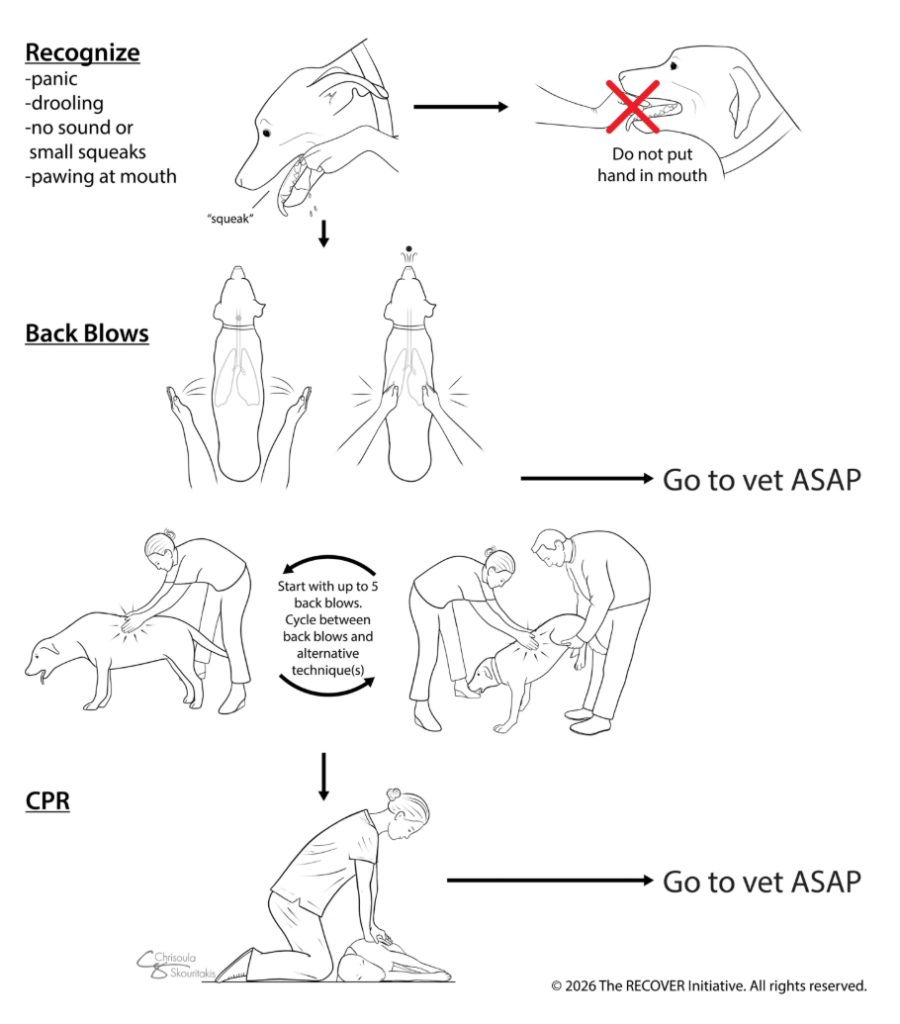
| Conscious choking                  | Administer up to 5 firm back blows; seek   |
|                                    | immediate emergency care.                  |
+------------------------------------+--------------------------------------------+
| Unconscious; abnormal breathing    | Call for help on speakerphone; start chest |
|                                    | compressions immediately.                  |
+------------------------------------+--------------------------------------------+
1. Allergic Reactions vs. Anaphylaxis: A Drug Selection Paradigm
The guidelines establish clear, treatment-focused definitions grounded in veterinary evidence and modern human anaphylaxis frameworks:
Uncomplicated Allergic Reaction: The sudden onset (within minutes to hours) of cutaneous signs such as hives (urticaria), facial swelling, or pruritus, occasionally accompanied by a single, self-limiting bout of vomiting or diarrhea. It is not immediately life-threatening.
Anaphylaxis: A severe, multi-system systemic hypersensitivity reaction involving respiratory, cardiovascular, gastrointestinal, and cutaneous manifestations (though skin signs may be completely absent). In a peracute setting, sudden collapse, hypotension, or severe respiratory distress confirms severe anaphylaxis, even if only one organ system appears visibly affected.
Antihistamines for Uncomplicated Reactions
For uncomplicated reactions, the guidelines recommend administering an oral histamine-1 receptor (H1R) antagonist—such as diphenhydramine or cetirizine—in the prehospital setting. However, antihistamines must never be relied upon to treat established anaphylaxis involving respiratory or cardiovascular collapse.
The Evidence: Experimental studies demonstrate that while antihistamines can block localized histamine effects when given prior to exposure, they fail to prevent cardiovascular collapse when anaphylaxis is fully triggered. Human observational studies associate early antihistamine administration with reduced odds of clinical progression, establishing their role as a preventative shield rather than a rescue reversal agent.
The Corticosteroid Controversy
Evidence regarding glucocorticoids in uncomplicated allergic reactions is inconsistent. Consequently, the guidelines suggest against their routine use.
In two available veterinary studies encompassing 880 dogs and 73 cats, supplementing diphenhydramine with dexamethasone yielded no statistically significant improvement in immediate response rates, time to resolution, or reduction in subsequent care needs. Furthermore, human dermatological trials noted worse urticaria scores at one week and one month following oral prednisolone therapy. A short, low-dose course (≤0.5 mg/kg/day prednisolone-equivalent for five days or fewer) is reserved strictly for cases failing to respond to H1R antagonists.
For true anaphylaxis, the guidelines explicitly recommend against routine systemic glucocorticoids, citing multiple large-scale human studies post-2020 showing no consistent clinical benefit or reliable reduction in biphasic reactions, alongside correlations with extended hospital stays.
Epinephrine: The Cornerstone of Anaphylaxis
Epinephrine is the undisputed treatment of choice for anaphylaxis. When respiratory distress is present, oral antihistamines are strictly contraindicated; coaxing a pill down the throat of a dyspneic patient delays transport, wastes precious minutes, delays epinephrine administration, and invites severe bite injuries.
Pre-Hospital IM Epinephrine: Suggested when it does not delay transport and can be executed safely using an autoinjector, prefilled syringe, or vial-and-syringe method. A 0.15-mg pediatric autoinjector closely mirrors the standard 0.01 mg/kg dosing requirement for a 15-kg patient. Studies confirm that in-date epinephrine drawn aseptically into recapped plastic syringes, stored at room temperature and shielded from light, remains sterile and chemically stable for up to 90 days.
In-Hospital Management: For moderate anaphylaxis, the guidelines advocate administering IM epinephrine as early as possible. For severe anaphylaxis accompanied by profound hypotension, a continuous epinephrine infusion (titrated to maintain a mean arterial pressure of $ge 70text mm Hg$) is favored over intermittent bolus dosing, which experimental models show fails to establish stable hemodynamics.
2. The End of Hydrogen Peroxide for Toxin Ingestion
"My dog just ate…" is perhaps the most anxiety-inducing phrase heard across emergency veterinary triage lines. The 2026 RECOVER guidelines overturn a deeply ingrained veterinary habit by recommending against routine prehospital emesis induction following acute non-caustic toxin ingestion.
The Evidence: Human toxicological literature demonstrates that induced vomiting improves neither survival rates nor overall clinical courses, yet frequently delays the administration of activated charcoal—which consistently proves more effective than gastric emptying in alert patients. Furthermore, home emetics inflict tangible physical harm. Hydrogen peroxide ($3%$) administered at emetic doses routinely induces severe, hemorrhagic gastritis and esophagitis in both dogs and cats.
The Exception: When a veterinary facility is genuinely inaccessible, and guidance is actively provided by a licensed veterinarian or a certified animal poison control center, emesis induction may proceed under direct instruction. Additionally, veterinarians may consider prescribing ropinirole ophthalmic solutions in advance for pica-prone dogs frequenting remote wilderness areas.
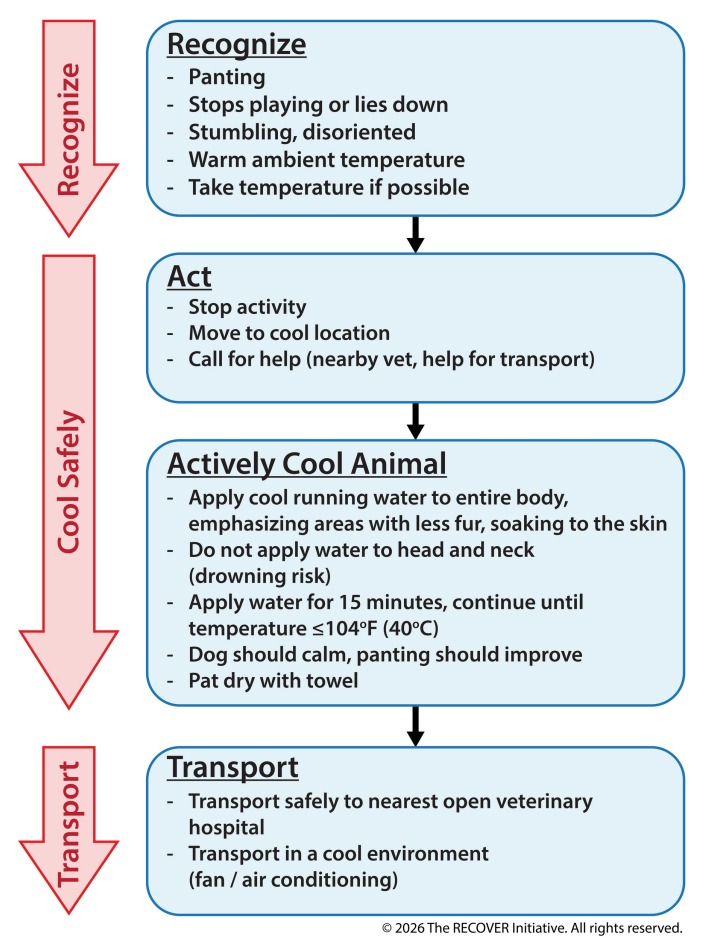
3. Cool First, Transport Second in Heat Stroke
When confronted with canine heat stroke, the instinctual reaction of most pet owners is to bundle the panting animal into a car and drive at high speed toward the nearest clinic. RECOVER’s guidelines emphasize a strict physiological imperative: Cool first, transport second.
The Rationale: The duration of hyperthermic cellular injury directly dictates clinical outcome. Human and canine observational data confirm that animals cooled on-scene prior to transit experience significantly lower mortality. In one benchmark canine study, approximately half of surviving patients had been actively cooled by owners on-scene, compared to only one-fifth of non-survivors.
The Technique: The recommended protocol involves applying cool running water directed against the thinnest hair-coat barriers—typically the ventral abdomen—saturating the fur completely down to the skin. Running water is superior to static immersion baths or single dousings, as still water quickly forms a warm, insulating boundary layer around the body. Whole-body immersion tubs are discouraged due to drowning hazards and the stress of handling.
Endpoint: Active cooling should continue until the patient’s rectal temperature drops to $39.7^circtextC$ to $40.0^circtextC$ ($103.5^circtextF$ to $104.0^circtextF$), or for a maximum of 15 minutes if no thermometer is available. For animals exhibiting stertor or stridor, cooling must continue until panting stabilizes or core temperature reaches $38.6^circtextC$ ($101.5^circtextF$), followed immediately by rapid transport.
4. Hypoglycemia Management: Sugar in the Cheek Pouch
For insulin-treated diabetic dogs and cats presenting with lethargy, weakness, or ataxia, pre-hospital intervention is straightforward. Owners are instructed to apply a viscous simple carbohydrate—such as corn syrup or glucose syrup—directly to the buccal mucosa nestled between the upper premolars/molars and the inner cheek wall (approximately $0.2text to 10text mL$, scaled to patient size).
Mechanism: The goal is mucosal coating rather than forced swallowing, facilitating rapid trans-mucosal absorption into the systemic circulation. Experimental and pediatric human trials confirm that buccal simple sugars elevate blood glucose within 15 minutes, outperforming swallowed oral boluses in emergency scenarios.
Absolute Contraindications:Never place viscous substances or liquids into the mouth of a seizing animal, and never attempt oral treatments when the risk of severe owner injury is high. Buccal glucose buys valuable time but does not resolve the underlying endocrinopathy; immediate veterinary transfer for intravenous dextrose support remains mandatory.
5. Choking Protocols: Back Blows First, Compressions on Collapse
When managing a conscious, choking dog or cat, traditional abdominal thrusts (the Heimlich maneuver) are no longer recommended as the initial response.
The Protocol: Rescuers should initiate up to five firm back blows delivered over the caudodorsal thorax, directed to either side of the spine rather than directly upon it.
The Evidence: Comparative human data reveal that back blows are roughly twice as effective as abdominal thrusts at relieving upper airway obstructions. Furthermore, abdominal thrusts carry severe documented complications, including aortic laceration and gastric rupture—risks magnified exponentially across varied canine body conformations (from Chihuahuas to Great Danes). Blind finger sweeps are strictly prohibited, as they routinely force foreign objects deeper into the pharynx.
Progression to CPR: If the animal loses consciousness, the rescuer must transition immediately to chest compressions. The new protocol mandates starting with 30 chest compressions at a rate of 100 to 120 beats per minute, briefly inspecting the airway, removing visible objects, delivering two rescue breaths (mouth-to-nose), and repeating the cycle. Bystander CPR is supported by extensive human epidemiological data showing a two- to three-fold increase in survival following asphyxial arrests.
Official Statements & Professional Implications
The implementation of the 2026 RECOVER First Aid guidelines places an immediate educational obligation on veterinary practitioners. Speaking on the integration of these protocols into everyday practice, veterinary leadership emphasizes that client education must pivot toward proactive preparedness.
"First aid will happen with or without us. One variable our profession can actively change is what pet owners have been taught when the emergency moment arrives," notes Kenichiro Yagi, co-chair of the RECOVER Initiative. "These guidelines provide the veterinary community with its very first standardized framework developed through a rigorous, transparent scientific process. The chain of survival now begins in living rooms, backyards, and trailheads. Our job is to ensure the people standing there know the first link."
Veterinary practices are encouraged to incorporate these guidelines into annual client communications, seasonal wellness checks (such as spring heat-stroke advisories and winter toxin warnings), and triage staff training modules. Two foundational axioms underpin every recommendation:
Provider Safety is Paramount: First aid should never be attempted if the risk of injury to the human handler is high. Safety is a clinical counseling point, not an afterthought.
First Aid Never Replaces Definitive Care: Pre-hospital interventions stabilize patients temporarily during critical minutes, but every treated animal must subsequently undergo professional veterinary examination and diagnostics.
Future Outlook
The publication of the 2026 RECOVER First Aid guidelines marks the dawn of a new era in veterinary emergency medicine. By dismantling outdated myths—such as the routine use of hydrogen peroxide for toxin evacuation and the improper application of home glucocorticoids—the veterinary profession is actively guiding public instinct with empirical science.
As these guidelines are integrated into veterinary nursing curricula, emergency triage protocols, and public-facing educational campaigns, the survival curves for out-of-hospital canine and feline emergencies will inevitably improve. Future iterations of the RECOVER Initiative will continue to track emerging translational data, ensuring that the first link in the veterinary chain of survival remains unbreakable.
References
RECOVER Initiative. (2026). Guidelines for Veterinary First Aid: General Principles and Systemic Recommendations. Journal of Veterinary Emergency and Critical Care.
Yagi, K., et al. (2026). Evidence-Based Consensus on Pre-Hospital Management of Allergic Reactions and Anaphylaxis in Dogs and Cats. Journal of Veterinary Emergency and Critical Care.
RECOVER First Aid Task Force. (2026). Bystander Interventions for Heat Illness, Toxic Ingestion, Hypoglycemia, and Airway Obstruction in Companion Animals. Journal of Veterinary Emergency and Critical Care.
[Additional foundational peer-reviewed veterinary and human medical references cited within the 2026 RECOVER First Aid Monograph, available via Wiley Online Library]