
By Alysia Martin, Rooftop Seabird Monitor
Special Investigative & Environmental Report
Executive Overview
When human beings contemplate the architecture of the avian world, our imaginations naturally gravitate toward the ornate: tightly woven cups of pine needles, suspended penduline pouches, meticulously engineered mud-pellet swallow nests, or deep cavities hollowed out of ancient oak trunks. We envision sanctuaries of high walls, soft down, and secluded canopies designed to shield fragile life from the harsh elements and predatory gazes.
Yet, along the sun-bleached stretches of our continent’s coastlines—from the windswept barrier islands of the Atlantic to the shimmering, humid shores of the Gulf of Mexico—some of nature’s most fascinating aerial acrobats reject conventional design entirely. Species such as the Least Tern (Sternula antillarum) and the Black Skimmer (Rynchops niger) practice an ultra-minimalist approach to architecture. Their ideal summer home features an open floor plan, unencumbered panoramic views, maximum natural light, and zero walls. In fact, their entire nursery consists of nothing more than a shallow depression, or "scrape," scratched directly into the burning, shifting sands of the open beach.
This report examines the delicate ecological balance governing these ground-nesting coastal colonies. While open-sand nesting represents a brilliant evolutionary adaptation designed to outwit predators and maximize environmental awareness, it simultaneously places these vulnerable avian populations on a collision course with human recreation, coastal development, and climate pressures. As conservation groups like Audubon step in with seasonal ropes, warning signs, and public outreach campaigns, the survival of these birds hinges on a fragile coexistence. This is the story of how a few feet of seemingly empty sand serve as a bustling, high-stakes nursery—and what humanity must do to ensure these species do not vanish from our shores.
Detailed Chronology: The Seasonal Rhythm of Coastal Seabirds
To understand the precarious reality of beach-nesting birds, one must trace the rhythmic, cyclical chronology of their annual reproductive cycle. For Least Terns, Black Skimmers, and related shorebirds, the calendar is dictated by the turning of the seasons, shifting thermal currents, and the relentless pulse of the tides.
Phase I: Spring Arrival and Courtship (March – April)
As winter yields to spring, migratory populations of Least Terns and Black Skimmers complete arduous journeys from their wintering grounds in Central and South America, the Caribbean, and coastal South America. Upon arrival at their traditional nesting grounds along the Gulf and Atlantic coasts, the air immediately fills with high-pitched, frantic calling and mesmerizing aerial displays.
During this period, males engage in elaborate courtship rituals, often presenting potential mates with freshly caught fish in mid-air. These dramatic acrobatic flights—featuring synchronized dives, steep climbs, and sharp banking maneuvers—serve to establish pair bonds and claim territories. Unlike songbirds that stake out dense thickets of brush, these seabirds claim parcels of open, unobstructed sand, often returning to the exact stretch of coastline where they hatched years prior.
Phase II: The Scrape and Egg-Laying (April – May)
Once pair bonds are cemented, the physical nesting process begins. Eschewing twigs, mud, and grass, the birds utilize a remarkably simple construction technique. Pressing their chests into the sand and kicking backward with their feet, the adults carve out a shallow depression—the "scrape."
Into this unassuming basin, the female deposits a clutch typically numbering two to three eggs. These eggs are marvels of natural camouflage: pale, speckled with dark browns, greys, and blacks, they mimic the surrounding shell fragments and coarse sand grains so perfectly that they are virtually invisible to the casual human observer.
Phase III: Incubation and the Summer Hatch (May – July)
Incubation is a shared responsibility between male and female, lasting roughly three weeks. In the blistering heat of late spring and early summer, when sand temperatures can reach lethal thresholds, incubation is not merely about keeping eggs warm; it is frequently about keeping them cool. Adults can often be seen flying out to the breaking surf, dipping their belly feathers in seawater, and returning to wet the eggs, using evaporative cooling to protect the developing embryos.
When the chicks finally hatch, they emerge as "precocial" young—meaning they are born covered in down, with open eyes, and are capable of walking within hours of leaving the shell. Unlike songbird nestlings that remain in a deep tree nest waiting to be fed, Least Tern and Black Skimmer chicks immediately begin wandering away from the scrape. They seek out the shelter of tiny drift logs, shell piles, or grass tufts to hide from overhead predators like gulls, hawks, and crows.
Phase IV: Fledging and Post-Breeding Dispersal (August – September)
By late summer, surviving chicks have developed their flight feathers, transitioning from clumsy ground-dwellers into agile flyers capable of hunting alongside their parents. As autumn approaches, the colonies slowly disband. The coastal nurseries empty out as the birds gather in large flocks, preparing to retrace their migratory routes southward, leaving the open sands once again to the wind, the tides, and human footsteps.
Supporting Context & Metrics: The Science of Open-Sand Survival
At first glance, building a home out in the open—entirely devoid of the structural defense mechanisms utilized by the vast majority of the avian world—appears to be an evolutionary miscalculation. Without trees to perch in, dense vegetation to hide within, or deep cavities to seal off, why have Least Terns and Black Skimmers persisted with this minimalist strategy for millennia?
Evolutionary Advantages of the Open Beach
Biologists and ornithologists point to several critical survival advantages inherent to open-habitat nesting:
- Unobstructed Field of View: In a dense forest or thick marsh, predators can approach unseen from multiple angles. On an open sandbar or wide beach, nesting birds have a 360-degree panoramic view of their surroundings. They can spot a potential mammalian or avian predator from hundreds of yards away.
- Early Warning and Mobbing Defense: Least Terns and Black Skimmers are intensely communal. If a predator approaches the colony, the adults do not hide in silence; instead, they launch into the air as a cohesive, screaming mob. They dive-bomb intruders, defecate on them, and relentlessly harass them until the predator is driven away from the nest site.
- Thermal Regulation and Wind Flow: Open beaches provide constant sea breezes that help dissipate intense tropical and subtropical heat, preventing nests from becoming stifling heat traps, provided parents manage the thermal extremes effectively.
The Metrics of Vulnerability
Despite these evolutionary payoffs, the modern reality has introduced variables that historical adaptations simply cannot handle. The intersection of wildlife biology and human demographics reveals alarming metrics regarding coastal conservation:
- Habitat Loss: Over the past century, coastal development, seawall construction, and beach nourishment projects have permanently altered or destroyed massive percentages of historical barrier island nesting grounds.
- Human Disturbance Impact: Studies on colonial waterbirds demonstrate that human foot traffic is the leading cause of nest abandonment. When beachgoers inadvertently walk through a colony, flushing brooding adults off their nests, unshaded eggs can cook in the midday sun within minutes, or vulnerable chicks can succumb to thermal shock.
- Predator Populations (Synanthropic Species): Human-altered landscapes artificially inflate populations of scavengers and predators—such as raccoons, opossums, domestic cats, and gulls—that thrive on human refuse. These predators heavily impact ground-nesting colonies.
Official Statements & Conservation Perspectives
As coastal ecosystems face unprecedented pressures, conservation organizations, wildlife biologists, and local management agencies are working in tandem to secure a future for these imperiled species.
The Audubon Perspective
Alysia Martin, a dedicated Rooftop Seabird Monitor and conservation advocate, emphasizes the delicate paradox of modern beach management:
"A few feet of sand may not seem like much to us, but it can mean the world of difference to these protected species. When we walk down to the ocean for recreation, we are entering someone else’s maternity ward. The Least Terns and Black Skimmers aren’t asking for much—just a little breathing room on a shared shoreline during their most critical months of the year."
Wildlife Management and Mitigation Strategies
State and federal wildlife agencies, working alongside non-profit entities like the National Audubon Society, deploy systematic intervention protocols every spring:
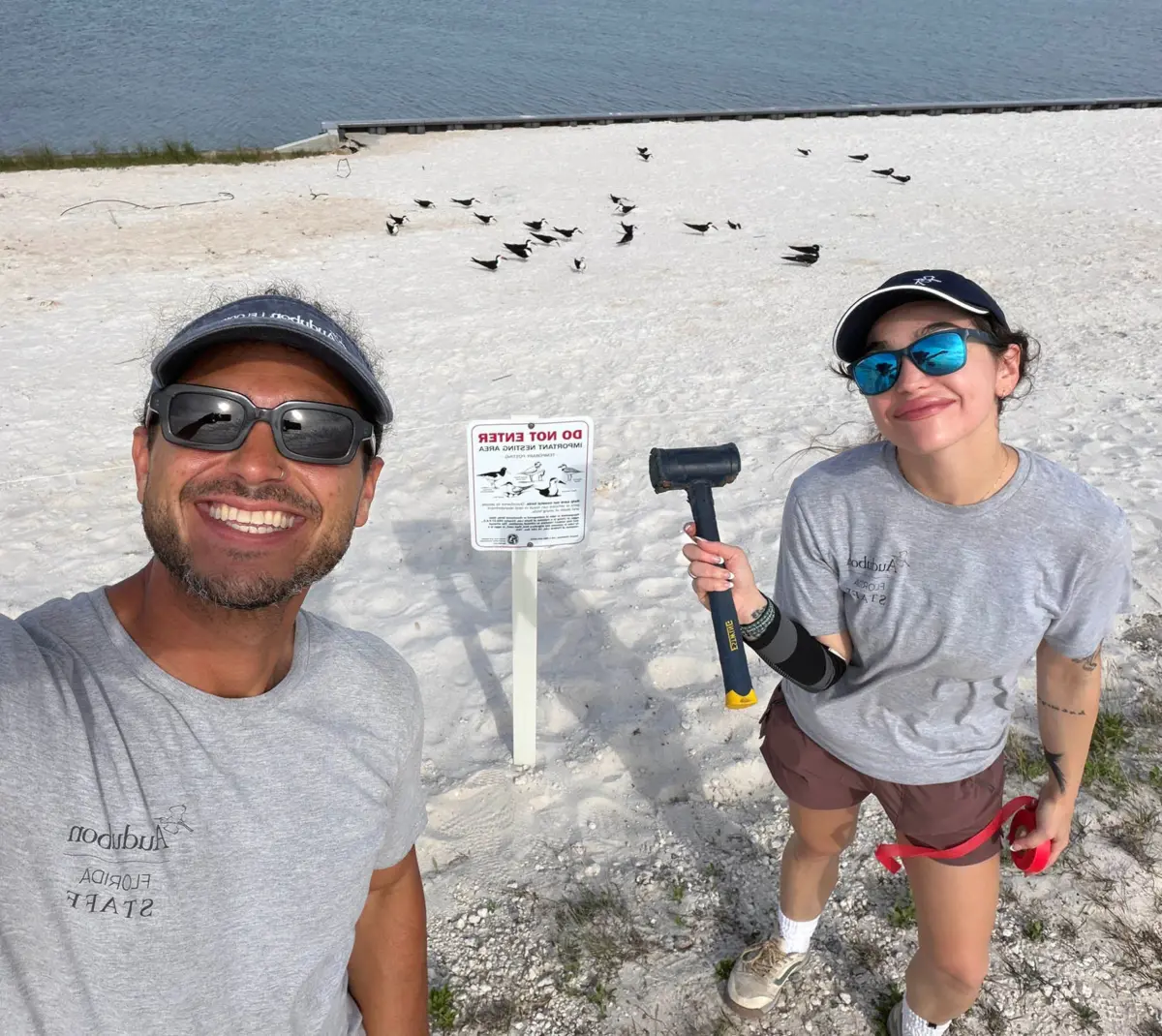
- Buffer Zones and Signage: Conservation teams install temporary symbolic fencing—typically yellow or orange twine strung between wooden stakes, accompanied by educational signage—around known nesting concentrations. These restricted zones give the birds a physical and psychological buffer from human intrusion.
- Rooftop Nesting Alternatives: Interestingly, as natural beaches have become increasingly inhospitable due to human activity and development, many Least Terns have adapted by relocating to large, flat gravel rooftops along the coast. Conservation programs now actively monitor and manage these urban rookeries, working with building owners to ensure safe breeding environments where human disturbance is virtually zero.
- Public Education and Compliance: Enforcement officers and volunteer docents patrol high-traffic beaches to educate the public. The core message remains consistent: respecting posted nesting areas, maintaining a wide berth around foraging flocks, and strictly adhering to local leash laws preserve the fragile link between human leisure and wildlife preservation.
Future Outlook: Coexisting on a Shared Shoreline
Looking toward the horizon, the long-term survival of beach-nesting seabirds depends heavily on our collective ability to shift our perception of the coastal zone.
Climate change introduces compounding threats, including rising sea levels, increased frequency and intensity of tropical storms, and severe coastal erosion that can wipe out entire nesting seasons in a single tidal surge. When storms wash away natural sandbars, birds are forced to concentrate on shrinking slivers of remaining beach, magnifying the friction between wildlife and human recreation.
However, there is substantial cause for optimism. Where robust community-based conservation programs are established, public compliance is generally high once beachgoers understand why certain areas are roped off. Educational programs integrated into coastal communities are fostering a culture of stewardship, transforming casual tourists into active protectors of local biodiversity.
What Beachgoers Can Do:
- Respect Posted Boundaries: Never cross symbolic fencing or enter closed nesting zones during spring and summer.
- Give Colonies Space: If birds begin calling frantically, diving, or displaying agitation overhead, you are too close. Back away slowly.
- Leash Your Pets: Dogs are viewed by ground-nesting birds as natural mammalian predators (resembling coyotes or foxes). Keep pets completely off nesting beaches or strictly on leash where permitted.
- Pack Out Your Trash: Do not leave food scraps or garbage on the beach, as these attract unwanted predators like raccoons and gulls that prey upon eggs and chicks.
Ultimately, the minimalist architecture of the Least Tern and Black Skimmer is a testament to nature’s resilience and simplicity. By practicing modest restraint—acknowledging that a patch of empty sand is far more than an empty playground—we can ensure that the piercing cries of these magnificent seabirds remain a defining soundtrack of our summer coasts for generations to come.