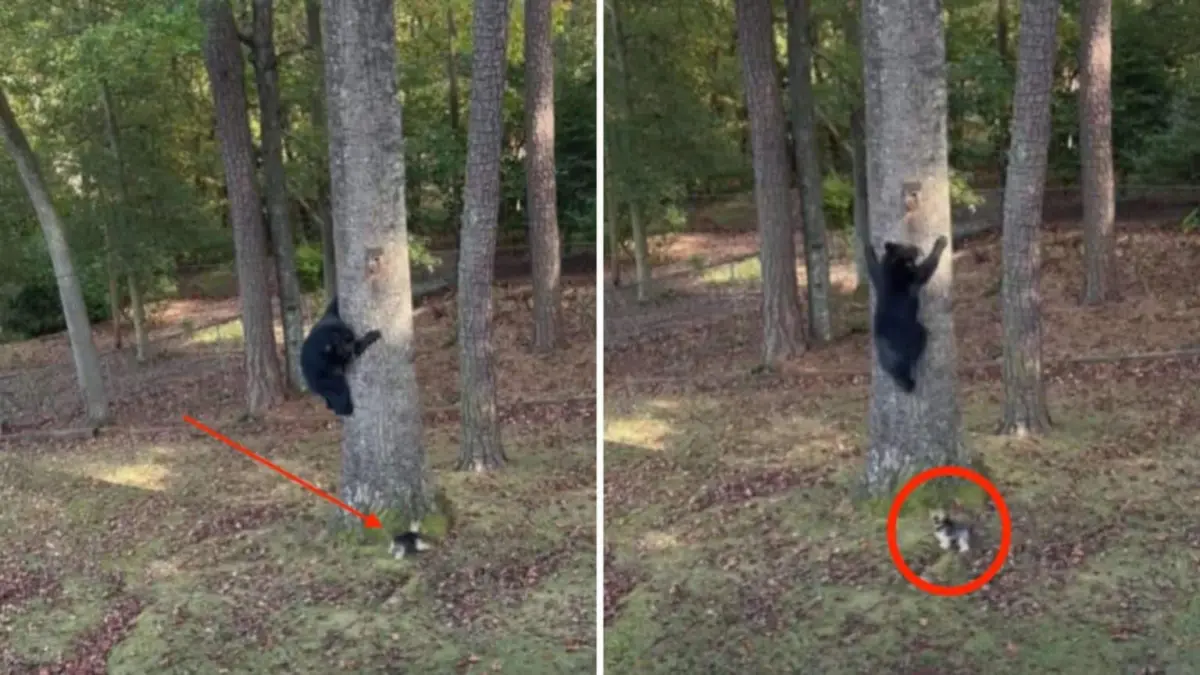
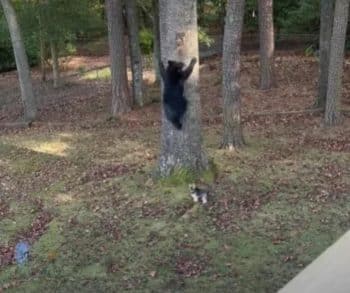
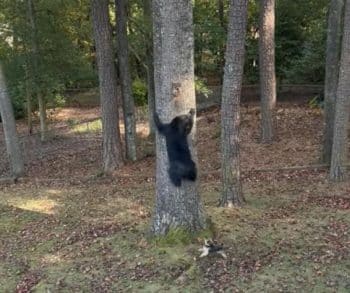
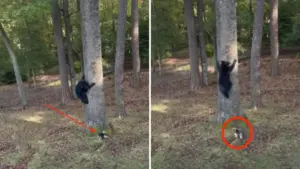
In an extraordinary demonstration of canine territoriality and fearless instinct, a Yorkshire Terrier named Benny made headlines after standing his ground against an apex visitor in his family’s North Carolina backyard: a full-grown black bear weighing several hundred pounds. Despite a staggering physical disparity—Benny weighing under ten pounds compared to the bear’s immense frame—the tiny dog aggressively pursued the intruder, barking relentlessly until the wild animal beat a hasty retreat off the property.
The incident, captured on camera and subsequently disseminated across major digital platforms, has sparked widespread public fascination. Beyond its viral entertainment value, the encounter serves as a dramatic case study in animal behavior, the historical traits of terrier breeds, and the growing frequency of wildlife-pet encounters along the wildland-urban interface in North Carolina.
While the event concluded without injury, wildlife management officials and veterinary behavioral experts emphasize that such encounters carry severe risks. This report delivers an exhaustive analysis of the incident, examining the precise timeline of events, the underlying biological and psychological dynamics of both species, historical wildlife metrics in the region, and essential safety guidelines for homeowners living alongside large carnivores.
Detailed Chronology of the Encounter
The event unfolded during a routine period in a residential North Carolina neighborhood, where lush forest boundaries frequently adjoin suburban backyards.
                                  TIMELINE OF EVENTS

  00:00 - Intrusion           00:15 - Detection           00:30 - Escalation          02:00 - Retreat
  ==================================================================================================
  Black bear emerges from     Benny spots bear and        Benny closes distance;     Bear ascends/moves
  treeline into residential    launches into rapid        owner shouts panic         away; Benny maintains
  backyard.                   territorial barking.       recalls ("Benny, NO!").    perimeter until clear.
1. The Initial Intrusion
The encounter began when a full-grown American black bear (Ursus americanus) emerged from the adjacent forest line and ambled onto the manicured lawn of Benny’s family residence. Drawn by curiosity or potential food scents typical of suburban environments, the bear moved slowly across the open yard, seemingly unbothered by its proximity to human dwellings.
2. Detection and Immediate Escalation
Benny, who was outdoors at the time, immediately spotted the massive intruder. Rather than seeking shelter, fleeing toward the house, or displaying submissive postures, the Yorkshire Terrier instantly engaged his territorial defense mechanisms. Charging across the grass, Benny unleashed a rapid sequence of high-pitched, authoritative barks and directly approached the giant animal.
3. Owner Intervention and High Tension
Upon witnessing the confrontation, Benny’s owner reacted with understandable panic. Understanding the lethal danger a black bear poses to a toy breed dog, the owner began shouting frantically from a safe distance, calling out, "Benny, Benny, NO!" in an urgent bid to break the dog’s focus and execute a recall. However, gripped by high arousal and territorial drive, Benny ignored the verbal commands, maintaining his gaze and forward pressure on the visitor.
4. The Bear’s Behavioral Pivot and Retreat
As Benny closed the physical distance, the black bear exhibited a classic flight response common to non-aggressive black bears facing noisy, unpredictable stimuli. Surprised by the tiny dog’s persistence and vocal aggression, the bear paused, hesitated, and began backing away. Benny continued to advance, pursuing the bear toward the edge of the yard as the animal began climbing over obstacles to put distance between itself and the persistent terrier.
5. Final Resolution
The high-stakes standoff lasted several minutes. Benny maintained a defensive perimeter, refusing to disengage until the bear fully vacated the property and retreated into the surrounding woods. Once the wild animal had vanished into the treeline, Benny returned safely to his family, unharmed and triumphant, leaving his owners equal parts relieved and astonished.
Supporting Context & Metrics
To fully comprehend the extraordinary nature of this encounter, it is necessary to analyze the physical metrics of the two species, North Carolina’s black bear population trends, and the inherent temperament of the Yorkshire Terrier.
Physical and Physiological Comparison
Attribute
Yorkshire Terrier (Benny)
American Black Bear (Ursus americanus)
Average Weight
4 – 7 lbs (1.8 – 3.2 kg)
200 – 550 lbs (90 – 250 kg)
Average Height
7 – 8 inches at shoulder
3 feet at shoulder (up to 6+ feet standing)
Historical Role
Ratting, small vermin hunting
Apex omnivore, foraging, opportunist
Primary Defense Mechanism
Vocalization, agility, tenacious persistence
Claws, immense bite force, sheer physical mass
Behavioral Strategy in Encounter
Direct confrontation, vocal deterrence
Avoidance, flight, risk minimization
The Genetics of Fearlessness: Why Terriers Don’t Back Down
Although modern Yorkshire Terriers are primarily companion pets, the breed was originally developed in 19th-century Yorkshire and Lancashire, England, to hunt rats and small vermin in textile mills and coal mines. Later, they were used to bolt badgers and foxes from underground dens.
This selective breeding instilled a neurological trait known as extreme tenacity or "gameness"—a relentless drive to confront quarry regardless of size or danger. When Benny encountered the bear, his brain responded not with size evaluation, but with a deeply ingrained prey and territorial drive that compelled him to push the intruder off his turf.
North Carolina is home to one of the most robust black bear populations in the eastern United States. According to data from the North Carolina Wildlife Resources Commission (NCWRC):
Statewide Population: Estimated at over 20,000 bears, with heavy concentrations in both the Western Blue Ridge Mountains and the Eastern Coastal Plains.
Suburban Expansion: Rapid residential development in forested regions has expanded the "Wildland-Urban Interface" (WUI). As housing developments encroach on historic habitats, bears increasingly traverse suburban yards in search of easy food sources (pet food, trash cans, bird feeders).
Incident Trends: The NCWRC receives thousands of bear-related calls annually, a significant portion involving domestic pets encountering bears in residential settings.
Official Statements & Expert Insights
Following the release of the video footage, wildlife biologists, animal behaviorists, and public safety experts weighed in on the dynamics of the confrontation.
Wildlife Management Perspective
Wildlife officers emphasize that while Benny’s defense appeared heroically successful, the interaction was fraught with extreme danger. A spokesperson for regional wildlife safety initiatives noted:
"American black bears are generally shy and instinctually averse to confrontation, which is why a small, noisy dog can sometimes intimidate them into retreating. The bear evaluates the situation based on noise and unpredictable movement rather than the physical size of the dog. However, if that bear had been a mother with cubs, had felt cornered, or had been protecting a food source, the outcome could have been tragic within a fraction of a second."
Veterinary and Canine Behavior Analysis
Canine behavioral specialists pointed out why Benny ignored his owner’s frantic commands during the climax of the event:
"When a dog enters a state of high drive—especially territorial aggression—their sympathetic nervous system takes over completely," explained Dr. Aris Thorne, a veterinary behavior specialist. "Auditory exclusion often occurs, meaning the dog literally tunes out human voices. This is why relying on verbal recall in the presence of apex wildlife is extremely risky, regardless of how well-trained the dog usually is."
Public and Social Media Reaction
The viral footage elicited a surge of lighthearted and astonished reactions from viewers worldwide:
"The bear and the dog both seem totally confused about who is supposed to be the predator," one viewer commented.
"That Yorkie doesn’t see a 300-pound bear in the mirror; he sees a 500-pound lion," remarked another.
"It’s a classic case of ‘It’s not the size of the dog in the fight, it’s the size of the fight in the dog.’"
Future Outlook & Risk Mitigation Protocols
As residential development continues to expand into wildlife habitats across North Carolina and the United States, interactions between domestic pets and large carnivores will inevitably rise. To prevent potentially fatal encounters, wildlife agencies urge homeowners to adopt proactive mitigation strategies.
Essential Safety Guidelines for Pet Owners in Bear Country
Conduct Pre-Clearance Yard Audits: Before letting dogs—especially toy breeds—out into the yard, owners should scan the treeline and perimeter, particularly during dawn and dusk when bear activity peaks.
Eliminate Environmental Attractants:
Secure household garbage in bear-resistant containers or keep cans inside a garage until the morning of pickup.
Remove outdoor bird feeders from spring through autumn, as seeds provide high-calorie nourishment for foraging bears.
Never leave pet food, outdoor grills with grease buildup, or fallen fruit outside.
Enhance Yard Security & Deterrents:
Install motion-activated floodlights, audible alarms, or high-decibel air horns near property entrances.
Maintain structural fencing where feasible, keeping low foliage trimmed to eliminate blind spots.
Develop High-Arousal Emergency Recall:
Train pets using high-value rewards (e.g., real meat or cheese) specifically reserved for emergency recall whistles, ensuring a response even under high distraction.
Never Encourage Pursuit:
If a wild animal enters the yard, owners should immediately secure pets indoors, lock doors, and make loud human noises (clapping, shouting, banging pots) from the safety of a deck or window to encourage the animal to leave.
Conclusion
Benny’s bold encounter with a North Carolina black bear remains a remarkable testament to the unflinching courage hardwired into small terrier breeds. While this particular event ended in a triumphant retreat by the wild intruder and a safe outcome for the fearless Yorkie, it serves as an enduring reminder of the delicate balance between suburban living and the wild dynamics of natural habitats. By implementing smart attractant management and maintaining active surveillance, pet owners can protect their beloved animals while safely coexisting with native wildlife.