
Executive Overview
Patience, they say, is a virtue. In the realm of wildlife photography, it is the fundamental currency of survival and success. The winners of the 2026 Audubon Photography Awards demonstrate that creating a masterclass image of an avian subject rarely comes down to mere happenstance. Instead, these striking frames are forged through hours, days, and sometimes years of calculated observation, profound ecological understanding, and an intimate familiarity with the natural rhythms of the Western Hemisphere’s most compelling bird species.
Now in its multi-tiered format, the international competition spans parallel tracks: one dedicated to photographers and videographers across the United States and Canada, and another spotlighting talent across Chile and Colombia. Evaluated by diverse panels of expert judges who sifted through thousands of anonymous submissions, the winning portfolios do more than simply capture a fleeting moment of beauty. They offer profound insights into avian behavior, underscore the fragility of vanishing ecosystems, and challenge observers to look closer at the complex web of life unfolding just beyond our human doorstep. From the volcanic caldera walls of Hawaiʻi to the windswept fjords of Patagonia, the 2026 gallery serves as a testament to the universal dedication required to document the birds of the Americas.
Detailed Chronology & Featured Masterworks
The journey through the 2026 award-winning captures reveals a continent-spanning mosaic of habitats, behaviors, and conservation narratives. Each selected work tells a distinct story of preparation meeting opportunity.
The United States and Canada Regional Contest
-
Grand Prize: Jacqueline Burke (Roseate Spoonbill)
Location: St. Augustine Alligator Farm Zoological Park, Florida, United States
Behind the Shot: Nestled within a protected rookery where alligators deter ground predators like feral cats and raccoons, wild wading birds gather annually. While the midday sun scorched most of the landscape in harsh light, photographer Jacqueline Burke identified a secluded cove draped in dense vegetation, plunging into deep shadow. When a Roseate Spoonbill stepped into this subterranean gloom to bathe and drink, a solitary shaft of sunlight caught its pale plumage and striking pink wings. The resulting image reveals the bird’s color, anatomical structure, and dynamic motion in a single, painterly frame reminiscent of a Flemish masterwork.
Judge’s Take: Mary Anne Karren praised the low-key scene’s technical brilliance, noting the dramatic lighting and the kinetic energy of fluttering wings lifting glistening splashes of water. -
Birds Without Borders: Nick Parayko (Tennessee Warbler)
Location: St. Albert, Alberta, Canada
Behind the Shot: Moving into a home backing onto a municipal ravine, Nick Parayko sought to document his local yard birds. His patience was rewarded when a migrating Tennessee Warbler lingered for over a week, drawn by a synchronized, mass emergence of flying ants. Concealing himself next to his home’s air-conditioning unit, Parayko captured the warbler perched dynamically on an elderberry against a soft, two-toned background, highlighting the rich biodiversity hidden within urban environments.
Judge’s Take: Taty Soto-Bartzi acknowledged the notorious frustration photographers face when trying to pin down warblers, applauding the image’s lovely color palette, intimate lighting, and sharp focus on the bug-hunting visitor. -
Video: Piper VanOrd (Great Blue Heron)
Location: Allegheny Islands Wilderness, Pennsylvania, United States
Behind the Shot: Having grown up along the Allegheny River, Piper VanOrd found solace in its waters until returning from her fourth humanitarian trip to Ukraine, where she felt emotionally detached. Seeking reconnection through curiosity, she committed to filming the river for at least 15 minutes every morning and evening. Placing GoPro cameras beneath the surface where herons hunted, she waited across 963 days of observation until a heron finally thrust its spearlike bill downward, its powerful feet landing dead center in the subaquatic frame.
Judge’s Take: Navarre Marshall commended the unique perspective, noting how effectively the footage demonstrates the raw speed and power herons harness to impale aquatic prey. -
Birds in Landscapes: Liron Gertsman (White-tailed Tropicbird)
Location: Hawaiʻi Volcanoes National Park, Hawaiʻi, United States
Behind the Shot: Lured by reports of White-tailed Tropicbirds nesting safely within the active volcanic caldera walls of Kīlauea, Liron Gertsman spent 10 days scouting and waiting at the Halemaʻumaʻu Crater. His patience paid off just before an eruption. The frame captures white water-vapor and carbon-dioxide gases on the left, top-right plumes of sulfur dioxide, swirling brown volcanic ash, and the intense, ambient glow of red lava on the right—an unforgiving, primeval landscape navigated effortlessly by the resilient seabirds.
Judge’s Take: Sadie Hine called it the most dramatic landscape of the year, emphasizing the powerful synergy between active volcanism and the resilient wildlife shaping these volatile ecosystems. -
Conservation: Josh Galicki (Northern Gannet)
Location: Isle of Noss, Shetland Islands, United Kingdom
Behind the Shot: While passing beneath towering nesting cliffs on a boat, Josh Galicki spotted a tragic sight: a deceased Northern Gannet suspended from discarded fishing line, while its colony mates continued their daily rituals undisturbed. Having witnessed the devastation wrought upon the same colony by avian flu just a year prior, Galicki framed the scene as a stark reminder of the anthropogenic hazards inflicted upon marine wildlife.
Judge’s Take: Sabine Meyer noted how the monochromatic color palette heightens the tragedy, setting up a poignant tableau where the promise of a new generation at the nesting sites contrasts sharply against the fatal cost of human debris. -
Plants for Birds: Mike Henry (Gila Woodpecker)
Location: Tucson, Arizona, United States
Behind the Shot: Saguaro cactus blossoms open briefly for just a day and a half each April. Because the flowers typically bloom far out of reach, Mike Henry monitored a lower arm growing outward on a local cactus every morning. His diligence was rewarded when a female Gila Woodpecker thrust its entire head deep into a newly opened blossom to feed on nectar, capturing a moment of mutualistic interaction.
Judge’s Take: Marlene Pantin observed that the image brilliantly encapsulates the symbiotic bond between Sonoran Desert flora and fauna, illustrating how birds secure nourishment while serving vital pollination roles. -
Youth: Ian Shultz (Rock Pigeon)
Location: Seattle, Washington, United States
Behind the Shot: While accompanying his father on paddleboarding excursions, young photographer Ian Shultz walked the Puget Sound shoreline, initially dismissing ubiquitous Rock pigeons as unworthy subjects. However, when a group swooped out from beneath an old pier to harvest nesting materials and flared their wings to brake against the wind, a shaft of sunlight illuminated one bird’s iridescent plumage. Shultz positioned himself on coastal boulders to capture the glowing, dynamic subject.
Judge’s Take: Sadie Hine praised the creative mastery of light, noting how the photographer elevated an everyday urban species into a striking, detail-rich photographic subject. -
Female Bird Prize: Gail Bisson (Common Merganser)
Location: East Bay Sandbar, Nova Scotia, Canada
Behind the Shot: Reluctant to brave a bitterly cold winter day, Gail Bisson nearly abandoned her waterfowl photography outing after 30 minutes of low duck activity. Fortunately, as she returned to her car, she spotted a female Common Merganser clutching a flatfish mid-air, defending its meal from competing flock members. Snapping the frame at eye level, Bisson secured a tack-sharp action portrait.
Judge’s Take: Jess Gorzo highlighted the dual nature of the capture, describing it as a field-guide-worthy portrait brought to life by bright lighting, reflective ice, and raw behavioral energy.
The Chile and Colombia Regional Contest
-
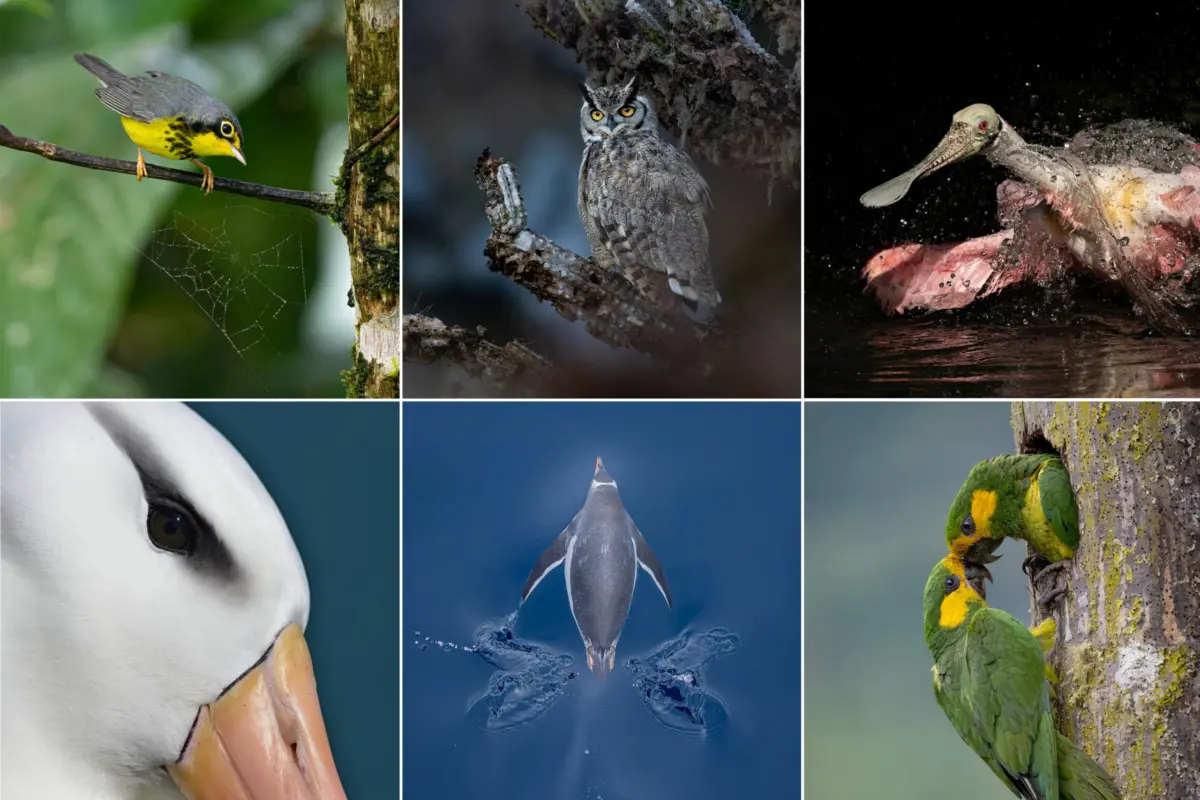
Grand Prize: Francisco Castro Escobar (Lesser Horned Owl)
Location: Paposo Natural Preserve, Antofagasta, Chile
Behind the Shot: Walking for hours through a hyper-arid northern Chilean desert where sea mist is trapped in ravines to sustain cacti and wildflowers, Francisco Castro Escobar and his companions spotted a distant silhouette. Moving in complete silence, he concealed himself behind desert flora to avoid disturbing Chile’s largest and most elusive owl species—often dubbed the "ghost of the desert" due to its legendary rarity.
Judge’s Take: Sebastian Herzog noted the fairy-tale atmosphere created by the owl’s piercing yellow eyes against a snow-white face, complemented by a perfectly calculated depth of field that incorporates a vibrant cactus as an unexpected companion. -
Birds in Landscapes, Chile: Timothy Dhalleine (Crested Caracara)
Location: Torres del Paine National Park, Magallanes and Chilean Antarctica, Chile
Behind the Shot: While hunting for unique sunrise perspectives in Chilean Patagonia, Timothy Dhalleine encountered a pair of Crested Caracaras seemingly contemplating the towering mountain range. Intent on shifting public perception away from dismissing these raptors as mere scavengers, Dhalleine composed a Romantic-period-esque masterpiece, aligning the mountain peaks reflected in the lagoon with the inquisitive birds in the foreground.
Judge’s Take: Sebastian Herzog lauded the originality of capturing a heavily photographed landscape, noting how the caracaras appear to pose deliberately for the camera, mirroring the grandeur of their environment. -
Birds Without Borders: Rodrigo González Pairoa (Black-browed Albatross)
Location: Albatross Islet, Magallanes and Chilean Antarctica, Chile
Behind the Shot: Battling freezing temperatures, shifting light, and violent, unpredictable winds in the remote Almirantazgo Sound, Rodrigo González Pairoa struggled to keep his camera steady. When a calm Black-browed Albatross allowed him to approach slowly, a brief window of absolute stillness occurred as the bird tilted its head in mutual curiosity, filling the frame with the sculptural textures of its plumage and its dark, piercing ocular outline.
Judge’s Take: Claudio Contreras Koob praised the abstract quality of the composition, noting how the clean background directs the viewer’s absolute focus toward the albatross’s intense, captivating gaze. -
Coastal Birds, Chile: Gonzalo Bertolotto Quintana (Gentoo Penguin)
Location: Bahía Fildes, Magallanes and Chilean Antarctica, Chile
Behind the Shot: Serving as a meteorologist aboard a 558-foot Chilean Navy vessel during a scientific expedition, Gonzalo Bertolotto Quintana watched Gentoo penguins swimming near the ship. From an elevated vantage point of nearly 130 feet, he captured a subaquatic view of a single penguin, revealing the trailing air bubbles and dynamic swirl created by its wing-flapping propulsion.
Judge’s Take: Katherine Sanhueza described the ocean as an infinite blue canvas where the penguin acts as an energetic brushstroke, creating a harmonious and poetic composition of fluid motion. -
Video: Nicolás Muñoz García (Black-browed Albatross)
Location: Isla Chañaral Marine Reserve, Atacama, Chile
Behind the Shot: Aboard a scientific vessel tracking fin and sperm whales, Nicolás Muñoz García observed a curious squadron of Black-browed Albatrosses circling the boat. Capitalizing on the exceptional water clarity, he submerged a GoPro camera on an extended pole to record the delicate propulsion of their webbed feet, capturing an inquisitive individual diving directly toward the lens in slow motion.
Judge’s Take: Niky Carrera Levy emphasized the immersive, cinematic quality of the footage, noting how the dive bridges the gap between spectator and subject while underscoring the necessity of protecting delicate marine ecosystems. -
Birds in Landscapes, Colombia: Faber Mosquera Álvarez (Oilbird)
Location: Cañón de los Guácharos, Quindío, Colombia
Behind the Shot: Venturing ahead of his group by crossing a rushing river in the dark interior of a cavern, Faber Mosquera Álvarez sought a vantage point to photograph the nocturnal, echolocating Oilbird. By pushing his camera’s light sensitivity (ISO 8000) and utilizing a blazing-fast shutter speed, he froze an explosion of fluttering wings as his companions entered the cave, enduring a painful fall on river rocks later that only amplified his elation upon reviewing the sharp image.
Judge’s Take: Sebastian Herzog underscored the technical mastery required to capture a sharp, flash-free flight shot of a nocturnal bird inside the pitch-black confines of a cave. -
Conservation: Santiago Pérez Rincón (Yellow-eared Parrot)
Location: Cañón del Río Anaime, Tolima, Colombia
Behind the Shot: Visiting Tolima for a wedding, Santiago Pérez Rincón ventured into an imperiled mountain landscape where remnant wax palm forests are increasingly cleared to establish monocultural Hass avocado plantations. Accompanied by a local guide, he documented the endangered Yellow-eared Parrot—a species whose life cycle is inextricably bound to the wax palm—serving as a visual warning against encroaching agribusiness.
Judge’s Take: Jair F. Coll praised the poignant composition, noting how the framing contrasts the parrot’s fragile isolation against the geometric imposition of monoculture crops, serving as an urgent call for environmental vigilance. -
Youth: Juan David Camacho Márquez (Canada Warbler)
Location: El Queremal, Valle del Cauca, Colombia
Behind the Shot: Following a successful morning birding walk that yielded a rare Plain-backed Antpitta sighting, Juan David Camacho Márquez encountered a Canada Warbler. Only upon reviewing his digital files later did he notice a delicate, dew-kissed spiderweb hanging precisely beneath the branch, creating a natural alignment as the warbler appeared to gaze into the geometry of the web after three years of chasing a clean portrait of the species.
Judge’s Take: Sebastian Herzog emphasized the precision of focus and depth of field required to freeze a hyperactive migratory warbler while simultaneously highlighting the shimmering, raindrop-adorned architecture of the spiderweb. -
Plants for Birds, Colombia: Santiago Giraldo (Yellow-eared Parrot)
Location: Anaime, Tolima, Colombia
Behind the Shot: Spending more than eight hours waiting beneath towering wax palms, Santiago Giraldo monitored a pair of Yellow-eared Parrots inspecting a nesting hollow excavated by woodpeckers in a dead palm trunk. Baffled by challenging overhead light as the birds entered the cavity, he shifted his focus to an intimate preening ritual—an essential behavioral display underscoring their lifelong pair bonds.
Judge’s Take: Niky Carrera Levy noted that the image successfully weaves narrative, behavior, and conservation into a single frame, highlighting not only the parrots but the vital ecological truth that dead wax palms continue to serve as sanctuaries of life.
Supporting Context & Metrics
The 2026 Audubon Photography Awards reflect a rapidly maturing field of wildlife documentation where technological advancements in mirrorless camera systems, high ISO handling, and stabilization allow photographers to operate in extreme environments previously deemed inaccessible.
- Geographic Scope: The competition encompasses two distinct operational hemispheres: the North American theatre (United States and Canada) and the Andean-Southern Cone theatre (Chile and Colombia). This dual structure ensures equitable representation of migratory songbirds, pelagic seabirds, high-altitude raptors, and specialized tropical endemics.
- Technological Trends: Winning submissions relied heavily on modern full-frame mirrorless bodies (such as the Canon EOS R5 series, Nikon Z8, and Sony Alpha 7 IV) paired with versatile telephoto zoom ranges (predominantly 150-600mm configurations). Notably, subaquatic action footage captured via modified GoPro setups has emerged as a powerful medium for revealing previously unrecorded avian behaviors beneath the water’s surface.
- Conservation Imperatives: Over 60% of the featured species in the 2026 awards face acute anthropogenic pressures, ranging from microplastic and fishing-line entanglement (Northern Gannet) to habitat fragmentation driven by industrial agriculture (Yellow-eared Parrot) and the compounding impacts of avian influenza outbreaks across breeding colonies.
Official Statements & Expert Commentary
Reflecting on the caliber of the 2026 submissions, the judging panels emphasized that technical proficiency alone is no longer sufficient to secure top honors in the competition.
"The winners of this year’s awards prove that bird photography is fundamentally an exercise in empathy and endurance," noted lead contest organizers. "Whether an artist spends 963 days positioning subaquatic cameras for a single glimpse of a heron’s talons, or navigates the active caldera of Kīlauea to document tropicbirds navigating sulfur vents, these creators are acting as vital visual stewards of our shared biosphere."
Judges across both regional panels echoed the sentiment that artistic composition must serve a higher ecological purpose. By transforming data points regarding habitat loss, climate stress, and animal behavior into visceral, painterly narratives, the winning photographers bridge the gap between hard science and public emotion.
Future Outlook
As environmental pressures across the Western Hemisphere intensify—driven by climate volatility, agricultural encroachment, and marine resource depletion—the role of wildlife photojournalism becomes increasingly critical. The images selected for the 2026 Audubon Photography Awards do more than celebrate aesthetic excellence; they establish a visual baseline of species distribution and behavioral adaptation in a changing world.
Looking forward, the Audubon Society plans to release its comprehensive Top 100 gallery on September 23, offering an even broader look at the submissions that defined the cutting edge of nature photography this year. Through continued support of both professional and youth divisions, the awards foster a rising generation of conservation-minded observers equipped to document, advocate for, and protect the fragile avian populations traversing our skies.