In the rapidly evolving landscape of digital media, pet-centric content has transitioned from simple, amusing clips to sophisticated showcases of animal intelligence and cooperative training. At the forefront of this movement is Promise, a highly trained Australian Shepherd, and her handler, Mary. Operating under the social media handle @my_aussie_gal, the duo has captivated millions of viewers globally.
A recent viral video depicting Promise executing a series of complex household chores—ranging from making beds and feeding cats to loading laundry and operating a vacuum cleaner—has sparked widespread fascination. While the video presents a lighthearted, fictionalized narrative of a dog running a household independently, it highlights a deeper, more significant reality: the profound cognitive capacity of working breeds and the efficacy of modern, positive-reinforcement training methodologies.
This investigative report analyzes the mechanics of Promise’s viral routine, examines the scientific and breed-specific contexts that make such behaviors possible, explores the legacy of Mary’s training philosophy, and projects the future of human-canine domestic partnerships.
Detailed Chronology: Deconstructing the Viral Household Routine
The viral video, which has amassed millions of views across Instagram and TikTok, is structured as a comedic "day-in-the-life" sequence. The narrative begins with Mary departing their residence for the day, leaving Promise to manage the household. What follows is a highly coordinated series of complex behavior chains that challenge traditional perceptions of canine capability.
Immediately following Mary’s mock departure, Promise initiates her "chores" by approaching an unmade bed. Utilizing her muzzle and paws, she systematically pulls the duvet and sheets into alignment.
Upon completing this task, she transitions to cat care. Promise retrieves a container of cat food, carries it to the feeding station, and carefully tips it to pour the kibble into a bowl. Throughout this sequence, the household’s resident cats observe from a close distance—a testament to the high degree of socialization and impulse control Promise possesses, as she refrains from consuming the food herself.
Phase 2: Laundry and Kitchen Operations
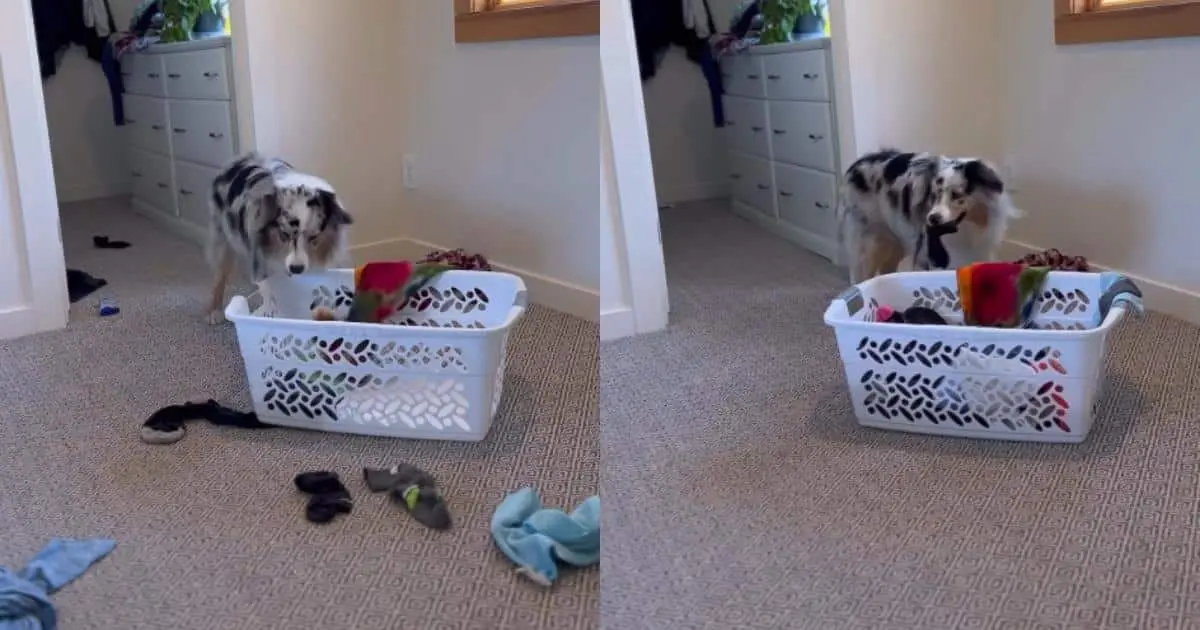
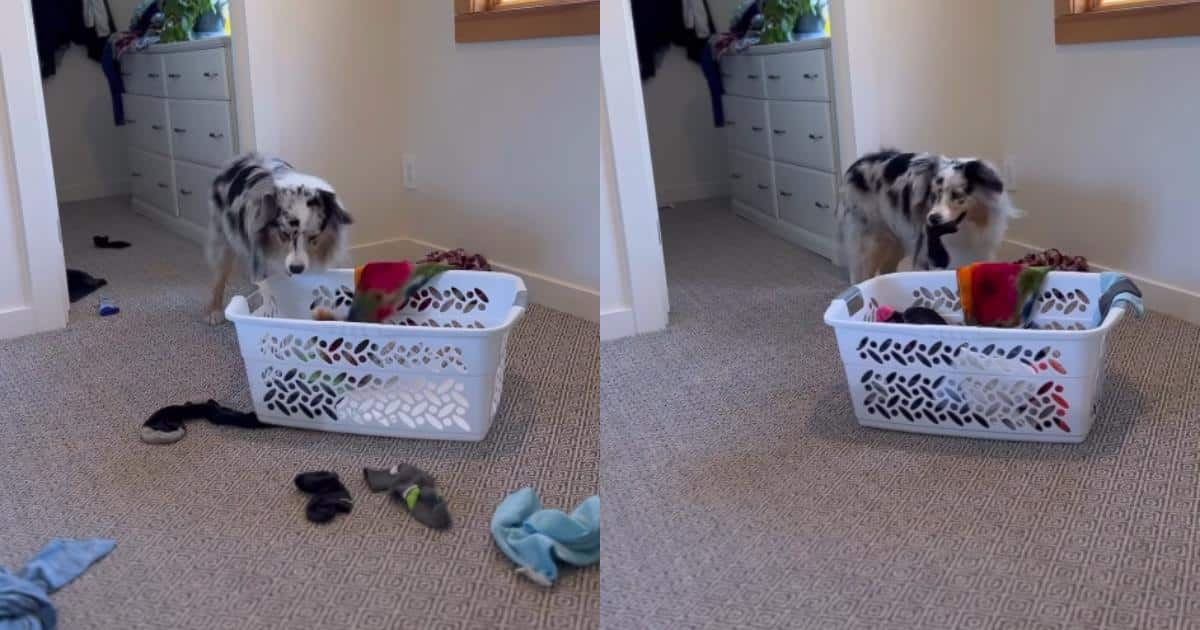
The routine escalates in complexity as Promise addresses the laundry. She identifies scattered clothing items, gathers them individually, transports them to an open washing machine, and deposits them inside. This task requires precise object manipulation, spatial awareness, and the coordination of multiple behavioral steps (find, pick up, carry, drop inside a raised container).
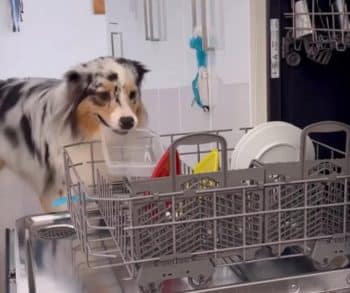
In the kitchen, Promise repeats this methodology with the dishwasher. She picks up dishes and places them carefully into the lower rack. Subsequently, she manages the household waste by opening the trash receptacle, depositing waste items, and closing the lid.
Phase 3: Flooring and Environmental Care
The final and perhaps most striking segment of the video involves floor maintenance. While most dogs view loose debris as an opportunity for foraging, Promise utilizes a broom. Holding the handle securely in her mouth, she pushes it across the floor in a sweeping motion.
Following the sweep, she targets carpeted areas with a vacuum cleaner. The vacuum is an object that traditionally triggers fear, anxiety, or predatory aggression in domestic dogs due to its high-decibel output and unpredictable movement. Promise, however, exhibits zero stress. She grasps the handle and actively guides the vacuum back and forth across the carpeted surface.
The Real-World Context: A Collaborative Effort
While the video is edited to suggest Promise works independently in Mary’s absence, Mary has clarified that the presentation is satirical. Mary works from home, and the tasks are actually performed as a collaborative, step-by-step team effort.
In follow-up content, Mary demonstrated the unedited reality of their routine: Promise works directly alongside her, dividing labor. While Mary sorts, Promise loads; while Mary clears surfaces, Promise manages the lower dishwasher rack. This collaborative dynamic transforms routine household maintenance into a structured cognitive enrichment session.
Supporting Context & Metrics: The Science of the Working Dog
The extraordinary capabilities demonstrated by Promise are not accidental; they are the intersection of genetic predisposition, highly structured training, and a deep understanding of canine psychology.
Breed Profile: The Australian Shepherd
The Australian Shepherd (Aussie) is a breed historically developed for demanding agricultural work, specifically herding livestock under challenging conditions. This heritage has selected for several key behavioral traits:
High Intelligence and Problem-Solving: Aussies possess an innate ability to assess situations and make independent decisions, a trait vital for managing stubborn livestock.
Stamina and High Energy: Developed for all-day physical labor, these dogs possess cardiovascular and muscular endurance that must be constructively channeled.
Bidirectional Communication: Herding requires a close working relationship with a human handler, meaning the breed is highly sensitive to human body language, verbal cues, and micro-signals.
When these dogs are kept purely as sedentary companion animals without mental or physical outlets, they frequently develop behavioral pathology, including obsessive-compulsive disorders, barrier frustration, destructive chewing, and excessive barking. Promise’s "chores" serve as a highly effective form of cognitive decompression.
The Power of Behavior Chaining
From a behavioral science perspective, Promise’s routine relies on a concept known as behavior chaining. A behavior chain is a sequence of individual behaviors occurred in a specific order, where each behavior acts as a cue (discriminative stimulus) for the next, culminating in a primary reinforcer (such as a high-value treat or play session).
Step
Trigger / Cue
Action
Behavioral Mechanism
1
Sight of laundry on floor
Pick up item
Object retrieval target
2
Holding laundry item
Walk to washing machine
Spatial navigation
3
Reaching open washer door
Deposit item inside
Drop/release command
4
Washing machine filled
Close door with nose
Touch/push target
By breaking complex tasks down into these micro-steps, trainers can teach dogs to perform sequences that appear remarkably human-like.
The Legacy of Secret
Promise’s training is built upon a profound personal legacy. Mary’s previous Australian Shepherd, Secret, was a globally recognized social media pioneer in the canine enrichment space. Secret gained fame for her ability to perform yoga alongside Mary (dubbed "Doga"), paint abstract art using a custom brush holder, play musical instruments, and sled down snowy hills.
[Secret (Passed 2022)] ── Legacy of Enrichment ──> [Promise (Current)]
   ↳ Yoga, Painting, Sledding                           ↳ Collaborative Chores, High-Level Problem Solving
Following Secret’s tragic passing from leukemia in 2022, Mary eventually welcomed Promise into her life. While Mary has been explicit that Promise is an individual with her own distinct personality and learning pace, the foundational training techniques developed during Secret’s lifetime have allowed Promise to achieve an equally astonishing level of cognitive development.
Official Statements and Owner Insights
In her public communications, Mary has consistently emphasized that her videos are intended to inspire, rather than to set an unrealistic standard for the average pet owner. Addressing the viral response to Promise’s chore routine, Mary shared insights into her training philosophy via her social media channels:
"Just kidding, I work from home and Promise and I do the chores together! And when we do leave the house it’s almost never alone."
— Mary, @my_aussie_gal
Mary’s commentary highlights several core tenets of her approach to canine guardianship:
Enrichment Over Compliance: Training is not used as a mechanism of strict obedience or control, but as a mutual language. By engaging Promise in household tasks, Mary transforms boring daily chores into interactive games that satisfy the dog’s intrinsic drive to work.
The Myth of the "Easy" Working Dog: Mary frequently reminds her audience that high-intelligence breeds require a massive commitment of time, patience, and mental stimulation. Promise’s seamless performance is the result of years of daily, incremental training sessions built on trust and positive reinforcement.
Individualized Learning: Every dog possesses unique physical and psychological boundaries. While Secret excelled at fine motor skills like holding a paintbrush, Promise displays immense strength in cooperative physical tasks, such as pushing, pulling, and sorting.
Future Outlook: The Evolution of Modern Canine Companionship
The viral success of Promise is indicative of a broader cultural shift in how society views and interacts with domestic dogs. The traditional paradigm of pet ownership—where a dog is expected to spend the majority of its day resting quietly on a couch—is increasingly being recognized as insufficient for high-energy, working-class breeds.
The Rise of "Jobs" for Companion Animals
As urbanization increases and traditional working roles for dogs decline, the veterinary and behavioral communities are heavily promoting the concept of "giving your dog a job." This does not require a farm or sheep; instead, it involves integrating cognitive challenges into the dog’s daily life.
Future trends in pet care are likely to see an increase in:
Cooperative Care and Training: Involving dogs in daily routines to reduce separation anxiety and build confidence.
Domestic Assistive Behaviors: Training non-service dogs to perform helpful tasks around the house, such as turning off lights, retrieving dropped items, or opening doors, as a form of daily enrichment.
Cognitive Toys and Tech: The development of advanced puzzle feeders and interactive smart devices designed to challenge a dog’s problem-solving skills when handlers are occupied.
A Realistic Takeaway for Pet Parents
While Promise has set an incredibly high bar for domestic helpfulness, canine behavioral experts urge owners not to feel discouraged by their own pets’ lack of household productivity. The value of Promise’s videos lies not in the literal expectation that a dog should vacuum, but in the inspiration to engage more deeply with our pets.
Teaching a dog to target an object with their nose, retrieve a specific toy by name, or simply participate in a game of find-the-treat are highly effective ways to stimulate their brains. Ultimately, Promise and Mary have demonstrated that when humans invest time into understanding canine cognition and communicating through positive reinforcement, the bond that forms can transcend basic companionship, turning a pet into a true partner in every aspect of domestic life.