
Executive Overview
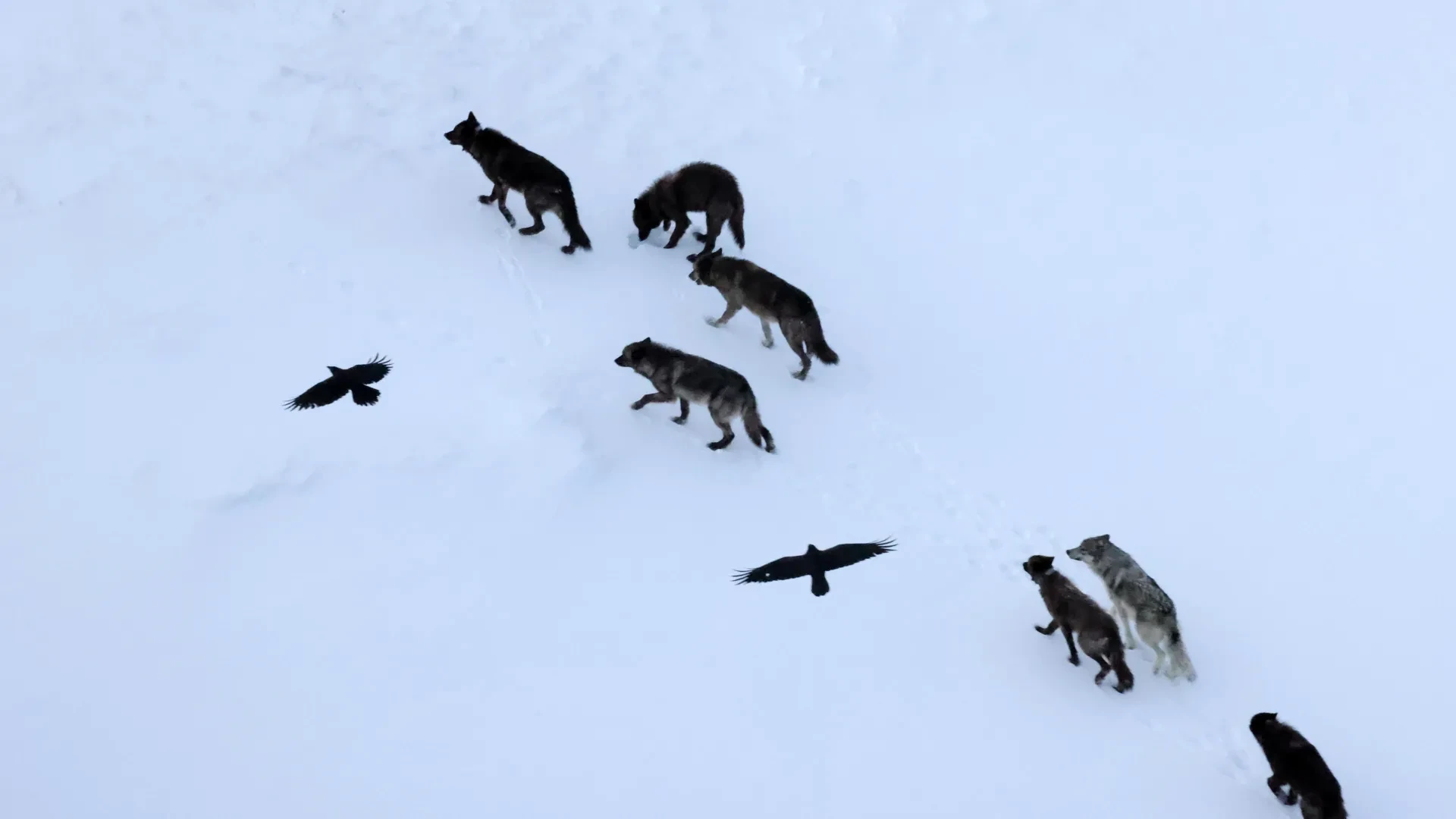
For generations, wildlife biologists, naturalists, and outdoor enthusiasts have shared a common assumption regarding one of nature’s most dynamic symbiotic relationships: when a wolf pack brings down prey, ravens are simply tailing them. The scene is iconic. Long before the alpha wolves even begin tearing into a fresh carcass, intelligent black silhouettes gather in the surrounding evergreens, waiting patiently to snatch whatever scraps become available. Their timing has always seemed almost uncanny—leading to the prevailing ecological consensus that corvids survived the harsh winters of the American West by acting as avian shadows to the canine apex predators.
However, a landmark new study published in the prestigious journal Science has fundamentally upended this long-held ecological dogma. Tracking the movements of both ravens and wolves across the rugged, unforgiving terrain of Yellowstone National Park over a rigorous two-and-a-half-year period, an international team of researchers has revealed a far more advanced, cognitively demanding strategy.
Instead of mindlessly trailing wolves across miles of snow and timber, ravens rely on sophisticated spatial memory, navigational prowess, and an acute understanding of the landscape. They remember specific geographic locations where kills are historically and probabilistically likely to happen, and they navigate directly to those zones—sometimes flying hundreds of kilometers from completely different areas.
"They can fly six hours non-stop, straight to a kill site," says Dr. Matthias Loretto, the study’s first author, illuminating a level of mental mapping and geographical recall that stuns even seasoned ornithologists.
This collaborative international project—spearheaded by the Research Institute of Wildlife Ecology at the University of Veterinary Medicine Vienna and the Max Planck Institute of Animal Behavior in Germany, alongside the Senckenberg Biodiversity and Climate Research Centre, the University of Washington, and Yellowstone National Park—changes how science views animal intelligence, foraging ecology, and predator-scavenger dynamics. By shifting the perspective from the wolf to the scavenger, science has uncovered an avian mastermind that operates with the strategic foresight of an experienced cartographer.
Detailed Chronology: Tracking the Unseen Architects of the Wild
To fully grasp the magnitude of this discovery, one must examine the timeline and methodology of the research that brought it to light. The project unfolded against the backdrop of Yellowstone National Park, an ecosystem uniquely suited for such an investigation. Here, gray wolves (Canis lupus) were famously reintroduced in the mid-1990s following a 70-year absence, radically restructuring the park’s ecological balance. Today, approximately one-quarter of the park’s dynamic wolf population is fitted with tracking collars annually, managed meticulously by park biologists.
The Long-Standing Paradigm and Its Challengers
Dr. Dan Stahler, a senior Yellowstone wildlife biologist who has studied the park’s wolves since their historic return, lived and breathed the traditional assumption.
"You see them flying directly above traveling packs or hopping close behind wolves as they take down prey," Stahler notes, describing a relationship that appeared, on the surface, to be an unbreakable tether. Because wolves create reliable, high-energy feeding opportunities for scavengers in an otherwise barren winter landscape, biologists naturally assumed the birds followed a simple directive: stick close to the canines.
Yet, this foundational hypothesis had never been rigorously, empirically tested. "We didn’t know what ravens were capable of because nobody had ever put them at the center; nobody had taken the scavenger’s point of view," Stahler explains.
Operation Raven: Capturing the Cunning
Putting ravens at the center of a telemetry study is easier said than done. Common ravens (Corvus corax) possess legendary intelligence, wariness, and problem-solving capabilities. They recognize human intent, remember faces, and are notoriously difficult to trap.
"Ravens are so observant of the landscape that they don’t step into traps easily," Dr. Loretto points out.
To overcome this evolutionary defense mechanism, the research team had to resort to psychological camouflage. They meticulously blended capture traps into the surrounding human-impacted environments. Near park campsites, for instance, traps were artfully disguised with everyday refuse and fast-food wrappers.
"Or else the ravens would suspect that something was off and wouldn’t come near it," Loretto remarks.
Ultimately, the team successfully outfitted an unprecedented 69 wild ravens with miniaturized, high-precision GPS tracking units. Simultaneously, movement patterns from 20 GPS-collared wolves were integrated into the analytical pipeline. Because winter is the prime season for raven-wolf interactions—when food is scarcest and wolf predation is highest—the researchers narrowed their primary focus to the coldest months. They recorded raven locations every 30 minutes and wolf locations every hour, cross-referencing these data streams with precise spatial logs of where and when wolves successfully killed prey, primarily elk, bison, and deer.
The Shocking Statistical Reality
When the massive dataset was finally compiled and analyzed, the results sent shockwaves through the research team. Over the entire two-and-a-half-year tracking period, researchers recorded only one unambiguous instance of a raven following a wolf for more than one kilometer or for longer than an hour.
"At first, we were puzzled," admits Loretto. "Once we realized that ravens are not following wolves over long distances, we couldn’t explain why the birds still arrive so quickly at wolf kills."
The answer lay hidden within the spatial-temporal coordinates. Instead of shadowing packs, ravens were consistently flying with laser-like precision directly to localized zones of high productivity. Some birds traveled up to 155 kilometers (roughly 96 miles) in a single day, ignoring the movements of local wolf packs entirely, and instead navigating via memory straight toward landscapes primed for a carcass.
Supporting Context & Metrics: Decoding the Resource Landscape
The revelation that ravens navigate via spatial memory rather than visual tracking forces a complete re-evaluation of how avian scavengers read their environments. To understand how a bird can pinpoint a carcass miles away without an escort, researchers had to look closely at the geography of Yellowstone.
+-------------------------------------------------------------------------+
|                        THE DUAL-TIER SCAVENGING MODEL                   |
+-------------------------------------------------------------------------+
|                                                                         |
|  MACRO-SCALE NAVIGATION (Long Range)                                    |
|  • Powered by Spatial Memory & Resource Landscapes                      |
|  • Ravens map historical kill zones, valleys, and terrain bottlenecks.  |
|  • Flight distances: Up to 155 km in a single day.                      |
|                                                                         |
|                                     │                                   |
|                                     ▼                                   |
|                                                                         |
|  MICRO-SCALE LOCALIZATION (Short Range)                                 |
|  • Powered by Direct Sensory Cues                                       |
|  • Ravens monitor vocalizations (howling), body language, and activity. |
|  • Fine-tuning approach once inside the target zone.                    |
|                                                                         |
+-------------------------------------------------------------------------+
The Geography of Carnivory
Wolf kills in Yellowstone are not distributed randomly across the park’s 2.2 million acres. Canids are tactical hunters; they favor specific topographical features where they can isolate, corner, and bring down large ungulates like elk and bison. Broad, flat valley bottoms, riparian corridors, and transitional snow-packed meadows emerge as natural hotspots for predation success.
The GPS data revealed that ravens visited these high-yield topographical zones exponentially more often than areas where wolf kills were historically sparse. The birds weren’t tracking the predators; they were tracking the productivity of the earth itself.
"We already knew that ravens can remember stable food sources, like landfills," Loretto explains, noting their urban adaptability. "What surprised us is that they also seem to learn in which areas wolf kills are more common. A single kill is unpredictable, but over time some parts of the landscape are more productive than others—and ravens appear to use that pattern to their advantage."
Quantitative Breakdown of the Study
- Study Duration: 2.5 years of continuous, intensive field monitoring.
- Primary Geographic Area: Yellowstone National Park (USA), spanning diverse elevations and winter microclimates.
- Target Avian Subjects: 69 wild common ravens fitted with state-of-the-art GPS telemetry backpacks.
- Target Canine Subjects: 20 GPS-collared gray wolves from active Yellowstone packs.
- Data Resolution: Raven positions logged every 30 minutes; wolf positions logged hourly.
- Maximum Daily Raven Flight Distance: Up to 155 kilometers in a single day.
- Documented Long-Distance Tracking Events: Exactly 1 instance of a raven following a wolf beyond 1 kilometer or 1 hour over the entire 30-month period.
This statistical distribution proves beyond a shadow of a doubt that long-distance shadowing is statistically negligible in raven foraging strategy. Memory is king.
Official Statements: Perspectives from the Scientific Vanguard
The publication of this study in Science has generated substantial commentary from the international scientific community, highlighting the profound implications of avian cognition.
Dr. Matthias Loretto, the study’s first author currently affiliated with the University of Veterinary Medicine Vienna, emphasizes the flexibility this grants the birds:
"Ravens can cover large distances by flying, and they seem to have a good memory, so they don’t need to constantly follow wolves in order to profit from the predators. They are flexible in where they decide to feed… This changes how we think about how scavengers find food."
Dr. Dan Stahler, Yellowstone National Park biologist, reflects on the humility required in long-term ecological research:
"We all assumed that the birds had a very simple rule; just stick close to the wolves… We didn’t know what ravens were capable of because nobody had ever put them at the center; nobody had taken the scavenger’s point of view. To find wolf kills locally, ravens likely use short-range cues, like monitoring wolf behavior or listening to wolf howling."
Prof. John M. Marzluff of the University of Washington, a renowned corvid expert and senior author on the study, points to the broader cognitive implications:
"What our study clearly shows is that ravens are flexible in where they decide to feed. They don’t stay tied to a particular wolf pack. With their sharp senses and memory of past feeding locations, they can choose among many foraging opportunities far and wide. This changes how we think about how scavengers find food—and suggests we may have underestimated some species for a long time."
Future Outlook: Reimagining Avian Ecology and Cognitive Research
The findings unveiled in Yellowstone open up exhilarating new avenues for ecological research and behavioral biology. If ravens—famously members of the corvid family, which also includes crows, jays, and magpies—possess a sophisticated mental map of landscape-level resource productivity, what does this mean for other intelligent scavengers across the globe?
Beyond Yellowstone: Global Implications
Ecologists are now beginning to question whether other species long thought to be obligate camp-followers—such as bald eagles, coyotes, or specific gull populations—similarly rely on spatial memory and environmental mapping rather than direct observation. The traditional linear model of predator-prey-scavenger interaction is rapidly transforming into a multi-dimensional matrix where cognitive mapping plays a central, guiding role.
Furthermore, this research has profound conservation applications. As human development fragments natural landscapes, large carnivores like wolves face restricted movement corridors. If avian scavengers depend on a mental map of stable, high-yield zones tied to historical predator activity, disruptions to predator populations or landscape connectivity could have cascading, unforeseen consequences for scavenger survival networks.
The Next Frontier in Corvid Intelligence
As technology shrinks GPS telemetry units while expanding battery life and data precision, researchers are poised to dive even deeper into the internal worlds of birds. Future studies aim to track juvenile versus adult ravens to determine at what age spatial memory networks are fully formed, and whether older birds pass down these mental topographical maps to younger generations through cultural transmission.
For now, the next time you stand in the crisp, sub-zero air of a Yellowstone valley and watch a raven descend silently from a cloudless sky to a freshly fallen elk carcass, look at the bird with renewed respect. It did not follow the wolf to get there. It read the land like a master navigator, consulting an internal library of geographical experience, and arrived precisely where history, memory, and biology dictated it should.