
Executive Overview
According to estimates from the American Veterinary Medical Association (AVMA), approximately 10 million cats and dogs go missing each year in the United States. For pet owners, the disappearance of a companion animal initiates a distinct psychological phenomenon known as "ambiguous loss." Unlike the definitive closure associated with a pet’s passing, a missing animal leaves owners suspended in uncertainty.
As clinical psychologist Megan Auster-Rosen explains, this mirrors the trauma of a missing person case. The lack of closure prevents individuals from moving through the standard stages of grief, trapping them in prolonged distress. To mitigate this risk, modern pet technology has evolved far beyond traditional metal ID tags and microchips. While microchips remain the gold standard for identification once an animal is recovered, cellular- and satellite-connected GPS trackers offer active intervention, allowing owners to monitor and locate escaped pets in near-real time.
Following rigorous, multi-year testing encompassing 26 evaluated models and 16 actively tested devices across varied terrains, climates, and urban environments, leading pet tech experts have identified the top-performing GPS collars for dogs and cats. This exhaustive assessment examines location accuracy, connection speeds, battery endurance, data privacy, and subscription structures to help owners make informed decisions.
Detailed Chronology of Testing and Methodology
The evaluation process behind these recommendations spans four rigorous rounds of testing dating back to 2024. Testing protocols were designed to simulate real-world crises, ranging from sudden canine escapes to independent feline expeditions.
Testing Environments and Canine/Feline Testers
Field evaluations were conducted across diverse geographical regions, including urban and suburban settings in Lincoln, Nebraska, and New Haven, Connecticut. Trackers were subjected to varying weather conditions—ranging from freezing temperatures and heavy snow to high-heat summer days and rain-soaked overcast skies that traditionally challenge satellite line-of-sight.
- Canine Testing: Primary canine tester Dave, a mixed-breed dog, logged over 65 dedicated field outings ranging from 30 to 45 minutes. Additional long-term data was collected using smaller companion dogs, including Mia (a 16-pound Chihuahua-poodle mix) and Piglet (a 24-pound miniature schnauzer-Chihuahua mix).
- Feline Testing: Recognizing that feline tracking presents unique spatial challenges, evaluations relied on specialized indoor-outdoor cat testers: Six (a 9-pound cat in Nebraska), Midnight Vampire (a 12-pound cat in Philadelphia), and Hobbes (a 14-pound orange tabby providing long-term telemetry feedback).
Evaluation Metrics
Each tracker was systematically benchmarked across seven core performance criteria:
- Live-Tracking Location Accuracy: Devices were evaluated during active search modes ("Lost Mode" or live tracking) by comparing real-time app telemetry against the actual physical paths taken by walkers and pets. Tests included timed head starts where handlers established a quarter-mile distance before tracking commenced.
- GPS Connection Speed: Timing how rapidly each device activated its live-tracking handoff and locked onto reliable satellite and cellular signals upon command.
- Escape-Alert Response Time: Measuring the exact latency between an animal breaching a designated geofenced "safe zone" and the delivery of a push notification to the owner’s smartphone.
- Battery Endurance: Monitoring battery degradation across 18 standardized outings utilizing intensive live-tracking modes and evaluating the efficiency of home Wi-Fi/Bluetooth power-saving zones.
- Ease of Use: Assessing app interface clarity, map rendering, zoom stability, and initial setup simplicity.
- Physical Build and Features: Factoring in device size, weight, waterproof ratings (IP68 standards), attachment mechanisms, and integrated auxiliary tools like LED lights and audio locators.
- Subscription and Data Policies: Analyzing pricing tiers, commitment minimums, return windows, and corporate data-collection transparency.
Supporting Context & Metrics: What the Data Reveals
The marketplace for pet trackers is crowded, but rigorous testing quickly eliminates inferior or inappropriate device categories.
Dismissed Technologies: Bluetooth and Shock Collars
- General-Purpose Bluetooth Trackers: Devices like Apple AirTags and Life360 Tile trackers were thoroughly dismissed for active pet recovery. While cost-effective for locating misplaced keys within a home, Bluetooth reliance means they only update locations when passing within range of a compatible smartphone network. During a rapid pet escape, this lag renders them dangerously ineffective.
- Electronic Training/Containment Collars: GPS-enabled collars utilizing physical deterrents, such as static stimulation or mild shocks for "invisible fences," were excluded without testing. These devices are legally banned in multiple jurisdictions, and veterinary science links electrical stimulation to adverse welfare and behavioral outcomes in dogs.
The Privacy Trade-Off
Deploying a modern GPS tracker requires pet owners to surrender a degree of domestic privacy. Because companion animals spend the vast majority of their time near their owners, granular telemetry data collected by pet tracking apps can inadvertently map human lifestyle habits, daily routines, and home locations. Wirecutter privacy expert Max Eddy notes that while major manufacturers implement encryption, deciphering the full scope of data retention and third-party sharing policies remains complex for the average consumer.
Official Statements and Industry Insights
Industry leaders have responded to growing consumer demand for seamless tracking, battery optimization, and stringent data protection standards:
- Tractive: Executive Vice President Andrew Bleiman emphasized that under optimal conditions, the Tractive Dog 6 refreshes its location coordinates every two to three seconds during live tracking. Addressing data privacy concerns, Bleiman noted, "As a European company, we operate under the strict guidelines of the General Data Protection Regulation (GDPR), which typically are considered more strict than data privacy guidelines in the US. At no time does Tractive sell or license this data."
- Fi: Founder and CEO Jonathan Bensamoun detailed the engineering behind Fi’s battery preservation algorithms. By leveraging Bluetooth Low Energy (BLE) inside the home and transitioning to home Wi-Fi networks within a 200-foot radius, the collar minimizes power draw until an actual geofence breach occurs. Regarding data policies, general counsel Tom Stein and Bensamoun reiterated, "We do not and will never sell any data," clarifying that limited metadata sharing is restricted solely to powering targeted digital advertising campaigns on platforms like Meta.
Top-Performing Device Breakdown
1. Top Pick for Dogs: Tractive Dog 6 Smart Dog Tracker
- Performance: Delivered the most consistently reliable location accuracy during live tracking, missing pinpoint coordinates by only a few yards under heavy canopy cover.
- Speed & Battery: Connected to live tracking in an average of 13 seconds (the fastest in testing) and retained 71% battery life after 18 rigorous test walks.
- Build: Features an IP68 waterproof rating, integrated USB-C charging port, and dual LED light strips for high visibility.
- Drawbacks: Bulkier profile than competing models; minimum subscription commitment requires a prepaid annual plan.
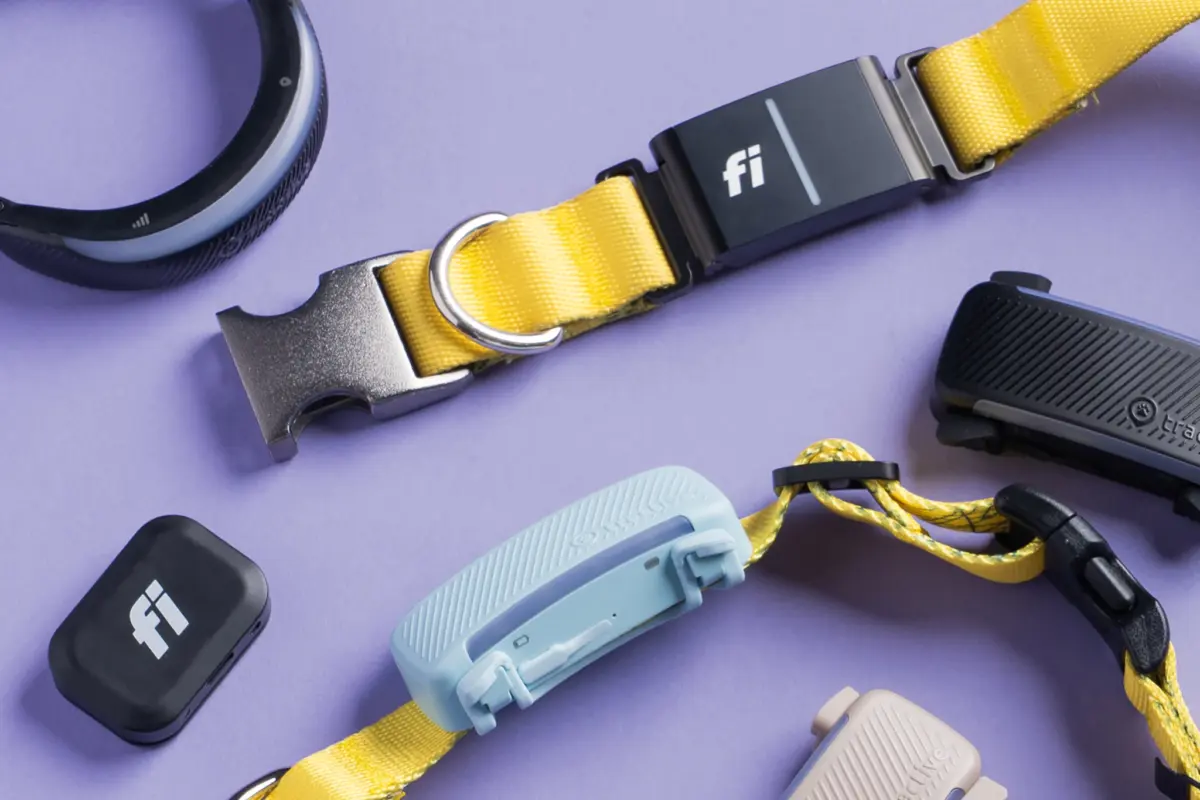
2. Top Pick for Dogs: Fi Series 3+
- Performance: Encased in marine-grade stainless steel and weighing just 1 ounce (excluding proprietary endlinks), this slim device supports dogs as light as 5 pounds.
- Speed & Battery: Averaged 16 seconds to initiate Lost Mode and matched the Tractive Dog 6’s impressive battery retention (71% after 18 walks) via its clever charging base and BLE handoff system.
- Behavioral Tracking: Offers advanced diagnostics tracking eating, drinking, licking, and resting behaviors alongside standard activity logs.
- Drawbacks: Requires proprietary endlink collars (rattling noises can occur and require O-ring fixes); app performs best when left running continuously in the background.
3. Runner-Up for Dogs: Fi Mini
- Performance: Weighing a mere 0.56 ounces, the Fi Mini is the lightest tracker evaluated. Crucially, it attaches securely to any existing dog collar or harness using flexible, custom-engineered silicone straps.
- Metrics: Matches the core accuracy of the Series 3+, connecting in roughly 18 seconds with 68% battery remaining after standardized testing rounds.
- Drawbacks: Lacks built-in LED lights; constructed entirely of plastic, raising long-term durability questions compared to the steel-reinforced Series 3+.
4. Top Pick for Cats: Tractive Cat 6 Mini
- Performance: Purpose-built with a curved casing to sit comfortably on a feline’s neck. It provides rapid connection speeds and identical live-tracking accuracy to its canine counterpart.
- App Features: Features an invaluable historical timeline, customizable heat maps indicating where a cat lingers, and territory boundary toggles.
- Drawbacks: Shorter battery life (exhausted after approximately 5.5 active days) and relies on a proprietary magnetic charging cable rather than universal USB-C.
Future Outlook
The pet tech landscape continues to expand rapidly. As manufacturers refine battery chemistries, miniaturize hardware components, and integrate cross-platform networks (such as upcoming evaluations of the Life360 Pet GPS ecosystem), the reliability of pet tracking will only improve.
For now, investing in a dedicated GPS tracker remains one of the most effective safety nets a pet owner can deploy. By bridging the gap between uncertainty and swift recovery, these devices protect not just the physical safety of companion animals, but the emotional well-being of the human families who love them.