
Executive Overview
For decades, the daily routine of cat ownership has included a universally shared chore: scooping the litter box. For millions of pet parents, this daily task is an unwelcome necessity—a chore prone to neglect during busy weeks or physical flare-ups. Enter the era of automated pet tech. Self-cleaning cat litter boxes promise a utopian future where clumping waste vanishes into sealed bins automatically, minimizing odor and lifting the physical burden of maintenance off human shoulders.
However, introducing motors, microchips, sensors, and rotating drums into a cat’s bathroom habits is not a plug-and-play affair. To separate marketing hype from genuine utility, Wirecutter’s pet care experts—backed by rigorous testing protocols, feedback from 16 discerning feline test subjects, and insights from professional cat-behavior consultants—evaluated a dozen automated machines over several months.
The findings are clear: while top-tier devices like the Litter-Robot 4 excel in reliability, build quality, and ease of maintenance, automated litter boxes are not a silver bullet. They demand significant upfront financial investments, continuous upkeep, careful acclimation for your cats, and, crucially, a vigilant human eye. This comprehensive guide details our top recommendations, how we tested them, the hidden pitfalls of tech-integrated pet care, and how the market’s leading options stack up against one another.
Detailed Chronology of the Testing Process
Evaluating equipment designed to process animal waste requires a rigorous, multi-phase testing strategy. Since 2025, our testing team considered 21 distinct automated litter boxes, ultimately narrowing the field to 12 machines for hands-on evaluation.
Phase 1: Stress-Testing Without Felines
In the first phase, each machine underwent a rigorous one-week stress test without cats present. During this stage, our researchers evaluated:
- Basic cleaning mechanics: Observing how effectively the sifter separated clumps from clean litter.
- Safety mechanisms: Systematically testing weight, motion, and infrared sensors. Researchers pushed fingers and foreign objects into potential pinch points to verify whether rotating globes or drums would instantly halt and reverse course.
- Deep-cleaning processes: Disassembling each machine to evaluate how intuitive, messy, or time-consuming the deep-cleaning process was.
Phase 2: Real-World Multi-Cat Trials
Following initial bench testing, we narrowed our pool to seven finalists, distributing them across multiple multi-cat households, including active cat foster homes. Over a three-week trial period, 16 cats—ranging in size from 6 to 18 pounds—used, scratched, and tested the machines. Observers tracked cleaning efficiency, odor control, sensor accuracy, app functionality, and build durability (using imitation cat urine and plastic-shredding tools to simulate wear and tear). Long-term evaluation of our top picks continues to this day.
Supporting Context, Metrics, and Expert Insights
Self-cleaning litter boxes offer undeniable perks, but they also present distinct structural and behavioral challenges that every prospective buyer should understand.
Who Are These Machines For?
- Busy Owners: If you struggle to stay on top of daily scooping schedules, self-cleaning boxes ensure the environment remains clean. As Philip Bloom, filmmaker and creator of the One Man Five Cats YouTube channel who has tested over two dozen automated boxes since 2020, notes: "The great thing about self-cleaning boxes is they’re always clean."
- Individuals with Mobility Challenges: For people with disabilities, chronic back pain, or joint issues that make bending down or holding a scoop difficult, these units can restore autonomy in pet care.
The Inherent Limitations
Despite their technological sophistication, automated boxes come with trade-offs:
- Size Constraints: Veterinarians generally recommend a litter box length equal to 1.5 times your cat’s length (from nose to tail base). Currently, none of the automated boxes on the market meet this gold standard. Most feature significantly smaller interior footprints, which can deter larger cats.
- Maintenance Demands: Paradoxically, automated boxes often require more intensive deep-cleaning sessions than traditional plastic pans. Urine, dust, and clay combine to form a challenging environment for moving mechanical parts.
- Behavioral Friction: Cats are creatures of habit. Because these machines move and hum, they can easily startle cautious felines. Cat-behavior consultant Dr. Mikel Delgado warns: "I don’t think people should be… leaving their cat alone for extended periods of time and just thinking that the robot is going to take care of your cat’s needs." Delgado advises keeping traditional, non-automated boxes in the home during a slow, deliberate transition period following the rule of "one box per cat plus one."
Official Statements and Industry Standards
Safety remains a paramount concern in the automated pet product market. Unlike consumer electronics or automotive parts, automated litter boxes lack formal safety certifications or federal regulatory oversight. Low-quality, unverified copycat models have historically posed severe mechanical risks.
Industry leaders emphasize the necessity of robust anti-pinch architecture. Jacob Zuppke, CEO and president of Whisker (parent company of Litter-Robot), notes that sensor sensitivity is a constant balancing act: "Just like any sensor anywhere, the more dust you’re exposing it to, the more that it’s going to essentially get dirty." However, industry experts agree that slightly overactive sensors are vastly preferable to lenient safety cutoffs.
Similarly, privacy concerns surrounding AI-enabled cameras have sparked intense debate. Max Eddy, Wirecutter’s security and privacy expert, has reviewed the companion apps of several camera-equipped models, noting that while manufacturers like Petkit claim they do not access user footage under normal circumstances, many corporate privacy and cloud storage policies remain distressingly vague regarding data collection, retention, and AI model training.
Top Picks and Recommendations
1. Top Pick: Litter-Robot 4
- Best For: Most cat owners looking for a spacious, highly reliable, and easily repairable machine.
- Why It Won: Though no machine is flawless, the Litter-Robot 4 outperformed every competitor across nearly every testing category—surpassing even Whisker’s newer generation releases. Released in 2022, it boasts a massive entry opening (just under 16 inches in diameter), rock-solid reliability, excellent odor control, and straightforward deep-cleaning instructions.
- The Repairability Factor: Whisker stands alone as the primary manufacturer offering direct replacement parts for DIY home repairs. Furthermore, they offer an optional extended three-year warranty (WhiskerCare). As Philip Bloom points out, having access to replacement parts is critical because “a litter box has urine in it, and sand… two worst possible things you could have inside anything with moving parts.”
- Flaws: Its sensors can occasionally become overly sensitive due to dust accumulation, and brand-name accessories, waste-bin bags, and carbon filters carry a steep recurring cost.
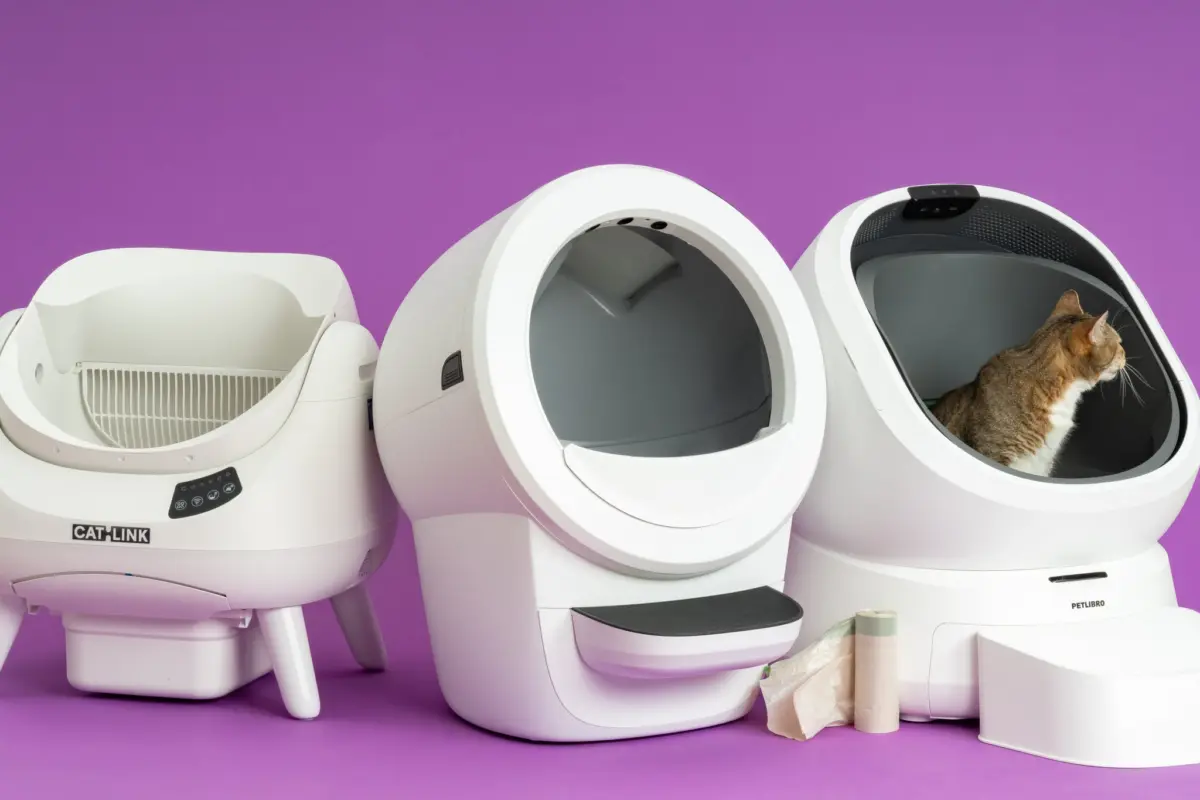
2. Best for Data and Insights: Petkit Purobot Max Pro 2
- Best For: Tech-enthusiast pet parents who want deep behavioral tracking and high-definition visual monitoring.
- Why It Won: Equipped with a wide entry door and a downward-pointing internal camera, the Purobot Max Pro 2 offers granular data via its companion app. It identifies specific cats by weight and visual recognition, records visit durations, logs toileting habits, and can flag early warning signs of illness (such as sudden changes in bathroom frequency). Its vertical side waste bin is exceptionally sturdy, and its gear system features intentionally missing teeth to physically prevent over-rotation and pinching.
- Flaws: The interior globe space is notably smaller than our top pick, deep-cleaning is a slightly more complex chore, and unlocking full cloud video storage requires an annual subscription ranging from $22 to $110.
3. Best for Uncovered Preferences: Petlibro Luma Smart Litter Box
- Best For: Cats who refuse enclosed or domed spaces.
- Why It Won: Many cats experience anxiety inside enclosed "globes." The Petlibro Luma provides an open-top architectural design paired with advanced multi-cat AI camera recognition. It delivers comprehensive usage analytics, features swappable sifters for clay or tofu litter, and cleans reliably behind your pets.
- Flaws: Its subscription plans are among the most expensive on the market ($95 to $160 annually), its AI occasionally mistakes urine for feces, and its privacy agreements contain clauses reserving broad access rights to stored cloud video.
4. Budget Pick: Catlink Scooper Open-X
- Best For: Budget-conscious buyers seeking reliable automated cleanup without premium price tags.
- Why It Won: The unenclosed Catlink Scooper Open-X strips away unnecessary luxury add-ons while retaining critical safety engineering—including a gear design that makes mechanical pinching physically impossible. It handles odor control effectively, tracks basic cat weight and visit metrics, and costs significantly less than competing flagship models.
- Flaws: The app setup process is glitchy and poorly translated, deep-cleaning requires navigating a non-intuitive litter-dumping routine, and the brand offers only a standard one-year warranty.
Future Outlook and Market Evolution
The automated pet tech market is evolving at breakneck speed. Manufacturers are increasingly integrating artificial intelligence, computer vision, and health-monitoring diagnostics directly into bathroom fixtures.
While brands like Whisker continue to roll out next-generation platforms like the Litter-Robot 5 Pro and compact EVO, early software bugs and connectivity hurdles indicate that first-generation tech iterations often require time to mature. Moving forward, buyers can expect increased regulatory scrutiny regarding consumer data privacy, more refined multi-cat AI recognition algorithms, and hopefully, larger interior footprints tailored to accommodate larger feline breeds comfortably.
Until then, investing in an automatic cat litter box requires weighing the convenience of automated scooping against the realities of equipment maintenance, subscription costs, and your cat’s unique behavioral preferences.